
QUEERING THE BOUNDARIES — a conversation with Lynley Edmeades [...] ELLIPSIS
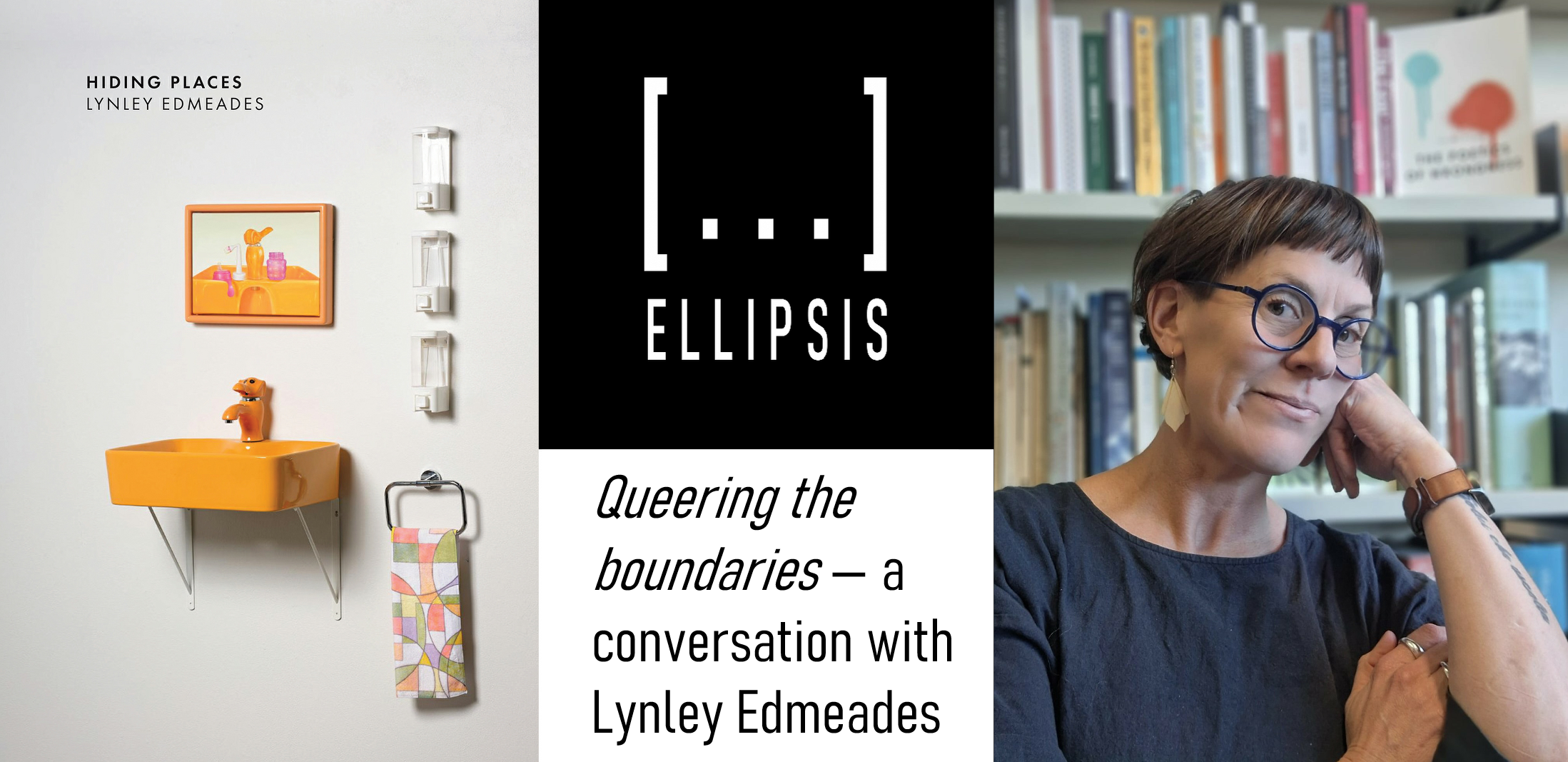
Lynley Edmeades’s Hiding Places is a book about the writing of a book (this book) in a life impacted by the arrival of a new life (a child) while caught also in a culture where both the writing of books and the raising of children are freighted with sets of judgements and expectations that make it hard to know, when you are doing either of these things best, if you are doing either of these things right (if there even is a right way to do either of them). The fragmentary form of the book and the cumulative immediacy of the fragments, often either pained or playful and frequently both, produce a work that is more confessional than evasive while treasuring the possibilities of evasion, and investigates shared experience while highlighting the complete individuality of the experiences it treats. — Thomas Pors Koed
THE INTERVIEW:
TPK: The first thing that struck me when I began to read Hiding Places, and something that immediately attracted me to it, was the absence of the first person register, even though the book does not pretend not to address your own experiences. The fragments slip between an observational ‘she’ and a rather alarming, almost accusatory ‘you’, carefully avoiding the I-would-say performative ‘I’. Why did you write it like this?
LE: I wanted to play with fact and fiction, and that seems to be a bit easier to do in the third and second person. There are parts of the book that are factual, i.e. based on real-life experience, but I wanted to anonymise them, to protect the people in those stories, so moving away from the ‘I’ was a natural fit. Once I started to do that, it seemed to open up lots of different avenues for queering the boundaries between self and other, me and you and them. I was also very consciously wanting to push against the book being read as a memoir, inspired by Chris Kraus’s I Love Dick, I think, where she says, “the book is about me but it’s not a memoir.” Reading that somewhere years ago opened things up for me. Lastly, I think there’s something very unstable about the ‘I’; as in, we cling very hard to the idea of the individual, when I think so much of that is a myth. The reliance on the ‘I’ as a way of understanding our subjectivities is increasingly fraught for me; I think we are made up of many subjectivities, and I love that writing can allow us to explore this aspect of ourselves, psychoanalytically speaking.
TPK: Yes, that is well put. I often feel that the use of the first person — regardless of whatever content may be associated with it in a sentence — is primarily an assertion of the special status of the ‘I’. This is something that makes me skittish when writing about myself, not so much because what I might write with an ‘I’ feels revealing; more that it feels fake — perhaps because it feels overdetermined to the point of inauthenticity. Do you have the same reservations about the use of the first person in fiction — or does the opposite apply? Under what circumstances, if any, are you able to write about yourself in the first person? And how do you feel when reading the sorts of texts that we might call ‘personal essays’ written by others?
LE: That’s a really good question. It’s interesting to me how much of an aversion we have to the ‘I’ now — potentially because of overuse? I mean, the ‘personal essay’ has totally had a boom, right? I marvel at writers who can do the first person thing, actually; like how do you make yourself sound so interesting that I want to keep reading? I think they have to be doing something else at the same time. For example, Kate Zambreno (who I address in Hiding Places) manages the personal by also inviting a feeling of duration, a lived experience, what Annie Ernaux has described as “a kind of absolute present, real life captured in closeup.” I have spent so much time with Zambreno’s books and I still can’t definitively say how she does this. It is an atmosphere, a tone perhaps; but it’s also somehow not self-indulgent. It’s life writing, or maybe autoethnography: not so much about the self but about the self in/and the world.
Hiding Places actually started out a book of what I may have called ‘personal essays’; I love the essay as form and all its many affordances, and many years ago had the idea of writing a book of essays about hiding, starting from the research I did about my grandfather going to Hanmer Springs (parts of which appear in Hiding Places). But, to be honest, I got bored! I got bored of my voice, and by my own subjectivity. And then I read ‘The Illusion of the First Person’, an article by Merve Emre that completely shook my foundations (or at least, the illusion of them), where she posits: “What if individual subjectivity were as much a fiction as the ‘I’ with which it so prettily speaks?” That kind of blew everything apart for me and forced me to question: who was the subject from which I was speaking. I think I subconsciously turned to my training in poetry, which then forced me to think about how the work was saying, not just what it was saying (c.f. Archibald MacLeish’s maxim that a poem should not mean, but be). That led me to think about performativity, the way the text could perform hiding, but also how it could play with a fluid subjectivity or an unstable self. In one review of this book, someone interpreted this as an expression of how we’re made up of multiple selves, which I really like.
TPK: Tell us more about the process of ‘converting’ text across registers after you had written it. As well as changing and possibly complicating how a reader might construe what they read, did this process give you new or altered access to the experiences addressed by these texts?
LE: I didn’t so much ‘convert’ the texts as I did shift my method of experimentation with text. Once I freed myself from the ‘I’ and began to use the second and third person, all sorts of fictional freedoms became possible. I loved the meta-narrative that could then occur, like when I try to write a ‘story’ about two old friends having an awkward conversation in a cafe and I don’t know how to finish it, so I then end the story there and write to ‘K’ and ask her if I can just ‘leave it there’. The experimentation with perspectives also allowed for more ways that I could ‘perform’ hiding; the slippage between perspectives might urge the reader to think who is this speaking, and if it’s not ‘her’ then where is ‘she’ hiding in this? So yes, it gave me an altered access to these experiences; it allowed me to see things from outside myself, so to speak, but to also get a taste for fiction. I mean, some of the book is completely made up; once I’d opened that door, it felt like anything was possible, that I can draw from life, but I can also fabricate, and so encourage the reader to think about the fine line between fact and fiction, perhaps.
TPK: Why does writing about yourself in the third person seem acceptable but talking about yourself in the third person seem weird?
LE: Ha! She doesn’t know the answer to this! It does seem weird, and somehow quite pompous to speak of oneself in the third person. But, what she would say is she wasn’t necessarily writing about herself when she’s using the third person…
TPK: I like the idea that how a text is saying should be considered perhaps even before what a text is saying. Do you think that the same critical approach could be usefully employed in other — non-literary, even non-language — areas of our lives? Is this what Foucault does when critiquing what I suppose we could call the grammar of society and its institutions? Does grammar always tell us more than lexis?
LE: In short, yes — I think so. I’m not sufficiently schooled on Foucault to speak authoritatively about his attitudes toward grammar, but on the face of it, yes. Grammar, syntax, diction — all these things are embodiments of structures, and within these structures there are inevitably hierarchies. But all we have is language, right? I mean, how would we think if it wasn’t for language? Well, we might have thoughts, but we might struggle to communicate them, or have trouble trusting that we are communicating effectively (and often we aren’t).
John Cage once compared syntax to the army. He believed that writers and artists had the job of demilitarising language to escape the control imposed by traditional language structures. He took this to the extreme with his Empty Words, where he tried to empty words out of meaning so he could potentially use words and their sounds as music. I am not trying to do that in Hiding Places (I did try to do something similar in a previous book, Listening In). Instead, this book is really interested in how genre and categorisation has become another manifestation of these power structures. Why, for example, some genres of writing or art are more highly thought of than others, and we are constantly trying to put work into neat categories. I’m really interested in what happens at the borders of genre; I feel that as fixed categories of interpretation, genres might also hold some of these so-called power structures or hierarchies. They come with sets of expectations of how a text should behave, and some genres of writing are considered more worthwhile or elitist than others. How a text says is, I think, an interplay between genre and language, and I really wanted to interrogate how I could get the text to do both; to consider the idea of hiding (what it says) and also perform hiding (how it says) at the same time. In order to experiment with this notion, I needed to free myself from the confines of one particular genre. I guess it would be like if I were working with several languages, and gosh, how deeply I admire those who have more than one language at their fingertips to think and write with.
TPK: I like the idea that grammar is a hiding place. I mean, both for you and more universally. That text is a hiding place. That we can always ask: What is hidden by this point of view? What is hidden in this employment of a tense? All these things are what we could call writerly decisions but they are also existential modes. But what exactly is it that is hidden in this book? Did you hide yourself — even from yourself, perhaps — or did you hide something? Was this a strategy or was it opportunistic?
LE: In some ways, writing a book about hiding was actually the opposite of hiding. That in talking about and interrogating the idea of hiding, I was attempting to come out from my hiding place. Or play around in the liminal space between. I mean, a lot of the book is quasi-confessional, which I’m using as a conceit in some ways, but I was also trying to be honest.
What is hidden in the book? I don’t know. Lots of things. Nothing at all. I guess I want the reader to make those leaps for themselves.
TPK: A child has a hiding place, but so does a fugitive. Which are you?
LE: More likely I am the child. But, in addition to the child and the fugitive, there’s also the paranoid, which I guess is a kind of self-inflicted fugitive. I’m also that.
I open the book with that lovely quote from D.W. Winnicott that a friend alerted me to after hearing me talk about the book before it went to press. Winnicott is talking about the child specifically; he says “it is a joy to be hidden but a disaster not to be found.” He’s alluding to the necessity for the child to be seen, to have the freedom to hide, but to trust that they can come out of hiding whenever they want and that their secure attachment will be there. The child hides in relation to another, knowing the other is there; the fugitive hides to avoid being in relation for fear of what that relation might bring. I think writing can be a bit of both: I do want what I write to be read, so I am in relation to a reader; I also write because I need to be alone to figure things out, so to get away from relation.
TPK: The more I think about the title of the book, the more I want to think about it. A hiding place is such a loaded and complicated space. We can’t help asking who or what is hidden in a hiding place, and from whom or what, and why. Hiding seems to be an act of agency, but one operating under constant threat from the overwhelming agency of a seeker. Agency for the hider is maintained only so long as the hiding is successful, the hiding being a state of suspension — of plausibly indefinite postponement, even — of a moment of discovery that is always immanent. This seems to be true not only for life-and-death situations but also for their corollaries in childhood games and in the concealment of secrets, contraband, drugs, chocolates, or whatever. In what ways can literature be an arena in which this suspension-dynamic between hider and seeker can be played out — if indeed it is a form of play? I’m asking this question not only in relation to your book Hiding Places but to any other examples from literature that you might think of.
LE: I suspect all writing is a form of hiding, if we really examine it. If I write a biography of someone, I’m hiding myself within the story of someone else. Likewise, a novel. If I write a poem, I’m often seeking clarity by hiding myself in the language or the form. I can’t speak for all writers, but there’s something necessary for me about this: the play, I guess; the wanting to hide then be found, hide and be found — like a tension and release. A rhythm, or maybe a kind of dance. Something in duration, in motion. Something happening inside the text — again, the doing and saying.
Poetry offers that, especially when it seeks to expand and contract time within the poem: to urge you to slow down, to speed up; to demand rereading, and to open up slowly as you break apart the pieces — to not be understood at once and thus easily consumed. But also queer texts, those that hover between genres or on the fringes of our preconceived genres. I’m thinking of work by Kate Zambreno (a ‘novel’ that is a book about a writing an essay about a dead writer), Renee Gladman (a book that is a ‘report’ on a book that never got written), or McKenzie Wark (‘fictocricitism’ or ‘an auto-ethnography of the opacity of the self’), for example. The text as, and in, process, perhaps.
TPK: Another first thing that struck me about Hiding Places is that it is composed of a large number of fragments of various kinds, primarily but not not only the second- and third-person ‘confessions’, but also particles of hearsay and fact, portions of ‘letters’ you’ve composed to the writer Kate Zambreno and others, verbatim portions of Truby King’s 1953 treatise Feeding and Care of Baby, family letters, medical records, and so forth. Why did you choose to assemble this book in this aggregate way? Or, why did you decide not to impose upon it another sort of form?
LE: It was not what I set out to do, really. At the outset, I thought the book would be a lot more unified and muscular. Instead, I didn’t have the mental capacity to really get muscular or to even unite my thoughts, to see thoughts through to their logical end. The material that I had gathered was more in line with a kind of autoethnographical approach perhaps, like collected data from the experience, perhaps like a lyric diary. Then, at some point when I had a lot of material to work with I then tried and sculpt it into a shape. But I also wanted to show the process, in a kind of post-modern way perhaps. For example, I was really sure that gaining access to my grandfather’s medical records would unlock something that could then allow me to write the story of his hiding. The truth is, I couldn’t even make out what was written there, so rather than force meaning into it, I simply observed — and documented — my own disappointment; tried to understand why I was searching for the ‘answers’, what was hiding behind that impetus.
TPK: How do you structure or shape a fragmentary text? Many fragmentary texts take the form of diaries or threads of memoir — or movement through space in the case of topographic literature — but Hiding Places is not really like this. How did you know when the book was finished? How about for a reader, does it matter if they read all the way from the beginning to the end? What are the cumulative rewards for a reader of a set of fragments, as opposed to the obvious immediate rewards?
LE: I am increasingly interested in the ‘fragment’ as a literary device and certainly haven’t finished thinking about it. There are lots of different ways to structure or shape a fragmentary text — once you start looking, you’ll notice them everywhere. I do a session with my Master of Creative Writing students on the fragment and try to show them a whole bunch of examples of how fragments can work, looking at Nelson’s Bluets, Carmen Maria Machado’s Into the Dream House, Vigdis Hjorth’s Is Mother Dead, Eula Biss’s The Balloonists, among others. The fragment has been around as a literary device for hundreds of years, and we deal with it all the time (the chapter break, the paragraph). We’ve just learnt to synthesise and connect so quickly that we don’t even notice it. But the way we consume information now is much more fractured, maybe harking back to the fragment of days gone. I think of T.S. Eliot, for example, in The Waste Land, where he was completely fixated on capturing the fragments of life in the modernist cityscape; or Virginia Woolf’s The Waves, perhaps. These great modernist texts are working to get at something of the human experience amidst rapid change and technological development. There are many parallels to challenges we face in navigating the world today, so the fragment is useful as a form that performs that feeling. I absolutely had this in mind when I was shaping the book; I’m always looking for ways to make the form exemplify the context (this is the stuff of poetry, but can totally be used to think about literature more generally).
Unlike a poetry book, I do think the reader benefits from reading this from beginning to end. There is a sense of accumulation or layering that I tried to achieve. And certainly the pauses in between are part of that (you can’t have a fragment without a pause). And reading it from start to finish runs somewhat counter to the way we live in fragments, which is increasingly without context. I want the fragments to speak to each other, build on each other, so the overall result is larger than the sum of its parts (is that the saying?).
With regards to knowing if and when a book is finished, that’s a tough one. You just shine and shine and polish and shine until you can’t any more and then you give it to a trusted reader and ask ‘is this a thing?’ and hope for the best.
TPK: Have you sent a copy of the book to Kate Zambreno?
LE: I have tried, oh, I have tried. My publisher even tried to reach them through their various publishers to get permission to use some quotes, but also had no luck. They seem to have erased themselves from the internet, which I suspect is a post-blogosphere effect. I attempted to contact them for an endorsement on the book before it was published (thinking, even if they said, “this book is written by a psychopath,” it would still be their words). Alas, no. I have a copy sitting on my desk with a card I bought especially for them to accompany it but have not had it in me to go searching again for an address. If anyone reading this might know Kate Zambreno, please tell them I’d be happy to send a copy. And, more importantly, please send my thanks.
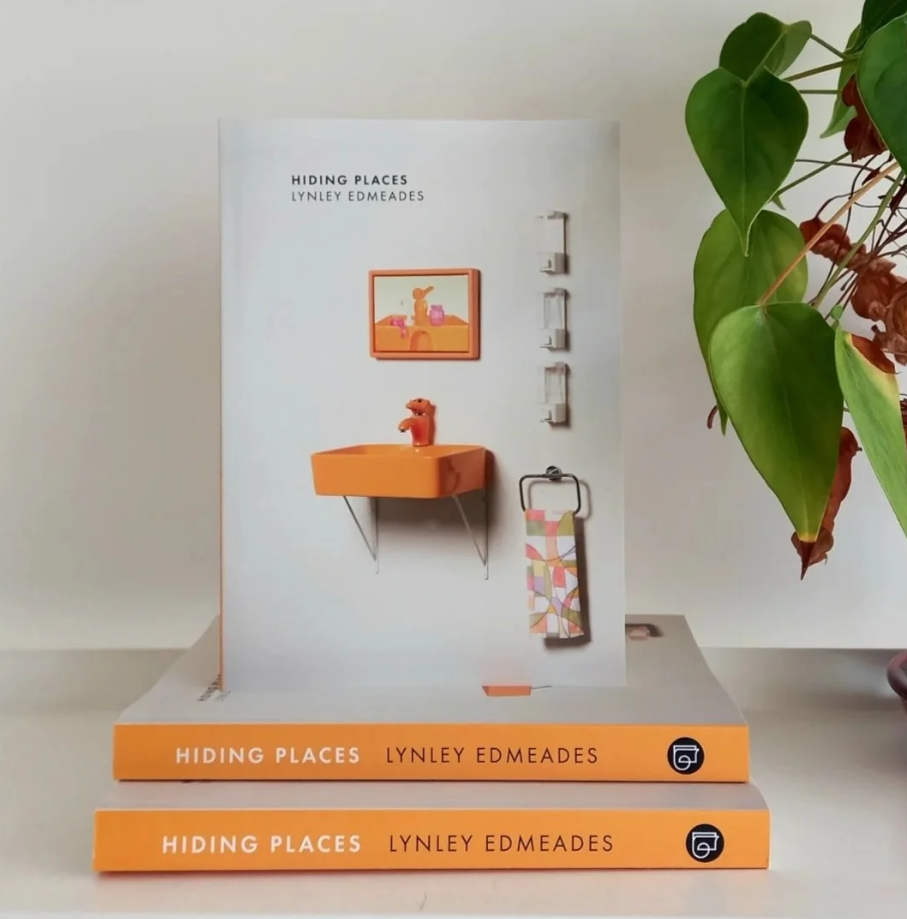
This interview was conducted in March 2026.
Lynley Edmeades is the author of Hiding Places (2025), Listening In (2019), and As the Verb Tenses (2016), all published by Otago University Press; and of Bordering on Miraculous (with Saskia Leek, 2022), published by Massey Univeristy Press in the ‘Kōrero’ series. She is the current editor of Landfall Tauraka.
Thomas Pors Koed is the author of, most recently, Some Things Wrong (2023).
