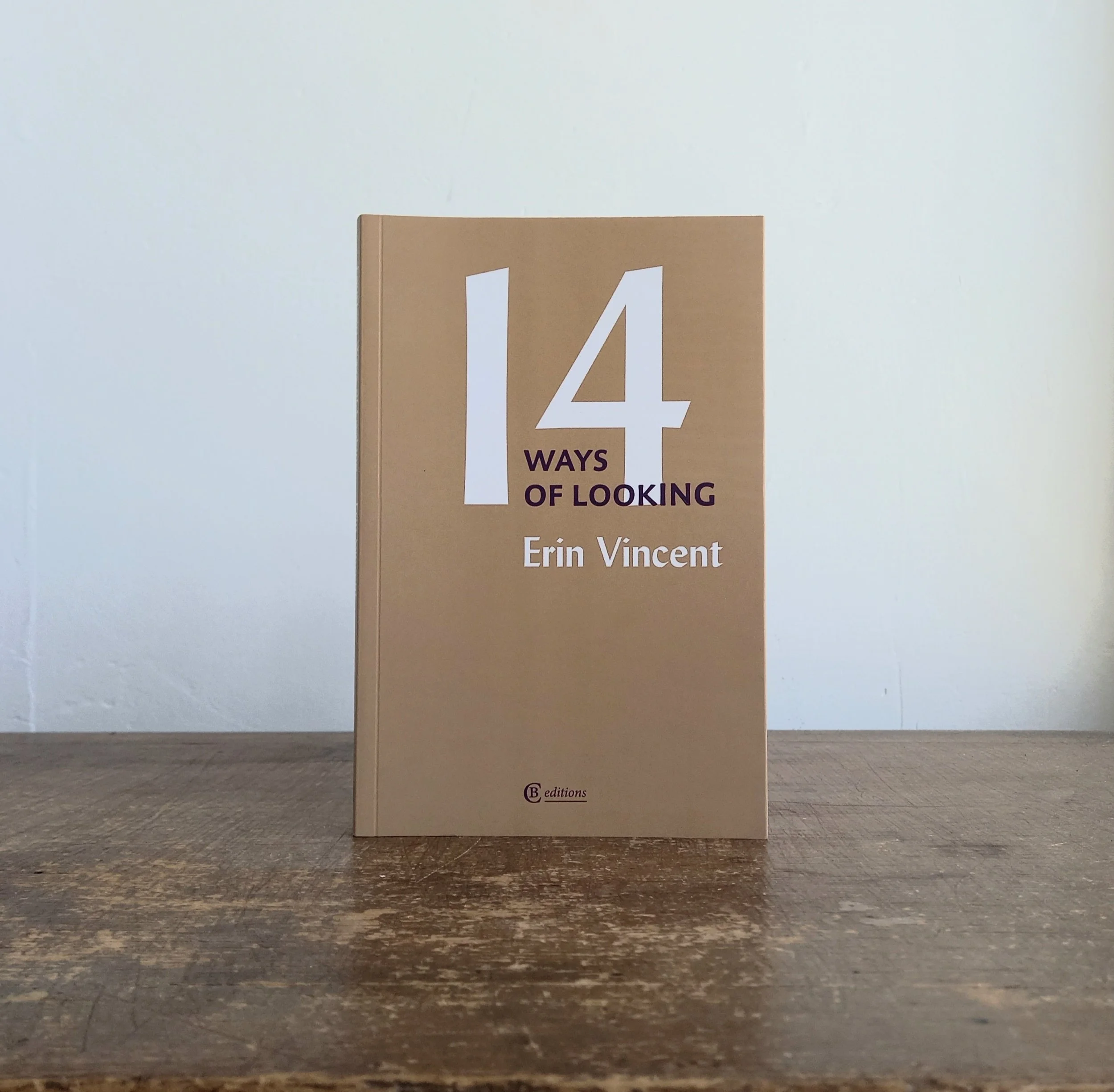
14 WAYS OF LOOKING by Erin Vincent — notes towards a review by Thomas
All attempts to understand the world involve the assembly of fragments into forms.
We feel threatened by experience so we anesthetise ourselves to it through representation.
Story may strive to comprehend experience but more importantly story’s purpose is to make us safe.
Story relieves us of experience by replacing it with narrative.
Memory is a species of narrative. Probably a native species.
Through memory, experience is neither reached nor left behind.
Story has a natural tendency towards schmaltz and is rendered in much the same way.
It is hard for story to resist cliché. But it might be possible.
The search for the particular results in the disintegration of forms.
Experience moves counterclockwise to understanding.
A trauma is misrepresented by forms. Trauma cannot be understood. Trauma is not tragedy.
Trauma is respected only by fragments.
Democracy of detail is preserved in the absence of form. Even though there is no such thing as the absence of form.
Everything is infected by whatever touches it. Could this give rise to a form?
[I found these fourteen notes scrawled on a piece of paper in what seems to be my handwriting in the back of my copy of Erin Vincent’s 14 Ways of Looking. Plausibly, they might be notes I made when reading the book, perhaps intended towards a review. The book, composed of fragments, demonstrates how the death of Vincent’s parents when she was fourteen invested that number with such associative trauma that she still cannot help finding everywhere examples of misfortune connected with it, sometimes directly, sometimes more tenuously. Maybe fourteen is just a bad number. It is impossible to tell how many of these misfortunes are only found by looking.]