ANIMAL STORIES by Kate Zambreno — reviewed by Thomas
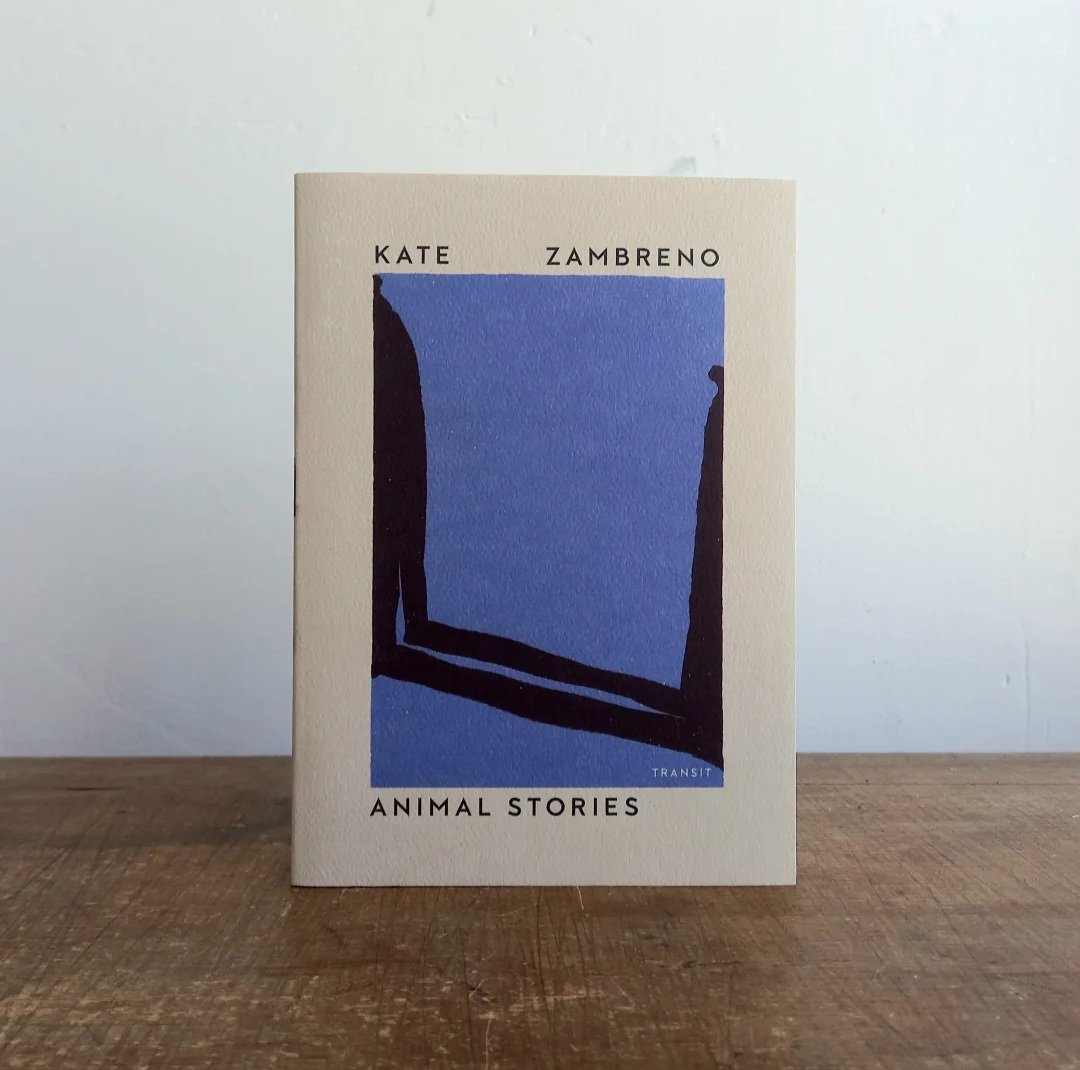
If the first recorded ‘drawing’ by an animal was a picture by an orangutan of the bars of its cage, what does this tell us about art? Are we ‘creative’ only to the extent that we are constrained, and is that constraint always therefore the underlying subject of our art? Nabokov’s assertion that such a drawing was made at Paris’s Jardin des Plantes zoo cannot be verified by documentation but seems to contain a truth that is too appealing to discredit (possibly this ‘seeming to contain a truth’ is more important to us than an actual truth, expressing a shared subjective state beyond the reach of facts, even though such thinking is the basis of our worst sorts of actions as well as of our best), but it is interesting that this supposed drawing was made by the sort of animal we see as most ‘similar’ to ourselves and that this ‘art’ occurred in a zoo, a place where we, as adults at least, see our own predicament in the constrained lives, boredom, helplessness and frustration of the animals, but are also kept separate from them by the grammar of the cage. The two zones demarcated by a single set of bars differ perhaps in physical scale more than they do in type. Is it for this reason that zoos are "deeply sad”, as Zambreno states in one of their reports that comprise ‘Zoo Studies’, the first half of this little book. “There is perhaps no more pronounced gap of awareness between a child and adult than when visiting the zoo,” writes Zambreno of visiting the zoo with their children, though they acknowledge, too, that children may experience the intense melancholy inherent in the species-alienation and the gazes that pass between the viewers and the viewed, gazes predicated on the bars through which they pass. Do we visit zoos to see in animals that which we are not or do not want to be? Are children more able than adults at seeing the actual individual behind the label on the cage? As adults are we blinded to the experiences of others by the very indignities of separation, classification and containment that we have expressed upon them?
The second half of Zambreno’s book, ‘My Kafka Method’, considers the actual impossibility of such a separation, through an accumulation of observations and fragments responding to first the life and then the animal stories of Franz Kafka. They see Kafka’s ambivalence about what could be called his ‘animal’ nature (though, when written, this term seems ludicrous) as the source of both his sufferings and his writings. If there is a zoo, Kafka is within the bars, his subjectivity complicated and enriched by the inescapability of his identification with the object of his attention. Our awareness, after all, is primarily a property of that of which we are aware. A text is a kind of cage in which the writer both performs for and avoids the gaze of the reader, a zone of both connection and separation, a space of porous and conflicted subjectivity, but Zambreno shows how, in Kafka’s stories, the circumstances of the writer, of the animal in the story, of Zambreno, of the reader — both of Kafka and of Zambreno — converge and begin to align. “Animals live in an ongoing present tense, the setting, possibly the subject, of this story,” Zambreno writes of ‘The Burrow’. Kafka does not exploit his animals as metaphors (“To make a metaphor of the animal is also to ignore the animal.”); he gives them enough vagueness of description to make them uncageable; he does not burden them with the sorts of meanings that would make their stories ‘signify’. “Don’t call them parables,” said Kafka. “If anything, call them animal stories.” We inhabit a zone of undifferentiated subjectivity. To draw a conclusion is to misrepresent the material.