
ALL MY CATS by Bohumil Hrabal (translated from Czech by Paul Wilson) — reviewed by Thomas
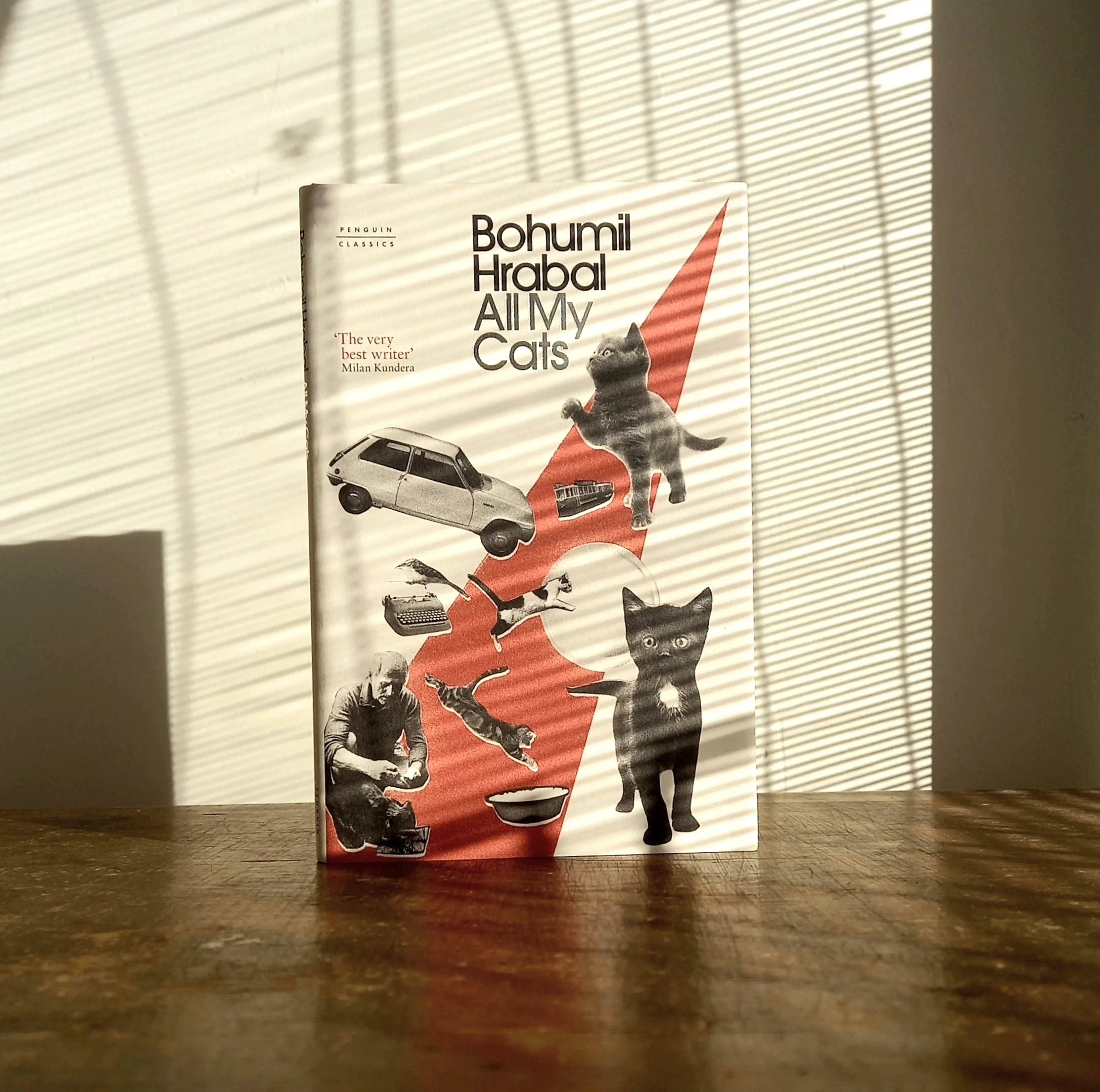
“What are we going to do with all those cats?” Hrabal’s wife asks throughout Hrabal’s book, All My Cats, for there are, over the years, a varying but large number of cats at the Hrabals’ country cottage in Kersko, near Prague, some of whom just arrive and start living there but most of whom are the offspring of other cats already living there, as desexing cats does not seem to have occurred to Hrabal or to Hrabal’s wife, or perhaps was not common practice in Czechoslovakia in the period about which the book was written. Hrabal’s love for the cats is immense and respectful, he is a perceptive and sensitive companion for the cats, he seems to feel greater affinity for the cats than for humans, especially than for his neighbours, but Hrabal is a man who is easily overwhelmed, a man also constantly resisting the urge to hang himself from the willow tree beside the stream, as the fortune teller had told him he would, and he succeeds in this: he died falling from a hospital window, after he had written this book, obviously. The greater Hrabal’s love for all his cats, the greater Hrabal’s feelings of guilt about those times when he has taken certain of his cats and killed them in the old mail sack in the shed, killed them for there being too many of them, for their demands being too great for Hrabal, both practically and emotionally, and Hrabal’s capacity to love ensures that his guilt will never be assuaged, his guilt grows more intense over the years, so much so that he even buys a brown car. How lucky you are, say Hrabal’s friends and acquaintances, to have this cottage at Kersko, bought with the income from your literary success, this cottage at Kersko to which you can go and write, to which you can go and enjoy the mental space and the mental time, the same thing, in which thoughts reveal their clinamen and collide with other thoughts to make that writing happen, but for Hrabal the mental space and the mental time spent in his cottage in Kersko are entirely filled with his cats, with his love for his cats and his guilt about killing his cats, and his time and his space are a torment, Hrabal could have made a torment of anything, the cats are central and everything else, from his accident in his brown car to his attempts to rescue a swan frozen into the river, gain their meaning for Hrabal from their relationship to the love-guilt axis he has with his cats. All of Hrabal’s writing is an elaboration on this love-guilt axis, or on the love-guilt axis of the characters in his books, a love-guilt axis that draws its authenticity from the love-guilt axis of their author. Hrabal shows how the mental space and mental time required for writing is also the mental space and mental time that runs what could be termed a constant existential risk, why else would we construct our normal lives, so to call them, our cultural and social and practical lives, so carefully to minimise our mental space and our mental time, if not to avoid the realisation of an underlying existential void, if not to avoid what we might call, offhandedly, a Kierkegaardian moment of enlightenment, an intolerable recognition of the meaningless, purposelessness and ennui that assail us from all sides and at every moment but which we avoid thinking about by deceiving ourselves. Thank goodness for love and guilt. Do I have enough of either?