
MY PRIZES: AN ACCOUNTING by Thomas Bernhard (translated by Carol Brown Janeway) — reviewed by Thomas
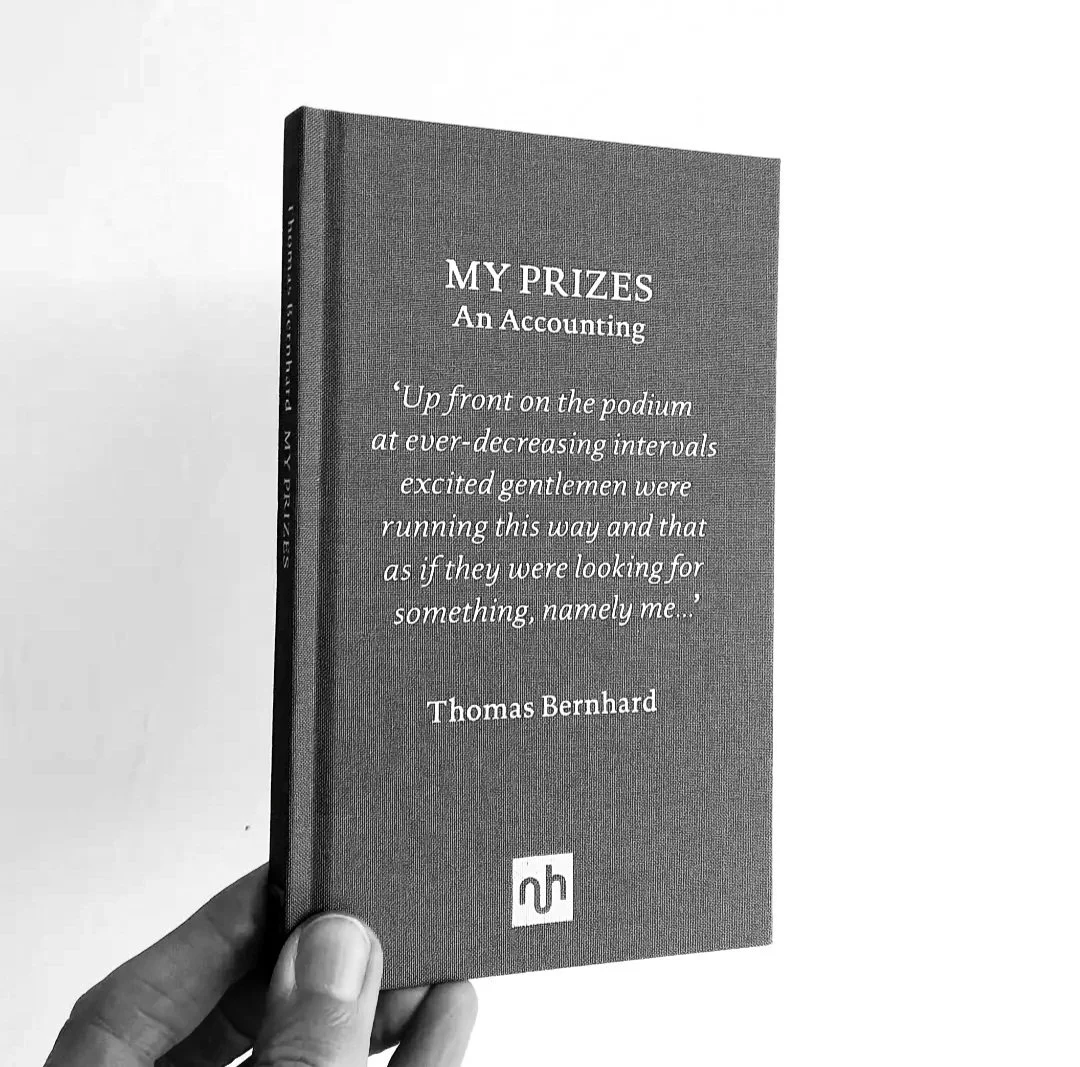
There is nothing more nauseating than admiration, he said. I want neither to admire nor be admired. Not much danger, though, he thought, of either. When he said, There is nothing more nauseating than admiration, he was perhaps, he feared, performing an act of admiration. He was not certain that Thomas Bernhard had not said exactly those words, or written words in German that could be translated into exactly those words or into words very like them, depending on the translator. I do not admire anyone, he shouted, but, he admitted, if I were to admire anyone it would perhaps be Thomas Bernhard, or rather his writing, that I would admire. His denial seemed unconvincing, he thought, until, at least, my denial is affirmed when I consider a book like Thomas Bernhard’s My Prizes, an account of the circumstances of the nine literary prizes that Bernhard accepted between 1963 and 1980, pretty much against his will, or so he says, before developing the strength of will not to accept any more. Strength of will or, maybe, financial security, for, so he says, he accepted these nine literary prizes only for the money and despite the indignity of receiving them. Though, better to accept the indignity of receiving the prize, along with the money, than have that indignity and that money being awarded to a lesser writer, Bernhard writes several times. Eventually he became successful enough not to accept any prizes. That is, if being successful is not a nauseating prize in itself, with all the hazards of every other sort of nauseating admiration. A writer who admires struggles to find their own voice behind or beneath the voice that they admire. Either behind or beneath, the metaphor is unspecific and spatially imprecise. I will tell you what is wrong with metaphors another time. And the writer who is admired struggles to free their own voice from the burden of admiration that their voice or so-called voice has received and which now cannot easily be ignored. It is better to be nobody, he shouted. It is better to be nobody than to be colonised by admiration, either by being like someone else or by being like your idea of someone else’s idea of yourself. Anyway, much as I may run the risk of admiring many others of Thomas Bernhard’s books, he has been careful that I will not admire My Prizes, other than the risk that I might admire the idea of a book written deliberately to avoid admiration. The Thomas Bernhard portrayed in My Prizes is grumpy and misanthropic, he is petulant and unreasonable, as are most of the grumpy, misanthropic, petulant and unreasonable narrators or focal characters of his other books, but in My Prizes there is no deep countercurrent in the text gradually altering our reading and subverting our understanding. In My Prizes there is just Thomas Bernhard on the surface, buying a suit and then taking it back after the prize ceremony, buying a new white Triumph Herald with his prize money and then writing it off in an accident, using his prize money to buy the first rotten old Austrian farmhouse he is shown by the land agent. Rather than the sublime and complex nested clauses, recursive sentences and perilous washes of philosophical inversion that I am most in danger of admiring in many others of Thomas Bernhard’s books, the sentences in My Prizes are crisp and direct and light, and rely for their success on comic timing. These pieces are self-satires, really, character auto-assassinations or deflations, prickly, sometimes tiresome, but relatable (there must be a better word than that, he thought), anecdotes of a life just as irritating as your own, all told like jokes. I have, in a previous sentence, revealed several of the punchlines of these jokes, but no matter. A punchline always spoils a joke and dissipates its energy. Receiving official recognition puts Thomas Bernhard in a bad temper, especially if the prize is an Austrian one. Thomas Bernhard scorns admiration, it is true, and he scorns prizes, but, I ask myself, is a literary prize actually an institution of literary admiration or is it a culture-mill that approves the product of its grinding, softening the grain, unattached to what it grinds? Strike out that metaphor with a hard blue pencil. If the admired dominates the admirer, even when the admirer steals from the admired, or especially then, then a prize is perhaps the opposite of admiration and even more of a risk. I will never risk winning a literary prize, he thought, even though I have written fewer bad sentences than some who have won prizes for them. I will never risk winning a prize. I do not want to be admired. I do not want to be known for anything I have written. I do not even want to have written, he wrote. I want only to write. Only when the sentences are forming themselves on the page can I experience what it is like not to exist at all. The best experience. That in itself is worth living for: the loss of yourself in the liberation of the sentences you write. But if this is true, he thought, can having a good excuse for not writing be anything other than a tragedy? And to whom am I presenting this excuse?