
TRANSCRIPTION by Ben Lerner — reviewed by Thomas
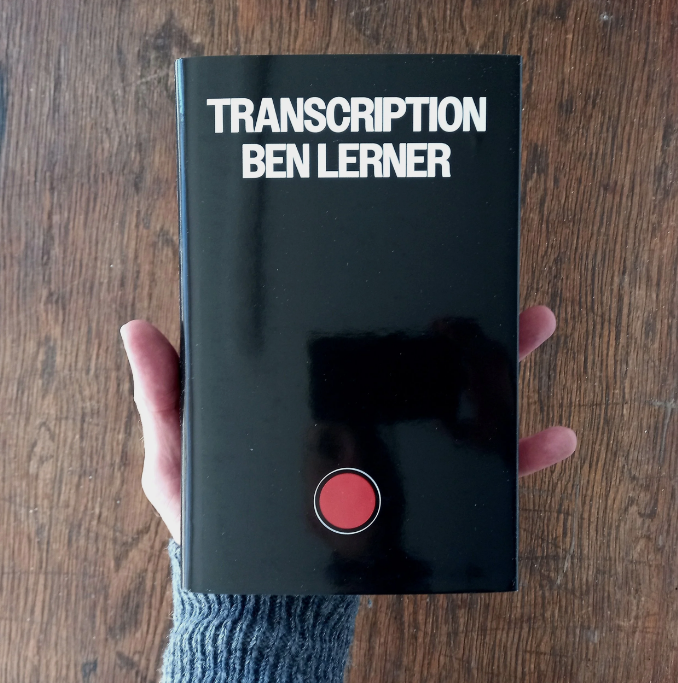
Novels and parenting are both traditional but unstable technologies of transmission. Neither are ‘resolvable’; both are technologies in which the ‘definitive’ is impossible and in which any attempt at the ‘definitive’ interferes with the transmission. Both progress in a single direction, as a series of moments, but in each moment multiple times are present simultaneously, layered, both present and absent, creating nodes of attention and possibilities for realisation and invention. Both novels and parenting privilege us to the experiences of others (for good or for ill) and through them the experiences of others again and so on, linking the influences of the past to the possibilities of the future. Each technology is a vector for the development of the characters to which it is applied but the more conforming the characters to external parameters the less interesting the result. Novels and parenting are both technologies of transmission, but the measure of their value lies entirely in the reader or child who either receives or resists the transmission according to their needs and in the way most suitable for them. Ben Lerner’s novel Transcription explores the possibilities and limitations of the novel as a technology of transferral while addressing the possibilities and limitations of parenting (both biological and metaphorical or ‘cultural’) as another technology of transferral, all the while contrasting both to the new attention-hungry technologies that are embedded for instance in a cell-phone, and charting how these new technologies have impacted the types of transferral addressed by the novel or by parenthood (biological or metaphorical). The new technologies in their most widely consumed mode tend to provide experiences that are temporally flat, a scrollable inescapable present, even though the moments that comprise that ersatz present are necessarily captured in the past. The ‘present’ of the new technology is discontinuous, uninhabitable, spaceless, compounding, and generally over-literal, inherently disjunctive and competing for attention with the other modes of experience that may be suggested by the actual location or circumstances of the rightful ‘owner’ of that attention. A novel, traditionally embedded in the codex as a hand-held device, offers one way in which attention may push at the limitations of its moment and enlarge its circumstances through an experience of simultaneity; scrolling social media on a cellphone — skimming — allows attention to push at — or be drawn through — the edges of its moment through an experience of algorithmically determined disjunctive seriality (this is not inherently a bad thing (but may (or may not) in effect be a bad thing)). Regardless of the content transferred, the medium is shaping and patterning our experience, though the medium itself is unseen as the transference occurs (which is what makes it a medium). When the narrator of Transcription drops his cellphone into the handbasin at the hotel on his way to conduct what will be the final published interview of his nonagenarian cultural mentor, Thomas, he finds himself unable to admit that he is not recording, and ends up reconstructing the interview from memory. When he admits this at a symposium in the second section of the novel, he is castigated, not unreasonably, by the attendees but it could also be said that Thomas’s voice, especially since his death, now speaks through or inhabits the narrator in a way that would not be possible if that voice was contained by and limited to forensically verified data. The new technologies are technologies of cumulative capture before they are anything else, performing literality and definitivity (even when they are wrong or fake). If the conversation between the narrator and Thomas written for us by the narrator in the first section of the book is an accurate reconstruction of the actual conversation (we play along with the author that there might be such an actual thing so that we can then speculate on the reliability of narrator’s account of it), it would have made a very poor written interview as Thomas is exhibiting post-Covid cognitive decline and the narrator is comically distracted and dense. Fortunately for Thomas’s legacy perhaps, there is no definitive recording of the interview and the narrator has therefore had to use a combination of memory and imagination to construct Thomas’s final interview for publication (of course, we as readers do not get to read this (novels are potentised by what they leave out)). Where a technology of capture literalises what it captures and presents it as definitive, memory and imagination allow the voice to live and change in those it inhabits, to use its force for further and yet further acts of nuance and transmission. Whether we think of this living-on-in-others (especially when the original personage can no longer contribute to or ‘own’ the idea of themselves) as colonisation, theft, or haunting, it demonstrates the transpersonal nature of what we think of as personhood: the idea of us continues to vibrate in others, diminishing but never completely disappearing even when it is no longer consciously noticed. We both receive and transmit; we ourselves are media of transference. The narrator's cultural relationship with Thomas, his mentor, privileges him to Thomas’s voice and to the thoughts it expresses but it also overwhelms the narrator’s own less certain voice. The narrator is the admiring cultural son, dominated by his father, hoping to live up to his standards, too frightened even to admit a misfortune. The narrator’s relationship with Thomas is contrasted, especially in the third section of the book, with that of Thomas’s biological son, Max,who was a university friend of the narrator’s and his double for the purposes of the novel (even Thomas confounds the two). Max’s experience of Thomas and of his shortcomings as a father contrasts with that of the narrator both on matters of fact and of perspective. Their experiences are often co-extensive both in time and space, but are very different. Max sees clearly from his position as the overlooked son, and his longing for and attempts at connection with Thomas are poignant. The narrator and Max each have young daughters who are exhibiting refusals that their parents find distressing and confusing: the cultural son’s daughter refuses to go to school; the biological son’s daughter refuses food. These refusals are also each refusals of transmission, disarming reactions by the otherwise powerless to systems that derive their power from their capacity to withhold. That each of the girls’ problems are ‘overcome’ by means of new technologies is both disconcerting and somehow plausible: the vacuous unboxing videos that enable Max’s daughter Emmie to start to eat again are effective precisely because of their vacuity: with irrelevant content, the underlying pattern of expectation, discovery and satisfaction resonates deeply and reassuringly in a world where expectation, discovery and satisfaction are unstable, undermined and uncertain, especially for the young. What then, though? Do the new media pattern our attention so that they appear to assuage the very problems they exacerbate? We are of course and as always asking the wrong question or only part of the right question. As with any medium we must ask not so much whether it is ‘good’ or ‘bad’ but: in which direction does the power flow, and to whom?