INTO THE WEEDS by Lydia Davis — reviewed by Thomas
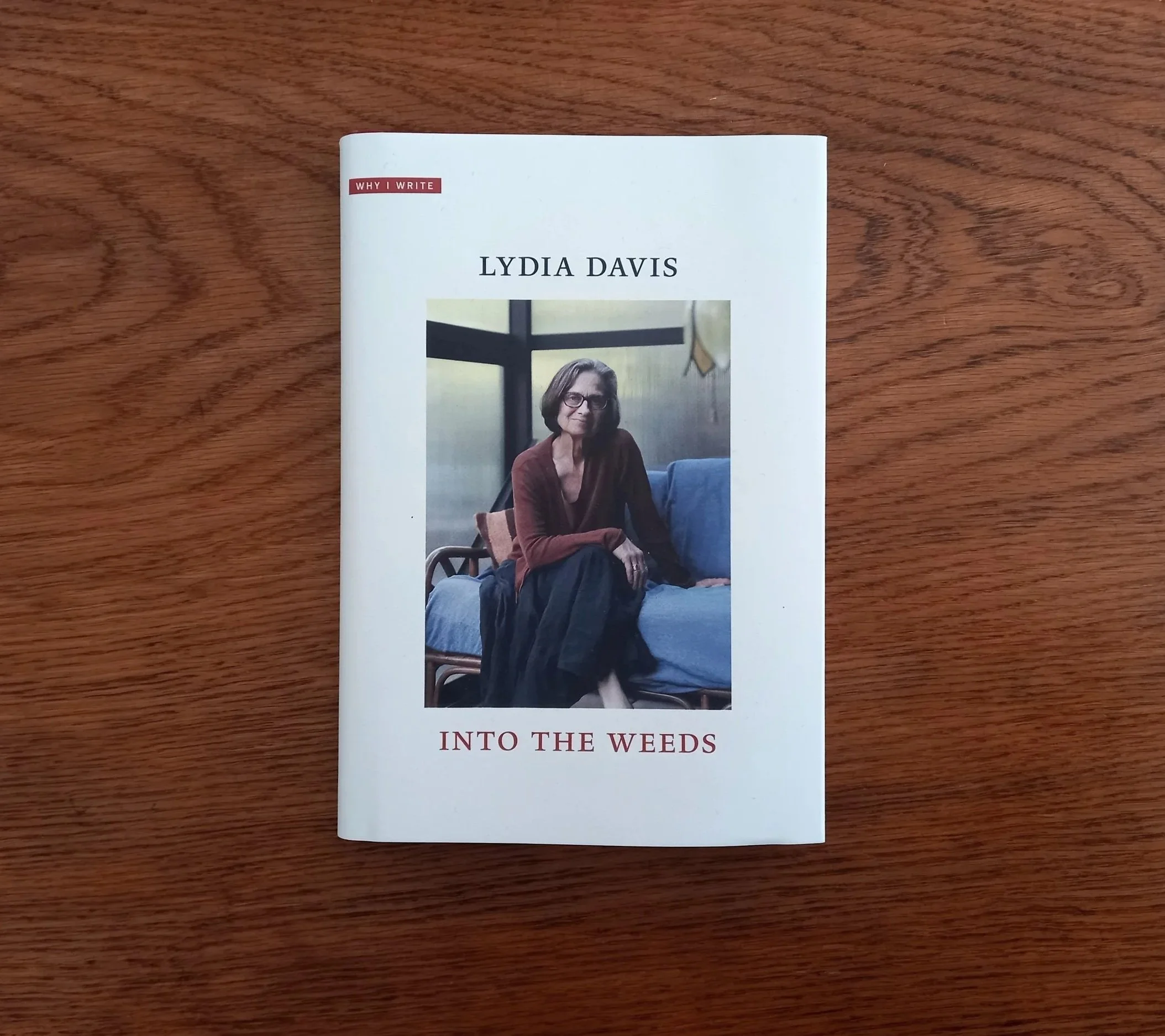
The case for the benefits of reading is easier to make than the case for the benefits of writing, which seems dubious to say the least except insofar as it enables the benefits of reading to be fulfilled. Although readers may be pleased that a writer has enabled the activity they have chosen and may therefore be inclined to tolerate writers per se, this does not reveal why it is that writers write. Egocentrism and unnatural personal extension into posterity are, really, vices, I would say, but are there reasons to write that are not exactly this sort of vice? If writing is done in the consideration of a reader, however hypothetical that reader, just who does a writer think they are to impose themselves upon this reader and demand the precious currency of their attention? The hypotheticality of a reader makes the impulse on the writer no less actual. Should everyone write, in the same way that everyone should read? Obviously not: already there is an oversupply of writing and the vast majority of it will bring little satisfaction to either its writer or any reader unless the reason for this writing is something other than the connection between these two on which our usual production models attempt to establish their validity. What else is there? Lydia Davis was asked to contribute a lecture and essay on the subject of ‘Why I write’, and soon regretted agreeing to do so. Her attempts to address the circumstance by, really, primarily writing about what she has been reading have produced a companionable and interesting little book, even if she largely avoids the question that provoked it. (Q: Why does she write this book? A: Because she thoughtlessly said that she would.) Davis gives us a good idea of why she reads, what she reads, how she writes (“When I am asked why I write, I instead think about how I write.”), what she writes, what someone else writes and how they write it and, to some extent, why she thinks that this someone might have written what they wrote (a piece of speculation that, I suppose, lies acceptably within the occupation of a reader). Throughout the book Davis does reveal a few what could be valid non-reader-oriented reasons for writing. She does seem to write in order to test and perfect, or, rather, move towards perfection, the transformation of thought into language (the inverse corollary of the activity of a reader), often reducing the size of her palette to the infraordinary contents of her daily experience in order to clarify this process of translation and to further sharpen the technical precision for which she is justly well known. Consciousness, after all, is only achievable through the suppression of the vast majority of stimuli that impress themselves upon us, and Davis similarly makes language alert by the rigour of her composition. Davis admits also that “I also write, sometimes, to figure out something that I don’t understand and that I want to understand,” which, I suppose, is fair enough, and also that she writes to “be rid of” a thought that “bothers” her (she thinks of this bother as a pleasurable sort of bother but I don’t see why unpleasant bothers should not also be a stimulus to writing — maybe even more so). Just as Kafka suggested that we photograph things in order to forget them, it is possible that we write things for the same reason, and this negative achievement is satisfyingly obliterative, at least to me. Davis is known for her cool descriptions, but, she writes, “Though my objective portrayals may not appear overtly loving, there is love in the motivation behind them.” Which is interesting. She also writes, nearly at the end of her book and feeling that she perhaps has still not addressed the question that provoked it: “It must be that relieving myself of the burden of strong feelings, by taking them out of myself and putting them into an objective form, a form that can also be shared by others out in the world, is just another reason why I write.” Writing “it must be” does not convince me that this last ‘reason’ has any particular validity, especially for this fine, clear writer whose finesse and clarity is achieved in part by the rigorous avoidance of exactly this sort of cliché.