
IT GETS IN YOUR BLOOD by Marty Smith — Review by Stella
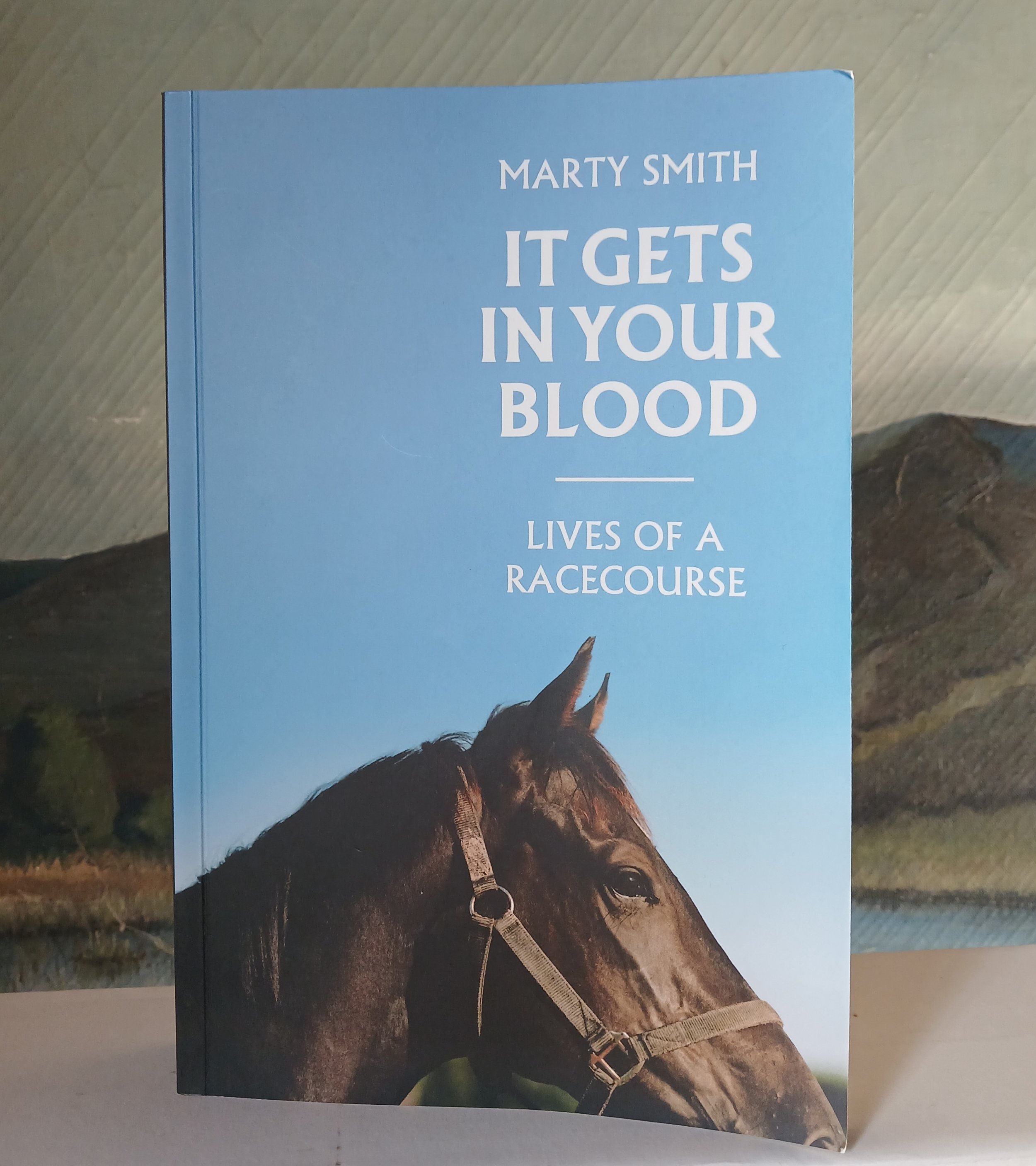
I never intended to be so topical. The news of racetrack closures across Aotearoa has been popping up across the channels this week. Reading about horses and the lives of those that work the track wouldn’t have regstered on my radar a few years ago, but after reading the compelling Kick the Latch by American author Kathryn Scanlan and watching Australian author Gerald Murnane talk about his obsession with horse racing, both real and imagined, and how it shaped his writing, had me reaching for the ARC (Advance Reading Copy) that had landed on my desk. Marty Smith’s work of memoir and portraiture It Gets In Your Blood: Lives of a Racecourse is centred on her local, Hawke’s Bay Racecourse, and follows the lives of the trainers, jockeys and trackworkers across a decade. Like Scanlan’s novel, she gets inside, behind the scenes. While Scanlan did this by developing a relationship with Sonia, a retired trainer, Marty is more like one of the crew. She’s trusted: she’s been a rider, owner/breeder; her family working with horses for generations. What started as a year-or-so project for this full-time teacher and poet morphed into a decade immersed in this world of thoroughbred racing, and the people who inhabit it. It’s a portrait of a community, one with its own rules, attitudes and language. A world where the horses are descibed as good and naughty, of 5am starts, of watching form and testing track conditions, of daring and risks — accidents happen. It has its stars, and its hacks, wins and losses.
In 2014 Marty Smith won The NZSA Jessie Mackay Best First Book of Poetry Prize for Horse with Hat, poems about her family, about horses and their human counterparts. Nina Mingya Powles described the collection as ‘gutsy’, the poems giving ‘ the impression of standing on the side of the road when a car swooshes past and you feel it shake the air in front of your face, tipping you a step backwards’. And Emma Neale wrote, 'This is alternately comic, wry, downbeat, vernacular, lyrical: yet is is also at times dark, plangent and moving in its use of narratives distilled from extended family relationships.' Smith brings these same sensibilities to her latest work. She gets alongside, witnesses and records faithfully, bringing to light the often unseen world of the trainer and the trackworkers. It Gets in your Blood has grit, drama alongside the daily grind, humour and pathos. There’s the vernacular of the workers, wry and sometimes oblique, often colourful; and the language of the track. For horse lovers some of this won’t be a foreign world, although it is a more particular subset of the riding world. For those who head to race days the terms of the Plough, Tie-Ups, Birdcage, Bullring, and so on, will be familiar. For the rest of us, we are outsiders, but through Marty Smith’s book we can come inside for a moment, she gives us a window to this world, blinkers off. In this it reminds me of Sven Lindqvist’s Bench Press (a dive into the world of bodybuilding). Like Scanlan’s book of episodic moments, Smith employs a shortpiece motif in the form of diary entries, ideal for this many-yeared project and for an industry that has a season, which kicks off in Spring. (Note: the Hawke’s Bay Racecourse is reopening very soon after unsafe track conditions closed it in September 2024 and, if you are in Hawke’s Bay, the book will be launched at the racecourse on Saturday 8 August). Like Kick the Latch, these pieces sometimes have witty titles, focus on a particular activity or happening, or a revealing conversation. There’s a handy map of the racecourse, as well as a table to explain the track form for the uninitiated, and a much needed list to the large cast, all those she spoke with and wrote about, and their roles on the horses and off. Occassionally, there’s also Marty herself, describing her own relationship with horses, her father and the love and respect she has for the industry. In her acknowldgements she reveals the working title for her project: Because I Love Them, claiming this was the answer, in one form ot another, to her question: Why do you do it? I think this is also the reason for Marty Smith’s immersion, and the result is Aotearoa’s own piece of racing literature, exploring a microcosm all its own.