LIFE OF M by Rachel Cusk — reviewed by Thomas
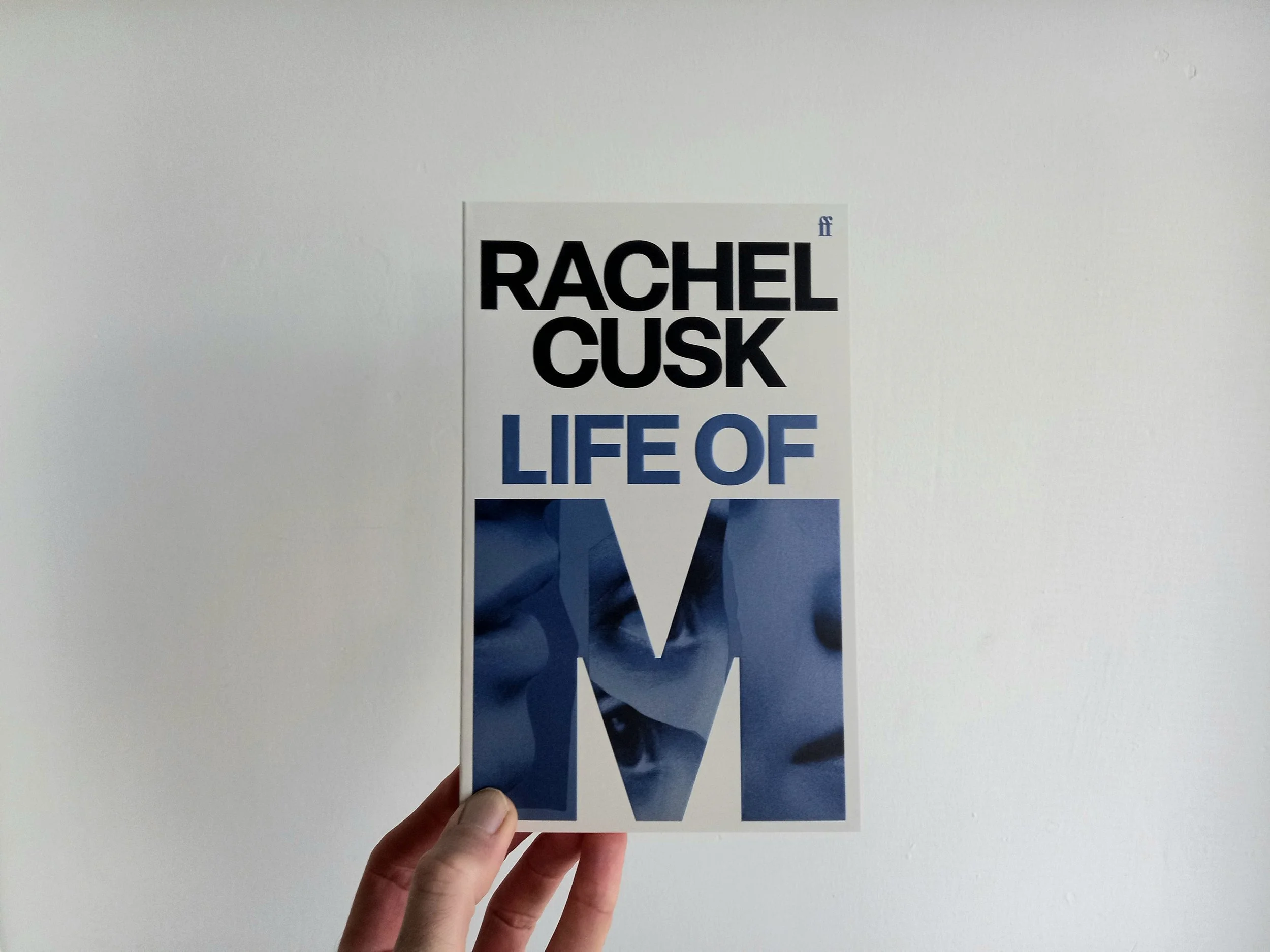
When I refer to myself as We, I mean both I and Me. Me is not introspective at all and exists, really, only in the eyes of others. I is invisible to others but always watching, including watching Me, or, rather, watching the effect of Me on others. Whether these others are more like Me or more like I is a matter purely for speculation; they may well be their own form of We, but this I cannot know. I would like to have an effect on how these others perceive Me. I would like them to like Me, so I and Me must be connected in some way, but probably no more than a practical way. Possibly I need Me more than Me needs I. Me might get on just fine without I, for all I know. Separated from I, Me is an object made of what surrounds Me in the world (so to call it): Me is a kind of Mirror, showing what the world presents to be seen. I is the only certain subject but, as this is too lonely to believe, it suits I to believe that the world is full of subjectivity, even if it isn’t, even if I is the only subject. We gets things done: I and Me work sometimes at least quite well together, but if I want to really understand the grammar of things getting done I must separate I from Me, at least as a thinking excercise. I must split the subject from the object. I must separate I from Me, a task for which I will need words, if it is not the case that all words perform this separation anyway by virtue of their nature. But really I am interested only in the grammar of this separation. The lexis of whatever I might write is fairly unimportant; words might be substituted for other words at any time without changing the form or the meaning of the form. Words are of the world they represent, but grammar is a form of understanding. Me might have the words but I supply the grammar. Consciousness is merely grammar, after all. If I were to write about Me, I would call this an autobiography as a joke. I would call it Life of M(e). I could substitute pretty much any set of details for the character of Me because these details are not important other than what the manner of their presentation might reveal. I might as well use the biographical details of a famous film actor, because these mean nothing and they belong to everyone, and they might make it clear that I am writing about Me and not I. Or perhaps that is not clear. I am interested only in mechanics, not in what passes through the machine. I am only interested in awareness, not in that of which I am aware. An actor is always playing a part, even when they are not playing a part, and every Me is an actor. Who is Me without the script they’re soaking in? Just like any object, Me is tossed about by the medium that holds Me in place, the medium that really is one substance with Me, except to the extent that I might think otherwise, as a game. I would like to think that I can have some effect upon Me, or on how the others might see Me, but really I’m not sure. The more I think about this, the less I think that I have an effect, or the less the effect that I think I have. I can’t say that this isn’t a problem. Me may not need I but I am bound to Me, whether I can have an effect on Me or not. When I write, though, I slip my leash. When I write there is no Me and I can for a while be free, free at least of Me. As Rachel Cusk writes in Life of M, which I have not been able to read without reading it as a laboratory of exactly all this stuff, “Being a creator was like being a dog that runs away from its violent master. For a while it runs free, it runs in search of something, but in the end there is nowhere else for it to go but back home.”