
SOMETHING FOR THE PAIN: A MEMOIR OF THE TURF by Gerald Murnane — Review by Stella
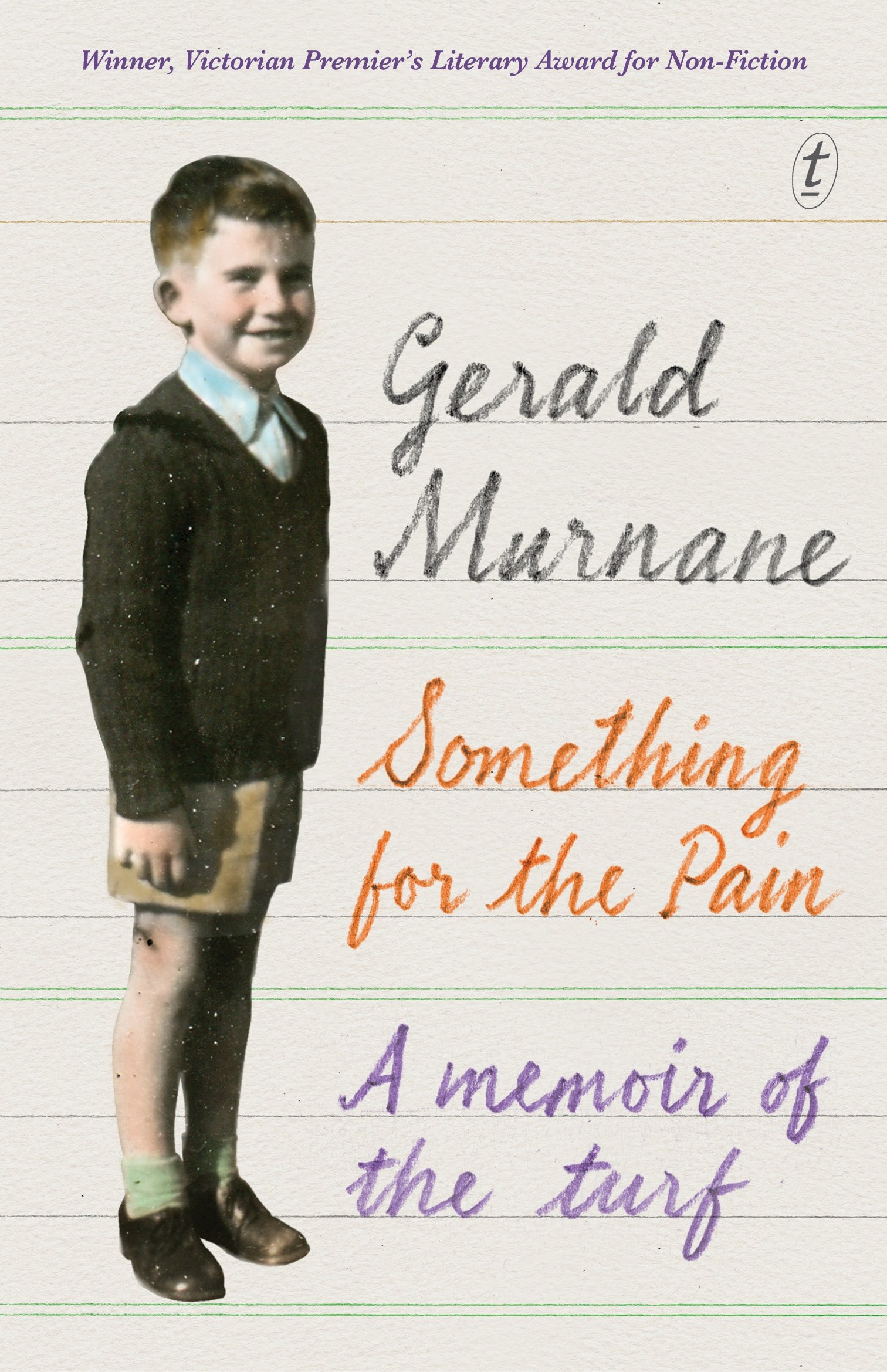
Still on racing and literature this week. I’ve been reviewing books for just over a decade on RNZ, and this week I had a thematic twist with my book selection: it was horseracing, which I find hilarious for a number of reasons. One: I’m in awe of horses, i.e a little terrified of their majesty (so, not a pony-club child, even if I did have a short fixation of wanting a pony and thinking there was plenty of room on the front lawn). Two: I have little interest in horse races and even less time for gamblers. This view was formed as a bored child waiting in the car outside the TAB, not quashed by the minute or so excitement of going to Trentham once — after the first race, there seemed to be a long hot day of waiting in the ‘family picnic area’ — a parched field of cars, mothers with headaches, and restless children. But I digress, as Gerald Murnane would say in his excellent memoir Something for the Pain. His love of horseracing started as a child, with the pictures of the horses in the newspaper and the racecallers’ voices through the radio. The names of the horses, the colours of the stable, the overheard stories of the adults around him: all a source of fascination. Strangely, he was not put off by his father’s wins and losses at the track; the debts often life-changing for the family. Murnane writes with such verve that I couldn’t help but be pulled in. In each chapter he tells a tale, one that reveals as much about the history of the racetrack in Australia from the 1940s through to the 70s and the people in his orbit, as it does with his idiosyncratic obsession (more on that later), and his life as a writer. (If you haven’t read any Murnane: think Beckett or Proust living in smalltown Australia.) His is the kind of writing where you stop mid-paragraph to wonder at the ease with which the language develops on the page. The sentences are near-perfect, the elliptical nature of the prose delightful rather than frustrating. And back to his idiosyncrasy. He has a real and imagined world of horses, names and colours. The colours of the stable being a central component of his love of the racetrack. When he describes two favourites in a race being (brown and white) (brown and cream) — always bracketed after the horse’s or jockey’s name — I imagine the field of horses racing around the track and the punters with their binoculars attempting to tell them apart. His imaginary world (not in this book; you’ll have to seek out a documentary about Murnane to find out more about this) consists of coloured marbles, names, and many files. It’s his schema. Which he does talk about in the memoir. A lifelong ambition to find the perfect betting style. Murnane’s gambling is one of patterns and restraint, of rules and analysis. It’s keeping your eyes open and ears to the ground, a studied form-book and people-watching. In Something for the Pain there is the comedic and the tragic; you could read it for the horseracing; for the insights into people’s behaviour, both good and bad; for the enjoyment of Murnane’s language; or to understand this excellent writer’s approach to literature.