

| STELLA | >> Read all Stella's reviews. |
 | Known and Strange Things by Teju Cole In this collection of essays, Teju Cole ranges across literature, art and politics. As a writer, photographer and art historian, Cole ranges widely. The essays, first published in the New York Times Magazine, are 55 moments of lucid thought: some are personal responses to Cole’s travels, his interest in photography and his fascination with several authors, while others are pointed commentary and questions about politics and society and the ways in which artists and writers interpret or present a viewpoint. Teju Cole has his opinions and these are intelligent missives. The essays are arranged in three sections. ‘Reading Things’ includes an interesting interaction with V.S.Naipaul, and a search for W.G. Sebald’s grave which is charmingly reminiscent of Sebald’s own work. As Cole ventures out across Norfolk with Jason the taxi driver, he is simultaneously journeying with Sebald. ‘Seeing Things’ deals with visual observations, predominantly contemporary photography. Here Cole’s ability and knowledge as a photographer gives this section real depth, and his ability to appreciate as well as add critical interpretation of the photographer’s intention raises some thought-provoking questions about the role of visual observation, the ability of a photograph to capture a moment and the lies that images can be. Cole looks at photographers who exhibit in art galleries alongside those who use google and instagram as a platform to communicate their work. The third section ‘Being There’ is firmly rooted in place and travel. The essays are fine examples of ponderings on politics and society, and in many of them Cole ventures into the conversation around racial politics in Africa, America and Europe. His interests range widely in this section - there are essays about drone warfare, terrorism’s personal impact, home and belonging. The first essay in this section, ‘Far Away from Home’, is a gem — Cole is in Switzerland and is overcome with an unexpected fascination with the Alps and the idea of Fernweh (a German expression meaning ‘one simply wants to be far away’). Teju Cole’s essays are places where you can journey — he pulls his ideas together with references to writing, art and history, giving texture to the well-constructed sentences. They are provocative, stimulating and rewarding. |
| >> Read all Thomas's reviews. | |
 | Malina by Ingeborg Bachmann {Reviewed by THOMAS} “‘Today’ is a word that only suicides ought to be allowed to use, it has no meaning for other people.” Even five decades after it was written, this wholly remarkable book continues to reveal new possibilities in literature and new impossibilities in living. In the first part of the book, ‘Happy With Ivan’, the unnamed narrator records her obsessive love affair with a man she first sees outside a florist’s shop near her home in Vienna. On account of Ivan, “the rest of the world, where I lived up to now — always in a panic, my mouth full of cotton, the throttle marks on my neck — is reduced to its petty insignificance.” She snatches evenings with Ivan, plays chess with him (resulting in stalemate), writes him letters (which she tears to shreds and throws away, unsent), and talks (or 'talks') with him on the telephone, but, mainly, she waits and thinks and narrates. “Ever since I’ve been able to dial this number, my life has finally stopped taking turns for the worse, I’m no longer coming apart at the seams. I hold my breath, stopping time, and call and smoke and wait.” But hers is a desperate happiness, not a convincing happiness, not really happiness at all but a straining towards the impossibility of happiness, agitation trying to pass as happiness. Just as the difference between pleasure and irritation is generally merely a matter of degree, there is, for the narrator, no substantial difference between ostensibly contradictory states and the case for her happiness is made so strenuously that it is clearly made from a position of great unhappiness. Ivan lives along the street, but the narrator shares an apartment with Malina, a civil servant who works at the Austrian Military Museum but who is so compartmentalised in the narrator’s mind that he never makes contact with Ivan, or, rather, never inhabits the Ivan compartment in the narrator’s mind. Although the narrator interacts with Malina, and we are told of her visiting elsewhere with him, it is very unclear that Malina exists outside the narrator’s mind, or, rather, that he is not an aspect of the narrator. “Ivan hasn’t been warned about me. He doesn’t know with whom he’s running around, that he’s dealing with a phenomenon, an appearance that can also be deceiving, I don’t want to lead Ivan astray but he has never realised that I am double. I am also Malina’s creation.” I increasingly began to suspect that Ivan also exists, at least mostly, in the narrator’s mind, and that, although probably affixed to someone she saw outside the florist’s shop, the Ivan with whom this 'love affair' persists is a never-quite-reachable eidolon of her longing and desperation. “My living body gives Ivan a reference point, maybe it’s the only one, but this same bodily self disturbs me. Extreme self-control lets me accept Ivan’s sitting opposite me.” Is there no exteriority? All these words, these truncated staccato telephone conversations, these endlessly commaed descriptions, these letters and interviews and documents in many versions, these moments and encounters, these details, these memories and revised memories, these stupendous rants, are they all the desperate invention of the narrator (in the same way that the novel is the desperate invention of the author)? “Whatever falls on my ground thrives, I propagate myself with words and also propagate Ivan.” The second part of the book, ‘The Third Man’, intimates, perhaps, the degree of trauma that underlies the narrator’s agitation and the fracturing of her psyche. Passages, seemingly dreams or memories, describe violence, torment and sexual abuse, largely at the hands of the narrator’s 'father' (and of, by extension, Austria and Nazism), enacted either upon the narrator or upon her naive and complicit alter ego Melanie. “Here there is always violence. Here there is always struggle.” Bachmann’s sentences offer no respite for the reader nor for the narrator. “I don’t want to be any more, because I don’t want war, then put me to sleep, make it end.” The dream sequences are interspersed with conversations, written as script, between the narrator and the rational, interrogating Malina, bringing into her awareness the nature of her trauma, and moving towards the possibility of understanding. “Although it disgusts me to look at him [father], I must, I have to know what danger is still written in his face, I have to know where evil originates.” But, Malina warns, “Once one has survived something the survival itself interferes with understanding.” The third part, ‘Last Things’, charts the shrinking of the narrator’s world, her gradual inevitable loss of Ivan, either as reality or eidolon, her loss of confidence in herself or hope in her world — and it is much funnier than this list would suggest, though no less tragic. Experience, once replaced with knowledge of — or description of — experience, loses the power of experience. Language at once conjures and replaces — annihilates — what is lived. But, says the narrator, “I must have reached a point where thought is so necessary that it is no longer possible.” Her conversations with Malina, in which Malina (or 'Malina') increasingly dominates, drain the reality from Ivan and reveal her isolation and self-suffocation. “I am not one person,” she says, “but two people standing in extreme opposition to one another, which must mean I am always on the verge of being torn in two. If they were separated it would be livable, but scarcely the way it is.” The slow, cumulative, fatal intrusion of rationality is here like a pin being pushed against the surface of a balloon with great, horrible, slow, thrilling patience. “The story of Ivan and me will never be told, since we don’t have any story.” Literature is lack. All that is written is written against the facts. Happiness, or imagined happiness, becomes harder and harder and at last impossible to sustain. All that is imgined is destroyed. The narrator’s ‘I’, her subjective self, “an unknown woman”, catches a last whiff of Ivan in the crack in the wall, enters the crack and disappears, leaving the rational alter ego, Malina, the cataloguer, the explainer, the understanding and inhibiting mind, to answer the telephone when Ivan rings (their first encounter) and to deny her very existence. The book ends with the bare sentence, “It was murder,” but, if the characters are all fractured parts of a single mind (if there can be such a thing), what is the nature of this ‘murder’? “What is life?” asks Malina. “Whatever can’t be lived,” the narrator replies. |

Book of the Week: Malina by Ingeborg Bachmann
In the wholly remarkable Malina, originally published in German in 1971, Bachmann draws the reader into a world stretched to the very limits of language. An unnamed narrator, a writer in Vienna, is torn between two men, who may or may not exist outside her head.
>>Read an extract. In the wholly remarkable Malina, originally published in German in 1971, Bachmann draws the reader into a world stretched to the very limits of language. An unnamed narrator, a writer in Vienna, is torn between two men, who may or may not exist outside her head.
>>Detonating the container of consciousness.
>>A singular woman adrift.
>>"We could call her happiness self-deception."
>>"I don't understand how one can live."
>>Reading Ingeborg Bachmann.
>>Is Malina "the truest portrait of female consciousness since Sappho"?
>>"The outrageous has become the everyday."
>>Malina was made into a film by Werner Schroeter in 1991.
>>As a piece of physical theatre.
>>A brief biography of Bachmann.
>>Books by Bachmann.
>> Fun fact: Bachmann appears as Maria in Thomas Bernhard's last novel, Extinction.
NEW RELEASES

Utopia Avenue are the strangest British band you've never heard of. Emerging from London's psychedelic scene in 1967 and fronted by folksinger Elf Holloway, guitar demigod Jasper de Zoet and blues bassist Dean Moss, Utopia Avenue released only two LPs during its brief and blazing journey from the clubs of Soho and draughty ballrooms to Top of the Pops and the cusp of chart success, to glory in Amsterdam, prison in Rome and a fateful American fortnight in the autumn of 1968.
The much-anticipated new novel from the author of Cloud Atlas and The Bone Clocks.

The Sunken Land Begins to Rise Again by M. John Harrison $38
"That M. John Harrison is not a Nobel laureate proves the bankruptcy of the literary establishment. Austere, unflinching and desperately moving, he is one of the very great writers alive today. And yes, he writes fantasy and sf, though of a form, scale and brilliance that it shames not only the rest of the field, but most modern fiction." —China Mieville
Shaw had a breakdown, but he's getting himself back together. He has a single room, a job on a decaying London barge, and an on-off affair with a doctor's daughter called Victoria, who claims to have seen her first corpse at age fourteen. It's not ideal, but it's a life. Or it would be if Shaw hadn't got himself involved in a conspiracy theory that, on dark nights by the river, seems less and less theoretical. Victoria is up in the Midlands, renovating her dead mother's house. But what, exactly, happened to her mother? Why has the local waitress disappeared into a shallow pool in a field behind the house? And why is the town so obsessed with that old Victorian morality tale, The Water Babies? As Shaw and Victoria struggle to maintain their relationship, the sunken lands are rising up again, unnoticed in the shadows around them.

"A man called Berg, who changed his name to Greb, came to a seaside town intending to kill his father." A new edition of Berg's 1964 astounding experimental novel, which introduced into British fiction many of the techniques of the French nouveau roman.

Smörgåsbord: Deliciously simple modern Scandinavian recipes by Signe Johansen $40
Seasonal, authentic and completely delicious, the relaxed—but—particular style of dining expresses all that is best in Scandinavian life. This lovely book includes both traditional and modern dishes. Recommended.

Isabel spent her life following Jane's lead. Of the conjoined twins, Jane was always the stronger one, both physically and emotionally. But when Jane dies on the operating table during a risky attempt to separate the twins, Isabel is left alone. Or is she? Soon, Jane returns, attached to Isabel from shoulder to hip just like she used to be. Except Isabel is the only person who can see Jane — a ghost, a phantom limb, a phantom twin.

Threshold by Rob Doyle $33
Finding himself heading into middle age, the author/narrator embarks on an increasingly desperate and futile quest for transcendence and mind-altering chemicals.
"A Pilgrim's Progress for our time." -Mike McCormack
"A sly tale told against its author takes the reader on a destabilising voyage of discovery and self-disgust." —Guardian
"Audacious, daring and deranged, endlessly entertaining, furiously funny and — to hurtle to the other end of the alphabet — wonderful." —Geoff Dyer
"An extremely funny book, a novel that sends itself up mercilessly even as it is created. His best work to date." —Kevin Barry
"I was buzzing after reading Threshold: it's the kind of work you have to come down from — playful, potent, lurid, moving and fearless." —Lisa McInerny
"Fearless and challenging, inventive and compulsive, unique and utterly heartfelt." —John Boyne

The Touch: Understanding the essentials of haptic design by Jonas Bjerre-Poulsen and Natahan Williams $135
What do a museum in Marrakech, a mid-century apartment in Berlin, and a graveyard north of Venice all have in common? In The Touch, creative collaborators Nathan Williams of Kinfolk and Jonas Bjerre-Poulsen of Norm Architects explore the idea that these inspiring spaces, and many more like them, share the five essential tenets of haptic, human-centric design: materiality, light, color, nature, and community. Good design is not only visually appealing — it engages all of the human senses.
>>Kinfolk.

The Ghosts on the Hill by Bill Nagelkirke $22
Lyttelton, 1884. Elsie is waiting for the fish to bite. She has her reasons for coming down to the waterfront so often, the main one being the memory of the lost boys. She was one of the last to see them alive, and now she is haunted by what happened to them. When the opportunity comes for Elsie to follow in their footsteps over the Bridle Path, and put their ghosts to rest, she doesn’t hesitate. "I’ll be careful," she says. But no one knows that the weather is about to change for the worse.

Loud and Proud: LGBTQ+ speeches that empower and inspire by Tea Uglow $40
From equal marriage to gender definitions, bullying to parenthood, the issues covered in these speeches touch on all aspects of LGBTQ+ and reflect the diverse and multi-faceted nature of this community. Includes Karl Heinrich Ulrichs, Robert G. Ingersoll, Theodora Ana Sprungli, Bayard Rustin, Franklin "Frank" Kameny, James Baldwin, Marsha P. Johnson, Sally Gearhart, Harvey Milk, Harry Hay, Vito Russo, Mary Fisher, Tammy Baldwin, Paul Martin, Wanda Sykes, Sally Ride, Lady Gaga, Lana Wachowski, Jason Collins, Laverne Cox, Debi Jackson, Lee Mokobe, Janet Mock.

The Tree in the Courtyard: Looking through Anne Frank's window by Jeff Gottesfeld and Peter McCarty $40
The tree watched a little girl, who played and laughed and wrote in a diary. When strangers invaded the city and warplanes roared overhead, the tree watched the girl peek out of the curtained window of the annex. It watched as she and her family were taken away-and when her father returned after the war, alone. The tree died the summer Anne Frank would have turned eighty-one, but its seeds and saplings have been planted around the world as a symbol of peace. A beautifully illustrated children's book.

Interesting perspectives on the 1967 June War, the 1968 Israeli air strikes on Jordan, and on Jordan's 1970 8-day civil war. Hazou was a freelance reported who went on to become Director of Information for the Middle East and North Africa for UNICEF.

"There is the mammal way and there is the bird way." This is one scientist's pithy distinction between mammal brains and bird brains: two ways to make a highly intelligent mind. But the bird way is much more than a unique pattern of brain wiring, and lately, scientists have taken a new look at bird behaviours they have, for years, dismissed as anomalies or mysteries. What they are finding is upending the traditional view of how birds conduct their lives, how they communicate, forage, court, breed, survive.

Ever since Margot was born, it's been just her and her mother. No answers to Margot's questions. No history to hold on to. Just the two of them, stuck in their run-down apartment, struggling to get along.But that's not enough for Margot. She wants family. She wants a past. And when she finds a photograph pointing her to a town called Phalene, she leaves. But when Margot gets there, it's not what she bargained for.Margot's mother left for a reason. But was it to hide her past? Or was it to protect Margot from what's still there? A new YA novel from the author of Wilder Girls.

From the Selkies of the Scottish seas, to the Iara of Brazil who love to outwit travellers. to the fearful Ningyo of Japan.

| >> Read all Thomas's reviews. | |
   | Minor Detail by Adania Shibli {Reviewed by THOMAS} Sand absorbs water poured upon it just as it absorbs blood spilled upon it and the actions committed upon it. Where does this water, this blood, and where do these actions go? Can they be recovered? How do they return? Adania Shibli’s remarkable novel is comprised of two parts. The first, told in the third person, describes with elegant impassivity and equivalence the actions and movements of an officer in the Israeli army in the Naqab/Negev desert during the 1948-49 Naqba/War of Independence. Although we gain no access to his thoughts (how could we gain access to his thoughts, after all?), we are witness to his obsessive washing routines, his watchfulness for spiders and insects within his hut and his destruction of them, his tending of a festering spider bite on his thigh, his journeys into the surrounding desert either in vehicles with his soldiers, using maps, searching for Arab ‘insurgents’, or alone, on foot around the camp, following the topography. The other soldiers have no reachable dimension other than being soldiers because any such dimensions would be irrelevant. The officer is the only one who speaks, and that hardly at all except for a long lecture expressing the view that the desert is a wasteland that can be made fertile when cleansed of its current inhabitants. As the rituals of army life are repeated and repeated, the tension builds beneath the narrative. The soldiers come across a group of unarmed Bedouin at an oasis and kill them and their camels, taking a dog and a young woman back to the camp. Their mistreatment of her, culminating in gang rape and later her murder and burial near the camp, can be felt in the narrative long before they occur. The howling dog witness shifts the first section of the book to the second, where a howling dog keeps the first-person narrator awake at night in her house in contemporary Ramallah. She has become obsessed with the fate of the young woman, which she has read about in a newspaper article, and by “the conviction that I can uncover details about the rape and murder as the girl experienced it, not relying on what the soldiers who committed it disclosed.” What happens to those who have no agency in their own story? The narrator cannot accept that the young woman is “a nobody who will forever remain a nobody whose voice nobody will hear,” and, with a borrowed ID, which will help her to enter different areas, and a rented car, one weekend she sets out to see if she can find out more. She takes a pile of maps: the official Israeli maps that show the roads, checkpoints, settlements and army zones in the Negev but do not mark even still-existing Palestinian settlements, and maps of the Naqab before 1948, which give information possibly relevant to her search. Maps are a way in which power imprints itself on territory, and Shibli spends a great deal of careful attention in both parts of the novel to the movements of her main characters over the land, contrasting the movement associated with maps with that concerned with and guided by the terrain. These different ways of moving have, for each of them, quite different results. The movements of the officer in the first section imprints power upon a territory, a pattern traced by the woman in the second section over land that holds the trace of violence in itself. The past is never left behind though it can never be recovered, either. In the first part, the officer has complete ease of movement, heading wherever he wishes, inside or out; in the second part the narrator has her movement checked and restricted wherever she goes (until she reaches the Naqab). “The borders imposed between things here are many. One must pay attention to them, and navigate them, which ultimately protects everyone from perilous consequences,” she notes, waiting at the checkpoints in the wall that divides the territory. “There are some who consider focusing on minor details as the only way to arrive at the truth, and therefore proof of its existence, to reconstruct an incident one has never witnessed simply by noticing little details that everyone else finds to be insignificant,” she says, as a reason for her search. This may be true, but if such minor details exist their significance may also be unrecognised by the searcher. In the military museum that she visits, the only ‘evidence’ is the soap, the jerry cans, the uniforms, the vehicles and the weapons mentioned in the first part. Intention leaves no residue. Also these objects constitute the majority of the soldiers’ experience, given how little the woman meant to them. Part of the narrator’s and Shibli’s project is to uncover the particular from the general, the experience from the history. Although both she and the author bewail injustice, the narrator shows no enmity towards any of the people she meets, all are treated with sympathy; harm arises only from structures of power. Power withdraws the evidence of its actions, hides its victims, disappears into the understructure of everyday life. There is no residue unless the land holds a residue. The second half of the book is lightly told, in keeping with the personality of its narrator, and often funny (she describes a film rewinding in a museum and the settlers dismantling their houses). She visits the settlement with the name of the place where the crime occurred and learns that the actual place is near by, she visits the place and finds nothing of interest, she walks through the surrounding plantations where the desert has been made fertile, but is frightened back by a dog. “I am here in vain,” she says. “I haven’t found anything I’ve been looking for, and this journey hasn’t added anything to what I knew about the incident when I started out.” Reluctant to return to Ramallah, she drives back and forth in the desert, gives a ride to an old woman, and then decides to follow her through a military zone, where she comes across an oasis. The land has drawn her to the core of her quest, but she has no way of recognising it as such, and she does not expect that her quest will be, still unknowingly, fulfilled in the last sentence of the book. |
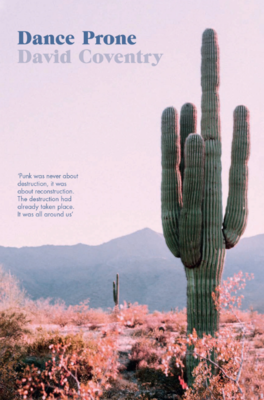 | Dance Prone by David Coventry {Reviewed by STELLA} Remember those gigs when your body was a sledgehammer slamming itself any which way and your aural senses were overwhelmed in the best hedonistic way, where the dance floor was small and cramped, where sometimes you ducked a fist and danced on. The opening lines of David Coventry’s new novel, Dance Prone, gives us the viewpoint of Con, the lead singer of a post-punk band in mid-80s America, watching the chaos unfold. Con is up for it, pushing to the edge of control, looking for perfection in chaos with his band, Neues Bauen. Yet like Coventry's first novel, The Invisible Mile, the setting isn’t exactly the theme. His brilliant debut took out the best first book at the Ockham New Zealand Book Awards in 2016, picked up for international publication and translated into numerous languages. Dance Prone looks set for a similar trajectory if the writing is anything to go by. This is the best New Zealand book I have read in a long time, and one of the most affecting novels about trauma, memory and its fallout, where language, pace and tension are expertly pitched and the chaotic music scene notches the decibels up to a level to absorb you in this world. Though it’s not all high intensity. The reflective passages, descriptions of people and place keep us anchored, and the dark humour keeps us amused, even when the psychological aspects of Con’s story threaten to flood our senses. We meet Con over several distinct periods in his life (between the 80s when he is a young man and 2020 when he is in his early 50s) as he intersects with his past band-mates and re-engages, or attempts to re-engage, with pivotal incidents. Not far in, we are beset by a shocking incident. It is wholly unexpected to the reader as it is to Con. Suddenly violence is very near and very real. This incident sets off a trigger of actions and inactions from Con and a crazy reaction from Tone, his kiwi bandmate. As Tone recovers in the hospital and the band tours the dives and front lounges of fans, Con finds himself split in two — before and after — and bereft of explanation and knowledge. Here we start to dig into the themes of denial and memory, or the erasure of fact. In the desert, appropriately, at an indie music gig complete with existential philosophy, this all comes to a head. As the story moves back and forth in time, the action and telling unfold alongside Con’s awareness. As he hides from the truth, the truth is hidden from the reader. What happens in Phoenix is only revealed by a scratchy video of the band’s last gig seen by Con in Marrakech in 2019, where he is searching for Tone, now living in the remote mountains with a group of artist-activists. Add to this a sweet romance, some great riffs on bands, the indie scene and philosophical rants, seemingly senseless behaviour and cravings for artistic perfection, and you have a deft and nuanced novel. And Coventry can write. Each sentence places you where you want to be, each conversation adds another dimension and the plot unfolds with a tension that keeps the bowstring taut and rewards with the aim of the arrow. Intelligent, intimate and raw, Dance Prone is stunning. |

>>"
>>To get you in the mood: The Gordons, Scorched Earth Policy, Dead C, Hüsker Dü, Einstürzende Neubauten.
NEW RELEASES
 Sprigs by Brannavan Gnanalingam $35
It is Saturday afternoon and two boys’ schools are locked in battle for college rugby supremacy. Priya — a fifteen year old who barely belongs — watches from the sidelines. Then it is Saturday night and the team is partying, Priya's friends have evaporated and she isn't sure what to do. Gnanalingam's new novel addresses New Zealand's culture of masculinity, racism and sexual predation, and the ways in which institutions seem often to have priorities than acknowledging victims' needs.
>>"There are ways of being male without it coming at the expense of other people."
>>"How do brown bodies move in white spaces in New Zealand?"
>>Sodden Downstream was short-listed for the 2018 Acorn Price for Fiction.
 A Traveller at the Gates of Wisdom by John Boyne $37
Some stories are universal. Some are unique. They play out across human history. This story starts with a family. For now, it is a father and a mother with two sons. One with his father's violence in his blood. One with his mother's artistry. One leaves. One stays. They will be joined by others whose deeds will determine their fate. It is a beginning. Their stories will intertwine and evolve over the course of two thousand years. They will meet again and again at different times and in different places. From Palestine at the dawn of the first millennium and journeying across fifty countries to a life among the stars in the third, the world will change around them, but their destinies remain the same. Can this pattern be escaped? An astounding new novel from the author of The Heart's Invisible Furies, A History of Loneliness and A Ladder to the Sky.
"John Boyne brings a completely fresh eye to the most important stories. He is one of the greatest craftsmen in contemporary literature." —Colum McCann
 Rat King Landlord by Murdoch Stephens $25
Colossal rats invade from the Wellington town belt. Your rent is going up but everyone is calling it a summer of love. Cryptic posters appear around town inciting people to join an evening of mayhem. Until now the rats have contented themselves with scraps. But as summer heats up and the cost of living skyrockets, we can no longer ignore that our friends are seeking their own rung on the property ladder.
>>"The real challenge for a community is how to self-rule beyond the easy villains."
It is Saturday afternoon and two boys’ schools are locked in battle for college rugby supremacy. Priya — a fifteen year old who barely belongs — watches from the sidelines. Then it is Saturday night and the team is partying, Priya's friends have evaporated and she isn't sure what to do. Gnanalingam's new novel addresses New Zealand's culture of masculinity, racism and sexual predation, and the ways in which institutions seem often to have priorities than acknowledging victims' needs.
>>"There are ways of being male without it coming at the expense of other people."
>>"How do brown bodies move in white spaces in New Zealand?"
>>Sodden Downstream was short-listed for the 2018 Acorn Price for Fiction.
Some stories are universal. Some are unique. They play out across human history. This story starts with a family. For now, it is a father and a mother with two sons. One with his father's violence in his blood. One with his mother's artistry. One leaves. One stays. They will be joined by others whose deeds will determine their fate. It is a beginning. Their stories will intertwine and evolve over the course of two thousand years. They will meet again and again at different times and in different places. From Palestine at the dawn of the first millennium and journeying across fifty countries to a life among the stars in the third, the world will change around them, but their destinies remain the same. Can this pattern be escaped? An astounding new novel from the author of The Heart's Invisible Furies, A History of Loneliness and A Ladder to the Sky.
"John Boyne brings a completely fresh eye to the most important stories. He is one of the greatest craftsmen in contemporary literature." —Colum McCann
Colossal rats invade from the Wellington town belt. Your rent is going up but everyone is calling it a summer of love. Cryptic posters appear around town inciting people to join an evening of mayhem. Until now the rats have contented themselves with scraps. But as summer heats up and the cost of living skyrockets, we can no longer ignore that our friends are seeking their own rung on the property ladder.
>>"The real challenge for a community is how to self-rule beyond the easy villains."

Annie Ernaux revisits the night fifty years earlier when she found herself overpowered by another's will and desire. In the summer of 1958, eighteen-year-old Ernaux submits her will to a man's, and then he moves on, leaving her bereft. Now, fifty years later, she realizes she can obliterate the intervening years and return to consider this young woman that she wanted to forget completely. And to discover that here, submerged in shame, humiliation, and betrayal, is the vital origin of her writing life, her writer's identity.
>>Read Thomas's review of The Years.
 Llew Summers: Body and soul by John Newton $65
 Theft by Luke Brown $40
 Fracture by Andrés Neuman $33
 Summer Kitchens: Recipes and reminiscences from every corner of Ukraine by Olia Hercules $53
 Stranger than Kindness by Nick Cave $70
A journey in images and words into the creative world of musician, storyteller and cultural icon Nick Cave. This highly collectible book contains images selected by Cave from 'Stranger Than Kindness: The Nick Cave Exhibition', presented by the Royal Danish Library in partnership with Arts Centre Melbourne. Featuring full-colour reproductions of original artwork, handwritten lyrics, photographs and collected personal artefacts, it presents Cave's life, work and inspiration and explores his many real and imagined universes, with texts from Cave and Darcey Steinke on themes that are central to Cave's work.
>>A trailer for the exhibition.
>>The song, live, 1987.
 Te Papa to Berlin: The making of two museums by Ken Gorbey $40
 Island Dreams: Mapping an obsession by Gavin Francis $45
Blending stories of his own travels with psychology, philosophy and great voyages from literature, Francis sheds new light on the importance of islands and isolation in our collective consciousness. Environment by Rolf Halden $22
 A Room Made of Leaves by Kate Grenville $48
 The Education of an Idealist by Samantha Power $37
 Abigail and the Restless Raindrop by Matthew Cunningham and Sarah Wilkins $20
 Crossing the Lines: The story of three homosexual New Zealand soldiers in World War 2 by Brent Coutts $50
 Pluses and Minuses: How maths solves our problems by Stefan Buijsman $37
Thousands of years ago, the inhabitants of Mesopotamia became the first humans to make complex calculations numbers. Since then, mathematics has become an unstoppable force. It's behind almost everything, from search engines to cruise control, from coffee-makers to timetables. But now that we hardly ever need to do arithmetic, how relevant is mathematics to everyday life?
[Can the case that could be made for 'plusses' over 'pluses' be so easily made for 'busses' over 'buses'?]
 Rootbound: Rewilding a life by Alice Vincent $33
A beautifully presented and illustrated record of the work and life of one of New Zealand's most recognisable sculptors, a man of warmth and vitality, whose works are daring, sensual and provocative.
What I did to them was terrible, but you have to understand the context. This was London, 2016. Paul has awoken to the fact that he will always be better known for reviewing haircuts than for his literary journalism. He is about to be kicked out of his cheap flat in east London and his sister has gone missing after an argument about what to do with the house where they grew up, after their mother's death. When Paul is granted a rare interview with Emily Nardini, a cult author, and is then received into her surprisingly grand home, everything begins to skid. A satire of the intersection of personal and political crises under the cloud of Brexit.
"A wry and stylish look at male privilege." —Financial Times
"Is this the most loathsome hipster in modern fiction?" —Telegraph
In 2011, Mr Watanabe, a Japanese electronics executive, is in Tokyo when the earthquake that precedes the Fukushima nuclear disaster strikes. In the aftermath, he fins himself on a journey to Fukushima, a tourist of the current day tragedy that mimics his own experiences of World War II. For Mr Watanabe is one of the few double hibakusha, a survivor of the atomic bombs dropped in Hiroshima and Nagasaki in 1945. The earthquake shifts his and others memories of those events. Meanwhile, four women based in Paris, New York, Buenos Aires, and Madrid tell their own stories of knowing and loving Mr Watanabe, a victim of one of the largest collective traumas of the last century. Fracture encompasses some of the most urgent political, social and environmental questions of contemporary life, about collective trauma, memory and love.
 Pencils You Should Know: A history of the ultimate writing utensil in 75 anecdotes by Caroline Weaver $35
Interesting, quirky and well-illustrated. Recommended for anyone who gets excited about the new Palomino Blackwing or a perfectly sharpened No. 2 Ticonderoga.
>>Also recommended: The Secret Life of the Pencil.
Interesting, quirky and well-illustrated. Recommended for anyone who gets excited about the new Palomino Blackwing or a perfectly sharpened No. 2 Ticonderoga.
>>Also recommended: The Secret Life of the Pencil.
Olia Hercules owes some of her earliest and fondest memories to the 'summer kitchens' of her parents, grandparents, neighbours and friends in Ukraine. These small buildings are separate from the main house, and always positioned near a fruit plot or veg patch so families can enjoy the home-grown produce as it ripens, and preserve the surplus in preparation for winter. The number of summer kitchens is dwindling these days, but there is still so much we can learn about making the most of the vibrant summer produce throughout the rest of the year.
"A complete revelation." —Nigella Lawson
Bulletproof Vest by Kenneth Rosen $22
The New York Times journalist Kenneth R. Rosen had just purchased his first bulletproof vest and was headed off on assignment. He was travelling into Mosul, Iraq, when he realized that the idea of a bulletproof vest is more effective than the vest itself. From its very inception, poly-paraphenylene terephthalamide, or Kevlar, was meant for tires. Its humble roots and mundane applications are often lost, as it is now synonymous with body armor, war zones, and domestic terrorism. What Rosen learned through intimate use of his vest was that it acts as a metaphor for all the precautions we take toward digital, physical, and social security. Bulletproof Vest is at once an introspective journey into the properties and precisions of a bulletproof vest on a molecular level and on the world stage. It's also an ode to living precariously, an open letter that defends the notion that life is worth the risk.
A journey in images and words into the creative world of musician, storyteller and cultural icon Nick Cave. This highly collectible book contains images selected by Cave from 'Stranger Than Kindness: The Nick Cave Exhibition', presented by the Royal Danish Library in partnership with Arts Centre Melbourne. Featuring full-colour reproductions of original artwork, handwritten lyrics, photographs and collected personal artefacts, it presents Cave's life, work and inspiration and explores his many real and imagined universes, with texts from Cave and Darcey Steinke on themes that are central to Cave's work.
>>A trailer for the exhibition.
>>The song, live, 1987.
After working on the development and realisation of Te Papa, Gorbey was recruited to salvage the Jewish Museum Berlin.
Blending stories of his own travels with psychology, philosophy and great voyages from literature, Francis sheds new light on the importance of islands and isolation in our collective consciousness.
What do we mean by environment? It affects everything we do and the way we think; we are part of it and yet we are uncertain how to think of it.
What if Elizabeth Macarthur—wife of the notorious John Macarthur, wool baron in the earliest days of Sydney—had written a shockingly frank secret memoir? And what if novelist Kate Grenville had miraculously found and published it? Grenville's first novel in a decade.
A relentless advocate for promoting human rights, Power has been heralded by President Barack Obama as one of America's "foremost thinkers on foreign policy." The Education of an Idealist traces Power's extraordinary journey, from Irish immigrant to human rights activist to war-zone correspondent to United States Ambassador to the United Nations.
>>Samantha Power talks with Paula Morris.
 Advice to Young Musicians by Robert Schuman and Steven Isserlis $25
Steven Isserlis revisits Schuman's perennial text and adds commentary of his own.
>>Isserlis plays the Schuman 'Cello Concerto Op.129.
Steven Isserlis revisits Schuman's perennial text and adds commentary of his own.
>>Isserlis plays the Schuman 'Cello Concerto Op.129.
Abigail is a little girl with big questions. Find out about the water cycle with her in this beautifully illustrated New Zealand book.

What is goodness? Is goodness achievable, and if so, how? If being a good person is a matter of doing the right thing, then what is the right thing to do? Is it acting rationally, promoting happiness, exercising moderation in all things or respecting the freedom of others, or is it somehow a concoction of all these abilities, wisely adjusted to suit circumstances?
A previously untold history of New Zealand homosexual soldiers in World War II, drawing on the experiences of ordinary men who lived through extraordinary times. At the centre of the story are New Zealand soldiers Harold Robinson, Ralph Dyer and Douglas Morison, who shared a queer identity and love of performance. Through their roles as female impersonators in Kiwi concert parties in the Pacific and Egypt they found a place to live as gay men within the military forces.
Thousands of years ago, the inhabitants of Mesopotamia became the first humans to make complex calculations numbers. Since then, mathematics has become an unstoppable force. It's behind almost everything, from search engines to cruise control, from coffee-makers to timetables. But now that we hardly ever need to do arithmetic, how relevant is mathematics to everyday life?
[Can the case that could be made for 'plusses' over 'pluses' be so easily made for 'busses' over 'buses'?]
"A book about heartbreak, salvation, nature and balcony gardens. Alice Vincent mixes memoir with botanical history to explore how plants can heal us." —Huffington Post
"Rootbound is a poignant testimony to the joy that greenery will bring to your life, and it is a magical reminder that humans, like plants, can mend and grow in their own good time." —Independent

| >> Read all Stella's reviews. | |
 | Hamnet by Maggie O'Farrell {Reviewed by STELLA} This evocative, heart-breaking and revealing story of grief lays bare the genesis of Shakespeare’s most famous play, Hamlet. Yet in Maggie O’Farrell’s novel, Hamnet, Shakespeare as we know him hardly has a role. Set almost exclusively in the village of Stratford-upon-Avon and centred around the domestic life of his wife and family, Will is referred to as the Latin tutor, the glover’s son, the father, the husband. and is often working away — letters arriving at intervals. Who do we meet on the first pages, but the son — desperately searching for an adult to help him. His sister is unwell and the plague is present. From here, as time and the shadow of death make their presence known, we circle back increment by increment into the world of this child and his sister, of the mother, of the extended family and the village. We circle further back to the young Latin tutor gazing out the window, bored by the tedium of his job with boys who will never become any great things, and spying a youth (at first he mistakes his future wife for a lad) with a bird (later we meet this kestrel) upon her arm; and circle back again to the reasons why he is entrenched in this wearisome role — his violent and domineering father. Agnes is central and crucial in this novel. O’Farrell takes what little knowledge of Shakespeare's wife and brings her to the reader as a full and fascinating woman in her own right. She reels from the pages with her supposed eccentricities — she is a gifted healer, a lover of plants and the wilderness (seen by some in the community as a wild thing — a woman shunned by some but needed by others) — and her independent life. Emotional and emotive, sly and quiet, when death visits at her door, her grief is unbounded. Life has been snatched from her in a startling and, to her, an uncomprehending way. Agnes and Hamnet hold you in the grooves of this novel, make you want more, and they will stay with you long after the covers are closed. You reside within Hamnet’s mind as he navigates his twin sister’s illness, as he tries to find sense in the madness of the fever and the adult world that stands just outside his grip. You walk alongside Agnes as she loses herself in nature’s wildness to emerge into a world that can only tear at her, yet is necessary for survival and the memories that bind her child to her. Each character offers up a story — a way of seeing this world and telling its tale — a tragedy wrapped in intrigue on a small stage with rippling emotions. Hamnet is historical fiction at its best — in the vain of Hilary Mantel’s Thomas Cromwell series — it sets you fair and square in this time with all its life, death and drama. Immersive, compelling and rich in language and tale. |
| >> Read all Thomas's reviews. | |
 | Jakob von Gunten by Robert Walser {Reviewed by THOMAS}
“What is the use of thoughts and ideas if one feels, as I do, that one doesn’t know what to do with them?” says Jakob. He abandons his family, we learn nothing of his family, and enrols himself in the Benjamenta Institute, ostensibly a school for servants, seemingly a school, in the loftier sense of the word, for the nullification of one’s individuality, all the better to conform, all the better to meet the demands of the world upon a person. “As an old man I shall have to serve young and confident and badly educated ruffians, or I shall be a beggar, or I shall perish,” says Jakob, realistically. There are no other options. The relinquishment of the self, so to call it, learned at the Benjamenta Institute is not a path to enlightenment but to its opposite, a path to unknowing, an abnegation, a resignation, an obliteration, a relief from the burden of internal life. Not so different from enlightenment, so to call it, perhaps. To obey, to conform, to suppress thought, to extinguish that part of yourself that resists boredom, the part that smarts from the indignity of existence, from mundanity, how better to fit in, to blend in, just as is expected of us? “What we pupils do, we do because we have to, but why we have to, nobody quite knows. We obey without considering what one day will come of all of this thoughtless obedience, and we work without thinking if it is right and good to do our work,” says Jakob, ominously. “We don’t rebel. It would never cross our minds. We have, collectively, so few thoughts. I have perhaps the most thoughts, that’s quite possible, but at root I despise my capacity for thinking.” What cannot be opposed must be allowed to extinguish us if it is not to cause us anguish. “One must learn to love and cherish necessity,” says Jakob. “Here at the Benjamenta Institute one learns to suffer and endure losses, and that is in my view a craft. We pupils have no hopes, it is even forbidden to us to nourish hopes for life in our hearts, and yet we are completely calm and happy.” This achievement is a non-achievement, an unenlightening. “I have become a quite different person, I have become an ordinary person,” says Jakob, “and I have the Benjamentas to thank for my becoming ordinary.” By conforming to expectations without the slightest resistance, Jakob displaces exactly his own volume in these expectations. His obedience is the ultimate disobedience, his submission is the ultimate escape. To oppose the forces of conformity would be to acknowledge those forces more generously than to submit to them, for one can sarcastically conform where one cannot sarcastically oppose. “It suits me to disappear, as inconspicuously as possible,” said Walser, somewhere else. Not only to disappear but to do so inconspicuously. (>>You can read something I wrote on Walser here.) “We are small, small all the way down the scale to utter worthlessness,” says Jakob. All actions in Walser’s books are without consequence, all details are immediately forgotten, time moves on with the sole result that the moments are left behind, relinquished, obliterated. If existence is anguish, this is the best possible result, this snagless moving-forward of time is almost cheerful. Walser seems capable of expressing anguish only in a cheerful way. He has no other vocabulary. He has inexhaustible anguish. He writes to suppress his anguish. Cheerfully. Walser’s characters are all surplus to the requirements of meaningful occurrence, so to call it, if there could even be such a thing as meaningful occurrence, and they are relieved of the conundrum of whether there could be such a thing as meaningful occurrence by being excluded in any case from meaningful occurrence if there was such a thing. Politeness relieves them of their lack of purpose. Politeness is a way of not existing, or, perhaps, a way of existing in your own absence. Jakob is the sworn enemy of his own individuality. He has no effect on the world and he is not affected by it. He is without reciprocation. His nullity is a blank mirror upon which Fraulein Benjamenta destroys herself by looking to him for love, a blank mirror for which Herr Benjamenta ultimately closes his school, declares his love for Jakob the perfectly unreachable pupil, attempts to strangle him, engages him to accompany him. “The individual in me is only a zero,” says Jakob. “But now I’ll throw away my pen! Away with the life of thought! I’m going with Herr Benjamenta into the desert.”
|
NEW RELEASES
 Recollections of My Non-Existence by Rebecca Solnit $40
How does a young writer find her voice in a society that would prefer women to be silent? Solnit's memoir is an electric account of the pauses and gains of feminism in the past forty years.
"There's a new feminist revolution — open to people of all genders — and Rebecca Solnit is one of its most powerful voices." —Barbara Ehrenreich
 Little Eyes by Samanta Schweblin $33
If an individual could be virtually inserted into the life of a random stranger, anywhere in the world, what effects would that have on them both? The characters in Schweblin's nove reveal the beauty of technological connection between far-flung persons — but they also expose the ugly truth of our increasingly linked world. Trusting strangers can lead to love, playful encounters and adventures, but what if it can also pave the way for unimaginable terror?
"Schweblin unveils the hidden horror of our own imaginations and our private spaces deftly and chillingly. Little Eyes is a brilliant, anxiety-provoking novel in a time where our anxiety, personally and societally, is at an all-time high. It is perhaps the novel we both need and deserve, and though it may take courage to pick it up, it is important we do so." —Tor
“Her most unsettling work yet — and her most realistic.” —New York Times
>>Read Thomas's review of Fever Dream.
 The Animals in that Country by Laura Jean McKay $37
Hard-drinking, foul-mouthed Jean is not good at getting on with other humans, apart from her beloved granddaughter, Kimberly. Instead, she surrounds herself with animals, working as a guide in a wildlife park. As disturbing news arrives of a pandemic sweeping the country, Jean realises this is no ordinary flu — its chief symptom is that its victims begin to understand the language of animals — first mammals, then birds and insects, too.
 Sex and Lies by Leïla Slimani $30
Slimani gives voice to young Moroccan women who are grappling with a conservative culture that at once condemns and commodifies sex. In a country where the law punishes and outlaws all forms of sex outside marriage, as well as homosexuality and prostitution, women have only two approved options for their sexual identities: virgin or wife.
 Aegean: Recipes from the mountains to the sea by Marianna Leivaditaki $50
Growing up in a taverna in Chania, the relaxed, delicious and achievable food of Crete and the wider Mediterranean is second nature to Leivaditaki. Very well presented.
>>The journal of a fisherman's daughter.
 Mazel Tov by J.S. Margot $30
Unemployed 20-year-old Margot takes up a tutoring job with the Schneiders, an Orthodox Jewish family. Indignant about the insularity and conservatism of their religious life, she dismisses her employers as socially backward, out of step with the modern world. With the Gulf War and the Intifada looming in the background, Margot finds herself caught between clashing cultures: her relationship with her Iranian boyfriend Nima is met with prejudice, while the Schneiders' devotion to Israel provokes similar discontent in him. Through impassioned debates over religion, belonging and cultural heritage, Margot and the Schneider family begin to move past conflict and towards mutual understanding and appreciation.
 Designing Disorder: Experiments and disruptions in the city by Richard Sennett and Pablo Sendera $35
In 1970 Richard Sennett published the ground-breaking The Uses of Disorder, that the ideal of a planned and ordered city was flawed, likely to produce a fragile, restrictive urban environment. Fifty years later, Sennett returns to these still fertile ideas and alongside campaigner and architect, Pablo Sendra, sets out an agenda for the design and ethics of the Open City. The public spaces of our cities are under siege from planners, privatisation and increased surveillance. Our streets are becoming ever more lifeless and ordered. What is to be done? Can disorder be designed? Is it possible to maintain the public realm as a flexible space that adapts over time? In this provocative essay Sendra and Sennett propose a reorganisation of how we think and plan the social life of our cities. What the authors call 'Infrastructures of disorder' combine architecture, politics, urban planning and activism in order to develop places that nurture rather than stifle, bring together rather than divide up, remain open to change rather than closed off. The book proves that ideas of disorder are still some of the most radical and transformative in debates on 21st century cities.
 Orwell: A man of our time by Richard Bradford $43
Despite the commonplace view that Animal Farm was aimed exclusively at Stalinist Russia, it was far more broadly focused and the similarities between aspects of the novel and Trump's America are obvious. Not only the parallels with the current President, but also by those who feel that his cult of personality is a mandate for collective nastiness. "Doublethink" features in Nineteen Eighty Four and it is the forerunner to "Fake News."
 Thinking Again by Jan Morris $37
In this second volume of her diaries, following In My Mind's Eye, Morris casts her eye over modern life in all its stupidity and glory. From her daily thousand paces to the ongoing troubles of Brexit, from her enduring love for America to the wonders of the natural world, and from the vagaries and ailments of old age to the beauty of youth, she displays her determined belief in embracing life and creativity.
 Instructions for a Funeral by David Means $23
Means writes with compassionate precision about fatherhood, marriage, a homeless brother, the nature of addiction, and the death of a friend at the hands of a serial killer nurse. He transmutes a fistfight in Sacramento into a tender, life-long love story; two FBI agents on a stakeout in the 1920s into a tale of predator and prey; a man's funeral instructions into a chronicle of organized crime, real estate ventures, and the destructive force of paranoia.
"One of the most talented writers of short fiction in America." —James Wood, New Yorker
 The Eighth: Mahler and the world in 1910 by Stephen Johnson $40
The world premiere of Gustav Mahler's Eighth Symphony in Munich in 1910 was the artistic breakthrough for which the composer had yearned all his adult life, filling Munich's huge Neue Musik-Festhalle on two successive evenings, to tumultuous applause. Stephen Johnson recounts its far-reaching effect on composers, conductors and writers of the time — Berg and Schoenberg, Korngold, Bruno Walter and Klemperer, and the writers Zweig and Mann
 The Disaster Tourist by Yun Ko-eun $33
Yona has been stuck behind a desk for years working as a programming coordinator for Jungle, a travel company specialising in package holidays to destinations ravaged by disaster. When a senior colleague touches her inappropriately she tries to complain, and in an attempt to bury her allegations, the company make her an attractive proposition: a free ticket for one of their most sought-after trips, to the desert island of Mui. She accepts the offer and travels the remote island, where the major attraction is a supposedly dramatic sinkhole. When the customers who've paid a premium for the trip begin to get frustrated, Yona realises that the company has dangerous plans to fabricate an environmental catastrophe to make the trip more interesting, but when she tries to raise the alarm, she discovers she has put her own life in danger.
 Home Stories: 100 years, 20 visionary interiors by Jasper Morrison, Mateo Kries and Jochen Eisenbrand $155
Our homes are an expression of how we want to live; they shape our everyday routines and fundamentally affect our well-being. Interior design for the home sustains a giant global industry and feeds an entire branch of the media. However, the question of dwelling, or how to live, is found increasingly to be lacking in serious discourse. This book sets out to review the interior design of our homes. It discusses 20 iconic residential interiors from the present back to the 1920s, by architects, artists and designers such as Assemble, Cecil Beaton, Lina Bo Bardi, Arno Brandlhuber, Elsie de Wolfe, Elii, Josef Frank, Andrew Geller, IKEA, Finn Juhl, Michael Graves, Kisho Kurokawa, Adolf Loos, Claude Parent, Bernard Rudofsky, Margarete Sch tte-Lihotzky, Alison and Peter Smithson, Jacques Tati, Mies van der Rohe and Andy Warhol. Including historic and recent photographs, drawings and plans, the book explores these case studies as key moments in the history of the modern interior.
 Coffee by Danny Lenney $22
Coffee—it's the thing that gets us through, and over, and around. The thing—the beverage, the break, the ritual—we choose to slow ourselves down or speed ourselves up. The excuse to pause; the reason to meet; the charge we who drink it allow ourselves in lieu of something stronger or scarier. Coffee goes to lifestyle, and character, and sensibility—where do we buy it, how do we brew it, how strong can we take it, how often, how hot, how cold? How does coffee remind us, stir us, comfort us?
How does a young writer find her voice in a society that would prefer women to be silent? Solnit's memoir is an electric account of the pauses and gains of feminism in the past forty years.
"There's a new feminist revolution — open to people of all genders — and Rebecca Solnit is one of its most powerful voices." —Barbara Ehrenreich
If an individual could be virtually inserted into the life of a random stranger, anywhere in the world, what effects would that have on them both? The characters in Schweblin's nove reveal the beauty of technological connection between far-flung persons — but they also expose the ugly truth of our increasingly linked world. Trusting strangers can lead to love, playful encounters and adventures, but what if it can also pave the way for unimaginable terror?
"Schweblin unveils the hidden horror of our own imaginations and our private spaces deftly and chillingly. Little Eyes is a brilliant, anxiety-provoking novel in a time where our anxiety, personally and societally, is at an all-time high. It is perhaps the novel we both need and deserve, and though it may take courage to pick it up, it is important we do so." —Tor
“Her most unsettling work yet — and her most realistic.” —New York Times
>>Read Thomas's review of Fever Dream.
Hard-drinking, foul-mouthed Jean is not good at getting on with other humans, apart from her beloved granddaughter, Kimberly. Instead, she surrounds herself with animals, working as a guide in a wildlife park. As disturbing news arrives of a pandemic sweeping the country, Jean realises this is no ordinary flu — its chief symptom is that its victims begin to understand the language of animals — first mammals, then birds and insects, too.
Slimani gives voice to young Moroccan women who are grappling with a conservative culture that at once condemns and commodifies sex. In a country where the law punishes and outlaws all forms of sex outside marriage, as well as homosexuality and prostitution, women have only two approved options for their sexual identities: virgin or wife.
Growing up in a taverna in Chania, the relaxed, delicious and achievable food of Crete and the wider Mediterranean is second nature to Leivaditaki. Very well presented.
>>The journal of a fisherman's daughter.
Unemployed 20-year-old Margot takes up a tutoring job with the Schneiders, an Orthodox Jewish family. Indignant about the insularity and conservatism of their religious life, she dismisses her employers as socially backward, out of step with the modern world. With the Gulf War and the Intifada looming in the background, Margot finds herself caught between clashing cultures: her relationship with her Iranian boyfriend Nima is met with prejudice, while the Schneiders' devotion to Israel provokes similar discontent in him. Through impassioned debates over religion, belonging and cultural heritage, Margot and the Schneider family begin to move past conflict and towards mutual understanding and appreciation.
In 1970 Richard Sennett published the ground-breaking The Uses of Disorder, that the ideal of a planned and ordered city was flawed, likely to produce a fragile, restrictive urban environment. Fifty years later, Sennett returns to these still fertile ideas and alongside campaigner and architect, Pablo Sendra, sets out an agenda for the design and ethics of the Open City. The public spaces of our cities are under siege from planners, privatisation and increased surveillance. Our streets are becoming ever more lifeless and ordered. What is to be done? Can disorder be designed? Is it possible to maintain the public realm as a flexible space that adapts over time? In this provocative essay Sendra and Sennett propose a reorganisation of how we think and plan the social life of our cities. What the authors call 'Infrastructures of disorder' combine architecture, politics, urban planning and activism in order to develop places that nurture rather than stifle, bring together rather than divide up, remain open to change rather than closed off. The book proves that ideas of disorder are still some of the most radical and transformative in debates on 21st century cities.
Despite the commonplace view that Animal Farm was aimed exclusively at Stalinist Russia, it was far more broadly focused and the similarities between aspects of the novel and Trump's America are obvious. Not only the parallels with the current President, but also by those who feel that his cult of personality is a mandate for collective nastiness. "Doublethink" features in Nineteen Eighty Four and it is the forerunner to "Fake News."
In this second volume of her diaries, following In My Mind's Eye, Morris casts her eye over modern life in all its stupidity and glory. From her daily thousand paces to the ongoing troubles of Brexit, from her enduring love for America to the wonders of the natural world, and from the vagaries and ailments of old age to the beauty of youth, she displays her determined belief in embracing life and creativity.
Means writes with compassionate precision about fatherhood, marriage, a homeless brother, the nature of addiction, and the death of a friend at the hands of a serial killer nurse. He transmutes a fistfight in Sacramento into a tender, life-long love story; two FBI agents on a stakeout in the 1920s into a tale of predator and prey; a man's funeral instructions into a chronicle of organized crime, real estate ventures, and the destructive force of paranoia.
"One of the most talented writers of short fiction in America." —James Wood, New Yorker
The world premiere of Gustav Mahler's Eighth Symphony in Munich in 1910 was the artistic breakthrough for which the composer had yearned all his adult life, filling Munich's huge Neue Musik-Festhalle on two successive evenings, to tumultuous applause. Stephen Johnson recounts its far-reaching effect on composers, conductors and writers of the time — Berg and Schoenberg, Korngold, Bruno Walter and Klemperer, and the writers Zweig and Mann
Yona has been stuck behind a desk for years working as a programming coordinator for Jungle, a travel company specialising in package holidays to destinations ravaged by disaster. When a senior colleague touches her inappropriately she tries to complain, and in an attempt to bury her allegations, the company make her an attractive proposition: a free ticket for one of their most sought-after trips, to the desert island of Mui. She accepts the offer and travels the remote island, where the major attraction is a supposedly dramatic sinkhole. When the customers who've paid a premium for the trip begin to get frustrated, Yona realises that the company has dangerous plans to fabricate an environmental catastrophe to make the trip more interesting, but when she tries to raise the alarm, she discovers she has put her own life in danger.
Our homes are an expression of how we want to live; they shape our everyday routines and fundamentally affect our well-being. Interior design for the home sustains a giant global industry and feeds an entire branch of the media. However, the question of dwelling, or how to live, is found increasingly to be lacking in serious discourse. This book sets out to review the interior design of our homes. It discusses 20 iconic residential interiors from the present back to the 1920s, by architects, artists and designers such as Assemble, Cecil Beaton, Lina Bo Bardi, Arno Brandlhuber, Elsie de Wolfe, Elii, Josef Frank, Andrew Geller, IKEA, Finn Juhl, Michael Graves, Kisho Kurokawa, Adolf Loos, Claude Parent, Bernard Rudofsky, Margarete Sch tte-Lihotzky, Alison and Peter Smithson, Jacques Tati, Mies van der Rohe and Andy Warhol. Including historic and recent photographs, drawings and plans, the book explores these case studies as key moments in the history of the modern interior.
Coffee—it's the thing that gets us through, and over, and around. The thing—the beverage, the break, the ritual—we choose to slow ourselves down or speed ourselves up. The excuse to pause; the reason to meet; the charge we who drink it allow ourselves in lieu of something stronger or scarier. Coffee goes to lifestyle, and character, and sensibility—where do we buy it, how do we brew it, how strong can we take it, how often, how hot, how cold? How does coffee remind us, stir us, comfort us?

>>Read an extract.
>>Auckland, 2015.
>>Fact, fiction and the familiar.
>>EStJM in conversation.
>>Unbridled.
>>Read the book!
>>Her previous novel, Station Eleven, sets Shakespeare after an apocalypse.


When her father leaves to save people from a giant who turns them to stone with his gaze, a child in a red dress is left alone. Many days and many nights go by. Every evening the girl says good night to herself in her mirror. When the last light burns down, the girl takes her mirror and a knife and sets out to find her father. "I will save my father from the giant," she says. A beautifully illustrated version of a Swedish fairy tale.
>>Read Stella's review.
>>The story is based on Elsa Beskow's Tripp Trapp Trull och Jätten Dum-dum.
>>Some artwork by Anna Hoglund.
>>Some artwork by Anna Hoglund.
>>Månansiktet (an animated film).
>>Prominaden (an animated film).
>>Buy The Stone Giant — we can send it anywhere.
| >> Read all Stella's reviews. | |
 | The Stone Giant by Anna Höglund {Reviewed by STELLA}
Another new favourite from the Gecko Press stables, The Stone Giant is both beautiful and taut. It is fairy-tale telling reminiscent of Grimms', but not too scary for little ones. Anna Höglund, inspired by the Swedish author Elsa Beskow’s Tripp, Trapp, Trull, brings us a tale of bravery, audacity and cleverness. A child lives with her father on an island. When her father, who just happens to be a knight, has to leave her to fight a giant who is turning everyone to stone, she waits for his return. After everything is mended and tidied, she watches out the window for his return by day and lights a candle at the window by night to guide him home over the dark seas. She says goodnight to herself as she gazes into her hand mirror. As the days and nights go by, she starts to think about the stone giant, how the gaze of a giant might turn you to stone and wonders whether her father will ever return. She realises that she must venture out to find him. The sea is dark and cold, but luckily this girl can swim — she can swim a long way. When she reaches land again, the sun shines down and dries her, and ahead of her is a shining path. A path that leads her into the forest. She walks and walks. The sun sets and through the trees, she spies a cottage. An old woman invites her in, feeds her, gives her a bed for the night and sends her on her way with a useful item — an umbrella. She continues her quest until she reaches a barren and dismal land and here she meets the monster. Quickly the umbrella opens and covers the girl. The monster is curious — who is hiding under the umbrella? What will the girl do? Clever and quick thinking makes the child the hero of this story. And yes, there is a happy ending! Anna Höglund’s text is sparse and direct, creating a harmonic synergy with the illustrations which are delicate and subtle in their detail. The quiet and contemplation in the first part of the book moves towards anticipation and endeavour as we venture with the girl in search of her father and the giant (who just happens to be a giant stone woman). Höglund’s illustrations are made by copper plate etchings and watercolour. They are expressive and have layers of depth, with her use of black and small petals of colour, not often seen in children’s books. Add to this the charm of the book’s design with its swirly green and red endpapers and a shiny hand mirror on the back cover and you will be charmed too with the brave young girl stepping out into the world to rescue her father in her red dress complete with pocket (useful for those everyday items that may defeat a giant).
|
| >> Read all Thomas's reviews. | |
 | Sleepless Nights by Elizabeth Hardwick {Reviewed by THOMAS} “Fact is to me a hindrance to memory,” writes the narrator in this remarkable collage of passages evoking the ways in which past experiences have impressed themselves indelibly upon her. The sleepless nights of the title are not so much those of the narrator’s youth, though these are either well documented or implied and so the title is not not about them, but those of her present life, supposedly as “a broken old woman in a squalid nursing home”, waking in the night “to address myself to B. and D. and C.—those whom I dare not ring up until morning and yet must talk to through the night.” As if the narrator is a projection of the author herself, cast forward upon some distorting screen, the ten parts of the book make no distinction between verifiable biographical facts and the efflorescence of stories that arise in the author’s mind as supplementary to those facts, or in substitution for them. Elizabeth the narrator seems almost aware of the precarity of her role, and of her identity as distinct from but overlapping that of the author: “I will do this work of transformed and even distorted memory and lead this life, the one I am leading today.” Hardwick writes mind-woundingly beautiful sentences, many-commaed, building ecstatically, at once patient and careering, towards a point at which pain and beauty, memory and invention, self and other are indistinguishable. Spanning over fifty years, the book, the exquisite narrowness of focus of which is kept immediate by the exclusion of summary, frame or context, records the marks remaining upon the narrator of those persons, events or situations from her past that have not yet been replaced, or not yet been able to be replaced, by the ersatz experiences of stories about those persons, events and situations. “My father…is out, because I can see him only as a character in literature, already recorded.” Hardwick and her narrator are aware that one of the functions of stories is to replace and vitiate experience (“It may be yours, but the house, the furniture, strain toward the universal and it will soon read like a stage direction”), and she/she writes effectively in opposition to this function. Observation brings the narrator too close to what she observes, she becomes those things, is marked by them, passes these marks on to us in sentences full of surprising particularity, resisting the pull towards generalisation, the gravitational pull of cliches, the lazy engines of bad fiction. Many of Hardwick’s passages are unforgettable for an uncomfortable vividness of description—in other words, of awareness—accompanied by a slight consequent irritation, for how else can she—or we—react to such uninvited intensity of experience? Is she, by writing it, defending herself from, for example, her overwhelming awareness of the awful men who share her carriage in the Canadian train journey related in the first part, is she mercilessly inflicting this experience upon us, knowing it will mark us just as surely as if we had had the experience ourselves, or is there a way in which razor-sharp, well-wielded words enable both writer and reader to at once both recognise and somehow overcome the awfulness of others (Rachel Cusk here springs to mind in comparison)? In relating the lives of people encountered in the course of her life, the narrator often withdraws to a position of uncertain agency within the narration, an observatory distance, but surprises us by popping up from time to time when forgotten, sometimes as part of a we of uncertain composition, uncertain, that is, as to whether it includes a historic you that has been addressed by the whole composition without our realising, or whether the other part of we is a he or she, indicating, perhaps, that the narrator has been addressing us all along, after all. All this is secondary, however, to the sentences that enter us like needles: “The present summer now. One too many with the gulls, the cry of small boats on the strain, the soiled sea, the sick calm.” |
NEW RELEASES
 Dance Prone by David Coventry $35
The much-anticipated new novel from the author of The Invisible Mile. During their 1985 tour, two events of hatred and stupidity forever change the lives of a band's four members. Neues Bauen, a post-hardcore Illinois group homing in on their own small fame, head on with frontman Conrad Wells sexually assaulted and guitarist Tone Seburg wounded by gunshot. The band staggers forth into the American landscape, investigating each of their relationships with history, memory, authenticity, and violence. With decades passed and compelled by his wife's failing health to track down Tone, Conrad flies to North Africa where her brother is rumoured to be hiding with a renowned artist from their past. There he instead meets various characters including his former drummer, Spence. Amongst the sprawl and shout of Morocco, the men attempt to recall what happened to them during their lost years of mental disintegration and emotional poverty.
"A gorgeous panegyric to the purity, poison and impossibly high stakes of punk. Funny, filthy, erudite and rude." —Carl Shuker
>>Read a sample.
>>The Invisible Mile.
>>Transit at Marrakech.
 Lost Property by Laura Beatty $23
In middle age, a writer finds herself despairing and uncomprehending at how modern Britain has become a place of such greed and indifference. In an attempt to understand her country and her species, she and her lover rent a van and journey across France to the Mediterranean, across Italy to the Balkans and Greece and on to the islands. To travel through space is also to travel through time: along the way, they drive through the Norman Conquest, the Hundred Years War, the wars with the Huguenots, the fragility of the Italian Renaissance, the Balkan wars of the 1990s and the current refugee crisis, meeting figures from Europe's political and artistic past — a Norman knight, Joan of Arc, Ariosto, d'Annunzio and Alan Moore's nihilistic Rorschach, each lending their own view of humanity at its best and at its very worst.
"The closer they get to their destination, the further they are from finding any definitive answers, and even the questions have become elusive. But this shifting, unsure quality, made luminous with an extraordinary descriptive brilliance, emerges as the book’s strength." —Guardian
 The Stone Giant by Anna Höglund $27
When her father leaves to save people from a giant who turns them to stone with his gaze, a child in a red dress is left alone. Many days and many nights go by. Every evening the girl says good night to herself in her mirror. When the last light burns down, the girl takes her mirror and a knife and sets out to find her father. "I will save my father from the giant," she says. A beautifully illustrated version of a Swedish fairy tale.
>>Artwork by Anna Hoglund.
 Machines in the Head: Collected stories by Anna Kavan $36
This new selection of Kavan's stories gathers work from across the many decades of her career, including oblique and elegiac tales of breakdown and institutionalization from Asylum Piece (1940), evocations of wartime from I Am Lazarus (1945), fantastic and surrealist pieces from A Bright Green Field (1958), and stories of addiction from Julia and the Bazooka (1970).
>>The awful force of inanimate things.
How Do You Make a Baby? by Anna Fiske $33
A very effective and informative blend of good information and hilarious illustrations.
>>See also Tell Me.
 The U.S. Antifascism Reader edited by Bill V. Mullen and Christopher Vials $43
Antifascism: as American as apple pie. Since the birth of fascism in the 1920s, well before the global renaissance of "white nationalism," the United States has been home to its own distinct fascist movements, some of which decisively influenced the course of US history. Yet long before Antifa became a household word in the United States, they were met, time and again, by an equally deep antifascist current. Many on the left are unaware that the United States has a rich antifascist tradition, because it has rarely been discussed as such, nor has it been accessible in one place. This reader reconstructs the history of US antifascism the twenty-first century, showing how generations of writers, organisers, and fighters spoke to each other over time.
 Ocean by Steve Mentz $22
The ocean comprises the largest object on our planet. Retelling human history from an oceanic rather than terrestrial point of view unsettles our relationship with the natural environment. Unlike familiar stories of agricultural settlements and conquering empires, an oceanic context immerses human bodies in alien waters. Our engagement with the world ocean can be destructive, as with today's deluge of plastic waste and acidification, but the mismatch between small bodies and vast seas also emphasises the frailty of human experience.
>>Some other books on the 'Object Lessons' series.
 Merchant, Miner, Mandarin: The life and times of the remarkable Chole Sew Hoy by Jenny Sew Hoy Agnew and Trevor Gordon Agnew $50
A history and legacy of a businessman from China's Guangdong Province who arrived in Port Chalmers in 1869. Good insight into New Zealand race relations in the nineteenth and early twentieth centuries.
 The Big Book of Blooms by Yuval Zommer $30
Beautifully illustrated and highly informative.
>>Other books by Yuval Zommer.
 Obsessive About Octopuses by Owen Davey $33
...and silly about squid. Did you know that an octopus has three hearts and a doughnut-shaped brain? You'll discover that these incredible creatures are super-smart and have great survival skills.From the truly terrifying giant Pacific octopus to the inventive common octopus, find out where members of this eight-armed family live, what they eat and how we can protect them.
 Madness in Civilisation: A cultural history of insanity by Andrew Scull $35
From the Bible to Freud, from exorcism to mesmerism, from Bedlam to Victorian asylums, from the theory of humours to modern pharmacology, Scull questions what we mean by madness and what place this construct plays in the functioning of society through time.
 Run Me to Earth by Paul Yoon $35
A novel of stories exploring the impact of American interference in Southeast Asia on three teenagers living in Laos.
"The chapters exercise hypnotic intensity, but the overall effect is even more profound. With his panoramic vision of the displacements of war, Yoon reminds us of the people never considered or accounted for in the halls of power." —The Washington Post
 Turned On: Science, sex and robots by Kate Devlin $25
An exploration of sexuality, technology, and humanity through the promises of artificial intelligence.
 The Quick and the Dead: True stories of life and death from a New Zealand pathologist by Cynric Temple-Camp $40
More from the author of the very popular The Cause of Death.
 Basquiat: Boom for Real by Eleanor Nairne, Dieter Buchhart and Lotte Johnson $90
Basquiat first came to prominence when he collaborated with Al Diaz to spray-paint enigmatic statements under the pseudonym SAMO(c). From there he went on to work with others on collages, Xerox art, postcards, performances, and music before establishing his reputation as one of the most important painters of his generation. This book places his collaborations in a wider art historical context and looks at his career through the lens of performance.
 Architek by Dominique Ehrhard $55
An introduction to architectural creation, the 95 precut cardboard elements in this book can be combined in an infinite variety of ways to build all sorts of fantastical structures. Follow the full-color idea diagrams to create more than 20 unique projects, then disassemble them and try something different. Developing direction-following skills and 3-D creativity, this kit allows young architects to both learn traditional design rules and break them.
The much-anticipated new novel from the author of The Invisible Mile. During their 1985 tour, two events of hatred and stupidity forever change the lives of a band's four members. Neues Bauen, a post-hardcore Illinois group homing in on their own small fame, head on with frontman Conrad Wells sexually assaulted and guitarist Tone Seburg wounded by gunshot. The band staggers forth into the American landscape, investigating each of their relationships with history, memory, authenticity, and violence. With decades passed and compelled by his wife's failing health to track down Tone, Conrad flies to North Africa where her brother is rumoured to be hiding with a renowned artist from their past. There he instead meets various characters including his former drummer, Spence. Amongst the sprawl and shout of Morocco, the men attempt to recall what happened to them during their lost years of mental disintegration and emotional poverty.
"A gorgeous panegyric to the purity, poison and impossibly high stakes of punk. Funny, filthy, erudite and rude." —Carl Shuker
>>Read a sample.
>>The Invisible Mile.
>>Transit at Marrakech.
In middle age, a writer finds herself despairing and uncomprehending at how modern Britain has become a place of such greed and indifference. In an attempt to understand her country and her species, she and her lover rent a van and journey across France to the Mediterranean, across Italy to the Balkans and Greece and on to the islands. To travel through space is also to travel through time: along the way, they drive through the Norman Conquest, the Hundred Years War, the wars with the Huguenots, the fragility of the Italian Renaissance, the Balkan wars of the 1990s and the current refugee crisis, meeting figures from Europe's political and artistic past — a Norman knight, Joan of Arc, Ariosto, d'Annunzio and Alan Moore's nihilistic Rorschach, each lending their own view of humanity at its best and at its very worst.
"The closer they get to their destination, the further they are from finding any definitive answers, and even the questions have become elusive. But this shifting, unsure quality, made luminous with an extraordinary descriptive brilliance, emerges as the book’s strength." —Guardian
When her father leaves to save people from a giant who turns them to stone with his gaze, a child in a red dress is left alone. Many days and many nights go by. Every evening the girl says good night to herself in her mirror. When the last light burns down, the girl takes her mirror and a knife and sets out to find her father. "I will save my father from the giant," she says. A beautifully illustrated version of a Swedish fairy tale.
>>Artwork by Anna Hoglund.
This new selection of Kavan's stories gathers work from across the many decades of her career, including oblique and elegiac tales of breakdown and institutionalization from Asylum Piece (1940), evocations of wartime from I Am Lazarus (1945), fantastic and surrealist pieces from A Bright Green Field (1958), and stories of addiction from Julia and the Bazooka (1970).
>>The awful force of inanimate things.
How Do You Make a Baby? by Anna Fiske $33

A very effective and informative blend of good information and hilarious illustrations.
>>See also Tell Me.
Antifascism: as American as apple pie. Since the birth of fascism in the 1920s, well before the global renaissance of "white nationalism," the United States has been home to its own distinct fascist movements, some of which decisively influenced the course of US history. Yet long before Antifa became a household word in the United States, they were met, time and again, by an equally deep antifascist current. Many on the left are unaware that the United States has a rich antifascist tradition, because it has rarely been discussed as such, nor has it been accessible in one place. This reader reconstructs the history of US antifascism the twenty-first century, showing how generations of writers, organisers, and fighters spoke to each other over time.
The ocean comprises the largest object on our planet. Retelling human history from an oceanic rather than terrestrial point of view unsettles our relationship with the natural environment. Unlike familiar stories of agricultural settlements and conquering empires, an oceanic context immerses human bodies in alien waters. Our engagement with the world ocean can be destructive, as with today's deluge of plastic waste and acidification, but the mismatch between small bodies and vast seas also emphasises the frailty of human experience.
>>Some other books on the 'Object Lessons' series.
A history and legacy of a businessman from China's Guangdong Province who arrived in Port Chalmers in 1869. Good insight into New Zealand race relations in the nineteenth and early twentieth centuries.
Beautifully illustrated and highly informative.
>>Other books by Yuval Zommer.
...and silly about squid. Did you know that an octopus has three hearts and a doughnut-shaped brain? You'll discover that these incredible creatures are super-smart and have great survival skills.From the truly terrifying giant Pacific octopus to the inventive common octopus, find out where members of this eight-armed family live, what they eat and how we can protect them.
From the Bible to Freud, from exorcism to mesmerism, from Bedlam to Victorian asylums, from the theory of humours to modern pharmacology, Scull questions what we mean by madness and what place this construct plays in the functioning of society through time.
A novel of stories exploring the impact of American interference in Southeast Asia on three teenagers living in Laos.
"The chapters exercise hypnotic intensity, but the overall effect is even more profound. With his panoramic vision of the displacements of war, Yoon reminds us of the people never considered or accounted for in the halls of power." —The Washington Post
An exploration of sexuality, technology, and humanity through the promises of artificial intelligence.
More from the author of the very popular The Cause of Death.
Basquiat first came to prominence when he collaborated with Al Diaz to spray-paint enigmatic statements under the pseudonym SAMO(c). From there he went on to work with others on collages, Xerox art, postcards, performances, and music before establishing his reputation as one of the most important painters of his generation. This book places his collaborations in a wider art historical context and looks at his career through the lens of performance.
An introduction to architectural creation, the 95 precut cardboard elements in this book can be combined in an infinite variety of ways to build all sorts of fantastical structures. Follow the full-color idea diagrams to create more than 20 unique projects, then disassemble them and try something different. Developing direction-following skills and 3-D creativity, this kit allows young architects to both learn traditional design rules and break them.