>> Read all Thomas's reviews. 


Old Masters by Thomas Bernhard (translated from German by Ewald Osers) {Reviewed by THOMAS}

It is very tiring to get everything done properly, he said, it is exhausting and, really, a waste of time to get everything done properly, but it is just as exhausting and just as much a waste of time to get everything done not properly, to do a mediocre job, so to speak, he said. As not doing anything at all does not seem to be an option available to me, despite its attractions, he said, as doing nothing is fraught with its own existential dangers, so to call them, I may as well do everything properly, he said. This is a terrible trap. I will exhaust myself and waste my time whether I do things properly or not, nobody will notice whether I do things properly or not, I am uncertain if I can tell whether I am doing things properly or not myself, but they would notice if I do nothing at all. Perhaps what I call properly is in fact mediocre, I aspire to the mediocre but fall short, or I aspire to excellence and fall short, it makes no difference, I fall to the same point, somewhere below the mediocre, far below excellence, I fall to my place in the order of things whether I aspire to the mediocre or to the excellent, I may as well aspire to excellence, whatever that means, and fail more grandly, he said, though he was unsure if this failure was more grand or more pathetic. He had, he said, entertained the intention, at least briefly, of writing a proper review of Old Masters by Thomas Bernhard, he had been rereading Old Masters not merely but at least partly for the purposes of writing this review, and he had even, while researching this review or this book, discovered what seemed to him to be a video game in which he could move around the  galleries of the Kunsthistorisches Museum in Vienna, although there were some galleries he could not enter for some reason, perhaps he had to advance to another level or perhaps he was just clumsy, avoiding the gallery attendants, searching for the location in which almost the entire book is set: the bench facing the painting White-Bearded Man by Tintoretto. Using the navigation arrows provided for the purpose by Google, he found, the player of the game can become well acquainted with the endless parquet flooring of the Kunsthistorisches Museum, with the marble staircases and gilded cornices and door-frames of the Kunsthistorisches Museum, and with much of what Reger, the dominant voice if not the narrator of Bernard’s book, dismisses as its collection of “Habsburg-Catholic state art. The Kunsthistorisches Museum is entirely in line with the artistic taste of the Habsburgs, who, at least where painting is concerned, had a revolting, totally brainless Catholic artistic taste,” writes Bernhard as Atzbacher quoting Reger, Atzbacher being the book’s narrator, even though pretty much all he does is quote what Reger has at some time said. He must concentrate on his review, he thought, I am determined to write a proper review, he said aloud, forgetting that he had already reviewed the book with a proper review, or in any case something slightly closer to a proper review than what he felt himself now capable of, not that that is saying much, some years before. Old Masters is an entirely musical book, he wrote, starting at last in a sensible way, despite being set in a painting gallery it is entirely musical both in its phrasing and in its structure, if there is a difference between the two, he thought, drifting from the task, the musical form of the book is what matters, he wondered if he could say the form is all that matters, that form is all that ever matters. Old Masters is narrated in one unbroken paragraph by Atzbacher, about whom we learn little, he wrote, but the voice that reaches us is the voice of Reger, an elderly music reviewer, who has arranged to meet Atzbacher on their regular bench in front of the White-Bearded Man but on an irregular day, they normally meet there on alternate days only. Atzbacher arrives early in order to watch Reger waiting for him from the next room, and the first half of the book consists of Atzbacher telling us what Reger has previously told him, of Reger speaking through Atzbacher, so it seems, just as Reger also speaks, as Atzbacher notes, through the museum attendant Irrsigler: “Irrsigler has, over the years, appropriated verbatim many, if not all, or Reger’s sentences. Irrsigler is Reger’s mouthpiece, nearly everything that Irrsigler says has been said by Reger, for over thirty years Irrsigler has been saying what Reger has said. If I listen attentively I can hear Reger speak through Irrsigler.” As with Irrsigler so with Atzbacher, he thinks, Atzbacher seemingly unaware of the irony. Old Masters is a very funny book, he thinks, Reger’s reported opinions amount to a stream of invective against pretty much everything held in esteem in the society in which Reger lives, and in which Bernhard lived, separated as they are only by tense, admiration, after all, being for Bernhard a form of mental weakness. “There has virtually been no culture in Vienna for a long time, and one day there will really be no culture of any kind left in Vienna, but it will nevertheless be a cultural concept even then. Vienna will always be a cultural concept, it will more stubbornly be a cultural concept the less culture there is in it,” writes Benhard as Atzbacher as Reger and perhaps again as Bernhard. Well, he thought, as with Vienna so with Nelson, though I will not write that down, he thought. Heidegger, Stifter, Bruckner, Vienna’s public lavatories, restaurants, politicians, all are derided in the most amusing fashion and at length, he wrote, in this first section, in the words of Reger as remembered by Atzbacher as he watches Reger waiting for him to arrive. This might even be Bernhard’s funniest book, he thought, the way Reger’s ridicule surges through it, builds and collapses. When Atzbacher keeps his appointment with Reger, Reger’s rants continue via Atzbacher, but at one step less remove, the rants continue but the tone changes, subtly, Old Masters might be Bernhard’s both least and most subtle book, he thought, the least subtle because of Reger’s ranting but the most subtle because of the modulation in that ranting, all in this one paragraph, the rant no longer filtered by Atzbacher’s memory is more extreme, nastier, less enjoyable, clumsier, is the fact that I can go along with Reger’s rants in the first half a mark against me, he wondered, and if so am I redeemed by being put off when we meet Reger himself in the second, so to speak, when we meet Reger in the raw, so to speak, he wondered, and Atzbacher intercuts what Reger says to him at this time in the gallery with recollections of what Reger has said to him previously at the Ambassador cafe, and the depth of Reger’s unhappiness since the death of his wife is expressed in sequences of sentences, each ending “...Reger said at the Ambassador then,” repeated like sobs, and the unhappiness flows through and gives depth to the rest of the book, which principally concerns the difficulties of carrying on living is a world devoid of value, Old Masters is perhaps Bernhard’s funniest book and his saddest. “Oh yes, Reger said, the logical conclusion would invariably be total despair about everything. But I am resisting this total despair about everything, Reger said. I am now eighty-two and I am resisting this total despair about everything tooth and nail, Reger said.” Reger’s vitriol is a survival mechanism, he wrote, to despise is to survive, that is clumsily put, he thought, too clumsily put to write down. “One’s mind has to be a searching mind, a mind searching for mistakes, for the mistakes of humanity, a mind searching for failure. The human mind is a human mind only when it searches for the mistakes of humanity, Reger said. A good mind is a mind that searches for the mistakes of humanity and an exceptional mind is a mind that finds the mistakes of humanity, and a genius’s mind is a mind which, having found these mistakes, points them out and with all the means at its disposal shows up these mistakes.” Reger despises nothing more than old masters, so Reger says, and this is why he has sat on his bench at the Kunsthistorisches Museum every other day for thirty years. “Art altogether is nothing but a survival skill, we should never lose sight of this fact, it is, time and again, just an attempt to cope with this world and its revolting aspects, which, as we know, is invariably possible only by resorting to lies and falsehoods, to hypocrisy and self-deception, Reger said. … All these pictures, moreover, are an expression of man’s absolute helplessness in coping with himself and with what surrounds him all his life. … All these so-called old masters are really failures, without exception they were all doomed to failure.” Our obsession with art, he thought, if we have an obsession with art, or with celebrity, if we have that, or with sport performers, so to call them, or with wealthy people, or actors, or singers, is not with how these apogees of achievement are more successful than us, more skilled, more wonderful, more spiritual even, whatever we mean by that, but with the flaws, the weaknesses, vices and misfortunes that make them like us after all, failures, and we are reassured that not even great success, however that is measured, not even great skill, not even great fame would stop us from being failures, and so we need not therefore even strive for these things, they would not in any case save us, so to speak. When the worst happens, though, we are devastated but it is not true to say that we do not also feel relief, and this is the saddest thing of all, he thought. “Reger was looking at the White Bearded Man and said, the death of my wife has not only been my greatest misfortune, it has also set me free. With the death of my wife I have become free, he said, and when I say free I mean entirely free, wholly free, completely free, if you know, or if at least you surmise, what I mean. I am no longer waiting for death, it will come by itself, it will come without my thinking of it, it does not matter to me when. The death of a beloved person is also an enormous liberation of our whole system, Reger now said. I have lived for some time now with the feeling of being totally free. I can now let anything approach me, really anything, without having to resist, I no longer resist anything, that is it, Reger Said.” Atzbacher accepts the ticket Reger offers him to attend a performance of Kleist’s The Broken Jug, a work also mocking human faillings, at the Bergtheater that evening, but, Atzbacher says, “The performance was terrible,” ending the book with the first opinion he has expressed that might be his own, though, given the formative influence of Reger upon him, can any opinion be his own, can anyone’s opinion anyway be considered their own, he wondered. I will give up on this review, he decided, I cannot write the review properly he realised, whatever could constitute properly, perhaps I could have done so once but I can do so no longer, at least not today, the only day I have to write it, he thought, my mind no longer performs in that way. He had spent a long time playing the Kunsthistorische Museum game but he could not find the painting of the White Bearded Man

 NEW RELEASES

Pure Colour by Sheila Heti               $35
Here we are, just living in the first draft of creation, which was made by some great artist, who is now getting ready to tear it apart. In this first draft, a woman named Mira leaves home for school. There, she meets Annie, whose tremendous power opens Mira's chest like a portal—to what, she doesn't know. When Mira is older, her beloved father dies, and she enters the strange and dizzying dimension that true loss opens up.
"Pure Colour tells the story of a life, from beginning to end. It is a galaxy of a novel: explosive, celestially bright, huge, and streaked with beauty. It is an atlas of feeling, and a shape-shifting epic. Sheila Heti is a philosopher of modern experience, and she has reimagined what a book can hold."
>>Also available as a lovely hardback.
>>Read an extract. 
>>Still asking questions.
>>Treated differently. 
>>Read our reviews of How Should a Person Be?
>>Read our reviews of Motherhood

Very Cold People by Sarah Manguso         $40
No-one is watching Ruth. She, however, watches everyone and everything, and waits, growing up on the outskirts of an affluent but threadbare New England township, on the outer edge of popularity. She doesn't necessarily understand what she is seeing, but she records faithfully and with absolute clarity the unfurling of her awkward youth, under even more awkward parenting. As they alternately mock, ignore, undermine and discount their daughter, Ruth's parents present now as damaged, now as inadequate, now as monstrous. All the while the Future comes towards them all, steadily, inexorably, for some of them fatally. And the fog of the Past and the abuses committed under it gathers, swirls, settles, intermittently clears. Watching the future come, the reader of Very Cold People is immobilised, transfixed as much by the gross failures of the adults to be adults, as by the determinedly graceful arc Ruth's trajectory makes towards an adulthood of her own making.
>>The apocalypse might come draped in ice
The Secret of Cricket Karlsson by Kristina Sigunsdotter and Ester Eriksson       $20
 Cricket Karlsson is going to become an artist just like her aunt, who loves cheese and art and always speaks her mind. Not like Cricket's mother, who is dieting and sighs at everything. But now Aunt Frannie has lost her joy and Cricket's best friend has dumped her for the horse girls. Eleven-year-old Cricket Karlsson is a warm and complex character with an artistic soul. Written as a diary, readers will fall in love with Cricket’s tough yet charming voice as she shares her secret thoughts about her best-friend-break-up, her Aunt’s breakdown and experimental chewing gum sculptures. Punkish and surprising comic-style illustrations perfectly compliment this coming-of-age story. This is a liberating and unexpected story about growing up, fitting in, and sorting out the adults in our lives.
Resonating Distances by Richard von Sturmer             $30
Resonating Distances is a work of complexity made out of simplicity. Each of the five sections consists of ten three or four part tanka sequences, from which the nouns have been excerpted and then employed as seeds with which to write the ten prose pieces which follow, in a disciplined yet strangely invisible manner. 
"The two forms swim alongside each other like eels in a stream; they walk together like lovers under an umbrella in the rain. The tanka flow from image to perception and back again. The prose pieces tell stories we seem to have heard before but not, in their brevity and their mystery, the way we hear them here." —Martin Edmond
“In Richard von Sturmer’s prose and poetry, the acts of seeing and thinking become one, and the end result is – to borrow a phrase from J. S. Bach – a musical offering, an exercise in marvellousness.” —Gregory O’Brien
Archetypes by Diana Halstead          $45
In the 1990s Diana Halstead broke with the formal abstract paintings she had been exhibiting in the preceding years, and in a rush of work created a remarkable series of drawings, a selection of which are contained in this book. Halstead used an unusual technique in the works. She began each image with a crayon, then added oil paint, then put on a layer of watercolour paint. This process has given the images a strange mixture of spontaneity and fustiness. The quickly drawn crayon lines make the pictures seem vigorous, intuitive. But the layers of paint obscure some of the crayon marks, and create a sense of age, even antiquity. Looking at them, we seem to see an artist entering a trance state, becoming fused, confused, with animals. Men and women have beaks. Heads crumble and regrow. Whales fill vaginas. Mullet leap from fleshy hips. The distinctions between the human and the non-human dissolve. The works are introduced by an essay by Scott Hamilton. 
>>Claustrophobia and the unconscious
>>A few of the images.
The Undercurrents: A story of Berlin by Kirsty Bell           $38
A dazzling work of biography, memoir, and cultural criticism told from a precise vantage point: a stately nineteenth-century house on Berlin's Landwehr canal, a site at the centre of great historical changes, but also smaller domestic ones. The view from this apartment window offers a ringside seat onto the city's theatre of action. The building has stood on the banks of the Landwehr Canal in central Berlin since 1869, its feet in the West but looking East, right into the heart of a metropolis in the making, on a terrain inscribed indelibly with trauma. When her marriage breaks down, Kirsty Bell becomes fixated on the history of her building and of her adoptive city. She moved into this house in 2014 with her then-husband and two sons, but before her was Herr Zimmermann, the wood-dealer who built the house, and the Salas, a family of printers who took it over in 1908, and lived here through both world wars. Their adopted daughter Melitta Sala, a Kriegskind or 'child of the war', inherited the building and takes hold of her imagination. Now, in the twenty-first century, it is Kirsty Bell's turn to look out of this apartment window. She looks to the lives of the house's various inhabitants, to accounts penned by Walter Benjamin, Rosa Luxemburg and Gabriele Tergit, and to the female protagonists in the works of Theodor Fontane, Irmgard Keun and Rainer Werner Fassbinder. A new cultural topography of Berlin emerges, one which taps into energetic undercurrents to recover untold or forgotten stories beneath the city's familiar narratives.
Night School by Michael Steven           $25
Winner of the Kathleen Grattan Poetry Award 2021, poet Michael Steven's Night School explores the gap between fathers and sons, the effects of toxic masculinity, how power corrupts and corrodes, and whether weed, art and aroha can save us in a godless world.
"This is the poet as pilgrim, traveller, and astonished survivor. His sonorous verse has an impeccable lapidary quality, each word fitted like a stone in a wall. Phrase by phrase, sentence by sentence, writing with a lucid precision, Michael Steven patiently builds up his world view, always making sure we are with him, always allowing us to share the understanding." —David Eggleton, Judge's Report Kathleen Grattan Poetry Award 2021
>>Books by Michael Steven
Gorse Poems by Chris Holdaway            $25
Chris Holdaway’s collection of poetry is based around the emblem of gorse – that barbed colonial invader that was first introduced to windbreak off native land into farmland, for the use of settlers. This touches on many of the main themes in the book: historical land grievances, ecological disaster, and worker exploitation. Gorse Poems has a social conscience at its heart, that is battered against the inequalities and injustices of contemporary New Zealand. But it also has a lyrical and postmodern persuasion, that is interested in what language can do – how the rhythms can be regulated, how words stacked in long DNA chains can spiral down the page building to a volume that threatens to overrun the reader. 
“Chris Holdaway’s Gorse Poems is a startlingly brilliant debut collection. Here is a postcolonial epic written in a textured language that not only exalts, contorts and repels, but is true to the difficult music of reality.” — Michael Steven
Emergency by Daisy Hildyard           $35
Hildyard reinvents the pastoral novel for the climate change era. Emergency is a novel about the dissolving boundaries between all life on earth. Stuck at home alone under lockdown, a woman recounts her 1990s childhood in rural Yorkshire. She watches a kestrel hunting, helps a farmer with a renegade bull, and plays out with her best friend, Clare. Around her in the village her neighbours are arguing, keeping secrets, caring for one another, trying to hold down jobs. In the woods and quarry there are foxcubs fighting, plants competing for space, ageing machines, and a three-legged deer who likes cake. These local phenomena interconnect and spread out from China to Nicaragua as pesticides circulate, money flows around the planet, and bodies feel the force of distant power. 
"Its prose is bewitching and uncompromising, alive to the enmeshing of cruelty with care that articulates our shared — human and nonhuman — existence." —Daisy Lafarge
>>Neither purpose nor persuasion
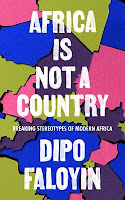
Africa Is Not a Country: Breaking stereotypes of modern Africa by Dipo Faloyin           $40
So often Africa is depicted simplistically as an arid red landscape of famines and safaris, uniquely plagued by poverty and strife. In this funny and insightful book, Dipo Faloyin offers a much-needed corrective, creating a fresh and multifaceted view of this vast continent. To unspool the inaccurate narrative, Africa Is Not A Country looks to a wide range of subjects, from chronicling urban life in Lagos and the lively West African rivalry over who makes the best Jollof rice, to the story of democracy in seven dictatorships and the dangers of white saviourism and harmful stereotypes in popular culture. It examines how each African country was formed, by white European explorers who turned up with loose maps and even looser morals, and how 90% of Africa's material cultural legacy was stolen during the colonial era. Important and very readable.
Elizabeth Finch by Julian Barnes              $40
"The task of the present is to correct our understanding of the past. And that task becomes the more urgent when the past cannot be corrected." Elizabeth Finch was a teacher, a thinker, an inspiration - always rigorous, always thoughtful. With careful empathy, she guided her students to develop meaningful ideas and to discover their centres of seriousness. As a former student unpacks her notebooks and remembers her uniquely inquisitive mind, her passion for reason resonates through the years. Her ideas unlock the philosophies of the past, and explore key events that show us how to make sense of our lives today. And underpinning them all is the story of J — Julian the Apostate, her historical soulmate and fellow challenger to the institutional and monotheistic thinking that has always threatened to divide us. Barnes's new novel is both an interrogation of the processes of memory and a celebration of liberating influence. 
"Barnes is in his element here – investigating with subtlety and gentleness the quiet mysteries that make up a life." —Guardian
Sonnets for Sio by Scott Hamilton          $25
Hamilton wrote these poems as letters to the sculptor, painter, and mystic Visesio Siasau. The poems look back on adventures the two shared amidst the jungle ruins and kava bars of Tonga, and discuss the alternately violent and beatific history of that nation. Sonnets for Sio is a book about art, goddesses, cicadas, sex, war, and intoxication. It celebrates a friendship that is intensified rather than broken by distance.
“One of the best of all our writers about the Pacific.” —Philip Matthews
“Scott Hamilton is one of the best writers and thinkers in New Zealand.” —Steve Braunias
The Stasi Poetry Circle: The creative writing class that tried to win the Cold War by Philip Oltermann             $37
Berlin, 1962. Morale is at rock bottom in East Germany, thrown into chaos by the new Berlin Wall. The Ministry for State Security is hunting for a new weapon in the war against capitalism. Rather than guns, tanks, or bombs, the Stasi resolve to fight the enemy through rhyme and verse, winning the Culture Wars through poetry. Consisting of 15 secret agents — from WW2 veterans to schoolboy recruits — the 'Working Group of Writing Chekists' met monthly from 1962 until the Wall fell. In a classroom adorned with portraits of Lenin, the spies wrote their own poetry and were taught verse, metre, and rhetoric by East German poet Uwe Berger. The regime hoped that poetry would sharpen the Stasi's 'party sword' by affirming the spies' belief in the words of Marx and Lenin, as well as strengthening the faith of their comrades. But as the agents became steeped in poetry, revelling in its imaginative ambiguity, the result was the opposite. Rather than entrenching state ideology, they began to radically question it — and, following a radical role reversal, the GDR's secret weapon dramatically backfired.
The Land of Short Sentences by Stine Pilgaard             $38
A young woman relocates to an outlying community in West Jutland, Denmark, and is forced to find her way, not only in the bewildering environment of the residential Folk High School, where her partner has been hired to teach, but also in the inscrutable conversational forms of the local population. And on top of it all, there's the small matter of juggling her roles as mother to a newborn baby and advice columnist in the local newspaper. In this understated and hilarious novel, Stine Pilgaard conjures a tale of venturing into new and uncharted land, of human relationships, dilemmas, and the perplexing byways of local social codes.
The Last Emperor of Mexico: A disaster in the New World by Edward Shawcross           $45
'One of the most monstrous enterprises in the annals of international history,' said Karl Marx. 'A madness without parallel since Don Quixote,' said a future French president. This is history's judgement on the events surrounding the ill-fated reign of Maximilian of Mexico, the young Austrian archduke who in 1864 crossed the Atlantic to assume a faraway throne. He had been convinced to do so by a duplicitous Napoleon III. Keen to spread his own interests abroad, the French emperor promised Maximilian a hero's welcome, which he would ensure with his own mighty military support. Instead, Maximilian walked into a bloody guerrilla war - and with a headful of impractical ideals and a penchant for pomp and butterflies, the so-called new emperor was singularly unequipped for the task. The ensuing saga would feature the great world leaders of the day, popes, bandits and queens; intrigue, conspiracy and cut-throat statecraft, as Mexico became the pivotal battleground in the global balance of power, between Old Europe and the burgeoning force of the New World: American imperialism.
Bacon in Moscow by James Birch             $40
This funny and personal memoir is the account of an audacious attempt by James Birch, a young British curator, to mount the ground-breaking retrospective of Francis Bacon's work at the newly refurbished Central House of Artists, Moscow in 1988. Side-lined by the British establishment, Birch found himself at the heart of a honey-trap and the focus for a picaresque cast of Soviet officials, attaches and politicians under the forbidding eye of the KGB as he attempted to bring an unseen western cultural icon to Russia during the time of 'Glasnost', just before the fall of the Berlin Wall.
"A rollicking cultural adventure before the fall of the Berlin Wall and the meteoric rise of contemporary art in the nineties." —Grayson Perry
>>Bringing the Bacon to Moscow
>>Dodgy plumbing.
The Social Lives of Animals: How co-operation conquered the natural world by Ashley Ward          $45
Some animal societies hold a mirror up to the human world: elephants hold funerals for departed family members. Pinyon jays run collective creches. Rats will go out of their way to help a cold, wet stranger. Other lifestyles can seem intensely alien (or maybe not so alien). Take locusts, surging over the land in their millions, unable to slow down for a moment because the hungry ranks behind will literally bite their legs off if they don't stay one step ahead.
"A great antidote to the dog-eat-dog view of nature that we grew up with. Ashley Ward takes the reader on a personal journey of discovery to make clear that animals often depend on cooperation for survival." —Frans de Waal
Faraway Girl by Fleur Beale            $24
Etta is worried about her brother, Jamie. The doctors can find nothing wrong with him, but he is getting weaker by the day. At breakfast one morning, he seems to have lost it completely - in a voice as pale as his face, he said, 'I think I can see a ghost.' However, when they all turn to look, sure enough, materialising on the window seat is a girl about Etta's age, wearing a beautiful Victorian wedding dress. Etta has to get off to school, she has no time for this, but she is about to discover that time has a whole new significance. She and her ghost companion have no choice but to work out what is going on before Jamie is lost for ever.

Matariki by Kirsten Parkinson and Kitty Brown           $23
How can we celebrate Matariki? Let's look to the stars! Maumaharatia: Remembering our past Tiakina te taiao: Caring for our environment. Te whakawhanaungatanga: Connecting with our people. 
Me pehea tatou e whakanui i a Matariki? Tirohia nga whetu! Maumaharatia te onamata. Tiakina te taiao. Te whakawhanaungatanga ki o tatou iwi. 
Explore the nine stars of Matariki in rich, detailed imagery and bilingual text. Dive into the meanings of the stars and Matariki itself. 


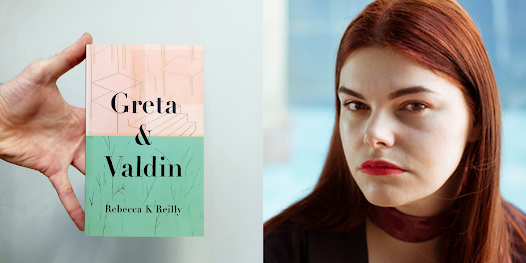
Our Book of the Week, the wholly remarkable Greta & Valdin by Rebecca K. Reilly, is an irrepressible, seemingly off-hand yet sharply insightful novel set in the queerness, nerdiness and cultural diversity of a distinctly vibrant contemporary Aotearoa. It has (unsurprisingly) been short-listed for the Jann Medlicott Acorn Prize for Fiction in the 2022 Ockham New Zealand Book Awards. 
>>Invented people on real streets — Stella interviews Rebecca K. Reilly. 
>>Read Stella's review of Greta & Valdin
>>What sort of pants do I wear?
>>Like an old lawnmower
>>The Acorn Prize round table
>>Infrequently asked questions
>>Put a straw under Baby
>>Videotapes.
>>Sender.
>>Time for a cultural reset
>>Re-Verb.
>>New notebooks.
>>Perversity, cynicism and sheer wickedness.
>>Watching, reading and listening
>>Gin & Vonic.
>>Your copy of Greta & Valdin
>>Other books short-listed for the 2022 Ockham New Zealand Book Awards


INVENTED PEOPLE ON REAL STREETS
An interview with REBECCA K. REILLY
author of GRETA & VALDIN


Stella: Greta & Valdin has been a sensation — topping the indie bestseller charts and capturing a rapturous audience. Why do you think it has been so well received?

Rebecca: Oh, I mean, I think only some of a book’s numbers are down to writing. It has to be in the right hands at the right time and have ticked a whole lot of boxes like inoffensive blurb, cover that doesn’t clash in a flat lay, author photo where the writer doesn’t look too furious. Then on top of that you need word of mouth recommendations, so the content of the book has to be okay as well. Here this book has good fortune because it doesn’t really have objectionable content in it, so if the reader enjoys it they can pretty much recommend it freely except to people who are homophobic or have a vested interest in preserving Iberian Spanish. Or people who tend to err on the side of finding any kind of vague angle of intellectualism pretentious and classist, this nerd book is not for them. One of my favourite books is Bear by Marian Engels and I can’t recommend it to many people at all because you have to be chill about what I guess we can call theoretical zoophilia here.

Stella: While reading this, I was actually aware of the balance you strike in keeping the lively energy of the protagonists (and the cityscape they live in — the city is vividly portrayed) front and centre while simultaneously delving into deeper themes on race and gender.  Do you think humour is a vital tool in your kete? And where is it most useful or most successfully employed? Can it also, in contrast, obscure the intent of the writer?

Rebecca: I think balance is the key for me here. When I’m editing, I’m mostly thinking about how I can achieve a balance of entertainment and, ugh, pathos I guess? I want to feed the reader the vegetables (the gay agenda) a little bit but I mainly want to do what’s best to make an entertaining story with emotional highs and lows. I think it would be disingenuous to leave out the political realities that people like the characters in the book have to live with, but I’m not, you know, I’m not in the business of achieving social justice through opaque messaging. We don’t need books for that, we have the Instagram explore page.

I guess humour is good when trying to squeeze through material that’s difficult somehow, dense or dull but necessary structurally, or just straight out painful. I am aware that what I’m writing in a manuscript is intended for public consumption so I’m purposefully trying not to obscure my intentions with weird edgy jokes. Sometimes I think of something that would be funny but it’s too much, which I don’t see as self-censorship but rather a form of curation. I save that stuff for my edgy personal associates.

Stella: Love is a central theme to the book, whether that is raw and new or more nuanced and convoluted. At times, your novel seemed to sit alongside a Sally Rooney work, while at other times a classic Austen, Dickens (all those machinations) or a Russian meld of Chekhov and Tolstoy. What do you think?

Rebecca: Ah, I think the book is kind of tricky in this way. It does sit alongside the novels of Sally Rooney, Naoise Dolan, Laura McPhee-Browne and others because in a way, I’m also this kind of writer, I was born at the same time and I’ve spent many years at university and wear midi skirts. But I can’t say that I was influenced by millennial novelists at all, because when I wrote this book I was very out of touch with what was going on culturally with novels. I read all these books after I wrote mine. I think I’m this genre of writer circumstantially, but. . . taller and indigenous and from a different country.

I got an Austen comparison on my original manuscript for this book by the examiner, but I didn’t really know what it meant because I have never read the work of Jane Austen. My grandmother had the BBC adaptation on video and I watched one of the videos, I guess twenty years ago. I’ve never read Dickens either, I just know enough about these things to yell five sisters or Ebenezer when I’m watching The Chase. I’ve never read a Russian novel either, actually. I’ve read Uncle Vanya and The Cherry Tree. I’ve seen a production of The Pōhutukawa Tree.

I think I’ve just always been interested in convoluted plots with many mysterious characters and motives, the first time I was asked to move onto a new project rather than writing one never-ending story was in Year 1 when I filled up a whole exercise book with my story We’re Going to Invercargill, a place I had heard mentioned approximately one time. I think this is maybe what happens when you have an autistic child who likes writing but has no interest in fantasy or science fiction or non-fiction. Just this elaborate take on social realism. I used to play limb centre with my dolls, after going with my dad to pick up a new prosthetic leg once. Now I’m an adult who can invent new people and situations from scratch but would be extremely pressed to make them exist on streets that aren’t real. I’m sorry, I haven’t said anything about love – I like thinking about how love works and how people relate to one another, what sort of forms that can take, how far it can stretch. It’s an interesting area of thought like oceanography or linguistics.

Stella: Your book has a happy ending — mostly. Did you intend this?

Rebecca: The end of the book is definitely the part I’ve had the most negs about (rushed, messy, loses it, but also overly neat, unrealistic, cutesy) but I did intend it to be how it is. I know the author’s intention doesn’t matter and it’s all up to the reader, but here my intention was not to show a happy ending as such, but a not-horrible ending for my two protagonists. You know, in the queer community and in the Māori community we’ve got enough media where something cooked happens to the characters right at the end. This is not a book where people are drowning or going to jail or revealing they’re actually straight-engaged to someone else at the end. My secondary intention was to show that although maybe everything is momentarily fine in the world of the protagonists, they also needed to realise that the world, and even the people closest to them, operate on their own terms without their intervention. I wanted to break from the insularity of the tight first person and show that other stuff was going on and other characters had different viewpoints and other things they were dealing with.

I’m interested in the narrative perspective of Less, by Andrew Sean Greer, where the third-person narrator turns out to be someone in love with the protagonist and A Series of Unfortunate Events where the narrator is in love with someone who turns out to be the deceased mother of the protagonists. I wanted this type of effect as well, for my own Beatrice, a smaller version of it, not directly through narration but an absence of it. From one perspective, this book is a year in the life of a woman who has a lot going on socially and emotionally, but we only ever hear about it from the perspectives of two of her children, one who has no idea what she’s up to and one who seems like he might actually, but he just doesn’t think about it. He’s got a lot on too and has strong reasons for not thinking too much into the affairs of his mother because they affect him too much.

I don’t know, I think that this thing I’m trying to do is definitely a two-book job and I don’t regret sowing the seeds into the first book even if I can never be bothered doing the second one and a fraction of people just think I’m shit at writing endings. They don’t know what’s in my mind. I’m a real shocker for putting information for one text in another, I wrote a short story for Starling set the year before this book and V says that when he turns thirty he’ll simply stop mentioning his age. Which he does, in Greta & Valdin, he says that he’s 29 and that it’s his birthday the next month several times in the first few chapters and then he never mentions it again. I’m just giving away information at this point because the book came out a year ago next week and I would like to stop talking about this one soon and move onto the next one, I’m shit at multi-tasking. Anyway, all the things I’ve done have been worth the risk, would trade again.


VOLUME Books


BOOKS @ VOLUME #276 (29.4.22)

Read our latest NEWSLETTER and find out  what we've been reading and recommending, and for book news and new books. 


VOLUME BooksNewsletter


>> Read all Stella's reviews.


Entanglement by Bryan Walpert  {Reviewed by STELLA}

A time traveller, a writer, a lover, a brother, a father. Bryan Walpert’s novel Entanglement, a novel of three parts — intersecting yet separate, entangled yet often also like a long open straight road, both precise and complex — has layers upon layers expanding and collapsing in on itself. It’s cerebral without being boring, pokes fun at itself while still having integrity, and has an emotional core which is richly textured. The three parts are distinct: 'Lake Lyndon Writer Retreat 2019', 'Time Traveller' and 'Sydney 2011'. We move between these stories seamlessly, picking up from where we left off in the previous related episode. Walpert gives each their own flavour. Lake Lyndon has the protagonist answerable to writers’ prompts — the retreat is the perfect time to work on the unwritten novel — to explore mechanisms for approaching his themes. These are often evocative passages, playing to the rules but pulling together story-telling and something of what might be the narrator’s own emotional memory landscape, melding dreamlike episodes with possibly factual encounters. 'Time Traveller' is instantly fascinating. Drawn in by the emotive title you are instinctively required to ask —  Who is this time traveller and where have they travelled from and where are they going? And why is it necessary? And then, as an afterthought, is it possible? It’s cold, it’s snowing, the bus is missed, the bus breaks down. The man is lost even in this familiar landscape. He knows he has to be somewhere but he can’t quite piece it together. Is this a willing deception? Walpert asks us to consider memory and trauma — regret lies at the heart of this devastated, desperate individual. 'Sydney 2011' is the love story that runs throughout, the meeting of two minds attracted to each other in a flurry of time philosophy chat and pillow talk. Anise is intelligent and independent. The narrator is drawn to her intellectually, emotionally and physically. Neither expected a romance. Each on their own trajectory, but, as with many paths, theirs intersect and become entangled in unexpected ways. This leads to marriage, a child and moving countries for reasons the couple may regret. Cleverly conceived, these chapters defy time order, sometimes moving backwards in time, so we, the reader, know more than we should and at other times the tale twists in on itself as the protagonist attempts to control the narrative, to keep us from the truth. This is his view, his story to tell. Pushing through the plot is the story of Daniel, the twin — a story that the brother wishes to change. Can time be altered? The writer’s residency at the Centre of Time in Sydney has him attempting to understand the physics of time, and the novel is rich with conversations with various department academics as they explain the science and philosophy of time. As the novel moves along, the time traveller is increasingly desperate to get to an event in the past but is waylaid by being mugged, getting a concussion, and being apprehended by a psychiatrist. We leave him standing on the ice of a frozen lake — or do we? The husband loses his wife and child and there is a heartbreaking awareness of his mistakes, now and then (in 1976). He is trapped in these moments. His guilt has clung to him, shaping the person he is and the decision he makes thirty years on. It is as if time is collapsing in on him and he knows of only one way out. But is it possible? Walpert writes with surety and restless energy. Like the structure of the novel, the thematic concerns are also layered, expressed with self-deprecating humour, earnest intent, and passages of lyrical beauty — as much a novel as a critique of writing itself. Clever and intriguing.


 >> Read all Thomas's reviews. 


Tractatus Philosophico-Poeticus by Signe Gjessing (traslated from Danish by Denise Newman)  {Reviewed by THOMAS}

For some reason it had become a habit for him to write his reviews of books in the style of the books themselves, or as near a style as he could manage, a habit or an affectation, he wasn’t sure which, but this habit or affectation, if it was indeed a habit or an affectation, did have a serious intent, and was therefore not really a habit although it still could be an affectation, in that he somehow seemed to believe that a review written in the style of the subject of the review might reveal to him, and possibility to the readers of the review if there chanced to be any readers of the review, if such things could be left to chance, really such things were always left to chance, what was he saying, he seemed to believe that a review written in the style of the subject of the review might reveal something otherwise unnoticed or essential or incidental about the book in question, perhaps he was attempting to remove himself from a position of agency or of responsibility for the review by enticing, if that is the word, the book to write a review of itself. Form generates content, he shouted, frightening the cat, I want to write like a machine, I want to tinker with form until it purrs like a literary motor, then I will be able to put anything at all into the hopper, switch it on, and out comes literature. The cat was quick to resettle, she was used to this kind of excitement. If I were to write a review of Signe Gjessing’s Tractatus Philosophico-Poeticus in the form of Signe Gjessing’s Tractatus Philosophico-Poeticus I would also be writing it in the form of Ludwig Wittgenstein’s Tractatus Logico-Philosophicus, he thought, I would be writing it in the form of  Ludwig Wittgenstein’s Tractatus Logico-Philosophicus because Signe Gjessing has written her book in the form of Ludwig Wittgenstein’s Tractatus Logico-Philosophicus, in order, he thought, to see what kind of poetry could be generated by such a form, in order to use form as a machine for the generation of text, in order, he thought, to test the limits of language, to see what it is and is not good for, just like Wittgenstein, or just like Wittgenstein thought he was doing at the time he wrote that book. If Wittgenstein made no distinction between form and content, the same must be true of poetry, he thought. If for Wittgenstein the limits of knowledge are the limits of language, what are we to say of poetry, always straining as it does, or as it should, he thought or thought that perhaps he thought, into the unsayable? If Wittgenstein sought the limit of what can be said, through progressing out linguistically from the obvious towards that limit, pushing at it and establishing it, he thought, he entails that beyond that limit there exists not nothing but rather that about which nothing can be said. What cannot be said is signified by the complete exhaustion of that which can be said. Gjessing also is obsessed with the limit with which Wittgenstein was at the time he wrote his book obsessed, but she stands at that limit as if from the habitat beyond, both Wittgenstein and Gjessing are concerned to discover the nature of the limit inherent in language, if there is such a limit and such a limit is inherent, but Gjessing wants, he thought, to destroy that limit or even to show that the destruction of the limit inherent in language is itself inherent in language. He had written in his bad handwriting in his notebook that Gjessing had written in the introduction to her book that “The poem is a modification of the universal — as though the sayable were an incapacity of the unsayable,” and, he thought, Gjessing is running Wittgenstien’s machine in reverse to see what poetry comes out. If the world is comprised not of things but of states of affairs which are the grammatical relations between things, there is no reason to think that that which is not the case is not governed by or, he thought, even generated by this universal grammar. Texts are comprised not of words but of grammar, he shouted, but the cat was long gone. Well, he thought, if I was going to write my review of Signe Gjessing’s Tractatus Philosophico-Poeticus in the form of Signe Gjessing’s Tractatus Philosophico-Poeticus, I should have started earlier, I should have started, as does Gjessing, as does Wittgenstein to whose text Gjessing’s text is a response and a rejoinder, with a number of numbered statements on the first level to which another number of statements numbered to the first decimal respond or are implied and to which another number of statements numbered to the second decimal respond or are implied and so on until perhaps the fourth decimal or what we could call the fifth level, I’m not exactly sure if this is clear, a shining rack of cogs used in Wittgenstein’s case to generate philosophy, if he believed at that time there even was such a thing, and in Gjessing’s case to generate poetry, or whatever we might choose to call it, if I had written my review like this, he thought, what would I have written? Perhaps if I can devise such a grammatical machine to write reviews, a machine I can just turn upon any text, I can perhaps be relieved of certain of my duties, except perhaps to now and again apply a little oil, and perhaps get sometimes earlier to bed. 


“3.01  The world is a good alternative to certainty.” —Signe Gjessing,
Tractatus Philiosphico-Poeticus


Our Book of the Week is fresh out of the carton! Ali Smith's hugely anticipated new novel Companion Piece, written in 'real time', continues the project of her outstanding 'Seasons' quartet. Few writers can manage to be at the same time as angry and as playful as Ali Smith, and few can directly face the most depressing aspects of our present moment and find such hope in humanity. 
>>In grave peril of becoming a national treasure
>>Not a shred of autofiction
>>A tightrope across a ravine.
>>Puns and wordplay are ceremonious.  
>>In a time when lies are sanctioned. 
>>Does art have anything to do with life? 
>>What to do when you lose faith in the writing process
>>Smith reads 'Nausicaa'.
>>Read Stella's reviews of the 'Seasons' quartet. 
>>Get your Companion Piece.
>>Also available as a beautiful cloth-bound hardback

 NEW RELEASES

Companion Piece by Ali Smith                 $37
"A story is never an answer. A story is always a question." Here we are in extraordinary times. Is this history? What happens when we cease to trust governments, the media, each other? What have we lost? What stays with us? What does it take to unlock our future? Ali Smith follows her wonderful 'Seasons' quartet, written in 'real time', with this further novel. Few writers can manage to be at the same time as angry and as playful as Ali Smith, and few can directly face the most depressing aspects of our present moment and find such hope in humanity.  
"A lockdown story of wayward genius. Lyrical visions alternate with fables and farce, history with Covid, in the scheme-busting fifth part of Smith's seasonal quartet." —The Guardian 
"Ali Smith is lighting us a path out of the nightmarish now." —Observer
>>
Also available as a beautiful cloth-bound hardback.
Tides by Sara Freeman            $33
A spare and taut novel about a woman who, finding her life suddenly drained of meaning after a tragedy, removes herself from her life and habits and ends up drifting penniless in a coastal town, where her encounters with tourists and locals at first alienate her still further from any sense she might have had of herself and then force her to re-examine her ideas of separation and connection, and the trajectory that brought her there. 
"Beautifully observed." —The Irish Times

Metronome by Tom Watson          $33
For twelve years Aina and Whitney have been in exile on an island for a crime they committed together, tethered to a croft by pills they must take for survival every eight hours. They've kept busy: Aina with her garden, her jigsaw, her music; Whitney with his sculptures and maps, but something is not right. Shipwrecks have begun washing up, and their supply drops have stopped. And on the day they're meant to be collected for parole, the Warden does not come. As days pass, Aina begins to suspect that their prison is part of a peninsula, and that Whitney has been keeping secrets. And if he's been keeping secrets, maybe she should too. Convinced they've been abandoned, she starts investigating ways she might escape. As she comes to grips with the decisions that haunt her past, she realises her biggest choice is yet to come.
"Taut, unsettling and so completely charged with both tension and emotion, I found myself captivated by Metronome. I loved the clarity of its vision and the clean intensity of its prose, and I know that its vivid characters and the bleak, brutal beauty of the world they inhabit will haunt my dreams for a long time." —Naomi Ishiguro
A Passage North by Anuk Arudpragasam            $23
Short-listed for last year's Booker Prize, Arudpragasam's novel explores the deep psychological and social impacts of the long civil war in Sri Lanka, and the struggle for agency for young people overwhelmed by societal trauma. 
"A Passage North is written with scrupulous attention to nuance and detail. At its center is an exquisite form of noticing, a way of rendering consciousness and handling time that connects Arudpragasam to the great novelists of the past." —Colm Toibin
"A Passage North is a profound and disquieting account of the making of a self, of the pressures of history, desire, will, and chance that determine the shape of a life. It's difficult to think of comparisons for Arudpragasam's work among current English-language writers; one senses a new mastery coming into being." —Garth Greenwell
>>It was his first time travelling north by train
>>No wrong answers.
>>How the past can enlighten our future
Paradais by Fernanda Melchor (translated by Sophie Hughes)           $37
Written in a chilling torrent of prose by one of Mexico’s most thrilling writers, Paradais explores the explosive fragility of Mexican society. Inside a luxury housing complex, two misfit teenagers sneak around and get drunk. Franco Andrade, lonely, overweight, and addicted to porn, obsessively fantasizes about seducing his neighbour - an attractive married woman and mother. Meanwhile Polo, the community’s gardener, dreams about quitting his gruelling job and fleeing his overbearing mother and their narco-controlled village. As each face the impossibility of getting what they think they deserve, together Franco and Polo hatch a mindless and macabre scheme.
>>Longlisted for the 2022 International Booker Prize.
Dominating the farmyard of the house where Sally Coulthard and her husband live in the gentle Howardian Hills of North Yorkshire is a large, stone-built barn. When Sally discovered a set of ancient 'witch-marks' scratched into the wall of the barn, she became intrigued by the sturdy old building and the story behind it. 
The Barn is a socio-historic exploration of a small patch of Yorkshire countryside - hidden, insignificant, invisible to the rest of the world - which has experienced extraordinary changes. From the last of the enclosures to the boom days of Victorian high farming, the fortunes of the barn have been repeatedly upturned by the unstoppable forces of agriculture and industry. Medicine, transport, education, farming, women's roles, war, technology - every facet of society was played out, in miniature, here. The walls of the barn are a palimpsest, written onto - and now about - by three hundred years of history.
Britain's Empire: Resistance, repression and revolt by Richard Gott          $25
Contrary to nationalist legend and schoolboy history lessons, the British Empire was not a great civilising power bringing light to the darker corners of the earth. Richard Gott recounts the empire's misdeeds from the beginning of the eighteenth century to the Indian Mutiny, spanning the red-patched imperial globe  to Australia, telling a story of almost continuous colonialist violence. Recounting events from the perspective of the colonised, Gott unearths the all-but-forgotten stories excluded from mainstream histories.
"Vivid and startling." —Guardian

Sticky: The secret science of surfaces by Laurie Winkless           $33
You are surrounded by stickiness. With every step you take, air molecules cling to you and slow you down; the effect is harder to ignore in water. When you hit the road, whether powered by pedal or engine, you rely on grip to keep you safe. The Post-it note and glue in your desk drawer. The non-stick pan on your stove. The fingerprints linked to your identity. The rumbling of the Earth deep beneath your feet, and the ice that transforms waterways each winter. All of these things are controlled by tiny forces that operate on and between surfaces, with friction playing the leading role. Winkless explores some of the ways that friction shapes both the manufactured and natural worlds, and describes how our understanding of surface science has given us an ability to manipulate stickiness, down to the level of a single atom. 
The Ruin of Witches: Life and death in the New World by Malcolm Gaskill             $45
In the American frontier town of Springfield in 1651, peculiar things begin to happen. Precious food spoils, livestock ails and property vanishes. People suffer fits, and are plagued by strange visions and dreams. Children sicken and die. As tensions rise, rumours spread of witches and heretics, and the community becomes tangled in a web of spite, distrust and denunciation. The finger of suspicion falls on a young couple struggling to make a home and feed their children. It will be their downfall. The Ruin of All Witches tells of witch-hunting in a remote Massachusetts plantation. These were the turbulent beginnings of colonial America, when English settlers' dreams of love and liberty, of founding a 'city on a hill', gave way to paranoia and terror, enmity and rage. Gaskill brings to life an existence steeped in the divine and the diabolic, in curses and enchantments, and precariously balanced between life and death. Through the micro-history of a family tragedy, we glimpse an entire society caught in agonized transition between superstition and enlightenment, tradition and innovation. We see, in short, the birth of the modern world.
"Malcolm Gaskill shows us with filmic vividness the daily life of the riven, marginal community of Springfield, where settlers from a far country dwell on the edge of the unknown. The clarity of his thought and his writing, his insight, and the immediacy of the telling, combine to make this the best and most enjoyable kind of history writing. Malcolm Gaskill goes to meet the past on its own terms and in its own place, and the result is thought-provoking and absorbing." —Hilary Mantel
Recovery: The lost art of convalescence by Gavin Francis           $12
When it comes to illness, sometimes the end is just the beginning. Recovery and convalescence are words that exist at the periphery of our lives - until we are forced to contend with what they really mean. Here, Gavin Francis explores how - and why - we get better, revealing the many shapes recovery takes, its shifting history and the frequent failure of our modern lives to make adequate space for it.

The Babel Message: A love letter to language by Keith Kahn-Harris          $33
A journey into the heart of language from a rather unexpected starting point. Keith Kahn-Harris is obsessed with something seemingly trivial: the warning message found inside Kinder Surprise eggs: "WARNING, read and keep: Toy not suitable for children under 3 years. Small parts might be swallowed or inhaled." On a tiny sheet of paper, this message is translated into dozens of languages - the world boiled down to a multilingual essence. Inspired by this, the author asks: what makes 'a language'? With the help of the international community of language geeks, he shows us what the message looks like in Ancient Sumerian, Zulu, Cornish, Klingon - and many more. Along the way he considers why he thinks Hungarian writing looks angry, how to make up your own language, and the meaning of the heavy metal umlaut. Overturning the Babel myth, he argues that the messy diversity of language shouldn't be a source of conflict, but of collective wonder. 
Welcome to the Universe in 3-D: A visual tour by Neil DeGrasse Tyson at al           $45
Presenting a rich array of stereoscopic color images, which can be viewed in 3D using a special stereo viewer that folds easily out of the cover of the book, this book reveals your cosmic environment as you have never seen it before.
To the Friend Who Did Not Save My Life by Hervé Guibert         $25
After being diagnosed with AIDS, Hervé Guibert wrote this devastating, darkly humorous and personal novel, chronicling three months in the penultimate year of the narrator's life. In the wake of his friend Muzil's death, he goes from one quack doctor to another, from holidays to test centres, and charts the highs and lows of trying to cheat death. On publication in 1990, the novel scandalized French media, which quickly identified Muzil as Guibert's close friend Michel Foucault. The book has since attained a cult following for its tender, fragmented and beautifully written accounts of illness, friendship, sex, art and everyday life. 
>>Read Kate Zambreno's To Write As If Already Dead—about her attempts to write an account of Guibert and this book
Dark and Magical Places: The neuroscience of how we navigate by Christopher Kemp          $43
Within our heads, we carry around an infinite and endlessly unfolding map of the world. Navigation is one of the most ancient neural abilities we have — older even than language. Kemp embarks on a journey to discover the remarkable extent of what our minds can do. From the secrets of supernavigators to the strange, dreamlike environments inhabited by people with 'place blindness', he will explore the myriad ways in which we find our way, explain the cutting-edge neuroscience that is transforming our understanding of it — and try to answer why, for a species with a highly-sophisticated internal navigation system that evolved over millions of years, do humans get lost such a lot?
The Lost Daughter by Elena Ferrante           $23
Leda is devoted to her work as an English teacher and to her two children. When her daughters leave home to be with their father in Canada, Leda anticipates a period of loneliness and longing. Instead, slightly embarrassed by the sensation, she feels liberated, as if her life has become lighter, easier. She decides to take a holiday by the sea, in a small coastal town in southern Italy. But after a few days of calm and quiet, things begin to take a menacing turn. Leda encounters a family whose brash presence proves unsettling, at times even threatening. When a small, apparently meaningless, event occurs, Leda is overwhelmed by memories of the difficult and unconventional choices she made as a mother and their consequences for herself and her family.
Grow! A children's guide to plants and how to grow them by Rizanino Reyes            $43
In this book, discover 15 plants, then learn how to grow them. Meet each plant's surprising relations (did you know the tasty tomato is a cousin of deadly nightshade?) discover their history (bromeliads defended themselves against the dinosaurs!). Then, follow the step-by-step instructions to grow and care for each plant, whether you have a big back garden or a sunny windowsill. Beautifully illustrated and full of information. 
Violets by Alex Hyde          $33
A young woman, Violet, lies in a hospital bed in the closing days of the World War Two. Her pregnancy is over and she is no longer able to conceive. With her husband deployed to the Pacific Front and her friends caught up in transitory love affairs, she must find a way to put herself back together. In a small, watchful town in the Welsh valleys, another Violet contemplates the fate she shares with her unborn child. Unwed and unwanted, an overseas posting offers a temporary way out. Plunged into the heat and disorder of Naples, her body begins to reveal the responsibility it carries even as she is drawn into the burnished circle of a charismatic new friend, Maggie. As the stories of these two Violets begin to intertwine, they both must find the courage necessary to take hold of their lives. 
"This is a profoundly unusual novel, an intricately composed and thoroughly corporeal portrait of the intertwined lives of two women during the war." —Guardian
The Manningtree Witches by A.K. Blakemore            $23
England, 1643. Parliament is battling the King; the war between the Roundheads and the Cavaliers rages. Puritanical fervour has gripped the nation, and the hot terror of damnation burns black in every shadow. In Manningtree, depleted of men since the wars began, the women are left to their own devices. At the margins of this diminished community are those who are barely tolerated by the affluent villagers - the old, the poor, the unmarried, the sharp-tongued. Rebecca West, daughter of the formidable Beldam West, fatherless and husbandless, chafes against the drudgery of her days, livened only by her infatuation with the clerk John Edes. But then newcomer Matthew Hopkins, a mysterious, pious figure dressed from head to toe in black, takes over The Thorn Inn and begins to ask questions about the women of the margins. When a child falls ill with a fever and starts to rave about covens and pacts, the questions take on a bladed edge. Soon the town is hosting witch trails and the atmosphere of distrust and betrayal grows more extreme. Now in paperback. 
>>Angels in anguish
>>Also available in hardback
Groundskeeping by Lee Cole             $37
Eager to clean up his act after his troubled early twenties, Owen has returned to Kentucky to take a job as a groundskeeper at a small college in the Appalachian foothills, one which allows him to enrol on their writing course. It's there that he meets Alma, a Writer-in-Residence, who seems to have everything Owen doesn't — a prestigious position, an Ivy League education, and published success as a writer. They begin a secret relationship, and as they grow closer, Alma, from a supportive, liberal family of Bosnian immigrants, struggles to understand Owen's fraught relationship with his own family and home. Exploring the boundaries between life and art, and how our upbringings affect the people we can become, Groundskeeping is a novel about two very different people navigating the turbulence of an all-consuming relationship.
Nano: The spectacular science of the very (very) small by Jess Wade and Melissa Castrillón          $22
This exciting non-fiction picture book introduces young readers to the fascinating (and cutting-edge) science of the very, very small. Everything is made from something – but the way we make things, from the materials we use to the science and technology involved, is changing fast. 
"Beautiful. Plunges deep into the world of atoms, materials and the applications of nanoscience, with accessible text and richly shaded pictures." –Guardian
The Howling Hag Mystery by Nicki Thornton           $20
When there's a murder in Twinhills and a hag is heard howling at the local inn, Raven Charming realises she may not be the only secret witch in the village. With the help of boy sleuth Mortimer Scratch, and talking cat Nightshade, she sets out to solve her first magical mystery.
Two Serious Ladies by Jane Bowles             $28
Eccentric, impulsive New York heiress, Christina Goering meets the anxious but equally unpredictable Mrs Copperfield at a party. Two serious ladies, for whom nothing s natural and anything is possible, they follow their singular paths in search of salvation. Mrs Copperfield visits Panama with her husband, whom she abandons for love of Pacifica, a local prostitute, and her brothel home. Miss Goering, for her part, seeks redemption by swapping her mansion for a squalid little house and relishing ever more extreme encounters with strangers. At the end, the two women meet again. First published in 1943, Two Serious Ladies is daring and original, with deadpan humour and devastating insights.
"The book I give as a gift. It feels like giving someone an exotic fruit." —Sheila Heti
Plain Pleasures by Jane Bowles            $28
In this collection of short fiction, ranging from North Africa to South America, Bowles explores her fascination with the hidden lives of apparently ordinary middle-aged women.
"One of the finest modern writers of fiction in any language." —John Ashberry
"A thoroughly original mind - a mind at once profoundly witty, genuinely unusual in its apprehensions, and bracingly, humanely true." —Claire Messud


>> Read all Stella's reviews.


Kurangaituku by Whiti Hereaka  {Reviewed by STELLA}
This absorbing and powerful novel draws on the pūrākau of Hatupatu and the Birdwoman. In the hands of Whiti Hereaka, the story of Kurangaituku is retold, repositioned and empowered — this is a feminist perspective — wahine strong. It’s also an appreciation of storytelling and the power of words, of language to shape us and contain or conversely to free us. Picking up this attractive Huia publication you are immediately struck by Rowan Heap’s artwork on the covers — (front and front, as this is a book you can start at either end and which overlaps in its telling in the middle) — claw and hand — beaked and unmasked. It would make little difference where you start (I happened to begin on the dark side) as Hereaka avoids linear construction or strict time constraints, and instead weaves the words and actions of Kurangaituku’s travels through time, the underworld and in the forest in moments that circle each other, intersect and mesmerise as only the best storytelling can. It feels both ancient and relevant, and in this it reminded me of the fascinating yet uncomfortable character Papa Toothwort and the world he inhabits in Max Porter’s Lanny — an entity from some hidden depths, always there, watching, listening and learning. In Rarohenga, the underworld, Hereaka creates a dreamlike poetic landscape which moves between nightmare and bliss. Kurangaituku’s travels here bring her both love (with Hinenuitepo) and the desire to be beautiful. Yet it also instils the lust for revenge. It shows her the undoing of man and her own appetite for power. It’s a compelling world to witness through Kurangaituku’s eyes, through her anger and naivety and her awareness of her otherness. In parts beautiful, in parts gruesome, yet also liberating — a place to walk towards the Void, a letting go. Yet what does this mean for Kurangaituku? A creature who is a bird, a woman, both, neither? Dead, not dead? And where can this lead but back to the beginning again? The world is new, and Kurangaituku is of and by the birds. The forest is her home and the birds are her companions. They are drawn to her and they draw her. This timeless expansive moment is interrupted only by the violent murmurings of the earth. When she comes to, the world has changed and the Song Makers have arrived. She watches them, but she can not communicate — she has no voice. Yet they grow to know of her and make her a new version of herself — the story builds, as stories do, with embellishments that become truths, creating a monstrous birdwoman. She is a story and cannot control her outcome — or can she? And in this world, she meets the young warrior, or trickster, Hatupatu for the first time. Her fascination with him, and his ultimate betrayal, is Kurangaituku’s tragedy. Whiti Hereaka’s novel sits comfortably with other feminist myth retellings (Atwood’s Penelopiad or Angela Carter’s The Bloody Chamber) which give voice to those poorly served by their traditional tellings, with the bonus that is situated here, in Aotearoa. For a novel which is structurally and thematically complex, Kurangaituku is surprisingly agile and wonderfully alluring.


 >> Read all Thomas's reviews. 


Suppose a Sentence by Brian Dillon {Reviewed by THOMAS}
Could he even write a review of a book he had read about someone writing about sentences that he in turn had read which were written by yet other people, some of whom, or, rather, some of which, he himself had read directly, if that is the word, that is to say not just in the book about sentences in which these sentences also appear and which he has also read? The question mark, when it finally arrived, seemed somehow out of place, so far did it trail the part of the sentence he had just written in which the matter of the question appeared early, all those clauses shoving the question mark to an awkward distance, already the thought that the sentence described was changing direction, as thoughts do, but the sentence was still obliged to display the mark that would make the first part of the sentence, and indeed the whole sentence thereby into a question, there was a debt to be paid after all, he was lucky to get off without interest. The separation of the question mark from the quested matter was not the only reservation he had about the sentence he had just written, he had other reservations, both about its structure and its content, in other words both about its grammar and its import, if that is the right word. One reservation was that he had chosen to write the sentence in the third person, a habit he had acquired, or an affectation that he had adopted, that depersonalised his reviews and made them easier to write and, he hoped, more enjoyable to read, certainly, he thought, less embarrassing for himself to read, or should that be re-read, not that he was particularly inclined to do such a thing. These reviews were also written in the past tense, for goodness sake. Could he write in the first person and in the present tense, he wondered, or was that a mode he contrarily reserved for fiction? Can I even write a review of a book I have read, he wrote as an experiment, about someone writing about sentences that he has read which were written by yet other people, some of whom, or, rather, some of which, I have read directly, if that is the word, that is to say not just in the book about sentences in which these sentences also appear and which I have also read?, he wrote, though I must say, he thought, that question mark is more problematic than ever. Also, would it not be ludicrous, he thought, to even attempt to write a review about a book about fine sentences, or exceptional sentences, or exemplary sentences or whatever, from William Shakespeare to Anne Boyer, including sentences from several of my favourite writers, though not perhaps the sentences of theirs that I would choose if I had been choosing, he thought, when my own sentences churn on, when in my own repertoire I have only commas and full stops, a continuation mark and a stopping mark, when those two marks for him are already too much for him to handle, accustomed as he had once made himself to the austerity of the full stop alone, you could write a whole book using only full stops, he thought, or he had once thought. He had wandered, and tried to return to the task in hand, or the book in hand, or to the thought in head, so to speak. Because the book was about sentences he found himself unable to write any sentences about it. If he wrote a review, he thought, he had no doubt that at least some of the readers of that review, if not all of the readers of that review, if there were any such readers, which seemed unlikely, would find his sentences fell short of their subject, or if they did not fall short they would quaver under their scrutiny, weaken and collapse, which is another sort of falling. His sentences would rather point than be pointed at. Thinking of writing would have to suffice. I would like to write, he thought of writing, that this book, Suppose a Sentence by Brian Dillon, is the sort of book that anyone interested in reading better, or, indeed, in writing better, which goes without saying, as writing is a subset of reading, if that goes without saying, though not everyone’s subset, he thought, and would have said had he been saying instead of thinking and writing, or, rather thinking and thinking of writing, Brian Dillon is good company in working out how text works when it works well, but, although he thought of writing this, as he had said, see, he does say though he said he was not saying, he did not write this as, by this time, his comma-infested sentences were almost unable to move in any direction even if not in a straight line, bring on the full stops, he thought. 

"Every writing worthy of its name wrestles with the Angel and, at best, comes out limping.” —Jean-François Lyotard


Our Book of the Week is The Bookseller at the End of the World by Ruth Shaw. Shaw didn't exactly intend to become a bookseller, but she found herself the proprietor of two tiny bookshops in the tiny settlement of Manapouri. In this charming volume, Shaw weaves together accounts of characters who visit her bookshop, musings on her favourite books, and bittersweet stories from her remarkable and varied life before she became a bookseller. She has sailed through the Pacific for years, was held up by pirates, worked at Sydney's King's Cross with drug addicts and prostitutes, campaigned on numerous environmental issues, and worked the yacht Breaksea Girl as an expedition/tourist boat with her husband, Lance. 
>>How to run a bookshop
>>Pirates, pigs and sex work
>>A life well lived. 
>>There were two... 
>>And now there are three!
>>Crammed with adventure
>>Read an excerpt

 NEW RELEASES

Slow Down, You're Here by Brannavan Gnanalingam         $25
Gnanalingam's last two novels have been short-listed for the Acorn Prize in the Ockham New Zealand Book Awards. In his new novel, Kavita is stuck in a dead-end marriage. A parent of two small kids, she is the family’s main breadwinner. An old flame unexpectedly offers her a week away in Waiheke. If she were to go, she’s not sure when — or if — she’d come back. Gnanalingam's novels are notable for their authentic texture and insight into the lives of others. 
>>Sprigs
Companion Piece by Ali Smith            $46
"A story is never an answer. A story is always a question." Here we are in extraordinary times. Is this history? What happens when we cease to trust governments, the media, each other? What have we lost? What stays with us? What does it take to unlock our future? Ali Smith follows her wonderful 'Seasons' quartet, written in 'real time', with this further novel. Few writers can manage to be at the same time as angry and as playful as Ali Smith, and few can directly face the most depressing aspects of our present moment and find such hope in humanity. Lovely in hardback. 
"A lockdown story of wayward genius. Lyrical visions alternate with fables and farce, history with Covid, in the scheme-busting fifth part of Smith's seasonal quartet." —The Guardian 
"Ali Smith is lighting us a path out of the nightmarish now." —Observer

Seasons by William Direen           $20   
Bill Direen's poetry diary spans a year on a strath an hour’s drive from Dunedin. It is written with a sharp eye for landscape, and a musician’s ear for the sounds of the Strath region, as it changes dramatically from drought to flood to extreme frosts and snow-bound winter. Begun after Direen returned to New Zealand from France, the poem is in three parts. It runs from autumn to autumn, blending description with personal micronarrative. Each copy of the book has a unique download code, offering the text combined with music by six New Zealand musicians.
Other listening:
>>World of the Winds (2021).
>>Moderation (1983)

The Candy House by Jennifer Egan             $38
Imagine a new technology, Own Your Unconscious, that allows you access to every memory you've ever had, and to share every memory in exchange for access to the memories of others. Such a technology would seduce multitudes. But not everyone. In spellbinding linked narratives, Egan spins out the consequences of Own Your Unconscious through the lives of multiple characters whose paths intersect over several decades. Egan introduces these characters in an astonishing array of styles—from omniscient to first person plural to a duet of voices, an epistolary chapter, and a chapter of tweets. In the world of Egan's spectacular imagination, there are 'counters' who track and exploit desires and there are 'eluders', those who understand the price of taking a bite of the Candy House. The Candy House is a bold imagining of a world that is moments away.
“Jennifer Egan’s radiant new novel explores what role the imagination can still play in a world overwhelmed by technology." —Slate
>>What the forest remembers
>>Everything was fine
>>How much sharing is too much sharing? 
Down from Upland by Murdoch Stephens            $30
Down from Upland is a kitchen sink, domestic novel that opens at the precise moment the first Millennials find themselves raising a teenager. While flirting with an open marriage, Jacqui and Scott nudge their son on a more moderate course as he begins at a new high school and makes new friends. Skewering the best and worst of Wellington’s leafy middle class, the novel features public servants with varying degrees of integrity, precocious Wellington High students and a foreign lover at the end of a working holiday visa. Stephens's writing, as always, defies gravity as the present moment really gets away on us. 
>>Read Stella's review of Rat King Landlord. 
We Still Have the Telephone by Erica Van Horn               $36
"My mother and I have been writing her obituary. We have been working on it for several years now. Before we started, she had already begun the project with my older sister. She wants to get it right." Assembling fragments of past and present Erica Van Horn describes a life laid out in detail, quietly registering the fuzziness of the line between eccentricity and madness. In this mosaic portrait, a singular everywoman emerges, whose immutable rituals exist on a par with an irrepressible anarchy. This delightful book suggests that the very details that never make it into obituaries are the ones that tell us the most about the person concerned. 
>>Some words for living locally. 
Tractatus Philosophico-Poeticus by Signe Gjessing (translated from Danish by Denise Newman)           $28
Ludwig Wittgenstein's Tractatus Logico-Philosophicus, often noted as the most important philosophical work of the 20th century, had a broad goal: to identify the relationship between language and reality, and to define the limits of science. Following on from Wittgenstein 100 years later, Signe Gjessing updates and reimagines the Tractatus, marrying poetry with philosophy to test the boundaries of reality. This is poetry which exacts the logical consequence of philosophy, while locating beauty and significance in the 'nonsense' of the world.
"Signe Gjessing’s highly original reconfiguration of Wittgenstein’s Tractatus unfolds at once logically and lyrically on the trembling cusp where philosophy and poetry intersect. Her witty, haunting propositions shimmer between the profound and the puzzling, and beautifully enact Wallace Stevens’s assertion that ‘Life’s nonsense pierces us with strange relation'." –Mark Ford
Revenge of the Scapegoat by Caren Beilin               $36
A tale of familial trauma that is also a broadly inclusive skewering of academia, the medical industry, and the contemporary art scene. One day Iris, an adjunct at a city arts college, receives a terrible package: recently unearthed letters that her father had written to her in her teens, in which he blames her for their family's crises. Driven by the raw fact of receiving these devastating letters not once but twice in a lifetime, and in a panic of chronic pain brought on by rheumatoid arthritis, Iris escapes to the countryside—or some absurdist version of it. Nazi cows, Picassos used as tampons, and a pair of arthritic feet that speak in the voices of Flaubert's Bouvard and Pécuchet are standard fare in this beguiling novel of odd characters, surprising circumstances, and intuitive leaps, all brought together in serious ways.
>>How do we stop repeating ourselves? 
The Bookseller at the End of the World by Ruth Shaw          $37
Ruth Shaw didn't exactly intend to become a bookseller, but she found herself the proprietor of two tiny bookshops in the tiny settlement of Manapouri. In this charming volume, Shaw weaves together accounts of characters who visit her bookshop, musings on her favourite books, and bittersweet stories from her remarkable and varied life before she became a bookseller. She has sailed through the Pacific for years, was held up by pirates, worked at Sydney's King's Cross with drug addicts and prostitutes, campaigned on numerous environmental issues, and worked the yacht Breaksea Girl as an expedition/tourist boat with her husband, Lance. 
"An extraordinary story." —Shaun Bythell
>>How to open a bookshop.
The Very Last Interview by David Shields           $38
David Shields (author of Reality Hunger) decided to gather every interview he's ever given, going back nearly forty years. If it was on the radio or TV or a podcast, he transcribed it. He wasn't sure what he was looking for, but he knew he wasn't interested in any of his own answers. The questions interested him—approximately 2,700, which he condensed and collated to form twenty-two chapters focused on such subjects as Process, Childhood, Failure, Capitalism, Suicide, and Comedy. The result is a lacerating self-demolition in which the author—in this case, a late-middle-aged white man—is strangely, thrillingly absent. 
“Remixing and reimagining 2,000 of the most annoying questions he’s been asked during his 40-year writing life, David Shields’s The Very Last Interview is an often hilarious, operatically tragic sojourn across American cultural life. What do we expect of our writers, of intellectual history, of fame, of celebrity? All the answers are in the questions. Shields turns inside out whatever glamour remains attached to an artistic life in this book that’s at once charming and damning.” —Chris Kraus
“The moment I started reading this book, the hair went up on my neck. I blasted through it in a night, thrilled by the energy. Shields doesn’t wear out the form; it keeps doing remarkable tricks on the reader’s brain right to the finish. Stunning.” —Jonathan Lethem
The Poem: Lyric, sign, metre by Don Paterson           $45
In illuminating and engaging prose, Paterson offers his treatise on the making and the philosophy of 'the poem', unpicking the process of verse composition, exploring the mechanics of how a poem works and, essentially, what a poem is. His findings take the form of three essays that make up the three sections of the book: 'Lyric' attends to the sound of the poem; 'Sign' envisages ideas of poetic meaning; while 'Metre' studies its underlying rhythms.
"Both remarkable and irresistible." —Scottish Review of Books
>>Metre readings
>>A word in your ear.
New Rome: The Roman Empire in the East, AD395—700 by Paul Stephenson           $55
 Long before Rome fell to the Ostrogoths in AD 476, a new city had risen to take its place as the beating heart of a late antique empire, the glittering Constantinople: New Rome. In this magisterial work, Stephenson charts the centuries surrounding this epic shift of power. He traces the cultural, social and political forces that led to the empire being ruled from a city straddling Europe and Asia, placing all into a rich natural and environmental context informed by the latest scientific research.
Found, Wanting by Natasha Sholl             $38
On Valentine’s Day, after a night of red wine and pasta and planning for their future, Natasha Sholl and her partner Rob went to bed. A few hours later, at the age of 27, his heart stopped. Found, Wanting tells the story of Natasha’s attempt to rebuild her life in the wake of Rob’s sudden death, stumbling through the grief landscape and colliding with the cultural assumptions about the ‘right way’ to grieve.
>>What not to say to someone who's grieving
The Man Who Tasted Words: Inside the strange and startling world of the senses by Guy Leschziner             $38
The information you receive from your senses makes up your world. But that world does not exist. What we perceive to be the absolute truth of the world around us is a complex reconstruction, a virtual reality created by the complex machinations of our minds in tandem with the wiring of our nervous systems.
But what happens if that wiring goes awry? What happens if connections falter, or new and unexpected connections are made? Tiny shifts in the microbiology of our nervous systems can cause the world around us to shift and mutate, to become alien and unfamiliar.

Quarantine by Philippa Werry         $20
New Zealand in 1936–37 is facing a pandemic of infantile paralysis, or polio, and nobody knows where it will strike next. When even the adults are afraid, Tom finds refuge in his dream—to run in the Olympics like his hero, Jack Lovelock. But it's the strength of some people closer to home that provides his biggest inspiration.
all about love: new visions by bell hooks             $30
At her most provocative and intensely personal, the renowned scholar, cultural critic, and feminist skewers our view of love as romance.
Eve Out of Her Ruins by Ananda Devi (translated by Jeffrey Zuckerman)         $21
Two girls: Eve, whose body is her only weapon and source of power; Savita, Eve's best friend and the only one who loves her selflessly, planning to leave, but not without Eve. Two boys: Saadiq, gifted would-be poet, deeply in love with Eve; Clélio, the neighbourhood tough, waiting without hope for his brother to send for him from France. All are desperate to escape the cycle of fear and violence in which they are trapped. A powerful young adult novel set in Mauritius. 
"The most vivid novel I’ve read in ages, magnificently translated by Jeffrey Zuckerman. The gorgeous, profoundly poetic writing is completely mesmerizing and viscerally affecting: it gave me goose bumps several times. The narrative slowly escalates through brilliant and memorable scenes, as well as haunting inner monologues, to its glorious conclusion. There is something so triumphant and so powerful in the structure of Eve, and something so real and touching in these characters, each consistent, unexpected, thought-provoking and wonderful. A work of profound sympathy and deep desire." —Jennifer Croft, translator of Flights, 2018 Man Booker International Prize.
>>Read Thomas's review
The British Surrealists by Desmond Morris          $55
Fêted for their idiosyncratic and imaginative works, the surrealists marked a pivotal moment in the history of modern British art. Many banded together to form the British Surrealist Group, while others carved their own, independent paths. Here, author and surrealist artist Desmond Morris — one of the last surviving members of this art movement — draws on his memories and experiences to present the lives of this curious set of artists. From the unpredictability of Francis Bacon to the rebelliousness of Leonora Carrington, from the beguiling Eileen Agar to the 'brilliant' Ceri Richards, Morris's vivid account is profusely illustrated by images of the artists and their artworks.


500 Chess Questions Answered by Andrew Soltis            $35
From learning how to train your mind with chess information to choosing the best chess opening, dip in and out of this invaluable guide to improve your chess in a minutes. Chess questions answered in this book include: Is there a best way to study chess? How do I know if I have a natural talent? How important is chess memory and how can I train mine? How long should I think before choosing a move? Is there a proper way to think? Can I think like a chess computer? How do I develop chess intuition? 


>> Read all Stella's reviews.


As Needed, As Possible: Emerging conversations about art, labour and collaboration in Aotearoa edited by Sophie Davis and Simon Gennard  {Reviewed by STELLA}
As Needed, As Possible is a collection of writing and reflections on and discussions about art, labour and collaboration in Aotearoa. Spearheaded by Enjoy Contemporary Art Space, editors Sophie Davis and Simon Gennard, and invited contributors explore the roles of artist-run spaces, collaboration, community and dialogue between artists and curators to engage readers of this publication in thoughtful writing and ongoing discussion. As often is the case with the best writing, it is questions that lead to the best innovation. Published in conjunction with GLORIA Books, designer Katie Kerr has captured the ‘ready to go’ aesthetic of the print-ready PDF file in a perfectly bound and attractive ‘hand’book retaining the autonomy of the individual pieces while embracing the collective whole — a description that could be used in underpinning the concerns of many of the writers in this publication. As conversations weave through the challenges and rewards of running artist-spaces; balancing, or in the cases of James Tapsell- Kururangi and Zoe Thompson-Moore embracing, the domestic sphere with their art practice; reflecting on the political and economic aspects of art within the wider neoliberal construct; and the role of collaboration for artists, the art sector and the wider community, the reader is aware of a breadth of thinking and research, of reflection, in the small pieces presented in this publication. Written over a number of years, some before the pandemic, others during Lockdown, they are varied in presentation and approach. The email exchange between Sarah Hudson and Zoe Thompson-Moore, artists and mothers of young children, in “The Making of Bread”, is lively and punchy, laced with humour amid the reality of domesticity — when you never have enough time, but ideas spark nevertheless — a bit like a well-made loaf. They discuss bread as the memories it sparks, sustenance which it gives, its necessity, and the words they list to describe it — maintenance, attention, fermentation, transformation etc — are delightfully applicable to the creative process. In his photo essay and reflections, “Gains? Grandmother. Grey Street.” James Tapsell-Kururangi also approaches the domestic as he documents and explores ‘a year of living' as an art project. In the essays “Finding Time to Discuss Nothing” from the Ōtautahi Kōrerotia collective and “Risky Business” a conversation between curators Emma Budgen and Chloe Geoghegan, artist-run spaces are considered from functional and analytical viewpoints providing insight and food for thought. The conversation between Budgen and Geoghegan, reflecting on past and present, their personal experiences in artist-run spaces, alongside political and social constructs (“Funding is never neutral” - EB) and the wider arts sector is particularly engaging in the labour/value/art discussion and the consideration of otherness or the embracing of an ethos of ‘relative autonomy'. In her closing statement, Budgen reveals that the conversation which reads seamlessly has occurred over many months in the moments after everything else, in the ‘gaps’. Another example of the value afforded art practice and conversation. While this necessity to exist in spite of challenges, time constraints, financial risk and the limits of a capitalist system (deftly explored in No nSense by Public Space — so simple, so perfect and so political) can be seen as a positive (it is often a barrier) towards stimulating engaging dialogue and creativity, it is interesting to note the recent acknowledgement of the ‘value’ of art in Ireland’s new Basic Income for artists scheme. A thought-provoking collection of writing for artists and anyone engaged with making space, literally or metaphorically, for art.


 >> Read all Thomas's reviews. 


An Attempt at Exhausting a Place in Paris by Georges Perec (translated by Marc Lowenthal)  {Reviewed by THOMAS}
You’re soaking in it, he thought, not for the first time. Could he quote David Hume, he wondered, and say, All there is is detail and anything else is conjecture, no, he could not quote Hume, at least not accurately, with that particular sequence of words, though of course he could not be certain that Hume did not say or think such a thing. The thought stands though, he thought, or the words that seemed at least to him to convey the thought, not that anyone reading the words would be in a position to judge the distance, if any distance is possible, between the thought and the words he wrote, but this is a whole other story and already he had come unfortunately quite far from that about which he purposed to write, he carefully wrote. All there is is detail, actually, he qualified deliberately, and we use these details to construct the sad narratives of our lives, or happy narratives, why not, though it would be more accurate to say that the narratives choose the details and not the other way round, neurology will back me up on this, he thought, no footnotes forthcoming, the narratives choose the details and not the other way round, he wrote, living and reading are not so different after all, the damage or whatever to the brain is the same whatever other harms may be avoided. Reality is produced by our failure to reach the actual, he wrote, but who he wondered could he pin this quote on. Anybody’s guess. A novel is more or less full of details, if there’s such a thing as more than full, in fact literature is all detail of one sort or another, supposedly all relevant and chosen by the authority, the reader has no business to think that there’s anything more, but also, he thought, no business to think that there isn’t anything more, in any case in the world of detail that we’re soaking in we assume there is more than those morsels of which we are aware, though in fact there may not be and no experiment can relieve us of this possibility, how claustrophobic, but let us assume for the sake of argument, if you want an argument, or for the sake of the opposite of claustrophobia, whatever that is, agoraphobia perhaps, the terrifying infinitude of possibility from which we protect ourselves with stories, to not be overwhelmed, that if we could let down our stories just for a moment we could expose ourselves to other details, unstoried or unstoried-as-yet, which could support quite other stories and all that attaches to those, or whatever. For three days in October in 1974 Georges Perec challenged himself to merely observe whatever passed before him in Saint-Sulpice, recording his observations as fast as he could write, except for when he was ordering coffee or Vichy water or Bourgueil. Observing without presupposing a story gives an equivalence to all details, the ordinary and what Perec calls the infraordinary are full participants in a thoroughly democratic ontology, every detail shines with significance even if it signifies nothing beyond its own existence. Almost it is as hard a discipline to stop a story suggesting itself as it is to suspend the stories we bring, although, I suppose, he thought, any story that suggests itself is in fact a story I have somehow brought with me even if I was unaware that I had it on board, which is interesting, he thought, in itself. No conjectures! Of course Perec cannot write fast enough, time, whatever that is, moves on or whatever it is that it does, the moment is torn away before he can catch much of it, the limits of his capacities affect his ability to observe, he is overwhelmed by his task but not destroyed so not in fact overwhelmed, so many details are suppressed by practicality, there must be some story taking place, the story of the observing I, of the capacities and the limitations that make up Georges Perec perhaps. Why these details and not other details given that we generally assume there to be a limitless amount of details out there, are we to conclude that every attempt at objectivity is autobiography, someone’s story, by necessity, at best. Subjectivity is a product of time, he thought, or produces time, whatever that is, the progression of our attention through a certain set of details, the constraining force that suppresses all but the supporting details, the readable details or at least the ones that we read, in either literature or life, the subjectivity that burdens us with personhood and other what we could call spectres of the temporal. He couldn’t get all the infraordinary down, he wrote, referring to Perec, Perec made an attempt at exhausting a place in Paris but his attempt was doomed to fail, just as it was revealing possibilities which made it a success it failed, due to time, due to the particular set of limitations that passes in this instance for Perec, he couldn’t get more of the infraordinary down without stopping time, without removing himself or at least seeming to, without taking a place, a small place, perhaps of necessity a fictional place but I’m not sure of this, without taking a place and truly exhausting it, stopping time, recording every infraordinary detail and watching them vibrate with the potential for unrealised story, without in other words sitting down and writing, soon after writing this book, his masterwork of detail, Life, A User’s Manual, he wrote.

Our Book of the Week sees Emily St. John Mandel (author of Station Eleven and The Glass Hotel) return with Sea of Tranquility, a novel of art, time, love, and plague that takes the reader from Vancouver Island in 1912 to a dark colony on the moon five hundred years later. Unfurling a story of humanity across centuries and space, this is a novel of time travel and metaphysics, but it is firmly rooted in the reality and issues of our current moment.
>>The apocalypse is always now
>>Stepping into her own multiverse. 
>>Marquee moon
>>The autofiction element
>>Sars Twelve
>>A moment of beauty
>>Some essays by E.St.J.M.
>>Read Station Eleven.

 NEW RELEASES

Never Did the Fire by Diamela Eltit (translated by Daniel Hahn)         $36
Never Did the Fire unfolds in the humdrum of everyday working class existence, making the afterlife of an agitator that of anyone living next door. For one old couple, brought together years ago in an underground cell, the revolution has ended in a small apartment, a grinding job caring for the bodies of the unwell well-to-do, and all the aches and pains that go with a long life and a long marriage. Untethered from the political action that defined them, and mourning the loss of their child, their bonds dissolve, but the consequences of their former life, and their dependence on each other, won't let them go. A literary icon in Chile and a major figure in the anti-Pinochet resistance, Diamela Eltit is at the height of her powers in this novel of breakdowns. Never Did the Fire evokes the charged air of Chile's violent past, and the burdens it carries into the present-day. What happens, when the structures we built, and the ones we succumbed to, no longer offer us any comfort or prospect of salvation?
Catching Fire: A translation diary by Daniel Hahn             $36
In Catching Fire, the translation of Diamela Eltit's Never Did the Fire unfolds in real time as a conversation between works of art, illuminating both in the process. The problems and pleasures of conveying literature into another language — what happens when you meet a pun? a double entendre? — are met by translator Daniel Hahn's humour, deftness, a deep appreciation for what sets Eltit's work apart, and his evolving understanding of what this particular novel is trying to do. The book offers superb insight into the process of translation. 
Young Mungo by Douglas Stuart                $38
Stuart won the 2020 Booker Prize for Shuggie Bain, and the new book is said to be even better. Set in an area of 1990s Glasgow knocked hard by unemployment, alcohol, Margaret Thatcher and violence, Young Mungo is a story of a family under stress but also of love and of romantic and sexual awakening. 
>>"Stuart is a genius."
Sea of Tranquility by Emily St. John Mandel            $38
The author of Station Eleven and The Glass Hotel returns with a novel of art, time, love, and plague that takes the reader from Vancouver Island in 1912 to a dark colony on the moon five hundred years later, unfurling a story of humanity across centuries and space. Sea of Tranquility is a novel of time travel and metaphysics firmly rooted in the reality of our current moment.
 “One of Mandel’s finest novels and one of her most satisfying forays into the arena of speculative fiction yet.” —The New York Times
Fragments from a Contested Past: Remembrance, denial and New Zealand history by Joanna Kidman, Vincent O'Malley, Liana MacDonald, Tom Roa and Keziah Wallis         $15
"What a nation or society chooses to remember and forget speaks to its contemporary priorities and sense of identity. Understanding how that process works enables us to better imagine a future with a different, or wider, set of priorities." History has rarely felt more topical or relevant as, all across the globe, nations have begun to debate who, how and what they choose to remember and forget. In this BWB Text addressing ‘difficult histories’, a team of five researchers, several from iwi invaded or attacked during the nineteenth-century New Zealand Wars, reflect on these questions of memory and loss locally.
>>Remembering and forgetting difficult histories. 
Tomb of Sand by Geetanjali Shree (translated by Daisy Rockwell)          $38
In northern India, an 80-year-old woman slips into a deep depression at the death of her husband, then resurfaces to gain a new lease of life. Her determination to fly in the face of convention confuses her bohemian daughter, who is used to thinking of herself as the more ‘modern’ of the two. To her family’s consternation, Ma then insists on travelling to Pakistan, confronting the unresolved trauma of her teenage experiences of Partition. 
"Despite its serious themes, Geetanjali Shree’s light touch and exuberant wordplay ensures that Tomb of Sand remains constantly playful — and utterly original." —Judges' commendation on short-listing the book for the 2022 International Booker Prize
In Cars: On Diana by Leeanne Shapton            $35
A visual essay, a poem, a study of Princess Diana, image, celebrity and identity. Leanne Shapton has painted Princess Diana from the hundreds of photographs of her getting out of cars, examining her iconography and meaning in gesture and form. In Cars: On Diana is about photography, celebrity, identity, facsimile, and where to hold the beheld. It is also an obsessive and loving collection of studies, abstracted and haunting.
"Leanne Shapton is one of the most broadly creative and gifted people at work today; a true artist, both visual and verbal." —David Rakoff
"Leanne Shapton writes with such curiosity ruefulness intelligence and grace.' —Sheila Heti 
"A strange and evocative poem, nesting in a sequence of paintings, both the art and the words examining Diana having her photograph taken getting out of cars — each path taking us inevitably to the final car ride. Like a gentler, kinder, J. G. Ballard, Leanne takes us on a journey into cars and iconography and the spirit of ecstasy." — Neil Gaiman
>>"We're on a definite warped thing."
>>The desire to always go bigger. 
Cain's Jawbone by 'Torquemada' [Edward Powys Mathers]         $23
Six murders. One hundred pages. Millions of possible combinations... but only one is correct. Can you solve Torquemada's murder mystery?  In 1934, the Observer's cryptic crossword compiler, Edward Powys Mathers (a.k.a. Torquemada), released a novel that was simultaneously a murder mystery and the most fiendishly difficult literary puzzle ever written.   The pages have been printed in an entirely haphazard order, but it is possible — through logic and intelligent reading — to sort the pages into the only correct order, revealing six murder victims and their respective murderers. Only three puzzlers have ever solved the mystery of Cain's Jawbone: do you have what it takes to join their ranks?  
Warning: This puzzle is extremely difficult and not for the faint-hearted.
Seven Steeples by Sara Baume             $36
It is the winter following the summer they met. A couple, Bell and Sigh, move into a remote house in the Irish countryside with their dogs. Both solitary with misanthropic tendencies, they leave the conventional lives stretched out before them to build another—one embedded in ritual, and away from the friends and family from whom they've drifted. They arrive at their new home on a clear January day and look up to appraise the view. A mountain gently and unspectacularly ascends from the Atlantic, "as if it had accumulated stature over centuries. As if, over centuries, it had steadily flattened itself upwards." They make a promise to climb the mountain, but—over the course of the next seven years—it remains unclimbed. We move through the seasons with Bell and Sigh as they come to understand more about the small world around them, and as their interest in the wider world recedes. 
>>"I will probably live to see the end of the world."
Portugal: The cookbook by Leandro Carreira         $90
With its diverse cuisine and intriguing culinary history, Portugal is a focus for food lovers worldwide. Portugal: The Cookbook gathers together over 550 recipes from every region of the country, including fish and shellfish dishes from the Algarve coast, hearty stews from the Douro Valley, and the famous pastries of Lisbon.
Accidental Gods: On men unwittingly turned divine by Anna Della Subin      $45
Unorthodox devotions have seen Prince Philip deified on a small island in the South Pacific, while a National Geographic article elevated Haille Selassie from Emperor toMessiah. Unlikely Gods blossomed in India, where British officers and bureaucrats found themselves at the centre of new religions. When Spanish explorers landed in the New World they spoke with the natives and heard the word 'God' on their lips. These transformations have attended on moments of emancipation and rebellion; they have excused enslavement and fuelled revolution. Spanning the globe and five centuries, Accidental Gods is a revelatory history of the unwanted divine, which tells the stories of the men and women who have profited and suffered from these curious apotheoses. In its bravura final part, Subin traces the colonial desire for deification through to the creation of 'race' and the white power movement today, and argues that it is time we rid ourselves of the 'White Gods' among us.
Radio Benjamin by Walter Benjamin (translated by Jonathan Lutes, Lisa Harries Schumann and Diana Reese)         $25
From 1927 to 1933, Walter Benjamin wrote and presented more than eighty broadcasts over the new medium of radio. Radio Benjamin gathers, for the first time in English, the surviving transcripts. This eclectic collection shows the range of Benjamin's thinking and includes stories for young and old, plays, readings, book reviews, a novella, and discussions of topics ranging from finding a job to the architecture of Berlin to an account of the railway disaster at the Firth of Tay. Now in paperback.
Nistisima: The secret to delicious vegan cooking from the Mediterranean and beyond by Georgina Hayden         $55
Nistisima means 'fasting food' — food traditionally eaten during lent and other times of fasting observed by those of Orthodox faith. Mostly this involves giving up meat and dairy and instead using vegetables, pulses and grains to create easy, delicious dishes that all just happen to be vegan. In this book, Hayden draws on the history and culture around nistisimo cooking in the Mediterranean, the Middle East and Eastern Europe to share the simple, nutritious and flavour-packed recipes at the heart of the practice.
So Far For Now by Fiona Kidman            $38
It is a little over a decade since Fiona Kidman wrote her last volume of memoir. But her story did not end on its last page; instead her life since has been busier than ever, filled with significant changes, new writing and fascinating journeys. From being a grandmother to becoming a widow, from the suitcase-existence of book festivals to researching the lives and deaths of Jean Batten and Albert Black, she has found herself in new territory and viewed the familiar with fresh eyes. She takes us with her to Paris and Pike River, to Banff, Belfast and Bangkok, searching for houses in Hanoi and Hawera, reliving her past in Waipu and experiencing a stint in Otago.
Why Didn't You Just Do What You Were Told? by Jenny Diski         $25
Jenny Diski was a fearless writer, for whom no subject was too difficult, even her own cancer diagnosis. Her columns in the London Review of Books — selected here by her editor and friend Mary-Kay Wilmers, on subjects as various as death, motherhood, sexual politics and the joys of solitude — have been described as virtuoso performances, and small masterpieces. From Highgate Cemetery to the interior of a psychiatric hospital, from Tottenham Court Road to the icebergs of Antarctica, Why Didn't You Just Do What You Were Told? is an interrogation of universal experience from a very particular psyche: original, opinionated — and mordantly funny. With an afterword by her daughter, Chloe Diski, this is a must-have for essay lovers everywhere. Now in paperback. Recommended.
"Diski expanded notions about what nonfiction, as an art form, could do and could be." —New Yorker
The Uses of Disorder: Personal identity and city life by Richard Sennett          $23
When first published in 1970, The Uses of Disorder was a call to arms against the deadening hand of urban planning upon the thriving chaotic city. Written in the aftermath of the 1968 student uprising in the US and Europe, it demands a reimagination of the city and how class, city life and identity combine. Too often, this leads to divisions, such as the middle class flight to the suburbs, leaving the inner cities in desperate straits. In response, Sennett offers an alternative image of a dense, disorderly, overwhelming cities that allow for change and the development of community. Fifty years later this book is as essential as it was when it first came out, and remains an inspiration to architects, planners and urban thinkers everywhere.
Amongst Our Weapons ('Rivers of London' #9) by Ben Aaronovitch           $38
There is a world hidden underneath this great city... The London Silver Vaults — for well over a century, the largest collection of silver for sale in the world. It has more locks than the Bank of England and more cameras than a celebrity punch-up. Not somewhere you can murder someone and vanish without a trace — only that's what happened. The disappearing act, the reports of a blinding flash of light and memory loss amongst the witnesses all make this a case for Detective Constable Peter Grant and the Special Assessment Unit. Alongside their boss DCI Thomas Nightingale, the SAU find themselves embroiled in a mystery that encompasses London's tangled history, foreign lands and, most terrifying of all, the North! And Peter must solve this case soon because back home his partner Beverley is expecting twins any day now. But what he doesn't know is that he's about to encounter something -—and somebody — that nobody ever expects.
This Mortal Coil: A history of death by Andrew Doig           $33
Dementia, heart failure and cancer are now the leading causes of death in industrialised nations, where life expectancy is mostly above 80. A century ago, life expectancy was about 50 and people died mainly from infectious diseases. In the Middle Ages, death was mostly caused by famine, plague, childbirth and war. In the Palaeolithic period, where our species spent 95% of its time, we frequently died from violence and accidents. Causes of death have changed irrevocably across time. In the course of a few centuries we have gone from a world where disease or violence were likely to strike anyone at any age, and where famine could be just one bad harvest away, to one where in many countries excess food is more of a problem than a lack of it. Why is this? Why don't we die from scurvy or smallpox any more? And why are heart attacks, Alzheimer's and cancer so prevalent today? This Mortal Coil explains why we died in the past, the reasons we die now and how causes of death are about to profoundly change.
What Colour Is the Sky? by Laura Shallcrass         $30
Explores the idea that all of us have different perspectives and opinions in life. This Aotearoa picture book for young children explores the wonder of nature and shows the importance of listening and respecting other opinions, even when we see things differently.
Witherward by Hannah Mathewson          $23
Welcome to the Witherward, and to a London that is not quite like the one we know. Here, it's summertime in February, the Underground is a cavern of wonders and magic fills the streets. But this London is a city divided, split between six rival magical factions, each with their own extraordinary talents – and the alpha of the Changelings, Gedeon Ravenswood, has gone rogue, threatening the fragile accords that have held London together for decades. Ilsa is a shapeshifting Changeling who has spent the first 17 years of her life marooned in the wrong London, where real magic is reviled as the devil's work. Abandoned at birth, she has scratched out a living first as a pickpocket and then as a stage magician's assistant, dazzling audiences by secretly using her Changeling talents to perform impossible illusions. When she's dragged through a portal into the Witherward, Ilsa finally feels like she belongs. But her new home is on the brink of civil war, and Ilsa is pulled into the fray. The only way to save London is to track down Gedeon, and he just so happens to be Ilsa's long-lost brother, one of the last surviving members of the family who stranded her in the wrong world. Beset by enemies on all sides, surrounded by supposed Changeling allies wearing faces that may not be their own, Ilsa must use all the tricks up her sleeve simply to stay alive.
Ways of Looking at Art: 50 cards to shift your perspective by Martin Jackson and George Wylesol          $30
Transform your relationship to art with fifty illustrated prompts. Rethink how you see. Each card offers a different way of looking at anything from graffiti to sculpture, painting to tapestry. Have a fresh encounter with whatever artwork comes your way.