
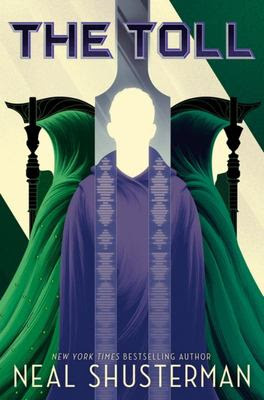
 | The Toll ('Arc of Sythe' #3) by Neal Shusterman {Reviewed by STELLA} The 'Arc of a Scythe' series is now concluded with the third instalment, The Toll. Greyson Tolliver has been claimed by the Tonists, Citra and Rowan have disappeared, presumed drowned (or devoured by flesh-eating fish) when the floating island of Endura was destroyed, Scythe Goddard is all-powerful and set on world domination, and the Thunderhead is silent. For those who haven’t read the previous books (Scythe and Thunderhead) in this intense young-adult series, here’s a quick breakdown: Earth is no longer ruled by elected representatives or despots, nor heading towards oblivion due to climate crisis, overpopulation and lack of resources. The Thunderhead, an AI, all-seeing and all-knowing, keeps the planet in equilibrium in a practical, emotional and intellectual sense. The world population is kept in balance with available resources and, while humans can age and die naturally, many choose to reset (put the clock back) and live another life. To give humans some sense of chance, there is the Scythedom — a group of special ‘cullers’ — ethical and trained to impart death without pain and with consideration. Each Scythe has a yearly quota which they may not exceed and a code of honour which must be upheld. New apprentices are taken on every few years and here’s where the story begins. Citra and Rowan — two teenagers are chosen, much to their abhorrence, to be Scythe apprentices (no one likes the Scythes — they are the bogeymen who come a-knocking), and, strangely, their teacher, Scythe Faraday has chosen two but only one can succeed. Citra and Rowan are pitted against each other and the backdrop is a Scythedom on the edge of turmoil. Different factions are at loggerheads about the rules. Some, like Goddard, want more autonomy — their egos are huge and their desire to kill outweighs their responsibility to the Scythe purpose — to keep the population in check. In the first book, we follow the trials and tribulations of Citra and Rowan — the passions, power and loyalties that drive them and send them into fields of ethical dilemma. In the second book, Thunderhead, we are introduced in greater detail to the Thunderhead (especially through the flawed character of Greyson Tolliver), the larger world and machinations of the Scythedom, Nimbus agents (like the FBI), the Tonists (a religious cult), and the Unsavouries (those whom the Thunderhead has deemed unworthy and cut communication with). Driving through this is Goddard’s increasing influence and power, culminating in a dramatic moment for the Scythedom and devastation for Citra and Rowan. It’s a cliffhanger book 2! So The Toll has been highly anticipated by fans. Greyson Tolliver plays a larger role in this book as the Toll — the only human left with open contact to the Thunderhead. Everyone else has been rendered 'unsavoury' and is no longer able to make direct contact with the AI. This is shocking for the human population who have had the Thunderhead (all-hearing, all-seeing) with them since birth — always there, always caring, and always knowing what was best. We are also introduced a new cast of characters. Jericho, a gender-fluid Madagascan captain on a salvage ship; Loriana, a Nimbus agent who comes into her own; and Scythes from the southern Americas and African sub-continent. Further developed is the archivist and librarian Munira, and Scythe Faraday is back in the mix. As the tension builds with the further rise of Goddard the plot picks up to a rip-roaring pace. Fear and power are his tools and while some resist, they are easily cut down as Goddard’s influence increases. Yet The Toll has a quiet power and The Thunderhead is using all its capacities to make the world better again. There are some excellent reflective moments in The Toll with the Thunderhead becoming a more conscious being — moving from perfection to doubt to improvement (possibly). Shusterman keeps the pace going but does not shy from moments of quiet and solitude — time for his characters to figure out who they are and what they desire. The 'Arc of a Scythe' series is more than an action-packed dystopia, it lays out a question for us to consider — what kind of future world do we desire and can this be a hopeful one? |
 |
Pond by Claire-Louise Bennett {Reviewed by THOMAS}
“English, strictly speaking, is not my first language by the way. I haven’t yet discovered what my first language is so for the time being I use English words in order to say things.” Always hinting at experience just beyond the reach of language, Bennett's remarkable book is impelled by the rigours of noticing. Encounters with persons and with the infraordinary are treated with equivalence: acute, highly acute, overly acute, observations immediately plunge the narrator’s awareness into the depths of her response (“My head is turned by imagined elsewheres and hardly at all by present circumstances.”), far from the surface at which outward contact may be made, or may be being made, a process that is both deeply isolating, terrifying and protective. Bennett’s unsparingly acute observations of the usually unacknowledged or unacknowledgeable motivations, urges and responses that underlie human interaction and quotidian existence seem here induced by an acceptance or a resignation that is enabled by despair, or is indistinguishable from despair, both a resignation and a panic, perhaps, a panic on the edge of self-dissolution which is perhaps our last resistance to self-dissolution and therefore fundamental to individual existence: the anxiety which all human activity is designed to conceal. Bennett’s is a very individual voice (click here to hear her read a sample), resonating at times with other works of irredeemably isolated interiority, such David Markson’s superb Wittgenstein’s Mistress or the suppressed hysteria of Thomas Bernhard’s narrators, but tracking entirely her own patterns of thought (I have perhaps made an error here of conflating the author with the narrator, but, if this is an error, it is one hard to avoid in the book in which style and content are inseparable) with an immediacy that precludes the artificially patterning, pseudo-assimilable explanation of a ‘story’. In one excellent section, ‘Control Knobs’, the narrator describes the gradual disintegration of the three knobs that control her cooker and speculates a coming time when the last interchangeable knob breaks and the cooker will become unusable. This reminds her of the counted matches in Marlen Haushofer’s The Wall (another novel of irredeemably isolated interiority), which mark the time to the point at which that narrator will no longer be able to light a fire to cook and warm herself. Following a discussion of Bennett’s narrator’s reading and misreading of that book, she returns to an account of the ultimate hopelessness of her attempts to procure new knobs for her cooker. “I feel at a loss for about ten minutes and it’s a sensation, I realise, not dissimilar to indifference. So, naturally, I handle it rather well.”
|
NEW RELEASES
 Some Trick: Thirteen stories by Helen DeWitt $32
How is it possible to live a life of the mind in a world that opposes even the slightest possibility of such a thing occurring? Is DeWitt the modern-day Gogol or Calvino?
"DeWitt's style is brilliantly heartless, and cork-dry; original herself, she is a witty examiner of human and cultural eccentricity. She can take a recognisable social situation or fact and steadily twist it into a surrealist skein." —James Wood, The New Yorker
"Brilliant and inimitable Helen DeWitt: patron saint of anyone in the world who has to deal with the crap of those in power who do a terrible job with their power, and who make those who are under their power utterly miserable. Certain stories have something in common with dreams: they’re expressions of the creator’s wish-fulfillment. Helen DeWitt’s wishes are distinct in American literature — in world literature, as far as I know." —Sheila Heti
>>Helen DeWitt has your number.
 Arboretum by David Byrne $45
In a wonderful series of eccentric annotated drawings — each in the form of a tree! — Byrne presents his thoughts about just about every human foible, habit and concept with the same gusto, irony and individual flair that he brings to both his music and his writing.
>>Stop making sense.
 At the Pond: Swimming at the Hampstead Ladies' Pond by
Ava Wong Davies, Margaret Drabble, Esther Freud, Nell Frizzell, Eli Goldstone, Amy Key, Jessica J. Lee, Sophie Mackintosh, So Mayer, Deborah Moggach, Nina Mingya Powles, Leanne Shapton, Lou Stoppard and Sharlene Teo $25
Esther Freud describes the life-affirming sensation of swimming through the seasons; Lou Stoppard pays tribute to the winter swimmers who break the ice; Margaret Drabble reflects on the golden Hampstead days of her youth; Sharlene Teo visits for the first time; and Nell Frizzell shares the view from her yellow lifeguard’s canoe.
>>Three writers dive in.
>>Read Esther Freud's piece.
>>The best place in the world.
 Self-Portrait by Celia Paul $55
"I'm not a portrait painter. If I'm anything, I have always been an autobiographer." From her move to the Slade School of Fine Art at sixteen, through a profound and intense affair with the older and better-known artist Lucian Freud, to the practices of her present-day studio, Paul meticulously assembles the surprising, beautiful, haunting scenes of a life. Paul brings to her prose the same qualities that she brings to her art: a brutal honesty, a delicate but powerful intensity, and an acute eye for visual detail.
"I had to make this story my own."
 2040 AD (McSweeney's Quarterly Concern #58) edited by Claire Boyle $50
A special issue wholly focused on climate change with original speculative fiction from twelve noted contributors in collaboration with twelve scientists. Global in scope, each story is focused on one part of the dire warnings issued by the 2018 Intergovernmental Report on Climate Change. Featuring Tommy Orange, Elif Shafak, Luis Alberto Urrea, Asja Bakic, Rachel Heng, and more.
>>"Given the dire news surrounding climate change, are you hopeful for the future?"
 How the Brain Lost its Mind: Sex, hysteria and the riddle of mental illness by Allan Ropper and B.D. Burrell $33
In 1882, Jean-Martin Charcot was the premiere physician in Paris, having just established a neurology clinic at the infamous Salpetriere Hospital, a place that was called a 'grand asylum of human misery'. Assessing the dismal conditions, he quickly set up to upgrade the facilities, and in doing so, revolutionised the treatment of mental illness. Many of Carcot's patients had neurosyphilis (the advanced form of syphilis), a disease of mad poets, novelists, painters, and musicians, and a driving force behind the overflow of patients in Europe's asylums. The trend of neurology at the time, though, led towards hypnosis and the treatment of the mind and away from medicine and the treatment of the brain. Does the relationship between psychology and neurology mirror that between the mind and the body?
 Broken Stars: Contemporary Chinese science fiction translated and edited by Ken Liu $23
The anthology features works of hard science fiction, cyberpunk, science fantasy, and space opera, as well as genres with deeper ties to Chinese culture: alternate Chinese history, chuanyue time travel, satire with historical and contemporary allusions. Stories include: "Goodnight, Melancholy" by Xia Jia, "The Snow of Jinyang" by Zhang Ran, "Broken Stars" by Tang Fei, "Submarines" by Han Song, "Salinger and the Koreans" by Han Song, "Under a Dangling Sky" by Cheng Jingbo, "What Has Passed Shall in Kinder Light Appear" by Baoshu, "The New Year Train" by Hao Jingfang, "The Robot Who Liked to Tell Tall Tales" by Fei Dao, "Moonlight" by Liu Cixin, "The Restaurant at the End of the Universe: Laba Porridge" by Anna Wu, "The First Emperor's Games" by Ma Boyong, "Reflection" by Gu Shi, "The Brain Box" by Regina Kanyu Wang, "Coming of the Light" by Chen Qiufan, "A History of Future Illnesses" by Chen Qiufan. Essays: "A Brief Introduction to Chinese Science Fiction and Fandom," by Regina Kanyu Wang,
"A New Continent for China Scholars: Chinese Science Fiction Studies" by Mingwei Song, "Science Fiction: Embarrassing No More" by Fei Dao.
 Nam June Paik by Sook-Kyung Lee and Rudolf Frieling $55
An early adopter of digital technologies and new media, Nam June Paik (1932-2006) was in many ways the founder of video art. His cutting-edge, innovative, yet playfully entertaining work continues to be a major influence on art and culture.This ground-breaking publication focuses on Paik's role in the cross-germination of radical aesthetics and experimental practices.
>>Charlotte Moorman performs Nam June Paik's 'TV Cello' (1976).
 The Other Bennet Sister by Janice Hadlow $38
It is a sad fact of life that if a young woman is unlucky enough to come into the world without expectations, she had better do all she can to ensure she is born beautiful. To be handsome and poor is misfortune enough; but to be both plain and penniless is a hard fate indeed. In Jane Austen's Pride and Prejudice, Mary is the middle of the five Bennet girls and the plainest of them all, so what hope does she have? Prim and pious, with no redeeming features, she is unloved and seemingly unlovable. The Other Bennet Sister, though, shows another side to Mary. An introvert in a family of extroverts; a constant disappointment to her mother who values beauty above all else; fearful of her father's sharp tongue; with little in common with her siblings - is it any wonder she turns to books for both company and guidance?
Immersive and engaging." —Guardian
 Ocean Sea by Alessandro Baricco $23
At the Almayer Inn, a remote shoreline hotel, an artist dips his brush in a cup of ocean water to paint a portrait of the sea. A scientist pens love letters to a woman he has yet to meet. An adulteress searches for relief from her proclivity to fall in love. And a sixteen-year-old girl seeks a cure from a mysterious condition which science has failed to remedy. When these people meet, their fates begin to interact.
 The Existentialist's Survival Guide: How to live authentically in an inauthentic age by Gordon Marino $37
What can Kierkegaard and the philosophers who came after him tell us about how to live now?
"Brilliant. Gives existentialism a 21st-century presence that is gripping, nuanced and convincing. The prose is electric, illustrating that existentialism is also literary." —The Los Angeles Review of Books
 A Political History of the World: Three thousand years of war and peace by Jonathan Holslag $26
In three thousand years of history, China has spent at least eleven centuries at war. The Roman Empire was in conflict during at least 50 per cent of its lifetime. Since 1776, the United States has spent over one hundred years at war. The dream of peace has been universal in the history of humanity. So why have we so rarely been able to achieve it?
 The Science of Being Human: Why we behave, think and feel the way we do by Marty Jopson $27
Starting with evolutionary biology and what it physically means to be a human being, this book moves on to include a wide range of topics such as artificial intelligence, virtual reality and how we are evolving as we interact with new technology.
 10 Voyages through the Human Mind edited by Catherine de Lange $30
Undoubtedly the most complex material in the universe, the human brain makes us who we are, but how it works and why has long been a mystery. Through this series of fascinating lectures at The Royal Institution, spanning over a hundred years, experts in the fields of psychology, neurology and biology examine the workings of our most important organ, revealing a hidden and complex world.
 Address Unknown by Kathrine Kressmann Taylor $23
First published in 1938, this novel told in letters between a Jew in America and his German friend demonstrates the way in which society is poisoned at all levels by fascism.
 Nightmareland: Travels at the borders of sleep, dreams, and wakefulness by Lex Lonehood Nover $37
Encompassing accepted medical phenomena such as sleep paralysis, parasomnias, and Ambien "zombies," and the true-crime casebook of those who kill while sleepwalking, to supernatural elements such as the incubus, alien abduction, and psychic attacks, Nover brings readers on an extraordinary journey through history, folklore, and science, to help us understand what happens when we sleep.
How is it possible to live a life of the mind in a world that opposes even the slightest possibility of such a thing occurring? Is DeWitt the modern-day Gogol or Calvino?
"DeWitt's style is brilliantly heartless, and cork-dry; original herself, she is a witty examiner of human and cultural eccentricity. She can take a recognisable social situation or fact and steadily twist it into a surrealist skein." —James Wood, The New Yorker
"Brilliant and inimitable Helen DeWitt: patron saint of anyone in the world who has to deal with the crap of those in power who do a terrible job with their power, and who make those who are under their power utterly miserable. Certain stories have something in common with dreams: they’re expressions of the creator’s wish-fulfillment. Helen DeWitt’s wishes are distinct in American literature — in world literature, as far as I know." —Sheila Heti
>>Helen DeWitt has your number.
In a wonderful series of eccentric annotated drawings — each in the form of a tree! — Byrne presents his thoughts about just about every human foible, habit and concept with the same gusto, irony and individual flair that he brings to both his music and his writing.
>>Stop making sense.
Ava Wong Davies, Margaret Drabble, Esther Freud, Nell Frizzell, Eli Goldstone, Amy Key, Jessica J. Lee, Sophie Mackintosh, So Mayer, Deborah Moggach, Nina Mingya Powles, Leanne Shapton, Lou Stoppard and Sharlene Teo $25
Esther Freud describes the life-affirming sensation of swimming through the seasons; Lou Stoppard pays tribute to the winter swimmers who break the ice; Margaret Drabble reflects on the golden Hampstead days of her youth; Sharlene Teo visits for the first time; and Nell Frizzell shares the view from her yellow lifeguard’s canoe.
>>Three writers dive in.
>>Read Esther Freud's piece.
>>The best place in the world.
"I'm not a portrait painter. If I'm anything, I have always been an autobiographer." From her move to the Slade School of Fine Art at sixteen, through a profound and intense affair with the older and better-known artist Lucian Freud, to the practices of her present-day studio, Paul meticulously assembles the surprising, beautiful, haunting scenes of a life. Paul brings to her prose the same qualities that she brings to her art: a brutal honesty, a delicate but powerful intensity, and an acute eye for visual detail.
"I had to make this story my own."
A special issue wholly focused on climate change with original speculative fiction from twelve noted contributors in collaboration with twelve scientists. Global in scope, each story is focused on one part of the dire warnings issued by the 2018 Intergovernmental Report on Climate Change. Featuring Tommy Orange, Elif Shafak, Luis Alberto Urrea, Asja Bakic, Rachel Heng, and more.
>>"Given the dire news surrounding climate change, are you hopeful for the future?"
In 1882, Jean-Martin Charcot was the premiere physician in Paris, having just established a neurology clinic at the infamous Salpetriere Hospital, a place that was called a 'grand asylum of human misery'. Assessing the dismal conditions, he quickly set up to upgrade the facilities, and in doing so, revolutionised the treatment of mental illness. Many of Carcot's patients had neurosyphilis (the advanced form of syphilis), a disease of mad poets, novelists, painters, and musicians, and a driving force behind the overflow of patients in Europe's asylums. The trend of neurology at the time, though, led towards hypnosis and the treatment of the mind and away from medicine and the treatment of the brain. Does the relationship between psychology and neurology mirror that between the mind and the body?
The anthology features works of hard science fiction, cyberpunk, science fantasy, and space opera, as well as genres with deeper ties to Chinese culture: alternate Chinese history, chuanyue time travel, satire with historical and contemporary allusions. Stories include: "Goodnight, Melancholy" by Xia Jia, "The Snow of Jinyang" by Zhang Ran, "Broken Stars" by Tang Fei, "Submarines" by Han Song, "Salinger and the Koreans" by Han Song, "Under a Dangling Sky" by Cheng Jingbo, "What Has Passed Shall in Kinder Light Appear" by Baoshu, "The New Year Train" by Hao Jingfang, "The Robot Who Liked to Tell Tall Tales" by Fei Dao, "Moonlight" by Liu Cixin, "The Restaurant at the End of the Universe: Laba Porridge" by Anna Wu, "The First Emperor's Games" by Ma Boyong, "Reflection" by Gu Shi, "The Brain Box" by Regina Kanyu Wang, "Coming of the Light" by Chen Qiufan, "A History of Future Illnesses" by Chen Qiufan. Essays: "A Brief Introduction to Chinese Science Fiction and Fandom," by Regina Kanyu Wang,
"A New Continent for China Scholars: Chinese Science Fiction Studies" by Mingwei Song, "Science Fiction: Embarrassing No More" by Fei Dao.
An early adopter of digital technologies and new media, Nam June Paik (1932-2006) was in many ways the founder of video art. His cutting-edge, innovative, yet playfully entertaining work continues to be a major influence on art and culture.This ground-breaking publication focuses on Paik's role in the cross-germination of radical aesthetics and experimental practices.
>>Charlotte Moorman performs Nam June Paik's 'TV Cello' (1976).
It is a sad fact of life that if a young woman is unlucky enough to come into the world without expectations, she had better do all she can to ensure she is born beautiful. To be handsome and poor is misfortune enough; but to be both plain and penniless is a hard fate indeed. In Jane Austen's Pride and Prejudice, Mary is the middle of the five Bennet girls and the plainest of them all, so what hope does she have? Prim and pious, with no redeeming features, she is unloved and seemingly unlovable. The Other Bennet Sister, though, shows another side to Mary. An introvert in a family of extroverts; a constant disappointment to her mother who values beauty above all else; fearful of her father's sharp tongue; with little in common with her siblings - is it any wonder she turns to books for both company and guidance?
Immersive and engaging." —Guardian
At the Almayer Inn, a remote shoreline hotel, an artist dips his brush in a cup of ocean water to paint a portrait of the sea. A scientist pens love letters to a woman he has yet to meet. An adulteress searches for relief from her proclivity to fall in love. And a sixteen-year-old girl seeks a cure from a mysterious condition which science has failed to remedy. When these people meet, their fates begin to interact.
What can Kierkegaard and the philosophers who came after him tell us about how to live now?
"Brilliant. Gives existentialism a 21st-century presence that is gripping, nuanced and convincing. The prose is electric, illustrating that existentialism is also literary." —The Los Angeles Review of Books
In three thousand years of history, China has spent at least eleven centuries at war. The Roman Empire was in conflict during at least 50 per cent of its lifetime. Since 1776, the United States has spent over one hundred years at war. The dream of peace has been universal in the history of humanity. So why have we so rarely been able to achieve it?
Starting with evolutionary biology and what it physically means to be a human being, this book moves on to include a wide range of topics such as artificial intelligence, virtual reality and how we are evolving as we interact with new technology.
Undoubtedly the most complex material in the universe, the human brain makes us who we are, but how it works and why has long been a mystery. Through this series of fascinating lectures at The Royal Institution, spanning over a hundred years, experts in the fields of psychology, neurology and biology examine the workings of our most important organ, revealing a hidden and complex world.
First published in 1938, this novel told in letters between a Jew in America and his German friend demonstrates the way in which society is poisoned at all levels by fascism.
Encompassing accepted medical phenomena such as sleep paralysis, parasomnias, and Ambien "zombies," and the true-crime casebook of those who kill while sleepwalking, to supernatural elements such as the incubus, alien abduction, and psychic attacks, Nover brings readers on an extraordinary journey through history, folklore, and science, to help us understand what happens when we sleep.

 | The Starless Sea by Erin Morgenstern {Reviewed by STELLA} Anticipation is a dangerous thing. Erin Morgenstern had a bestseller — a phenomenon — with her debut, The Night Circus. The book is about a mystical black and white circus, star-crossed lovers, competitive magicians and a cast of acts fantastic in all their endeavours, as well the circus devotees in all their guises. Some readers watched for that circus to pop up unexpectedly in their neighbourhood. It’s been eight years between books, and this one will thrill some, but not everyone. More magical, more fantastical and more complex, The Starless Sea isn’t for the fainthearted. It has stories within stories, books hidden in libraries, doors that appear to chosen individuals only to lead them into the caverns and winding underworld pathways of misinformation, discovery and confusion; dead ends, surprises, beauty and words, stories forever and ever. It’s whimsical as well as captivating, full of symbolism, borrowings (fantasy tropes) and myth. Opening with an imprisoned pirate telling tales to a woman who will rescue him, only for that rescue to be thwarted elsewhere in the book, we flip to completely different stories in the next few chapters. The first part of this novel feels disjointed, but bear with it: as part of the charm of these stories is that they reappear, develop and intertwine throughout the book alongside the main characters' discoveries in the world beyond the mysterious doors. Zachery Ezra Rawlins — a senior university student — is spending his term break reading his way through the library. When he comes across a book out of place he goes to check it out to find that it isn’t recorded in the library’s catalogue. A manual entry is made and Zachery heads home with it only to discover that this strange book is telling his own story — part of it. The tale is of a boy who discovers a painted door on a wall, an image so realistic that it seems like you could reach out, turn the handle, open the door and step through. The boy hesitates and walks on. The next day the door is gone. This childhood memory is revived, and Zachery, understandably, is disconcerted. His fascination with this book leads to some detective work on his part and he takes himself off to New York to a masked ball — a fundraiser for the Trust connected to the mysterious book. Here Zachery meets the stunning and enigmatic Mirabel (a woman from the world beyond the doors) as well as the attractive Damian who sets him a task — one which will plunge him into the labyrinthine world of the Starless Sea. Part of the enjoyment of this novel is piecing the bits of the puzzle together. What is the Starless Sea? Why do some want to preserve it while others wish to destroy it? There are nods to many other fables and myths, as well as to contemporary literary fantasy worlds, and while this is sometimes distracting it is also part of the cosmos Morgenstern has built. Stories within stories within books, and books pulled apart and thrown to the wind — pages folded into origami stars and floated upon the strange sea, others cast off on ribbons — their words mingling and changing. In The Night Circus Morgenstern created vivid imagery, and here she again plays with descriptive metaphor and symbols, adding to the mix a heady scent — the forest comes alive with the smell of trees, humus and needles, the charred remains of a room a lingering reminder of things gone wrong, the sweet cloying smell of honey — close and insular but overwhelming. Will Zachery find his fate? Will Mirabel change hers? And will the young lovers find each other in the pages of a book or be consumed by the Starless Sea — a thing of beauty and threat? |
 |
Summer in Baden-Baden by Leonid Tsypkin {Reviewed by THOMAS}
Nothing drives an obsession to unsustainable extremes more than the unnameable terror that a more moderate degree of love would be overwhelmed by its complementary revulsion. Our so-called cultural artefacts and so-called social institutions are, likewise, mechanisms for privileging one pole of an ambivalence, mechanisms for giving a (usually) positive cast to what we think of as our individual or communal selves. For some individuals, including, seemingly, Leonid Tsypkin and, especially, Fyodor Dostoyevsky (the ostensible subject of Tsypkin’s novel), whatever it is that separates the existential extremes is either exceptionally rigid and brittle or unusually permeable when unattended or in some way unreliable or, possibly, sporadically assailable, which enables, for those individuals, transports both of remarkable insight and of psychological risk. In Tsypkin’s novel, the narrator Tsypkin (or ‘Tsypkin’) is travelling by train from Moscow to Petersburg to visit the Dostoyevsky museum. As he travels, he reads the diary of Dostoyevsky’s young second wife Anna concerning their time spent in Europe, mainly staying in various German towns and suffering, often, from the financial consequences of Fyodor’s gambling addiction (which he had written about in The Gambler and practiced thereafter). Tsypkin’s astounding book, in which each paragraph is a single virtuoso sentence building, often, to hysterical length, dissolves the distinctions between the author (or ‘author’) and his subject, slipping, unnoticed and often within a few clauses, over a century in time and deep into the inner life of Dostoyevsky, revealing the sufferings, tensions and passions that both caused hardship for Dostoyevsky and his wife and enabled Dostoyevsky to write novels of such psychological penetration. The uncommon access that the past has to the present and to cause harm there, what we might call memory, repeatedly damages Dostoyevsky — for instance the humiliations visited upon him during his imprisonment lead him to repeatedly set himself up for humiliations that replay that he had received at the hands of the commandant — but also provide him and us with an intimacy with aspects of human experience that might otherwise be inaccessible. Dostoyevsky’s cycles of enthusiasm and despair are described with great sympathy, both for him and for Anna, and Tsypkin’s unsparing portrayal of the faults of his literary hero produce a suitably ambivalent effect, often within a single sentence, moving at once towards both ridicule and sympathy (readers of Thomas Bernhard will appreciate the mastery here). How is it possible to love another (as Tsypkin loves Dostoyevsky, as Anna loves Fyodor) despite their faults, despite, even, their unforgivable faults? “Why was I so strongly attracted and enticed by the life of this man?” asks Tsypkin, who, like many other Jews, has found that Dostoyevksy and his novels possess a “special attraction” despite Dostoyevsky’s antisemitism. “It strikes me as strange to the point of implausibility that a man so sensitive in his novels to the sufferings of others, this jealous defender of the insulted and the injured … despised me and my kind.” While keeping strictly to biographical fact, Tsypkin has written a novel that provides the sort of psychological insight that is only available through fiction.
|

>>Read Thomas's review.
>>"There's no such thing as no style."
>>On balance and coherence.
>>"A few words well chosen."
>>"Language is character."
>>A writer's writer's writer.
>>Advice to the young.
>>The art of fiction.
>>"Honour the syntax."
>>"My style is a reaction to Proust's long sentences."
>>"Did the idea of having your language corrected have a repressive effect on your talking?"
>>Davis's short — and often very short — stories are exemplars of the form, and her translations are outstanding.
NEW RELEASES

In 1934, the Austrian painter Christiane Ritter travelled to the remote Arctic island of Spitsbergen to spend a year with her husband, an explorer and researcher. They lived in a tiny ramshackle hut on the shores of a lonely fjord, hundreds of miles from the nearest settlement. At first, Christiane is horrified by the freezing cold, the bleak landscape the lack of equipment and supplies, but as time passes, and after encounters with bears and seals, long treks over the ice and months on end of perpetual night, she finds herself falling in love with the Arctic's harsh, otherworldly beauty, gaining a sense of inner peace and a new appreciation for the sanctity of life. A rediscovered classic.

Benson says that the terrifying sequence of Zeus poems that form the first half of Vertigo & Ghost emerged from ‘a long buried experience, and then a sudden pouring-in of words, that I can only explain as coming out of the woods’. The sequence makes palpable the sexualised violence latent in Greek mythology, with Zeus as abuser-in-chief, abetted and feared. It is followed by an exploration of the complex and ambivalent terrain of early motherhood.
Winner of the 2019 Forward Prize.
>>Interview.
>>In conversation with Daisy Johnson.

Really good. See also A Maori Word a Day.

109 photographs taken between 1962 and 1971 in what was Czechoslovakia (Bohemia, Moravia and Slovakia), Romania, Hungary, France and Spain. A unique record of a vanished world.

A lonely psychiatrist in 1948 is preparing fro retirement when he is drawn to a seemingly fragile woman who comes to him as a patient.
"A shrewd, skilful tale of loneliness, the search for meaning and a place in the world, and the problems of truly relating to another human being.” —Independent

The Summer Isles are a sporadically inhabited archipelago off the west coast of the Scottish Highlands. Marsden reached them by sailing along the exposed western coasts of Ireland and Scotland. It is a course that has been followed for centuries by explorers and adventurers, fishermen and monks, all drawn to the western seas and their distant horizons. Combining travel writing, memoir and cultural history, this is a book about the search for real places, for imagined places, and for places that might always exist somewhere in between. Beautifully written.

A record of how a future Moscow was envisioned by a bold generation of architects in the 1920s and early 1930s. Through a wealth of rarely seen material, this book provides a window into an idealistic fantasy of the Soviet capital that was never realised and has since been largely forgotten. Focusing on six unbuilt architectural landmarks, Imagine Moscow explores how these projects reflected changes in everyday life and society following the Revolution.

“The material universe and consciousness are made out of the same stuff.” —Ernst Schrödinger
Is consciousness one of the fundamental properties of all matter? How would our understanding of our universe be altered if we took this to be the case?
"An illuminating introduction to the topic of consciousness. It addresses the real issue — unlike almost all recent popular books on this subject. It stands a good chance of delivering the extremely large intellectual jolt that many people will need if they are to get into (or anywhere near) the right ballpark for thinking about consciousness. This is a great thing." —Galen Strawson, Guardian

Breeze block is back. This surge of interest in the material, though, is more than a nostalgic yearning for the golden years of modernism. Contemporary designers are not only rediscovering the forgotten qualities that made it such an appealing medium for mid-century architects, but finding new ways to enhance and exploit them.

The Marquise of O— by Heinrich von Kleist $28
A crisp new translation by Nicholas Jacob of Kleist's comic novel of the clash between sexuality and respectability, set in northern Italy during the Napoleonic Wars.

How does our perception of the world change in the course of a lifetime? When Heike Faller's niece was born she began to wonder what we learn in life, and how we can talk about what we have learnt with those we love. And so she began to ask everyone she met, what did you learn in life? Out of the answers of children's writers and refugees, teenagers and artists, mothers and friends, came 99 'lessons' — each here delightfully illustrated by Valerio Vidali.

A hilarious collection of essays from "the premier observer of our world and its weirdnesses." —Adam Kay

Showcasing Hervé's signature bold colours and minimalist shapes and lines, this wildly graphic and highly intuitive card game will unlock every young (and old) artist's creative potential. Select WHAT to draw from one deck and HOW to draw it from the other; then flick the colourful spinner wheel to randomise the options. From "draw a tree with your eyes closed" to "draw a friend... upside down!", the combinations are endless — and endlessly fun!

 | The Man Who Saw Everything by Deborah Levy {Reviewed by STELLA} Deborah Levy’s books are not what you expect and are better for it. A simple story-line, not predictable but understandable, is usually where she opens — but where she ends is a place of surprise and delight. And always with elegance and tenacity. Levy’s last three novels, including this one, The Man Who Saw Everything, have been long-listed for the Booker Prize. In The Man Who Saw Everything, Saul Adler is a young historian fooling around with his art student girlfriend Jennifer Moreau and readying himself to visit East Germany as part of his research. It’s 1988, just a few years before The Wall comes down. Adler is good-looking and idealistic, somewhat perplexed by his girlfriend, haunted by his mother’s death (he was twelve when she died in an accident) and tormented by his bullying father and brother. When we meet Saul has just been knocked down by a car on a pedestrian crossing. Bruised and a bit bloody he gets himself sorted and limps on to Jennifer's flat. Jennifer Moreau — photographer. Favourite subject of her final year exhibition — Saul Adler and his body. Or so he thinks: “It’s like this Saul Adler: the main subject is not always you. It’s like this Jennifer Moreau: you have made me the main subject.” In this situation, Levy turns the artist's-muse-as-role in on itself, reversing the gender stereotypes. In her work later, Jennifer Moreau is recognised for her observing eye — her ability to see a body in all its fragments through the lens. Saul is banned from saying anything about Moreau’s ‘beauty’ and must be content with the role of the observed rather than the observer. A day like any other — sex with Jennifer in the afternoon — turns out to be the last day of their relationship. Jennifer Moreau is off to America, and when Saul proposes she sends him packing. In East Germany, he meets Walter Müller and his sister Luna. He falls in love with Walter, sleeps with both Walter and Luna, and proceeds to make a hash of his time in East Germany by putting them both under suspicion with the local Stasi. Or so he thinks. There are some clues in this part of the novel to the state of Saul Alder’s mind — he is somewhat paranoid — often questioning people’s behaviour towards him, and the black telephone he sees in Mrs Stechler’s flat in London and in Walter’s mother’s flat are too similar to be ignored, especially when starts tapping the wall, looking for something, but what he is not sure. Levy is playing with her reader, but in the most humorous of ways, as she unpacks Saul for us. And when we arrive in 2016 — Saul is knocked down for a second time on the same crossing — we sense that some cogs have become undone. This time there is no brushing himself off and limping to Jennifer Moreau’s place. He's in hospital and Jennifer is there, as is Rainer the East German informer, and his brother, Matt. As this section of the novel unfolds, you are cast into confusion — not helped by our narrator’s concussion. Memory and time are flipping over each other and Saul Adler is no longer a reliable narrator, but he is our only guide — so read the prompts carefully. It will be rewarding. Excellent writing from Levy reminds me why I return to her work and am always impressed just a little bit more by her concepts of the self, of identity, memory and the impact that human action (and inaction) has on the other and oneself. In The Man Who Saw Everything, she reminds us that the truth is within our grasp but easily clouded by our own disillusion and self-importance. |
 | Exposition by Nathalie Léger {Reviewed by THOMAS} What is the relation between an atemporal — or, rather, idiotemporal — work and the temporality — or evanescence — both of its creation and of its reading? In photography, as in literature, as in any of the so-called arts — and here we turn back before proposing a ‘useful’ definition of ‘art’ — it is the relationship between passing and unpassing time that forms the unterlayer of our understanding of the work, and of what, if anything, we can see beyond it, if it can be said to have a beyond, and, as with all relationships, whether in the arts or in society, the first question must always be one of power. Who or what is affected by who or what at the instigation of who or what? Which forces are here promulgated and which forces are resisted? What is revealed and what is — perhaps by that revelation — concealed? And, more interestingly, what is concealed and what is — perhaps by that concealment — revealed? The ostensible subject, so to call it, in any work of art is of relative insignificance to these considerations, and to the mechanisms of representation to which they give rise. Ostensibly concerning a four-decades-long series of photographs taken of the Countess Virginia Oldoini Castiglione by the Parisian society photographer Pierre-Louis Pierson from the 1850s to the 1890s, Exposition reveals Léger's thinking on exposure, concealment and over-exposure, on representation and self-representation, on the politics of the gaze especially when concerning the power or otherwise of women, on the limited and limiting truths of photography, on time and history, and also, half-reluctantly but therefore crucially, on uncomfortable aspects of her own family history (for instance, on a childhood photograph of Léger that shows her face peering through some bushes was taken by her father’s lover, who was aware that Léger was gazing at their dalliance when thinking herself unseen). “They contemplated her beauty the way people enjoyed freak shows,” says Léger of Castiglione. From her youth, through her time as mistress of Napoleon III in Second Empire France, through to her declining years, Castiglione was obsessed with the way in which she was seen and conscious always of controlling her self-representation, directing Pierson in a stupefying series of lavishly staged and costumed photographs, some recreating — faking — key moments in her life. This project, with its vapid and cloying results, is the work of a woman determined at all costs to keep a gaze upon her but to reveal nothing of herself. She appears “at once defiant and imploring,” both monstrous and needy. Her self-representation is not that of Cindy Sherman for the first gaze in Sherman’s photographs is Sherman’s own, whereas for Castiglione the first gaze is that of the passive, male, invisible photographer. There is a tyranny in her command of the gaze of others but also a desperation, an existential insecurity, a sense that the subject is lost to herself and — impossibly — seeks assurance in the response of others to the fake self she presents (and long before instagram, too). Photography, “her only mask”, is what makes her both visible and impossible to be seen. There is nothing to Castiglione below the surface — or at least not as far as we can tell — she has made herself into an object, her so-called “beauty” is a characterlessness, a blandness; she is an object that demands no sympathies other than admiration, if admiration can be considered a sympathy. Léger is, rightly, not interested in Castiglione beyond her photographic project, but she is interested in the spaces, the absences, in which the ungraspable could exist if it did exist (“Like death, and one or two other little things the subject is simply the name for what cannot be spoken.”). If ellipses are a means of removing content from a sentence without altering its meaning, how much content is the greatest amount that can be removed while preserving enough meaning to at least simulate coherence? At what point does the process of ellipsis itself become the meaning? (>>Read my review of Léger’s Suite for Barbara Loden here) |

>>Read Stella's review.
>>"Writing this book was a weird seance."
>>Reading.
>>"My novel is more about the space between what we see and misunderstand, rather than understand."
>>The Psychopathology of the Doppelgänger.
>>How to live with death.
>>Blurring vividly.
>>"The new generation of young women can change the world."
>>Other books by Deborah Levy.
>>Come and discuss the book on 13 February!
NEW RELEASES

Ostensibly concerning a four-decades-long series of photographs taken of the Countess Virginia Oldoini Castiglione from the 1850s to the 1890s, this subtle book reveals Léger's thinking on exposure, concealment and over-exposure, on the gaze and its relevance to the power-status of women, on the limited truths of photography, on time and history, and also, half-reluctantly on aspects of her own family history.
"In Nathalie Leger's magnificent text, everything is turned on its head, everything is paradox. Exposition is the fragile and dangerous attempt to reconstitute the self, to seek, in the secret of another woman the very thing that eludes us within ourselves. Thus it is the ellipsis (the blanks between the fragments) that gives Exposition its beauty and its truthfulness." —Les Inrockuptibles
>>Read an extract.

A sharp, innovative novella from the author of When I Hit You. Karim and Maya are lovers. They share a home, they worry about money, and then Maya falls pregnant. But Karim is still finishing his film degree, pushing against his tutors' insistence that his art must be Arab like him. And Maya, working a zero-hours job and fretting about her family, can't find the time to quit smoking, let alone have a child. Framed with fragments and peppered with footnotes Exquisite Cadavers is at once a bricolage of influence, and a love story that knows no borders.
"Fascinating." —Guardian

An idiosyncratic exploration of mass consumption, both physical and digital, through our relationship with food.
"Ed Atkins is the artist of ugly feelings — gruesome and smeared and depleted. But everything he does in his videos or paintings, I’ve always thought, he really does as a writer. He uses language as a system where everything gets reprocessed and misshapen – a unique and constant mislaying of tone that’s as dizzying as it’s exhilarating." —Adam Thirwell
"Violent, emetic, immoderate, improper, impure – that’s to say it’s the real thing. Atkins’s prose, which may not be prose, adheres to Aragon’s maxim 'Don't think – write'." —Jonathan Meades
>>An extract of Old Food.
>>Hear the author reading another extract.
>>Visit the exhibition.

Kings, lords, liars, usherettes, goal-hangers, gun-men and prostitutes, Whether or not these stories bear any relation to life as it is lived in Endland [sic] is not my problem and good riddance to all those what prefer to read about truly good, lucky and nice people — you won't like this crap at all.
A series of 39 cautionary tales for our digital age, Endland is comical and brutal, set in strangely familiar locations that at times seem like Thatcher-era Northern towns under military rule or post-Brexit council estates after a Farage party bender. And things are leaking into Endland from all over the place. Nothing is stable. Now is also then and next year, a landscape that is future and medieval at the same time. What's more, the gods have started drinking at lunchtime, which can only lead to trouble. In narratives working a bit like poetry or cartoons, in empty tower blocks, midnight diners and bomb-site cities, Endland is a dysfunctional mirror of England.
"Scabrous." —Guardian
>>Read an extract.
>>Forced Entertainment.
>>Swimming against the tide.
>>Tim Etchells, Collector of language.

What do we know? And how do we know it? These are essential questions to consider when a functioning democracy is reliant on an informed populace. Yet at this moment in the information age something has gone awry with our public knowledge. Are we cultivating an environment for the sharing of ideas? Who has access to the institutions and practices that hold our collective knowledge? Do we know when to act and when to delegate to experts? Is our education, in the broader sense of the term, sufficient for us to meaningfully participate in public life? From archives and mātauranga Māori to formal education models and knowledge types that inspire action, this multi-author book explores the state of our public knowledge, its potential and how it affects our public life and conversations. With the need to find responsive solutions to the challenges facing us, the health of our public knowledge matters to us all. Contributions by Barnaby Bennett (designer), Golriz Ghahraman (Member of Parliament), Gwynn Compton (public relations), Hannah Benbow (cartoon librarian). Jared Davidson (archivist & historian), Joseph Hullen (Ngai Tuahuriri/Ngati Hinematua), Lana Lopesi (editor), Marianne Elliott (researcher & advocate), Michael Macaulay (Victoria University), Morgan Godfery (writer & trade unionist), Nicola Gaston (University of Auckland), Ruth Boyask (Auckland University of Technology), Sacha McMeeking (researcher & commentator), Sally Blundell (journalist).

Is boredom the enemy of humanity? Does boredom mean our time is being wasted? In this thoughtful picture book, a boy finds that this seemingly stagnant state is actually a portal into a dynamic, mind-blowing experience.
>>All of Shinsuke Yoshitake's books are both thoughtful and playful.

Wark argues that the all-pervasive presence of data in our networked society has given rise to a new mode of production, one not ruled over by capitalists and their factories but by those who own and control the flows of information. Yet, if this is not capitalism anymore, could it be something worse? What if the world we're living in is more dystopian than the techno utopias of the Silicon Valley imagination? And, if this is the case, how do we find a way out?
>>The ideas behind the book.

In this hypersharp, subtle and humane novel, Ginzburg portrays a family drawn to the brink of an abyss by one of its member's absence. Introduction by Claire-Louise Bennett.
"Ginzburg's beautiful words have such solidity and simplicity. I read her with joy and amazement." —Tessa Hadley
>>Read an extract.
>>"The novel’s new English title is evocative. That comma is like the pre–big bang universe shrunk to a pinhead."
>>Read other books by Ginzburg.

"Hanne Ørstavik crafts an atmosphere of unease out of the ordinary. An old man giving a young boy a pair of skates, a man inviting a woman over for coffee, in Orstavik’s hands these seemingly harmless moments become filled with an underlying sense of dread. Longing and loneliness fill these pages, while always there is a sense of the impossibility of real understanding and connection between people. Ørstavik is a true observer of human nature and Love is her masterpiece." —Emily Ballaine
"In Hanne Ørstavik’s Love, the equilibrium between a tense, disquieting plot and a gently experimental binary structure sustain the reader’s attention and awe from beginning to end. The aerial beauty of Martin Aitken’s translation contributes to make the novel a successful rarity: a book that is at the same time a thriller and a dense literary object. 'Perfect' may be the proper adjective to describe it." —National Book Awards citation
"Love is Hanne Ørstavik’s strongest book." —Karl Øve Knausgaard

One of the most important designers and architects of the 20th century, Eileen Gray (1878-1976) wielded enormous influence — though often unacknowledged, especially in her lifetime — in a field largely dominated by men. Today, her iconic designs, including the luxurious Bibendum chair and the refined yet functional E.1027 table, are renowned throughout the world. Resolutely independent and frequently underappreciated, Gray evolved from a creator of opulent lacquer furniture into a pioneer of the modernist principle of form following function. Definitive.
>>See also the graphic novel A House Under the Sun.

As humans evolved, we developed technologies to modify our environment, yet these innovations are increasingly affecting our behavior, biology, and society, as well as having dangerous cumulative consequences for our habitat. Now we must figure out how to function in the world we've created. New Zealand author.

In the late nineteenth century, Tomo, the faithful wife of a government official, is sent to Tokyo, where a heartbreaking task is awaiting her. From among hundreds of geishas and daughters offered up for sale by their families she must select a respectable young girl to become her husband’s new lover. Externally calm, but torn apart inside, Tomo dutifully begins the search for an official mistress.

The characters in the stories in Hall's third collection walk, drive, dream, and fly, trying to reconcile themselves with their journeys through life, death, and love. Science fiction meets folktale and philosophy meets mortality. A woman with a new generation of pacemaker chooses to shut it down in the Lakeland, the site of her strongest memories. A man repatriated in the near east hears the name of an old love called and must unpack history's dark suitcase. From the new world-waves of female anger and resistance, a mythical creature evolves. And in the woods on the border between warring countries, an old well facilitates a dictator's downfall, before he gains power.
"Sarah Hall is one of those rare writers whose short fiction has the same luminosity as her novels. But the short form allows her more room to probe and roam, to experiment with form, to sink her fingers into the earth." —The Observer

Discover a realm of travel writing little-known in the West - a literary tradition extending over a thousand years: here are asobi, the wandering performers who prefigured geisha; travelling monks who sleep on pillows of grass and listen to the autumnal insects; and a young girl who passionately longs to travel to the capital and read more stories. Interesting.

An interesting history and study of what used to be considered a natural state but which is becoming an increasingly elusive accomplishment.

A guide to 100 Bauhaus structures throughout Germany, often in unexpected places.

The world is not always what we think it is. This book presents unusual borders, enclaves and exclaves, divided or non-existent cities and islands. Numerous conflicts have left countries divided and often shattered. Remnants of countries can by design or accident be left behind as a legal anomaly in this complex world.
Beautifully presented.

A writer tires of trying to improve the literary aspects of his writing and concentrates instead on improving his handwriting as an access route to success. The novelist begins to keep a notebook of handwriting exercises, hoping that if he is able to improve his penmanship, his personal character will also improve.

Stunning photographs of Soviet Metro Stations from across the former states of the USSR and Russia itself. Astounding.

The second of Markovits's projected three novels following the Essinger family is as sharp — and funny — as the first, A Weekend in New York.

A clear analysis of the ways in which fear, and especially induced fear, disempowers society, undermines democracy, and plays into the hands of unscrupulous leaders.

"A brave and beautiful exploration into food, race, memory and the very meaning of life. I read it greedily - and so will you." —Meera Sodha, author of Fresh India

Laurenzo and Jiacomo are identical twins, as alike as two drops of water. No one can tell them apart (which comes in very handy for playing tricks on their teachers). And no one can split them up. But when tragedy strikes their carefree young lives, they must make their own way in the world. As each brother chooses his own path - hardworking Laurenzo to make beautiful objects from gold and silver, and fearless Jiacomo to travel, explore and become an unlikely thief - it is the start of a series of incredible escapades that will test them to their limits. Along the way they will face terrible danger, solve cunning riddles, become prisoners in a castle, sail across the ocean, fall in and out of love, stay at an enchanted inn, help save a priceless pearl, even become kings by mistake. They must use all their talents, wiles and wisdom to survive. From the author of The Letter for the King.

"We've finished the earthly tsars and we're coming for the heavenly ones!" A wonderful assembly of Soviet anti-religious propaganda.

Use the selector to choose your seasonal gifts and summer reading.
Use the 'click and collect' function on our website to reserve your copies, or pay on-line for delivery anywhere (let us know if you'd like them gift-wrapped). If you don't find what you're looking for here, come and talk to us: we have many other interesting books on our shelves — or browse our website.
List #1: FICTION
List #3: SCIENCE & NATURE
List #4: FOOD & DRINK
List #5: BIOGRAPHY, MEMOIR & ESSAYS
List #6: CHILDREN'S NON-FICTION
List #7: NEW ZEALAND POETRY
List #8: HISTORY & POLITICS
List #9: VISUAL CULTURE
List #10: GRAPHIC NOVELS
List #6: CHILDREN'S NON-FICTION
List #7: NEW ZEALAND POETRY
List #8: HISTORY & POLITICS
List #9: VISUAL CULTURE
List #10: GRAPHIC NOVELS


 | I Who Have Never Known Men by Jacqueline Harpman {Reviewed by STELLA} Forty women are in an underground bunker with no clear understanding of their captivity. Why are they there? What was their life before? And as the years pass, what purpose do the guards, or those who employ the guards, have for them? The narrator of this story is a young woman—captured as a very young child—who knows no past: her life is the bunker. The women she lives with tolerate her but have little to do with her and hardly converse with her. She is not one of them. They have murky memories of being wives, mothers, sisters, workers. They know something catastrophic happened but can not remember what. The Child (nameless) is seen as other, not like them, not from the same place as them. The Child has been passing the days and the years in acceptance, knowing nothing else, but her burgeoning sexuality and her awareness of life beyond the cage (she starts to watch the guards, one young man in particular), limited as it is to this stark underground environment, also triggers an awakeness. She begins to think, to wonder and ask questions. As she counts the time by listening to her heartbeats and wins the trust of a woman in the group, The Child’s observations, not clouded by memories, are pure and exacting. We, as readers, are no closer to understanding the dilemma the women find themselves in, and like them are mystified by the situation. Our view is only that of The Child and what she gleans from the women—their past lives that are words that have little meaning to her, whether that is nature (a flower), culture (music) or social structures (work, relationships)—this world known as Earth is a foreign landscape to her. When the sirens go off one day, the guards abandon their positions and leave. Fortunately for the women, this happens just as they have opened the hatch for food delivery. The young woman climbs through and retrieves a set of keys that have been dropped in the panic. The women are free, but what awaits them is in many ways is another prison. Following the steps to the surface takes them to a barren plain with nothing else in sight. What is this place? Is it Earth? And where are the other people? Will they find their families or partners or other humans? The guards have disappeared within minutes—we never are given any clues to where they have gone—have they vapourised? Have they left in swift and silent aircraft? The women gather supplies, of which there are plenty, and begin to walk. I Who Have Never Known Men is a feminist dystopia in the likes of The Handmaid’s Tale or The Book of the Unnamed Midwife but is more silent, more internal and both frustrating and compelling. I found myself completely captivated by the mystery of this place and the certainty of the young woman. The exploration of humanity and its ability to hope and love within what we would consider a bleak environment, and the magnitude of one woman to gather these women to her and cherish them as they age is exceedingly tender. The introduction by Sophie MacKintosh ( author of The Water Cure), which I recommend reading after rather than before, adds another layer of meaning to the novel. I Who Have Never Known Men is haunting and memorable—a philosophical treatise on what it is to be alone and to be lonely, and what freedom truly is. |
 STELLA'S 'BOOKS OF THE YEAR':
1. I Who Have Never Known Men by Jacqueline Harpman
2. Spring by Ali Smith
3. The Absolute Book by Elizabeth Knox
4. The Secret Commonwealth by Philip Pullman
>> Read all of Stella's reviews.
 |
Malina by Ingeborg Bachmann {Reviewed by THOMAS}
“‘Today’ is a word that only suicides ought to be allowed to use, it has no meaning for other people.” Even five decades after it was written, this wholly remarkable book continues to reveal new possibilities in literature and new impossibilities in living.
In the first part of the book, ‘Happy With Ivan’, the unnamed narrator records her obsessive love affair with a man she first sees outside a florist’s shop near her home in Vienna. On account of Ivan, “the rest of the world, where I lived up to now — always in a panic, my mouth full of cotton, the throttle marks on my neck — is reduced to its petty insignificance.” She snatches evenings with Ivan, plays chess with him (resulting in stalemate), writes him letters (which she tears to shreds and throws away, unsent), and talks with him on the telephone, but, mainly, she waits and thinks and smokes. “Ever since I’ve been able to dial this number, my life has finally stopped taking turns for the worse, I’m no longer coming apart at the seams. I hold my breath, stopping time, and call and smoke and wait.” But hers is a desperate happiness, not a convincing happiness, not really happiness at all but a straining towards the impossibility of happiness, agitation trying to pass as happiness. Just as the difference between pleasure and irritation is generally merely a matter of degree, there is, for the narrator, no substantial difference between ostensibly contradictory states and the case for her happiness is made so strenuously that it is clearly made from a position of great unhappiness. Ivan lives along the street, but the narrator shares an apartment with Malina, a civil servant who works at the Austrian Military Museum but who is so compartmentalised in the narrator’s mind that he never makes contact with Ivan, or, rather, never enters the Ivan compartment in the narrator’s mind. Although the narrator interacts with Malina, and we are told of her visiting elsewhere with him, it is very unclear that Malina exists outside the narrator’s mind, or, rather, that he is not an aspect of the narrator. “Ivan hasn’t been warned about me. He doesn’t know with whom he’s running around, that he’s dealing with a phenomenon, an appearance that can also be deceiving, I don’t want to lead Ivan astray but he has never realised that I am double. I am also Malina’s creation.” I increasingly began to suspect that Ivan also exists, at least mostly, in the narrator’s mind, and that, although probably affixed to someone she saw outside the florist’s shop, the Ivan with whom this love affair persists is a never-quite-reachable eidolon of her longing and desperation. “My living body gives Ivan a reference point, maybe it’s the only one, but this same bodily self disturbs me. Extreme self-control lets me accept Ivan’s sitting opposite me.” Is there no exteriority? All these words, these truncated staccato telephone conversations, these endlessly commaed descriptions, these letters and interviews and documents in many versions, these moments and encounters, these details, these memories and revised memories, these stupendous rants, are they all the desperate invention of the narrator (in the same way that the novel is the desperate invention of the author)? “Whatever falls on my ground thrives, I propagate myself with words and also propagate Ivan.”
The second part of the book, ‘The Third Man’, intimates, perhaps, the degree of trauma that underlies the narrator’s agitation and the fracturing of her psyche. Passages, seemingly dreams or memories, describe violence, torment and sexual abuse, largely at the hands of the narrator’s father (and of, by extension, Austria and Nazism), enacted either upon the narrator or upon her naive and complicit alter ego Melanie. “Here there is always violence. Here there is always struggle.” Bachmann’s sentences offer no respite for the reader nor for the narrator. “I don’t want to be any more, because I don’t want war, then put me to sleep, make it end.” The dream sequences are interspersed with conversations, written as script, between the narrator and the rational, interrogating Malina, bringing into her awareness the nature of her trauma, and moving towards the possibility of understanding. “Although it disgusts me to look at him [father], I must, I have to know what danger is still written in his face, I have to know where evil originates.” But, Malina warns, “Once one has survived something the survival itself interferes with understanding.”
The third part, ‘Last Things’, charts the shrinking of the narrator’s world, her gradual inevitable loss of Ivan, either as reality or eidolon, her loss of confidence in herself or hope in her world — and it is much funnier than this list would suggest, though no less tragic. Experience, once replaced with knowledge of — or description of — experience, loses the power of experience. Language at once conjures and replaces — annihilates — what is lived. But, says the narrator, “I must have reached a point where thought is so necessary that it is no longer possible.” Her conversations with Malina drain the reality from Ivan and reveal her isolation and self-suffocation. “I am not one person,” she says, “but two people standing in extreme opposition to one another, which must mean I am always on the verge of being torn in two. If they were separated it would be livable, but scarcely the way it is.” The slow, cumulative, fatal intrusion of rationality is here like a pin being pushed against the surface of a balloon with great, horrible, slow, thrilling patience. “The story of Ivan and me will never be told, since we don’t have any story.” Literature is lack. All that is written is written against the facts. Happiness, or imagined happiness, becomes harder and harder and at last impossible to sustain. The narrator’s ‘I’, her subjective self, “an unknown woman”, catches a last whiff of Ivan in the crack in the wall, enters it and disappears, leaving the rational alter ego, Malina, the cataloguer, the explainer, the understanding mind, to answer the telephone when Ivan rings (their first encounter) and to deny her very existence. The book ends with the bare sentence, “It was murder,” but, if the characters are all fractured parts of a single mind (if there can be such a thing), what is the nature of this ‘murder’? “What is life?” asks Malina. “Whatever can’t be lived.”
|
 THOMAS'S 'BOOKS OF THE YEAR' (so to call them):
1. Malina by Ingeborg Bachmann
2. Ducks, Newburyport by Lucy Ellman
3. Lanny by Max Porter
4. Sleepless Nights by Elizabeth Hardwick
>> Read all of Thomas's reviews.
NEW RELEASES

Virginia and her cruel, beautiful brother, Daniel, grow up in a decaying country mansion. They leave for the city, but the change of locale leaves Virginia's internal life unperturbed. In intensely poetic language, Lispector conducts a stratigraphic excavation of Virginia's thoughts, revealing the drama of Clarice's lifelong quest to discover "the nucleus made of a single instant". Written when Lispector was 23.
"Sphinx, Sorceress. Sacred monster. The Chandelier offers an early glimpse of Clarice Lispector’s power." —The New York Times

How pleasant to know Mr Lear!
Who has written such volumes of stuff!
Some think him ill-tempered and queer,
But a few think him pleasant enough.
The writer of nonsense rhymes was also a serious painter and a gentle, melancholy man for whom the society he so amused with his verses made little room.
"Jenny Uglow has written a great life about an artist with half a life, a biography that might break your heart." —Robert McCrumb, Guardian

Black Mountain College had an explosive influence on American poetry, music, art, craft, dance, and thought; it’s hard to imagine any other institution that was so utopian, rebellious, and experimental. Founded with the mission of creating rounded, complete people by balancing the arts and manual labor within a democratic, nonhierarchical structure, Black Mountain was a crucible of revolutionary literature. Although this artistic haven only existed from 1933 to 1956, Black Mountain helped inspire some of the most radical and significant midcentury American poets. This anthology begins with the well-known Black Mountain Poets— Charles Olson, Robert Creeley, Robert Duncan and Denise Levertov—but also includes the artist Josef Albers and the musician John Cage, as well as the often overlooked women associated with the college, M. C. Richards and Hilda Morley.
>>Redefining the Black Mountain poets.
>>Expressions of something shared.

Each phase of his wandering life is included, from an essay written while still at Cambridge in 1921, through his fame in the aftermath of the publication of Lolita to the final interviews given shortly before his death in 1977.

In the years leading up to the Second World War, four sisters live in dilapidated houses in Osaka and Ashiya, and each navigate their own complex, personal relationship to the fading lustre of the Makioka family name. Rich with breathtaking descriptions of ancient customs and an ever-changing natural world, Junichiro Tanizaki evokes in loving detail a long-lost way of life even as it withers under the harsh glare of modernity.
"An exquisite novel about four sisters living though a turbulent decade. I'd put it in the 10 greatest books of the 20th century." —David Mitchell
"A near-perfect novel." —Hanya Yanagihara

The 2019 Nobel Laureates in Economics show how traditional western-centric thinking has failed to explain what is happening to people in a newly globalised world. This books shows why migration doesn't follow the law of supply and demand, and why trade liberalisation can drive unemployment up and wages down.

It's New Year's Eve, the holiday of forced fellowship, mandatory fun, and paper hats. While dining out with her husband and their friends, Bunny—an acerbic, mordantly witty, and clinically depressed writer—fully unravels. Her breakdown lands her in the psych ward of a prestigious New York hospital, where she refuses all modes of recommended treatment. Instead, she passes the time chronicling the lives of her fellow "lunatics" and writing a novel about what brought her there.
"There is a great deal of humor, compassion, and sensitivity for the material. Readers will quickly commit to this extraordinary novel. Laser-sharp prose, compelling observations, and an engaging, sympathetic central figure conspire to make it a page-turner. Rabbits for Food is an impressive achievement. It should be read as soon as possible." —Los Angeles Review of Books

An amnesiac detective on the streets of Paris is unaware that the person he seeks is himself, and that he in somehow implicated in something he cannot remember during the Nazi occupation.

In the Tokyo suburbs four women work the graveyard shift at a factory. Burdened with heavy debts, alienated from husbands and children, they all secretly dream of a way out of their dead-end lives. A young mother among them finally cracks and strangles her philandering, gambling husband. She confesses her crime to her colleagues and unexpectedly, they agree to help.

Do doctors really know what they are talking about when they tell us vaccines are safe? Should we take climate experts at their word when they warn us about the perils of global warming? Why should we trust science when our own politicians don't? In this landmark book, Naomi Oreskes offers a bold and compelling defense of science, revealing why the social character of scientific knowledge is its greatest strength, and the greatest reason we can trust it.

This history of a widow and her children whose lives were transformed by the conditions of her husband’s will takes readers to the violent frontiers where squatters ran sheep in South Australia and Victoria, to Melbourne, Ireland, England and, occasionally, New Zealand. Caroline’s Dilemma reveals much about women’s property rights, widowhood, sibling relations, migration, settler colonialism, and Catholic-Protestant conflict. It also reminds us why feminists in the 19th century fought so hard first for wives to retain control of their own property, then for limitations on husband’s rights to bequeath family property as they wished, and in the 1970s for fair division of matrimonial property when couples divorced. Both succession law and the question of couples’ claims on relationship property are once again on the legislative agenda in New Zealand, Australia and elsewhere.
>>Bettina Bradbury on Radio New Zealand.

Grace Wales Bonner is a 28 year old fashion designer from south-east London. She has been feted by the worlds of both serious culture and high glamour, but here’s the unusual part: her clothes come with reading lists. Interviewed by Booker Prize-winning author Ben Okri, Grace explains how she sees herself on some level as a researcher. She visits libraries, digests acres of complex ideas about politics and identity, and expresses them, among other things, via the realm of clothes.
The featured book of this issue is Joris-Karl Huysmans’s Against Nature (1884), supposedly the most decadent novel ever written. Its relentless inventory-keeping thrills and inspires some readers and baffles others, and is highly relevant to this season of non-stop accumulation. Contributors include Jarvis Cocker, Lydia Davis, Rob Doyle and Jeanette Winterson.
We have been asked to name OUR FAVOURITE BOOKS OF THE YEAR (so far). Click on the titles to read our reviews and to secure your own copies.
THOMAS:
1. Malina by Ingeborg Bachmann
2. Ducks, Newburyport by Lucy Ellman
3. Lanny by Max Porter
4. Sleepless Nights by Elizabeth Hardwick
>> Read all of Thomas's reviews.
STELLA:1. I Who Have Never Known Men by Jacqueline Harpman
2. Spring by Ali Smith
3. The Absolute Book by Elizabeth Knox
4. The Secret Commonwealth by Philip Pullman
>> Read all of Stella's reviews.