

| >> Read all Stella's reviews. | |
 | The Great Godden by Meg Rosoff {Reviewed by STELLA} Meg Rosoff’s new book for teens is a coming-of-age story that crosses a golden summer holiday with an unexpected sequence of events involving a Patricia-Highsmith's-Mr-Ripley character in the form of Kit Godden. Our narrator, never named and gender-neutral (there are no clues — the reader can decide), child number two in a family of four siblings, is our eyes and ears to this tale. The usual family antics play out as they arrive at their holiday home — the jostling of the siblings, the relief of being released from the squeeze of the car, and that marvellous sense of arrival in a place and pace both familiar and different from home. The holiday has begun and anything is possible. For our narrator, it's a chance to draw and enjoy the beach surroundings, despite their own self-consciousness in comparison to just slightly older sister Mattie, who has become irresistibly gorgeous. Their close family friends, Mal and Hope, have already arrived at the neighbouring house and the summer seems set to be a golden one. And the shine seems even greater with the arrival of Hope’s godmother’s sons, Kit and Hugo Godden. Kit is immediately captivating to the family group, especially the impressionable teens, and from the get-go, you know that trouble follows where this young man wanders. A story of love, lust, obsession, and the ability of a charismatic figure to be a catalyst for emotions and actions that otherwise may have lain dormant, Rosoff’s novel is captivating and unfolds in an unexpected way as the family and friends navigate around each other and circle this young man. Kit and Mattie, unsurprisingly, strike up a steamy summer romance, which to all purposes looks like it will be a classic boy-meets-girl/girl-meets-boy cliche. However, this is not to be, as Kit is more interested in the effect he has on others and the skills he has to manipulate and push others beyond their intentions. Enter, stage left, his brother Hugo, who is, in comparison, surly and antisocial. Here we are given the trigger warning — something is up between these two siblings and the burden that Hugo carries runs deeper than he can articulate. As the summer runs on, the family continues with their often jolly activities and summer traditions, each of the siblings playing out their roles, and the older teens circling each other. As Kit’s affections and attentions move from one to other of the party, including flattering some of the adults, the stakes run high for our besotted narrator, the confused Mattie (Kit’s on-again/off-again games are a tease which begins to wear her down) and the increasingly fractious adult group. Yet The Great Godden isn’t merely a story about a sociopath but, more importantly, an awakening of a young person into the adult world, the desires that can drive decisions, and the ability to see through facades as well as ways in which to discover meaningful emotional and physical connections in a world that doesn’t always make sense. Excellent writing, with Rosoff’s ability to blend humour with adversity, makes this a compelling and sensitive teen novel with a narrator who you can’t help falling for. |
| >> Read all Thomas's reviews. | |
 | Autoportrait by Édouard Levé {Reviewed by THOMAS} “I am inexhaustible on the subject of myself,” states Édouard Levé in a book that is nothing less than an attempt to exhaust everything that he can think of to say about himself, no matter how banal or embarrassing, with relentless objectivity. In one long string of seemingly random declarative statements without style or development or form (other than the form of the list, if a list can be said to be a form), the details accumulate with very fine grain, but the effect is disconcerting: the author comes no closer to exhausting his observations, and the idea that there is such a thing as a 'person' beyond the details seems more and more implausible. The list is not so much an accumulation as an obliteration: facts obscure that which they purport to represent. “I dream of an objective prose, but there is no such thing.” Levé’s style is deliberately and perfectly and admirably flat throughout (all perfect things should be admired (whatever that means)), like that of a police report. “I try to write prose that will be changed neither by translation nor by the passage of time.” The constructions often feel aphoristic but eschew the pretension of aphorisms to refer to anything other than the particulars of which they are constructed. There is no lens formed by these sentences to ‘see through’, no insight, no intimation of personality other than the jumbled bundling of details and tendencies assembled under the author’s name, no ‘self’ that expresses itself through these details or is approachable through these details, because we are none of us persons other than what we for convenience or comfort (or, rather, out of frustration and fear) bundle conceptually, mostly haphazardly, and treat as an entity or ‘person’. The more fact is compounded (or, rather, facts are compounded), the stronger the intimation that any attempt to exhaust the description of a person will never be approach we usually think of as a person. “If I look in mirrors for long enough, a moment comes when my face stops meaning anything.” As well as demonstrating the impossibility of the task which it attempts, description also cancels itself by implying for each positive statement a complementary negative statement. Each statement of the self-description of Édouard Levé functions to include those of us among his readers who are similar and to exclude those who are dissimilar. We find each statement either in accord or in disagreement with a statement we could similarly (or dissimilarly) make about ourselves. The reader is charted in the text as much as the author. The reader is continually comparing themselves to the author, finding accord or otherwise, exercising the kind of judgement concealed beneath all social interaction but typically hidden by content and mutuality. In Autoportrait, the author’s self-obsession is matched by our fascination with him, with the kinds of details that may or may not come to light in social interchange. Because the author is not aware of us and is not reciprocally interested in us, or feigning reciprocal interest in us, as would be the case in ‘real life’ social interaction, we feel no shame in our fascination, our fascination is dispassionate, clinical. He is likewise unaffected by our interest or otherwise in him. But as well as bundling together an open set of details that we may conveniently think of as facts (“Everything I write is true, but so what?”) about Édouard Levé (or ‘Édouard Levé’), the text also conjures an inverse Édouard Levé (or ‘Édouard Levé’) who is the opposite to him in every way, the person who nullifies him (in the way that all statements call into being their simple or compound opposites, their nullifiers). Levé’s obsession with identity, facsimile and the corrosive effects of representation reappear throughout the book, and towards the end he mentions the suicide of a friend from adolescence, which would form the basis for Levé’s final book, Suicide (after which Levé himself committed suicide). Édouard Levé was born on the same day as me, but on the other side of the planet. In Autoportrait he writes, “As a child I was convinced that I had a double on this earth, he and I were born on the same day, he had the same body, the same feelings I did, but not the same parents or the same background, for he lived on the other side of the planet, I knew that there was very little chance that I would meet him, but still I believed that this miracle would occur.” We never met and I am not that person. |

At school, Selina is teased for her big, frizzy hair. Kids call her ‘mophead’. She ties her hair up this way and that way and tries to fit in. Until one day, after Sam Hunt visits her school, Selina gives up the game. She decides to let her hair out, to embrace her difference, to be herself — to be WILD!
>>Warrior poet.
>>On being New Zealand Poet Laureate.
>>How your difference makes a difference.
>>On being a Pasifika role model.
>>On the relationship between the tale and the teller.
>>Five minutes with Selina Tusitala Marsh.
>>The most memorable book launch.
>>Is New Zealand 'the lucky country'?
>>Telling it to the Queen. >>And after!
>>Books by Selina Tusitala Marsh.
>>Mophead Tu: The Queen's poem is due for release in November, Order a copy now.
>>Other category winners in the NZBACYA.
NEW RELEASES

An unnamed narrator, recently bereaved, travels to a small village southeast of Rome. It is winter, and from her temporary residence on a hill between village and cemetery, she embarks on walks and outings, exploring the banal and the sublime with equal dedication and intensity. Seeing, describing, naming the world around her is her way of redefining her place within it. For readers of W.G. Sebald.
"Deeply sad and darkly beautiful. The novel is masterly and uplifting and without any doubt it offers solace." —Jury for the Düsseldorf Literature Prize

The seventh collection from one of New Zealand's most admired poets. Camp stares down the ordinary until it reveals both its beauties and its threats.
 The Swimmers by Chloe Lane $30
Erin's mother has motor neurone disease and has decided to take her fate into her own hands. As Erin looks back at her twenty-six-year-old self, she can finally tell the story of the unimaginable task she faced one winter.
"The Swimmers has the kind of intelligent and beautiful quiet that explodes a brightness deep within the reader. It's an incredibly humane book that looks closely at love — not the easy, conventional love but the complicated, brutal love that invites us at once to forget ourselves and know ourselves completely. We are faulty and perfect in our faults. Sad and buoyant with our sorrows. I can't remember the last time I read a more generous book about care, courage and figuring it out." —Pip Adam Intimations: Six essays by Zadie Smith $16
 Far-Flung by Rhian Gallagher $25
 The Bird Within Me by Sara Lundberg $30
 The Great Godden by Meg Rosoff $18
 Why Visit America by Matthew Baker $33
 Entangled Life: How fungi make our worlds, change our minds, and shap our future by Merlin Sheldrake $40
 In the Company of Crows and Ravens by John M. Marzluff $55
 The Conservation Revolution: Radical ideas for saving nature beyond the Anthropocene by Bram Buscher and Robert Fletcher $33
 Selected Poems by James Brown $40
 The New New Zealand: Facing demographic disruption by Paul Spoonley $40
 Sex Robots and Vegan Meat: Adventures at the frontier of birth, food, sex and death by Jenny Kleeman $40
Erin's mother has motor neurone disease and has decided to take her fate into her own hands. As Erin looks back at her twenty-six-year-old self, she can finally tell the story of the unimaginable task she faced one winter.
"The Swimmers has the kind of intelligent and beautiful quiet that explodes a brightness deep within the reader. It's an incredibly humane book that looks closely at love — not the easy, conventional love but the complicated, brutal love that invites us at once to forget ourselves and know ourselves completely. We are faulty and perfect in our faults. Sad and buoyant with our sorrows. I can't remember the last time I read a more generous book about care, courage and figuring it out." —Pip Adam
A series of perceptive essays on the experiences and lessons of lock-down. "There will be many books written about the year 2020: historical, analytic, political and comprehensive accounts. This is not any of those. What I've tried to do is organize some of the feelings and thoughts that events, so far, have provoked in me, in those scraps of time the year itself has allowed. These are, above all, personal essays: small by definition, short by necessity. Early on in the crisis, I picked up Marcus Aurelius and for the first time in my life read his Meditations not as an academic exercise, nor in pursuit of pleasure, but with the same attitude I bring to the instructions for a flat-pack table - I was in need of practical assistance. I am no more a Stoic now than I was when I opened that ancient book, but I did come out with two invaluable intimations. Talking to yourself can be useful. And writing means being overheard."
Far-Flung traverses multiple terrains — home and upheaval, our connection to the environment and to people, our relation to the past, place and placelessness. From 'the Kilmog slumping seaward' to 'the bracts and the berries and the leaves' of the Mackenzie country; the moth ('courier of bloom powder'); the wind that grows like an animal and 'the great loneliness / of grass' — Gallagher is in conversation with the natural world. Her lyric poems, marked by attentiveness, have an earthy, intuitive music and a linguistic clarity. Gallagher moves easily from the ecological and personal concerns of contemporary life to the nineteenth-century Irish migrants and the historic legacy of the Seacliff Lunatic Asylum.
Berta is a young girl growing up on a farm in the Swedish countryside at the beginning of the 20th century. Her father doesn't understand her and her mother is dying. Berta longs to be an artist and can't stay on the farm forever. This beautifully illustrated book is based on the life of Swedish artist Berta Hansson. It is the story of a young woman with the bravery to follow her own path, despite the protests of her father and society at the time.

For the first time, McSweeney's Quarterly is illustrating each short story with full-spread, elaborately-staged photographs. Featuring eight original stories, and accompanying photos by the award-winning photographer Holly Andres, Issue 60 contains tales of healing powers discovered in a neighborhood market and retiring baseball stars, of ill-fated father-daughter float-plane trips and a romance with the ghost of an old Hollywood heartthrob.
"A key barometer of the literary climate." —The New York Times
"This is an issue you'll want to keep preserved in a temperature-controlled room for generations to come."—Timothy McSweeney
"Everyone talks about falling in love like it's the most miraculous, life-changing thing in the world. Something happens, they say, and you know That's what happened when I met Kit Godden. I looked into his eyes and I knew. Only everyone else knew too. Everyone else felt exactly the same way." An excellent YA novel about a family and a summer — the summer when everything changes.
A young man breaks the news to his family that he is going to transition from an analogue body to a digital existence. A young woman abducts a child — her own — from a government-run childcare facility. The citizens of Plainfield, Texas, have had it with the United States. So they decide to secede, rename themselves America in memory of their former country, and set themselves up to receive tourists from their closest neighbour — America. The stories in Matthew Baker's collection portray a world within touching distance. This is an America riven by dilemmas — from old age to consumerism, drugs to internet culture — each turned on its head by this darkly innovative and defiantly strange writer.
"This is the first of its kind, a work born of a deep understanding and a philosophical awareness of how things are. Over a century ago James Joyce aimed to write a moral history of his country: Matthew Baker has achieved that for his own. At the end of this acclaimed and untouchable collection there has been horror, but what remains is love.” – Lunate
Neither plant nor animal, fungi are found throughout the earth, the air and our bodies. It can be microscopic, yet also accounts for the largest organisms ever recorded, living for millennia and weighing tens of thousands of tonnes. Its ability to digest rock enabled the first life on land, it can survive unprotected in space, and thrives amidst nuclear radiation.
"A dazzling, vibrant, vision-changing book. Sentence after sentence stopped me short. I ended it wonderstruck at the fungal world. A remarkable work by a remarkable writer." —Robert Macfarlane
From the cave walls at Lascaux to the last painting by Van Gogh, from the works of Shakespeare to those of Mark Twain, there is clear evidence that crows and ravens influence human culture. Yet this influence is not unidirectional, say the authors of this fascinating book: people profoundly influence crow culture, ecology, and evolution as well.
Heated debates about the rise of the Anthropocene and the current 'sixth extinction' crisis demonstrate an urgent need and desire to move beyond mainstream approaches. Yet the conservation community is deeply divided over where to go from here. Some want to place 'half earth' into protected areas. Others want to move away from parks to focus on unexpected and 'new' natures. Many believe conservation requires full integration into capitalist production processes. Buscher and Fletcher argue that the Anthropocene challenge demands something bolder, a revolution that goes beyond protected areas and faith in markets to incorporate the needs of humans and nonhumans within integrated and just landscapes.
"James Brown is the New Zealand poet laureate of torpor, resignation and exhaustion — with intermittent bouts of fanatical bicycle riding. The miracle is that he can make it all so interesting and darkly humorous and weirdly moving." —Gregory O'Brien
"This is not a poetry book for the faint-hearted." —Pania Brown (James's sister)
"In 2030 there may be six million of us. One and a half million of us will live overseas. We will be clustered in Auckland, dependent on migration, and worried about a shortage of workers. We haven't planned for this. We need to."
What if we could have babies without having to bear children, eat meat without killing animals, have the perfect sexual relationship without compromise or choose the time of our painless death? To find out, Jenny Kleeman has interviewed a sex robot, eaten a priceless lab-grown chicken nugget, watched foetuses growing in plastic bags and attended members-only meetings where people learn how to kill themselves. Many of the people Kleeman has met say they are finding solutions to problems that have always defined and constricted humankind. But what truly motivates them? What kind of person devotes their life to building a death machine? What kind of customer is desperate to buy an artificially intelligent sex doll — and why? This is not science fiction.
AntiRacist Baby by Ibram X. Kendi and Ashley Lukashevsky $25
A board book. Start as you mean to go on.


>>Read Thomas's review.
>>Read an extract.
>>Preview the book (Text Publishing edition).
>>Another extract (Fitzcarraldo Editions).
>>Writing Palestine from the inside.
>>The choreography of violence.
>>Silence.
>>Book now to hear Adania Shibli at the Edinburgh Festival (to be held this year on your sofa).
>>A session with Dr. Shibli.
>>The politics of translation.
>>Meet the translator, Elisabeth Jaquette.
>>Choose your edition of Minor Detail. >New Directions, >Text Publishing, >Fitzcarraldo Editions.
>>Books by Adania Shibli.
| >> Read all Thomas's reviews. | |
 | The Dominant Animal by Kathryn Scanlan {Reviewed by THOMAS} He was careful not to write a review that was longer than the stories in the book he was reviewing, but he was uncertain how he could do this. Uncertain seems more of an introspective word than careful, for some reason, and is therefore unsuitable for use in a review of a book which contains no introspection, or at least displays no introspection. This is not to say that the characters are not propelled by forces deep below the surfaces of their appearances, they are propelled entirely by such deep forces, unconscious compulsions, so to call them, we all have them, or similar ones, but these are not manifest in anything but action, action and appearances also, both austerely told, or seemingly so, briefly, directly, barely, or something to that effect, each of the forty stories, he thinks it is around forty stories, told like a folk or fairy tale, without anything unnecessary, without elaboration, like a folk or fairy tale in which someone, the narrator, so to call her, is trapped in the first person. Folk and fairy tales are never told in the first person because the first person is a trap, or trapped, there in the mechanism of the story, told in the past tense, unalterable, and, like fairy tales, Scanlan’s forty stories are about the relations of power, as the title suggests, about the struggle for dominance that is the basis of all stories. All that happens happens as if by instinct, or by reflex, awareness lags, is only good for telling a story and only in the past tense, and, as with all stories, as with all relations of power, as with all struggles for dominance, everything in the past tense is at once horrible and ludicrous. And the same goes for the present. The horrible is ludicrous, the ludicrous is horrible, there are no other modes of being. All other modes are modes of non-being, if there are other modes, he supposed, fictional modes, perhaps, but he was not sure. That which we see in animals, the tooth-and-nail struggle, so to call it, the immediacy of all response, the inescapability of all compulsion, the way of nature, the cruelty, so to call it, what we call cruelty, is mainly true of us, he thought, without introspection he hoped, that which we affect to see in animals we see only of ourselves, is not apt of animals, who in any case have the advantage over us of seldom being capable either of deception or of self-deception. Just like objects, he thought, Scanlan gives objects the same agency as persons, not by giving agency to objects but by removing it from persons, or by recognising its absence, persons are just objects moving in rather complex ways, scudded on by some force, momentum, compulsion, whatever, but no freer to be otherwise or do otherwise than an object thrown at a wall, notable primarily through the effects of our velocity. Scalan is master of the velocity of her prose, honed to sharpness, careful, devastating, puncturing the imposed limit of the conscious to deliver the reader precisely at the point where rationality, or what passes by that name, flounders in what lies beyond, behind, beneath, or wherever, the point where the unsayable is both revealed and annulled. Think Fleur Jaeggy, Lydia Davis, Diane Williams, he thought, these authors share a sensibility both verbal and incisive, but Scalan’s sentences are no-one’s but her own, she who ends a story, “I watched the man drive away in his glossy, valuable car and prayed he might be met with some misfortune. Due to a major failing — the pathological poverty of my imagination — I could not call to mind anything more specific than that.” |
| >> Read all Stella's reviews. | |
 | Blanket by Kara Thompson {Reviewed by STELLA} When you think of a blanket, initially what might come to mind is a source of comfort or warmth: a blanket in a crib or across the end of a child’s bed — something to protect and keep one safe. And then, the blanket as an item of exchange or gift, maybe passed down through generations with a family history embedded. It’s also the object which is used to cover the unsightly: the ill or the dead and, metaphorically, the deed not wanting to be seen. In Kara Thompson’s essay, Blanket, in the 'Object Lessons' series, she starts with her inability to write about this object, with what eludes her. “When I try to write about blankets, I tell the story of death.” In her introduction, Thompson aligns the concept of the fold and the blanket — she writes about what is hidden beneath and what is condensed, culturally in particular, within the object’s folds. What do we no longer see and, by unfolding, what do we and must we reveal? As a professor of English and American Studies, it is no surprise that the meanings of the blanket as exchange and weapon arise in this exploration of an everyday object that we use often, that has a central role to play in political and social interactions, and has been a tool of distraction and exploitation. With chapters headed Witness, Folds, Extraction, Security, Cover, and Carriers, Thompson delves deeply and honestly, recording historic as well as contemporary voices in her study of this seemingly innocuous item. From the blankets, knowingly infested with smallpox, given to indigenous peoples in the 1760s, spearheading an epidemic that killed 90 per cent of the population in Ohio, making a land grab and the desires of colonists easier, to a star quilt made by a Dakota artist presented to President Obama with an embroidered message, "NoKXL", as a protest against the pipeline proposed for Standing Rock, blanket and land have been intricately linked in our political histories. Recorded in blankets through their woven patterns and decorative elements are stories passed down through generations. Thompson focuses here on the Ute blanket — made between 1840 and 1860 by Navajo (Diné) peoples as they were disenfranchised from their lands during and at the conclusion of the Mexican-American war. The Diné women continue to weave and their blankets tell their story — the forced march, imprisonment and railroads are manifest in their designs. Thompson does not only focus on the blanket as telling of colonial histories but also as remembrance — the AIDS quilts and the symbol of illness and recovery. The blanket enfolds us when we are born and covers us as we falter. Interspersed with her examination of cultural histories, contemporary artists’ use of blanket in sculpture and blanket as protector, is Thompson's own personal story of her brother’s death as a young man and her memories triggered by the blanket that covered him as he lay at home, and of the hospital blankets, always white, and the blanket in which she found shelter. Each ‘Unfold’ reveals a little more or her brother’s story of illness and her inescapable memories of death in the house of her childhood. They are brief and affecting, making the story of the blanket-as-object more personal, and enable the reader to reflect on their own cultural knowledge and personal experiences, triggering memories and examination. This is another excellent addition to the 'Object Lessons' series — the books are always fascinating and relevant, windows into something you may have not considered previously — in this case, to fold a blanket now has greater resonance. |
NEW RELEASES
 The Inkberg Enigma by Jonathan King $30
Miro and Zia live in Aurora, a fishing town nestled in the shadow of an ancient castle. Miro lives in his books; Zia is never without her camera. The day they meet, they uncover a secret. The fishing works, the castle, and the town council are all linked to an ill-fated 1930s Antarctic expedition. But the diary of that journey has been hidden, and the sea is stirring up unusual creatures. Something has a powerful hold over the town. With Zia determined to find out more, Miro finds himself putting aside his books for a real adventure. A superb graphic novel for 8—12-year-olds.
>>Watch the trailer!
 After Midnight by Irmgard Keun $24
"In 1937, German author Irmgard Keun had only recently fled Nazi Germany with her lover Joseph Roth when she wrote this slim, exquisite, and devastating book. It captures the unbearable tension, contradictions, and hysteria of pre-war Germany like no other novel. Yet even as it exposes human folly, the book exudes a hopeful humanism. It is full of humor and light, even as it describes the first moments of a nightmare. After Midnight is a masterpiece that deserves to be read and remembered anew." —Fantastic Fiction
 Beyond these Shores: Aotearoa and the world edited by Nina Hall $15
In recent years, more people are calling for an independent, values-based foreign policy and parties of all political stripes are looking for new ideas to achieve that. This book brings together a diverse group of New Zealanders to outline their visions for New Zealand's role in the world. It sparks a conversation about how we can exercise leadership and influence in the international arena.
 The Island of Sea Women by Lisa See $23
A tale of friendship between two members of an all-female diving collective on a small Korean island, set in the decades covering the Japanese colonial period, World War 2, and the Korean War.
 Across the Risen Sea by Bren MacDibble $19
Neoma and Jag and their small community are 'living gentle lives' on high ground surrounded by the risen sea that has caused widespread devastation. When strangers from the Valley of the Sun arrive unannounced, the friends find themselves drawn into a web of secrecy and lies that endangers the way of life of their entire community. Soon daring, loyal Neoma must set off on a solo mission across the risen sea, determined to rescue her best friend and find the truth that will save her village. New from the author of How to Bee and The Dog Runner.
 Human Compatible: A.I. and the problem of control by Stuart Russell $26
Russell considers that if we do not prioritise the objectives of potential artificial intelligence, humans' crowning inventions may be their last.
 All Adults Here by Emma Straub $37
One of Astrid's grandchildren becomes the catalyst for the revelation of secrets that she had successfully hidden from her children, and even from herself.
"Intimate, epic, beautifully observed." —Jennifer Egan
"Has all the pleasures of Anne Tyler's compelling family portraits, with a Lorrie Moore-like sense of the absurdities of contemporary life." —Michiko Kakutani, New York Times
>>The author's bookshop.
 Shouting Zeros and Ones: Digital technology, ethics and policy in New Zealand edited by Andrew Chen $15
A diverse group of contributors reveal the hidden impacts of technology on society and on individuals, exploring policy change and personal action to keep the internet a force for good. Timely.
 The Telling Time by P.J. McKay $35
Two young women, a generation apart, travel to opposite sides of the world on fraught journeys of self-discovery. 1958: Gabrijela yearns to escape the confines of bleak post-war Yugoslavia and her tiny fishing community, but never imagines she will be exiled to New Zealand- a new immigrant sent to housekeep for the mysterious and surly Roko, clutching a secret she dare not reveal. 1989: Luisa, Gabrijela's daughter, departs on her own covert quest, determined to unpick the family's past. But not all decisions are equal and amid Yugoslavia's brewing civil unrest, Luisa's journey confronts her with culture shocks and dark encounters of her own.
"A vivid, engrossing family story that crosses oceans and eras, exploring the price two women pay when new and old worlds collide." —Paula Morris
 Brasswitch and Bot ('Rise of the Remarkables' #1) by Gareth Ward $23
Screams surge along York's narrow Victorian streets as a run-away crackle-tram races toward disaster. Fearing an accident like the one that killed her parents, Brasswitch Wrench is forced to reveal her powers - a decision that will change her life forever. Recruited to the sinister department of Regulators who hunt down others like her, Wrench teams up with their maverick mechanical leader, Bot as they are tasked with halting the rise of the aberration threat. Until today, being called Brasswitch would have got you killed. Now, it might save your life. The first book in an exciting new series from the author of 'The Traitor and the Thief'.
 Overkill: W@hen modern medicine goes too far by Paul Offit $38
Dr Offit contends that many common medical procedures and treatments do rather more harm than good.
>>Is medicine the answer?
 Beyond a Boundary by Cyril Lionel Robert James $26
In this classic summation of half a lifetime spent playing, watching and writing about the sport, James recounts the story of his overriding passion and tells us of the players whom he knew and loved, exploring the game's psychology and aesthetics, and the issues of class, race and politics that surround it. Part memoir of a West Indian boyhood, part passionate celebration and defence of cricket as an art form, part indictment of colonialism, Beyond a Boundary addresses not just a sport but a whole culture and asks the question, 'What do they know of cricket who only cricket know?'
"To say 'the best cricket book ever written' is piffingly inadequate praise." —Guardian
"Great claims have been made for Beyond a Boundary since its first appearance in 1963: that it is the greatest sports book ever written; that it brings the outsider a privileged insight into West Indian culture; that it is a severe examination of the colonial condition. All are true." —Sunday Times
 How To Be Old: Poems by Rachel McAlpine $25
Always developing her own aging, McAlpine has written a selection of poems that capture often unnoticed aspects of this process.
>>Rachel's website.
 Dirty Politics: How attack politics is poisoning New Zealand's political environment by Nicky Hager $35
Recent political developments have made elements of this book relevant again, and it has been reprinted.
 A Book of Surrealist Games compiled by Alastair Brotchie $30
Game playing was a primary creative method of the Surrealists. This book provides language games, alternative card games, "Dream Lotto", automatic techniques for making poems, stories, collages and photo-montages to re-enact Surrealist creativity. The games may also be used to delve into the collective unconscious in much the same ways as the original surrealists did at the start of the movement.
>>Exquisite corpses.
Miro and Zia live in Aurora, a fishing town nestled in the shadow of an ancient castle. Miro lives in his books; Zia is never without her camera. The day they meet, they uncover a secret. The fishing works, the castle, and the town council are all linked to an ill-fated 1930s Antarctic expedition. But the diary of that journey has been hidden, and the sea is stirring up unusual creatures. Something has a powerful hold over the town. With Zia determined to find out more, Miro finds himself putting aside his books for a real adventure. A superb graphic novel for 8—12-year-olds.
>>Watch the trailer!
"In 1937, German author Irmgard Keun had only recently fled Nazi Germany with her lover Joseph Roth when she wrote this slim, exquisite, and devastating book. It captures the unbearable tension, contradictions, and hysteria of pre-war Germany like no other novel. Yet even as it exposes human folly, the book exudes a hopeful humanism. It is full of humor and light, even as it describes the first moments of a nightmare. After Midnight is a masterpiece that deserves to be read and remembered anew." —Fantastic Fiction
In recent years, more people are calling for an independent, values-based foreign policy and parties of all political stripes are looking for new ideas to achieve that. This book brings together a diverse group of New Zealanders to outline their visions for New Zealand's role in the world. It sparks a conversation about how we can exercise leadership and influence in the international arena.
A tale of friendship between two members of an all-female diving collective on a small Korean island, set in the decades covering the Japanese colonial period, World War 2, and the Korean War.
Neoma and Jag and their small community are 'living gentle lives' on high ground surrounded by the risen sea that has caused widespread devastation. When strangers from the Valley of the Sun arrive unannounced, the friends find themselves drawn into a web of secrecy and lies that endangers the way of life of their entire community. Soon daring, loyal Neoma must set off on a solo mission across the risen sea, determined to rescue her best friend and find the truth that will save her village. New from the author of How to Bee and The Dog Runner.
Russell considers that if we do not prioritise the objectives of potential artificial intelligence, humans' crowning inventions may be their last.
One of Astrid's grandchildren becomes the catalyst for the revelation of secrets that she had successfully hidden from her children, and even from herself.
"Intimate, epic, beautifully observed." —Jennifer Egan
"Has all the pleasures of Anne Tyler's compelling family portraits, with a Lorrie Moore-like sense of the absurdities of contemporary life." —Michiko Kakutani, New York Times
>>The author's bookshop.
A diverse group of contributors reveal the hidden impacts of technology on society and on individuals, exploring policy change and personal action to keep the internet a force for good. Timely.
Two young women, a generation apart, travel to opposite sides of the world on fraught journeys of self-discovery. 1958: Gabrijela yearns to escape the confines of bleak post-war Yugoslavia and her tiny fishing community, but never imagines she will be exiled to New Zealand- a new immigrant sent to housekeep for the mysterious and surly Roko, clutching a secret she dare not reveal. 1989: Luisa, Gabrijela's daughter, departs on her own covert quest, determined to unpick the family's past. But not all decisions are equal and amid Yugoslavia's brewing civil unrest, Luisa's journey confronts her with culture shocks and dark encounters of her own.
"A vivid, engrossing family story that crosses oceans and eras, exploring the price two women pay when new and old worlds collide." —Paula Morris
Screams surge along York's narrow Victorian streets as a run-away crackle-tram races toward disaster. Fearing an accident like the one that killed her parents, Brasswitch Wrench is forced to reveal her powers - a decision that will change her life forever. Recruited to the sinister department of Regulators who hunt down others like her, Wrench teams up with their maverick mechanical leader, Bot as they are tasked with halting the rise of the aberration threat. Until today, being called Brasswitch would have got you killed. Now, it might save your life. The first book in an exciting new series from the author of 'The Traitor and the Thief'.
Dr Offit contends that many common medical procedures and treatments do rather more harm than good.
>>Is medicine the answer?
In this classic summation of half a lifetime spent playing, watching and writing about the sport, James recounts the story of his overriding passion and tells us of the players whom he knew and loved, exploring the game's psychology and aesthetics, and the issues of class, race and politics that surround it. Part memoir of a West Indian boyhood, part passionate celebration and defence of cricket as an art form, part indictment of colonialism, Beyond a Boundary addresses not just a sport but a whole culture and asks the question, 'What do they know of cricket who only cricket know?'
"To say 'the best cricket book ever written' is piffingly inadequate praise." —Guardian
"Great claims have been made for Beyond a Boundary since its first appearance in 1963: that it is the greatest sports book ever written; that it brings the outsider a privileged insight into West Indian culture; that it is a severe examination of the colonial condition. All are true." —Sunday Times
Always developing her own aging, McAlpine has written a selection of poems that capture often unnoticed aspects of this process.
>>Rachel's website.
Recent political developments have made elements of this book relevant again, and it has been reprinted.
Game playing was a primary creative method of the Surrealists. This book provides language games, alternative card games, "Dream Lotto", automatic techniques for making poems, stories, collages and photo-montages to re-enact Surrealist creativity. The games may also be used to delve into the collective unconscious in much the same ways as the original surrealists did at the start of the movement.
>>Exquisite corpses.

| STELLA | >> Read all Stella's reviews. |
 | Known and Strange Things by Teju Cole In this collection of essays, Teju Cole ranges across literature, art and politics. As a writer, photographer and art historian, Cole ranges widely. The essays, first published in the New York Times Magazine, are 55 moments of lucid thought: some are personal responses to Cole’s travels, his interest in photography and his fascination with several authors, while others are pointed commentary and questions about politics and society and the ways in which artists and writers interpret or present a viewpoint. Teju Cole has his opinions and these are intelligent missives. The essays are arranged in three sections. ‘Reading Things’ includes an interesting interaction with V.S.Naipaul, and a search for W.G. Sebald’s grave which is charmingly reminiscent of Sebald’s own work. As Cole ventures out across Norfolk with Jason the taxi driver, he is simultaneously journeying with Sebald. ‘Seeing Things’ deals with visual observations, predominantly contemporary photography. Here Cole’s ability and knowledge as a photographer gives this section real depth, and his ability to appreciate as well as add critical interpretation of the photographer’s intention raises some thought-provoking questions about the role of visual observation, the ability of a photograph to capture a moment and the lies that images can be. Cole looks at photographers who exhibit in art galleries alongside those who use google and instagram as a platform to communicate their work. The third section ‘Being There’ is firmly rooted in place and travel. The essays are fine examples of ponderings on politics and society, and in many of them Cole ventures into the conversation around racial politics in Africa, America and Europe. His interests range widely in this section - there are essays about drone warfare, terrorism’s personal impact, home and belonging. The first essay in this section, ‘Far Away from Home’, is a gem — Cole is in Switzerland and is overcome with an unexpected fascination with the Alps and the idea of Fernweh (a German expression meaning ‘one simply wants to be far away’). Teju Cole’s essays are places where you can journey — he pulls his ideas together with references to writing, art and history, giving texture to the well-constructed sentences. They are provocative, stimulating and rewarding. |
| >> Read all Thomas's reviews. | |
 | Malina by Ingeborg Bachmann {Reviewed by THOMAS} “‘Today’ is a word that only suicides ought to be allowed to use, it has no meaning for other people.” Even five decades after it was written, this wholly remarkable book continues to reveal new possibilities in literature and new impossibilities in living. In the first part of the book, ‘Happy With Ivan’, the unnamed narrator records her obsessive love affair with a man she first sees outside a florist’s shop near her home in Vienna. On account of Ivan, “the rest of the world, where I lived up to now — always in a panic, my mouth full of cotton, the throttle marks on my neck — is reduced to its petty insignificance.” She snatches evenings with Ivan, plays chess with him (resulting in stalemate), writes him letters (which she tears to shreds and throws away, unsent), and talks (or 'talks') with him on the telephone, but, mainly, she waits and thinks and narrates. “Ever since I’ve been able to dial this number, my life has finally stopped taking turns for the worse, I’m no longer coming apart at the seams. I hold my breath, stopping time, and call and smoke and wait.” But hers is a desperate happiness, not a convincing happiness, not really happiness at all but a straining towards the impossibility of happiness, agitation trying to pass as happiness. Just as the difference between pleasure and irritation is generally merely a matter of degree, there is, for the narrator, no substantial difference between ostensibly contradictory states and the case for her happiness is made so strenuously that it is clearly made from a position of great unhappiness. Ivan lives along the street, but the narrator shares an apartment with Malina, a civil servant who works at the Austrian Military Museum but who is so compartmentalised in the narrator’s mind that he never makes contact with Ivan, or, rather, never inhabits the Ivan compartment in the narrator’s mind. Although the narrator interacts with Malina, and we are told of her visiting elsewhere with him, it is very unclear that Malina exists outside the narrator’s mind, or, rather, that he is not an aspect of the narrator. “Ivan hasn’t been warned about me. He doesn’t know with whom he’s running around, that he’s dealing with a phenomenon, an appearance that can also be deceiving, I don’t want to lead Ivan astray but he has never realised that I am double. I am also Malina’s creation.” I increasingly began to suspect that Ivan also exists, at least mostly, in the narrator’s mind, and that, although probably affixed to someone she saw outside the florist’s shop, the Ivan with whom this 'love affair' persists is a never-quite-reachable eidolon of her longing and desperation. “My living body gives Ivan a reference point, maybe it’s the only one, but this same bodily self disturbs me. Extreme self-control lets me accept Ivan’s sitting opposite me.” Is there no exteriority? All these words, these truncated staccato telephone conversations, these endlessly commaed descriptions, these letters and interviews and documents in many versions, these moments and encounters, these details, these memories and revised memories, these stupendous rants, are they all the desperate invention of the narrator (in the same way that the novel is the desperate invention of the author)? “Whatever falls on my ground thrives, I propagate myself with words and also propagate Ivan.” The second part of the book, ‘The Third Man’, intimates, perhaps, the degree of trauma that underlies the narrator’s agitation and the fracturing of her psyche. Passages, seemingly dreams or memories, describe violence, torment and sexual abuse, largely at the hands of the narrator’s 'father' (and of, by extension, Austria and Nazism), enacted either upon the narrator or upon her naive and complicit alter ego Melanie. “Here there is always violence. Here there is always struggle.” Bachmann’s sentences offer no respite for the reader nor for the narrator. “I don’t want to be any more, because I don’t want war, then put me to sleep, make it end.” The dream sequences are interspersed with conversations, written as script, between the narrator and the rational, interrogating Malina, bringing into her awareness the nature of her trauma, and moving towards the possibility of understanding. “Although it disgusts me to look at him [father], I must, I have to know what danger is still written in his face, I have to know where evil originates.” But, Malina warns, “Once one has survived something the survival itself interferes with understanding.” The third part, ‘Last Things’, charts the shrinking of the narrator’s world, her gradual inevitable loss of Ivan, either as reality or eidolon, her loss of confidence in herself or hope in her world — and it is much funnier than this list would suggest, though no less tragic. Experience, once replaced with knowledge of — or description of — experience, loses the power of experience. Language at once conjures and replaces — annihilates — what is lived. But, says the narrator, “I must have reached a point where thought is so necessary that it is no longer possible.” Her conversations with Malina, in which Malina (or 'Malina') increasingly dominates, drain the reality from Ivan and reveal her isolation and self-suffocation. “I am not one person,” she says, “but two people standing in extreme opposition to one another, which must mean I am always on the verge of being torn in two. If they were separated it would be livable, but scarcely the way it is.” The slow, cumulative, fatal intrusion of rationality is here like a pin being pushed against the surface of a balloon with great, horrible, slow, thrilling patience. “The story of Ivan and me will never be told, since we don’t have any story.” Literature is lack. All that is written is written against the facts. Happiness, or imagined happiness, becomes harder and harder and at last impossible to sustain. All that is imgined is destroyed. The narrator’s ‘I’, her subjective self, “an unknown woman”, catches a last whiff of Ivan in the crack in the wall, enters the crack and disappears, leaving the rational alter ego, Malina, the cataloguer, the explainer, the understanding and inhibiting mind, to answer the telephone when Ivan rings (their first encounter) and to deny her very existence. The book ends with the bare sentence, “It was murder,” but, if the characters are all fractured parts of a single mind (if there can be such a thing), what is the nature of this ‘murder’? “What is life?” asks Malina. “Whatever can’t be lived,” the narrator replies. |

Book of the Week: Malina by Ingeborg Bachmann
In the wholly remarkable Malina, originally published in German in 1971, Bachmann draws the reader into a world stretched to the very limits of language. An unnamed narrator, a writer in Vienna, is torn between two men, who may or may not exist outside her head.
>>Read an extract. In the wholly remarkable Malina, originally published in German in 1971, Bachmann draws the reader into a world stretched to the very limits of language. An unnamed narrator, a writer in Vienna, is torn between two men, who may or may not exist outside her head.
>>Detonating the container of consciousness.
>>A singular woman adrift.
>>"We could call her happiness self-deception."
>>"I don't understand how one can live."
>>Reading Ingeborg Bachmann.
>>Is Malina "the truest portrait of female consciousness since Sappho"?
>>"The outrageous has become the everyday."
>>Malina was made into a film by Werner Schroeter in 1991.
>>As a piece of physical theatre.
>>A brief biography of Bachmann.
>>Books by Bachmann.
>> Fun fact: Bachmann appears as Maria in Thomas Bernhard's last novel, Extinction.
NEW RELEASES

Utopia Avenue are the strangest British band you've never heard of. Emerging from London's psychedelic scene in 1967 and fronted by folksinger Elf Holloway, guitar demigod Jasper de Zoet and blues bassist Dean Moss, Utopia Avenue released only two LPs during its brief and blazing journey from the clubs of Soho and draughty ballrooms to Top of the Pops and the cusp of chart success, to glory in Amsterdam, prison in Rome and a fateful American fortnight in the autumn of 1968.
The much-anticipated new novel from the author of Cloud Atlas and The Bone Clocks.

The Sunken Land Begins to Rise Again by M. John Harrison $38
"That M. John Harrison is not a Nobel laureate proves the bankruptcy of the literary establishment. Austere, unflinching and desperately moving, he is one of the very great writers alive today. And yes, he writes fantasy and sf, though of a form, scale and brilliance that it shames not only the rest of the field, but most modern fiction." —China Mieville
Shaw had a breakdown, but he's getting himself back together. He has a single room, a job on a decaying London barge, and an on-off affair with a doctor's daughter called Victoria, who claims to have seen her first corpse at age fourteen. It's not ideal, but it's a life. Or it would be if Shaw hadn't got himself involved in a conspiracy theory that, on dark nights by the river, seems less and less theoretical. Victoria is up in the Midlands, renovating her dead mother's house. But what, exactly, happened to her mother? Why has the local waitress disappeared into a shallow pool in a field behind the house? And why is the town so obsessed with that old Victorian morality tale, The Water Babies? As Shaw and Victoria struggle to maintain their relationship, the sunken lands are rising up again, unnoticed in the shadows around them.

"A man called Berg, who changed his name to Greb, came to a seaside town intending to kill his father." A new edition of Berg's 1964 astounding experimental novel, which introduced into British fiction many of the techniques of the French nouveau roman.

Smörgåsbord: Deliciously simple modern Scandinavian recipes by Signe Johansen $40
Seasonal, authentic and completely delicious, the relaxed—but—particular style of dining expresses all that is best in Scandinavian life. This lovely book includes both traditional and modern dishes. Recommended.

Isabel spent her life following Jane's lead. Of the conjoined twins, Jane was always the stronger one, both physically and emotionally. But when Jane dies on the operating table during a risky attempt to separate the twins, Isabel is left alone. Or is she? Soon, Jane returns, attached to Isabel from shoulder to hip just like she used to be. Except Isabel is the only person who can see Jane — a ghost, a phantom limb, a phantom twin.

Threshold by Rob Doyle $33
Finding himself heading into middle age, the author/narrator embarks on an increasingly desperate and futile quest for transcendence and mind-altering chemicals.
"A Pilgrim's Progress for our time." -Mike McCormack
"A sly tale told against its author takes the reader on a destabilising voyage of discovery and self-disgust." —Guardian
"Audacious, daring and deranged, endlessly entertaining, furiously funny and — to hurtle to the other end of the alphabet — wonderful." —Geoff Dyer
"An extremely funny book, a novel that sends itself up mercilessly even as it is created. His best work to date." —Kevin Barry
"I was buzzing after reading Threshold: it's the kind of work you have to come down from — playful, potent, lurid, moving and fearless." —Lisa McInerny
"Fearless and challenging, inventive and compulsive, unique and utterly heartfelt." —John Boyne

The Touch: Understanding the essentials of haptic design by Jonas Bjerre-Poulsen and Natahan Williams $135
What do a museum in Marrakech, a mid-century apartment in Berlin, and a graveyard north of Venice all have in common? In The Touch, creative collaborators Nathan Williams of Kinfolk and Jonas Bjerre-Poulsen of Norm Architects explore the idea that these inspiring spaces, and many more like them, share the five essential tenets of haptic, human-centric design: materiality, light, color, nature, and community. Good design is not only visually appealing — it engages all of the human senses.
>>Kinfolk.

The Ghosts on the Hill by Bill Nagelkirke $22
Lyttelton, 1884. Elsie is waiting for the fish to bite. She has her reasons for coming down to the waterfront so often, the main one being the memory of the lost boys. She was one of the last to see them alive, and now she is haunted by what happened to them. When the opportunity comes for Elsie to follow in their footsteps over the Bridle Path, and put their ghosts to rest, she doesn’t hesitate. "I’ll be careful," she says. But no one knows that the weather is about to change for the worse.

Loud and Proud: LGBTQ+ speeches that empower and inspire by Tea Uglow $40
From equal marriage to gender definitions, bullying to parenthood, the issues covered in these speeches touch on all aspects of LGBTQ+ and reflect the diverse and multi-faceted nature of this community. Includes Karl Heinrich Ulrichs, Robert G. Ingersoll, Theodora Ana Sprungli, Bayard Rustin, Franklin "Frank" Kameny, James Baldwin, Marsha P. Johnson, Sally Gearhart, Harvey Milk, Harry Hay, Vito Russo, Mary Fisher, Tammy Baldwin, Paul Martin, Wanda Sykes, Sally Ride, Lady Gaga, Lana Wachowski, Jason Collins, Laverne Cox, Debi Jackson, Lee Mokobe, Janet Mock.

The Tree in the Courtyard: Looking through Anne Frank's window by Jeff Gottesfeld and Peter McCarty $40
The tree watched a little girl, who played and laughed and wrote in a diary. When strangers invaded the city and warplanes roared overhead, the tree watched the girl peek out of the curtained window of the annex. It watched as she and her family were taken away-and when her father returned after the war, alone. The tree died the summer Anne Frank would have turned eighty-one, but its seeds and saplings have been planted around the world as a symbol of peace. A beautifully illustrated children's book.

Interesting perspectives on the 1967 June War, the 1968 Israeli air strikes on Jordan, and on Jordan's 1970 8-day civil war. Hazou was a freelance reported who went on to become Director of Information for the Middle East and North Africa for UNICEF.

"There is the mammal way and there is the bird way." This is one scientist's pithy distinction between mammal brains and bird brains: two ways to make a highly intelligent mind. But the bird way is much more than a unique pattern of brain wiring, and lately, scientists have taken a new look at bird behaviours they have, for years, dismissed as anomalies or mysteries. What they are finding is upending the traditional view of how birds conduct their lives, how they communicate, forage, court, breed, survive.

Ever since Margot was born, it's been just her and her mother. No answers to Margot's questions. No history to hold on to. Just the two of them, stuck in their run-down apartment, struggling to get along.But that's not enough for Margot. She wants family. She wants a past. And when she finds a photograph pointing her to a town called Phalene, she leaves. But when Margot gets there, it's not what she bargained for.Margot's mother left for a reason. But was it to hide her past? Or was it to protect Margot from what's still there? A new YA novel from the author of Wilder Girls.

From the Selkies of the Scottish seas, to the Iara of Brazil who love to outwit travellers. to the fearful Ningyo of Japan.

| >> Read all Thomas's reviews. | |
   | Minor Detail by Adania Shibli {Reviewed by THOMAS} Sand absorbs water poured upon it just as it absorbs blood spilled upon it and the actions committed upon it. Where does this water, this blood, and where do these actions go? Can they be recovered? How do they return? Adania Shibli’s remarkable novel is comprised of two parts. The first, told in the third person, describes with elegant impassivity and equivalence the actions and movements of an officer in the Israeli army in the Naqab/Negev desert during the 1948-49 Naqba/War of Independence. Although we gain no access to his thoughts (how could we gain access to his thoughts, after all?), we are witness to his obsessive washing routines, his watchfulness for spiders and insects within his hut and his destruction of them, his tending of a festering spider bite on his thigh, his journeys into the surrounding desert either in vehicles with his soldiers, using maps, searching for Arab ‘insurgents’, or alone, on foot around the camp, following the topography. The other soldiers have no reachable dimension other than being soldiers because any such dimensions would be irrelevant. The officer is the only one who speaks, and that hardly at all except for a long lecture expressing the view that the desert is a wasteland that can be made fertile when cleansed of its current inhabitants. As the rituals of army life are repeated and repeated, the tension builds beneath the narrative. The soldiers come across a group of unarmed Bedouin at an oasis and kill them and their camels, taking a dog and a young woman back to the camp. Their mistreatment of her, culminating in gang rape and later her murder and burial near the camp, can be felt in the narrative long before they occur. The howling dog witness shifts the first section of the book to the second, where a howling dog keeps the first-person narrator awake at night in her house in contemporary Ramallah. She has become obsessed with the fate of the young woman, which she has read about in a newspaper article, and by “the conviction that I can uncover details about the rape and murder as the girl experienced it, not relying on what the soldiers who committed it disclosed.” What happens to those who have no agency in their own story? The narrator cannot accept that the young woman is “a nobody who will forever remain a nobody whose voice nobody will hear,” and, with a borrowed ID, which will help her to enter different areas, and a rented car, one weekend she sets out to see if she can find out more. She takes a pile of maps: the official Israeli maps that show the roads, checkpoints, settlements and army zones in the Negev but do not mark even still-existing Palestinian settlements, and maps of the Naqab before 1948, which give information possibly relevant to her search. Maps are a way in which power imprints itself on territory, and Shibli spends a great deal of careful attention in both parts of the novel to the movements of her main characters over the land, contrasting the movement associated with maps with that concerned with and guided by the terrain. These different ways of moving have, for each of them, quite different results. The movements of the officer in the first section imprints power upon a territory, a pattern traced by the woman in the second section over land that holds the trace of violence in itself. The past is never left behind though it can never be recovered, either. In the first part, the officer has complete ease of movement, heading wherever he wishes, inside or out; in the second part the narrator has her movement checked and restricted wherever she goes (until she reaches the Naqab). “The borders imposed between things here are many. One must pay attention to them, and navigate them, which ultimately protects everyone from perilous consequences,” she notes, waiting at the checkpoints in the wall that divides the territory. “There are some who consider focusing on minor details as the only way to arrive at the truth, and therefore proof of its existence, to reconstruct an incident one has never witnessed simply by noticing little details that everyone else finds to be insignificant,” she says, as a reason for her search. This may be true, but if such minor details exist their significance may also be unrecognised by the searcher. In the military museum that she visits, the only ‘evidence’ is the soap, the jerry cans, the uniforms, the vehicles and the weapons mentioned in the first part. Intention leaves no residue. Also these objects constitute the majority of the soldiers’ experience, given how little the woman meant to them. Part of the narrator’s and Shibli’s project is to uncover the particular from the general, the experience from the history. Although both she and the author bewail injustice, the narrator shows no enmity towards any of the people she meets, all are treated with sympathy; harm arises only from structures of power. Power withdraws the evidence of its actions, hides its victims, disappears into the understructure of everyday life. There is no residue unless the land holds a residue. The second half of the book is lightly told, in keeping with the personality of its narrator, and often funny (she describes a film rewinding in a museum and the settlers dismantling their houses). She visits the settlement with the name of the place where the crime occurred and learns that the actual place is near by, she visits the place and finds nothing of interest, she walks through the surrounding plantations where the desert has been made fertile, but is frightened back by a dog. “I am here in vain,” she says. “I haven’t found anything I’ve been looking for, and this journey hasn’t added anything to what I knew about the incident when I started out.” Reluctant to return to Ramallah, she drives back and forth in the desert, gives a ride to an old woman, and then decides to follow her through a military zone, where she comes across an oasis. The land has drawn her to the core of her quest, but she has no way of recognising it as such, and she does not expect that her quest will be, still unknowingly, fulfilled in the last sentence of the book. |
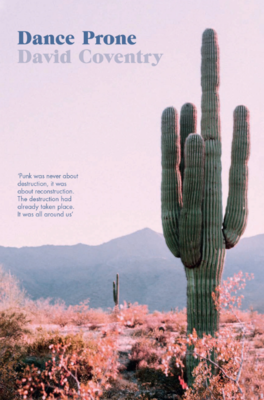 | Dance Prone by David Coventry {Reviewed by STELLA} Remember those gigs when your body was a sledgehammer slamming itself any which way and your aural senses were overwhelmed in the best hedonistic way, where the dance floor was small and cramped, where sometimes you ducked a fist and danced on. The opening lines of David Coventry’s new novel, Dance Prone, gives us the viewpoint of Con, the lead singer of a post-punk band in mid-80s America, watching the chaos unfold. Con is up for it, pushing to the edge of control, looking for perfection in chaos with his band, Neues Bauen. Yet like Coventry's first novel, The Invisible Mile, the setting isn’t exactly the theme. His brilliant debut took out the best first book at the Ockham New Zealand Book Awards in 2016, picked up for international publication and translated into numerous languages. Dance Prone looks set for a similar trajectory if the writing is anything to go by. This is the best New Zealand book I have read in a long time, and one of the most affecting novels about trauma, memory and its fallout, where language, pace and tension are expertly pitched and the chaotic music scene notches the decibels up to a level to absorb you in this world. Though it’s not all high intensity. The reflective passages, descriptions of people and place keep us anchored, and the dark humour keeps us amused, even when the psychological aspects of Con’s story threaten to flood our senses. We meet Con over several distinct periods in his life (between the 80s when he is a young man and 2020 when he is in his early 50s) as he intersects with his past band-mates and re-engages, or attempts to re-engage, with pivotal incidents. Not far in, we are beset by a shocking incident. It is wholly unexpected to the reader as it is to Con. Suddenly violence is very near and very real. This incident sets off a trigger of actions and inactions from Con and a crazy reaction from Tone, his kiwi bandmate. As Tone recovers in the hospital and the band tours the dives and front lounges of fans, Con finds himself split in two — before and after — and bereft of explanation and knowledge. Here we start to dig into the themes of denial and memory, or the erasure of fact. In the desert, appropriately, at an indie music gig complete with existential philosophy, this all comes to a head. As the story moves back and forth in time, the action and telling unfold alongside Con’s awareness. As he hides from the truth, the truth is hidden from the reader. What happens in Phoenix is only revealed by a scratchy video of the band’s last gig seen by Con in Marrakech in 2019, where he is searching for Tone, now living in the remote mountains with a group of artist-activists. Add to this a sweet romance, some great riffs on bands, the indie scene and philosophical rants, seemingly senseless behaviour and cravings for artistic perfection, and you have a deft and nuanced novel. And Coventry can write. Each sentence places you where you want to be, each conversation adds another dimension and the plot unfolds with a tension that keeps the bowstring taut and rewards with the aim of the arrow. Intelligent, intimate and raw, Dance Prone is stunning. |

>>"
>>To get you in the mood: The Gordons, Scorched Earth Policy, Dead C, Hüsker Dü, Einstürzende Neubauten.