NEW RELEASES

Ruth & Pen by Emilie Pine           $37
Pine follows her remarkable 2019 essay collection Notes to Self with a novel of equal clarity and perspicacity. Dublin, 7 October 2019.One day, one city, two women- Ruth and Pen. Neither known to the other, but both asking themselves the same questions — how to be with others and how, when the world doesn't seem willing to make space for them, to be with themselves? Ruth's marriage to Aidan is in crisis. Today she needs to make a choice — to stay or not to stay, to take the risk of reaching out, or to pull up the drawbridge. For teenage Pen, today is the day the words will flow, and she will speak her truth to Alice, to ask for what she so desperately wants.
"Full of empathy and good will." —The Irish Times
They by Kay Dick          $23
A forgotten dystopian classic, first published in 1977. The Sussex coast. Sunsets paint the windswept ocean; seagulls haunt the marshland; hunting rifles crack across hillsides. But this is England through-a-glass-darkly. They are coming closer. They begin with a dead dog, shadowy footsteps, confiscated books. Then, the National Gallery is purged; motorway checkpoints demarcate Areas, violent mobs stalk the countryside, destroying cultural artefacts — and those who resist. The surviving writers, artists and thinkers gather together, welcoming 'dissidents' like the unmarried and the childless. These polyamorous and queer communities preserve their crafts, create, love, and remember. But as 'subversives' are captured in military sweeps, cured of identity, desensitised in retreats, They make it easier to forget. Introduction by Carmen Maria Machado.
"A masterpiece of creeping dread. —Emily St. John Mandel
"Lush, hypnotic, compulsive. A reminder of where groupthink leads." —Eimear McBride
"A masterwork of English pastoral horror: eerie and bewitching." —Claire-Louise Bennett
Three Rings: A tale of exile, narrative and fate by Daniel Mendelsohn             $20
Mendelsohn explores the mysterious links between the randomness of the lives we lead and the artfulness of the stories we tell. Combining memoir, biography, history, and literary criticism, Three Rings weaves together the stories of three exiled writers who turned to the classics of the past to create work of their own — work that pondered the nature of narrative itself: Erich Auerbach, the Jewish philologist who fled Hitler's Germany and wrote his classic study of Western literature, Mimesis, in Istanbul; Francois Fenelon, the seventeenth-century French archbishop whose ingenious sequel to the Odyssey,The Adventures of Telemachus — a veiled critique of the Sun King, and the best-selling book in Europe for one hundred years — resulted in his banishment; and the German novelist W. G. Sebald, self-exiled to England, whose distinctively meandering narratives explore Odyssean themes of displacement, nostalgia, and separation from home. Intertwined with these tales of exile and artistic crisis is an account of Mendelsohn's struggles to write two of his own books — a family saga of the Holocaust and a memoir about reading the Odyssey with his elderly father — that are haunted by tales of oppression and wandering. 
>>How literature makes reality feel. 
Revolutionary Letters by Diane di Prima          $40
During the tumult of 1968, Beat poet Diane di Prima began writing her "letters," poems filled with a potent blend of utopian anarchism and Zen-tinged ecological awareness that were circulated via underground newspapers and stapled pamphlets. In 1971, Lawrence Ferlinghetti published the first collection of these poems in his iconic Pocket Poets Series, and di Prima would go on to publish four subsequent editions, expanding the collection each time. During the last years of her life, di Prima got to work on the final iteration of this lifelong project, collecting all of her previously published "letters" and adding the new work, poems written from 2007 up to the time of her death in October 2020. Published in a board-bound edition that features the original edition's cover art by Lawrence Ferlinghetti.
>>A living weapon in your hand
Mona by Pola Oloixarac (translated by Adam Morris)              $28
Mona is a Peruvian writer based on a Californian campus, open-eyed and sardonic, a connoisseur of marijuana and prescription pills. In the humanities she has discovered she is something of an anthropological curiosity — a female writer of colour treasured for the flourish of rarefied diversity that reflects so well upon her department. When she is nominated for 'the most important literary award in Europe', Mona sees a chance to escape her sunlit substance abuse and erotic distraction, and leaves for a small village in Sweden. Now she is stuck in the company of her competitors, who arrive from Japan, France, Armenia, Iran and Colombia. The writers do what writers do: exchange flattery, nurse envy and private resentments, stab rivals in the back and go to bed together. But all the while, Mona keeps stumbling across traces of violence on her body, the origins of which she can't — or won't — remember.
"Mona reads like Rachel Cusk's Kudos on drugs." —The Atlantic 
"Ruthless, very funny." —New York Times 
"One of the great writers of the Internet, the only country larger than Argentina." —Joshua Cohen 
A Girl Returned by Donatella di Pietrantonio      $23
"I was the Arminuta, the girl returned. I spoke another language, I no longer knew who I belonged to. The word 'mama' stuck in my throat like a toad. And, nowadays, I really have no idea what kind of place mother is. It is not mine in the way one might have good health, a safe place, certainty." Without warning or a word of explanation, an unnamed 13-year-old girl is sent away from the family she has always thought of as hers to live with her birth family: a large, chaotic assortment of individuals whom she has never met and who seem anything but welcoming. Thus begins a new life, one of struggle, conflict, especially between the young girl and her mother, and deprivation. But in her relationship with Adriana and Vincenzo, two of her newly acquired siblings, she will find the strength to start again and to build anew and enduring sense of self. Translated  by Ann Goldstein, who has also translated the works of Elena Ferrante.
A Florence Diary by Diana Athill             $23
In August 1947, Diana Athill travelled to Florence by the Golden Arrow train for a two-week holiday with her good friend Pen. In this playful diary of that trip, Athill recorded her observations and adventures — eating with (and paid for by) the hopeful men they meet on their travels, admiring architectural sights, sampling delicious pastries, eking out their budget and getting into scrapes. Enjoyable. 
The Lobster's Shell by Caroline Albertine Minor (translated from Danish by Caroline Waight)             $33
A complex tale of family mythology and regret, The Lobster's Shell is the story of three orphaned siblings, now in their thirties and forties; their attempts at connection, their failures and frustrations. Over the years their differences have driven them apart, but during five days in April they have to confront their relationship and shared history. Sidsel asks Niels for a service that challenges his chosen loneliness and Ea gets in touch from the United States. Hoping to make contact with their mother, she has visited a clairvoyant. Lately, a nagging question has been haunting her.
"Minor's acute, elliptical observations and silky prose are a delight to read, as the misunderstandings, machinations and mysteries of past and present knit together, fall apart, and re-establish themselves in an uneven, bright weave in Caroline Wright's distinctive, unforced translation." —The Irish Times 
80 spice-infused recipes following the trails of ancient maritime trade through Indonesia, Malaysia, China, Vietnam, Thailand, Sri Lanka, India, Iran and the Emirates. Ford combines historical research with a travel writer's eye and a cook's nose for a memorable recipe. Interwoven are stories that explore how spices from across the Indian Ocean — the original cradle of spice — have, over time, been adopted into cuisines around the world.
Matariki Around the World: A cluster of stars, A cluster of stories by Rangi Mātāmua & Miriama Kamo         $35
The Matariki constellation (or Pleiades) is known by many different names and is seen and celebrated by many cultures around the world. This beautifully illustrated book features 9 stories that explore the Māori Matariki stars, and 12 stories from different cultures around the globe that also reference this constellation, from the Pacific Islands to Australia, Asia, the Americas, Europe and Africa.


Te Toi Whakairo: The art of Māori carving by Hirini Moko Mead             $50
A new edition of this indispensable guide to te toi whakairo. Beginning with carving's mythical origins, this book explores the evolution of styles and techniques through the four main artistic periods to the present day, and provides detailed explanations of carving styles in different parts of the country, using examples from meeting houses and leading artists. Later chapters delve into the main structures, forms and motifs, and the role of the woodcarver, and explore the status of the art in contemporary New Zealand. Practical guidance is given for use of materials, tools, techniques, surface and background decoration, the human figure, and carving poupou.
Fledgling by Lucy Hope            $17
A cherub is blown into Cassie Engel's bedroom during a thunderstorm, triggering a series of terrifying events. Cassie must discover if its arrival was an accident or part of something more sinister. With a self-obsessed opera singer for a mother, a strange taxidermist father, and a best friend who isn't quite what he seems, Cassie is forced to unearth the secrets of her family's past. As the dark forces gather around them, can Cassie protect all that she holds dear?
Seven and a Half Brief Lessons about the Brain by Lisa Feldman Barrett         $25
In seven short chapters (plus a brief history of how brains evolved), this slim, entertaining, and accessible collection reveals mind-expanding lessons from the front lines of neuroscience research. You'll learn where brains came from, how they're structured (and why it matters), and how yours works in tandem with other brains to create everything you experience. Along the way, you'll also learn to dismiss popular myths such as the idea of a 'lizard brain' and the alleged battle between thoughts and emotions, or even between nature and nurture, to determine your behaviour.
Good both for beginners and those who just want to improve. Fully illustrated. 

Mrs Death Misses Death by Salena Godden               $23
Mrs Death has had enough. She is exhausted by her job and now seeks someone to unburden her conscience to. She meets Wolf, a troubled young writer, who — enthralled by her stories — begins to write Mrs Death's memoirs. As the two reflect on the losses they have experienced (or facilitated), their friendship flourishes. All the while, despite her world-weariness, Death must continue to hold humans' fates in her hands, appearing in our lives when we least expect her. A paperback edition of this enjoyable, life-affirming book.  
"A modern-day Pilgrim's Progress leavened with caustic wit. This is not light-hearted stuff, yet Godden has produced a miraculously light-hearted novel, an elegant, occasionally uproarious, danse macabre." —Guardian
Thin Places by Kerri ní Dochartaigh            $23
Kerri ní Dochartaigh was born in Derry, on the border of the North and South of Ireland, at the very height of the Troubles. She was brought up on a council estate on the wrong side of town. But for her family, and many others, there was no right side. One parent was Catholic, the other was Protestant. In the space of one year they were forced out of two homes and when she was eleven a homemade petrol bomb was thrown through her bedroom window. Terror was in the very fabric of the city, and for families like Kerri's, the ones who fell between the cracks of identity, it seemed there was no escape. Thin Places, a mixture of memoir, history and nature writing, explores how nature kept her sane and helped her heal, how violence and poverty are never more than a stone's throw from beauty and hope, and how political misadventure is, once again, allowing the borders to become hard, and terror to creep back in. Paperback edition. 
"A special, beautiful, many-faceted book." —Amy Liptrot
"A remarkable piece of writing. Luminous." —Robert Macfarlane
The Nightworkers by Brian Selfon             $40
A Brooklyn family of money launderers thrown into chaos when a runner ends up dead and a bag of dirty money goes missing. Shecky Keenan's family is under fire—or at least it feels that way. Bank accounts have closed unexpectedly, a strange car has been parked near the house at odd hours, and Emil Scott, an enigmatic artist and the family's new runner, is missing—along with the $250,000 of dirty money he was carrying. Inspired by a career that has included corruption cases and wiretaps as an investigative analyst for New York law enforcement, Selfon unspools a tale of crime and consequence through shifting perspectives across the streets, alleys, bodegas, and art studios of Brooklyn. 

Women Will Rise! Recalling the Working Women's Charter edited by Gay Simpkin and Marie Russell           $30
In the late 1970s, as the women’s movement was fracturing, trade union women put forward a new agenda to bring feminists and women workers together. The one-page, 16-clause Working Women’s Charter covered: ★ the right to work ★ equal pay ★ an end to discrimination at work ★ better conditions, family leave, flexible work arrangements ★ free, quality childcare ★ reproductive rights —and more. Challenged by patriarchal union traditions, the women worked hard to win union support for their demands. This book includes chapters by women who promoted the Charter, and others looking at what has been achieved since — and what remains to be done.
Soundings: Journeys in the company of whales by Doreen Cunningham          $38
Doreen first visited Utqiagvik, the northernmost town in Alaska, as a young journalist reporting on climate change among indigenous whaling communities. There, she joined the spring whale hunt under the neverending Arctic light, watching for bowhead whales and polar bears, drawn deeply into an Inupiaq family, their culture and the disappearing ice. Years later, plunged into sudden poverty and isolation, living in a Women's Refuge with her baby son, Doreen recalls the wilderness that once helped shape her own. She embarks on an extraordinary adventure: taking Max to follow the grey whale migration all the way north to the Inupiaq family that took her in, where grey and bowhead whales meet at the melting apex of our planet.
All the Frequent Troubles of Our Days: The true story of the woman at the heart of the German resistance to Hitler by Rebecca Donner       $40
Born and raised in America, Mildred Harnack was twenty-six when she enrolled in a PhD programme in Germany and witnessed the meteoric rise of the Nazi party. In 1932, she began holding secret meetings in her apartment-a small band of political activists that by 1940 had grown into the largest underground resistance group in Berlin. She recruited Germans into the resistance, helped Jews escape, plotted acts of sabotage and collaborated in writing leaflets that denounced Hitler and called for revolution. Her co-conspirators circulated through Berlin under the cover of night, slipping the leaflets into mailboxes, public restrooms, phone booths. When the first shots of the Second World War were fired she became a spy, couriering top-secret intelligence to the Allies. On the eve of her escape to Sweden, she was ambushed by the Gestapo. During a hastily convened trial at the Reichskriegsgericht — the Reich Court-Martial — a panel of five judges sentenced her to six years at a prison camp, but Hitler overruled the decision and ordered her execution. On 16 February 1943, she was strapped to a guillotine and beheaded.
Niho Taniwha: Improving teaching and learning for ākonga Māori by Melanie Riwai-Couch          $70
Niho Taniwha equips educators with culturally responsive practices to better serve and empower Māori students and their whānau. The book is centred around the Niho Taniwha model, in which both the learner and the teacher move through three phases in the teaching and learning process: Whai, Ako and Mau. Written by a senior advisor to the Ministry of Education, the book shows that educational success for Māori students is about more than academic achievement – it includes all aspects of hauora (health and wellbeing). This book demonstrates how to create learning environments that encompass self-esteem, happiness and engagement in Māori language, identity and culture.
All That She Carried: The story of Ashley's sack, a Black family keepsake by Tiya Miles            $36
In 1850s South Carolina, an enslaved woman named Rose faced a crisis, the imminent sale of her daughter Ashley. Thinking quickly, she packed a cotton bag with a few precious items as a token of love and to try to ensure Ashley's survival. Soon after, the nine-year-old girl was separated from her mother and sold. Decades later, Ashley's granddaughter Ruth embroidered this family history on the bag in spare yet haunting language—including Rose's wish that "It be filled with my Love always." Ruth's sewn words, the reason we remember Ashley's sack today, evoke a sweeping family story of loss and of love passed down through generations. Winner of a (US) National Book Award.
"Deeply layered and insightful. A bold reflection on American history, African American resilience, and the human capacity for love and perseverance in the face of soul-crushing madness." —The Washington Post
Jungle Nama by Amitav Ghosh, illustrated by Salman Toor            $35
A beautifully illustrated verse adaptation of a legend from the Sundarbans, the world's largest mangrove forest. It tells the story of the avaricious rich merchant Dhona, the poor lad Dukhey, and his mother; it is also the story of Dokkhin Rai, a mighty spirit who appears to humans as a tiger, of Bon Bibi, the benign goddess of the forest, and her warrior brother Shah Jongoli. Jungle Nama is the story of an ancient legend with urgent relevance to today's climate crisis. Its themes of limiting greed, and of preserving the balance between the needs of humans and nature have never been more timely.
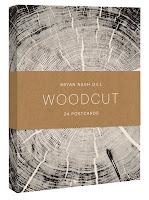
Woodcut Postcard Book by Bryan Nash Gill             $35
24 cards of twelve prints taken from the arboreal rings of actual trees. 


Book of the Week: The Fish by Lloyd Jones
In this fable-like novel from the author of (most famously) Mister Pip and (most recently) The Cage, the narrator's sister gives birth to a very different sort of child, who reveals the family's capacities for both love and shame, set against small-town small-minded New Zealand in the 1960s. Just what is Fish's relationship with the sea beside which he was born, and what bearing might this have on the Wahine disaster? And what is the relationship between the narrator writing this account and the events that are contained within it? 
>>Read Stella's review.
>>The Wahine disaster
>>Read Thomas's reviews of The Cage and High Wire
>>....and then there were none


>> Read all Stella's reviews.


The Fish by Lloyd Jones  {Reviewed by STELLA}
Lloyd Jones's latest novel, firmly set in 1960s New Zealand, turns the tables on our expectations. The Fish is a story of a writer, and a tale of a family fraught with shame, tragedy and love. When the teenage daughter, always referred to as The Fish’s Mother, gives birth to ‘Fish’ she is simultaneously both protected and rejected by her family, and by extension, her child also. That this baby is viewed as different — he has googly eyes, a lopsided wide gob, smells strongly and sometimes has gills — is more a reflection of the family’s shame or discomfort with the situation they find themselves in rather than the child in and of itself. Although you do, through the eyes of his uncle (the narrator of this story), get the district impression of an oddity — Fish is not like other children and possibly not like other humans. This otherness lies at the heart of the novel (what happens when you take a fish out of water, or, as a writer, you are both inside and outside of lived family experience?), and the family’s complex responses to Fish, and interactions with each other. Both daughters are wayward: Clara, the eldest, escapes to Sydney, where she works in ‘modelling’ or as she later puts it, the "professional girl-friending" business. The Fish’s Mother is promiscuous and drug-addicted, often found on the ships. Uncle, our narrator, is the youngest of this trio of siblings and, only nine when Clara leaves home and The Fish arrives on the scene, is both witness and victim of the complex family narrative. Anyone who has grown up in a family with a challenging sibling will instantly recognise the conflicting emotions that arise in such family dynamics, moving in a forever-cycle of guilt, blame and shame as well as love and care. Jones hints at incest, but this is ambiguous. Mrs Montgomery’s insistence at naming Fish ‘Colin Montgomery’ after her husband may be her finger-pointing, and her shoplifting, drinking and later dementia may indicate her various forms of escape from the unhappy household. Water — the sea specifically — plays a major character role. As a gentle loving embrace — the house and the caravan (a central refuge, as well as a symbol of heartache, for all the family members at different times in their lives) on the coast, the summers at the beach, the freedom of the ocean, and Fish’s great ability to stay underwater for significant periods of time. And in comparison an angry force, unforgiving and prepared to wreak havoc — the sea (or the ships) take the Fish’s Mother away, washes through Colin Montgomery senior as his heart fails, and a storm, specifically the one that sank the Wahine, swallows its victims — some are spat out, but others are taken to its depths. Lloyd Jones writes with both careful silences — much is unsaid or only hinted at — and descriptive clarity — the Wahine storm is vivid, while the building tempo of 1960s society, piece by piece, reaches a crescendo, its own storm wave. Littered with oblique references to mythology, sea lore, and with metaphoric resonance, The Fish is a thought-provoking novel unafraid, like its protagonist, to travel against the tide while still adhering to what makes a tale compassionate — humanity in all its glory and squall.


 >> Read all Thomas's reviews. 


The Very Last Interview by David Shields   {"Reviewed" by THOMAS}


So, what makes you want to write a review of David Shields’s new book, The Very Last Interview

Then why are you writing one?

Every week? Whose idea was that?   

Surely at your age, you shouldn’t be so bound by obligation or by expectation, or whatever you call it?

Yes, but do you really care what these readers might think, and do you even believe that there are such people? Aren’t you being altogether a bit precious? 

Do you really think that this helps to pay the mortgage, I mean that this makes a direct and measurable contribution towards paying your mortgage? Or even an indirect and unmeasurable but still valuable contribution towards paying your mortgage? 

Well, what else would you be doing?

Surely you’re joking? 

Okay, we’ve got a bit off the track there. I will reframe my first question. What makes you think that you are able to write a review of David Shields’s new book? 

Don’t you think your humility is a bit mannered?

The Very Last Interview is a book consisting entirely of questions that interviewers have asked David Shields over the years, omitting his answers, assuming he will have answered probably at least most of the questions, and your review, if we can call it that, of this book also consists of a series of questions ostensibly directed at you but without your answers, if indeed there were answers, which is less certain in your case than in the case of David Shields. Is this, on your part, a deliberate choice of approach, and, if so, is it justifiable? 

Do you really believe that a review written in imitation of, or in the style of, the work under review inherently reveals something about that work, even if the review is badly written, or should your approach rather be attributed to laziness, stylistic insecurity, or creative bankruptcy? 

Has it ever occurred to you that the supposedly more enjoyable qualities of your writing are actually nothing more than literary tics or affectations, and, furthermore, that it might be these very literary tics and affectations that prevent you from writing anything of real literary worth? 

Do you think that, by removing his input into the original interviews but retaining the questions, David Shields is attempting to remove himself from his own existence, or merely to show that our identities are always imposed from outside us rather than from inside, or that we exist as persons only to the extent that we are seen by others? Is this, in fact, all the same thing? 

What do you mean by that statement, ‘We are defined by the limits we present to the observations of others’?

What do you mean by that statement ‘There is no such thing as writing, only editing,’ and how does that relate to Shields’s work? 

Do you think that David Shields, in this book as in the much-discussed 2010 Reality Hunger, sees the individual as an illusion, a miserable fragment of what is actually a ‘hive mind’ or collective consciousness, and that ‘creativity’, so to call it, is another illusion predicated on this illusion of individuality?

You don’t?

What do you think David Shields would have answered, when asked, as he was, seemingly in this book, “But what is the role of the imagination in this ‘post-literature literature’ that you envision?” and how might this differ from the answer you might give if asked the same question? 

Shields was asked if he had written anything that couldn’t be interpreted as ‘crypto-autobiography’, but don’t you think the salient question is whether it is even possible to write anything that couldn’t be interpreted as crypto-autobiography? 

Is a perfectly delineated absence, such as David Shields approximates in The Very Last Interview, in fact the most perfect portrait of a person, even the best possible definition of a person, as far as this is possible at all? 

But do you actually have a personal opinion on this? 

Do you think then that you, like Shields, like us all perhaps, are, in essence, a ghost?

 NEW RELEASES

Otherlands: A world in the making by Thomas Halliday          $54
An exhilarating journey into deep time, showing us the Earth as it used to exist, and the worlds that were here before ours. Travelling back in time to the dawn of complex life, and across all seven continents, Halliday gives us a mesmerizing up close encounter with eras that are normally unimaginably distant. Halliday immerses us in a series of ancient landscapes, from the mammoth steppe in Ice Age Alaska to the lush rainforests of Eocene Antarctica, with its colonies of giant penguins, to Ediacaran Australia, where the moon is far brighter than ours today. We visit the birthplace of humanity; we hear the crashing of the highest waterfall the Earth has ever known; and we watch as life emerges again after the asteroid hits, and the age of the mammal dawns. These lost worlds seem fantastical and yet every description—whether the colour of a beetle's shell, the rhythm of pterosaurs in flight or the lingering smell of sulphur in the air—is grounded in the fossil record. Otherlands is an imaginative feat: an emotional narrative that underscores the tenacity of life—yet also the fragility of seemingly permanent ecosystems, including our own. To read it is to see the last 500 million years not as an endless expanse of unfathomable time, but as a series of worlds, simultaneously fabulous and familiar.

Wivenhoe by Samuel Fisher              $40
A young man is found brutally murdered in the middle of the snowed-in village of Wivenhoe. Over his body stands another man, axe in hand. The gathered villagers must deal with the consequences of an act that no-one tried to stop. Wivenhoe is a haunting novel set in an alternate present, in a world that is slowly waking up to the fact that it is living through an environmental disaster. Taking place over twenty-four hours and told through the voices of a mother and her adult son, we see how one small community reacts to social breakdown and isolation. Fisher imagines a world, not unlike our own, struck down and on the edge of survival. If society as we know it is lost, what would we strive to save? At what point will we admit complicity in our own destruction?
"Quiet, fable-like menace radiates from every page of Wivenhoe. Elegant and searching, it asks vital questions about what it means to be part of a community — about integrity, belonging, and how darkness can go unchecked when isolation and suspicion sets in — questions that now feel more relevant than ever." —Sophie Mackintosh

Landfall 243 edited by Lynley Edmeades           $30
Words by Vincent O’Sullivan, Bill Direen, Louise Wallace, David Eggleton, Emma Neale, Janis Freegard, Tim Upperton, Erik Kennedy, Rebecca Hawkes, and many others. Images by Sione Monū, Kim Pieters, and James R. Ford. This issue also announces the 2022 winner of the Charles Brasch Young Writers’ Essay Competition.
The Rooftop by Fernanda Trías (translated from the Spanish by Annie McDermott)          $34
'The world is this house,’ says Clara while she is trying to protect her beloved ones from the world – yes, that one outside their house walls – which seems to threaten them more and more. Clara entrenches herself with her father and her daughter Flor in a dark apartment that inevitably crumbles on them. The roof becomes their last recess of freedom. A caged bird is the only witness of Clara’s fear and resistance against those she thinks are trying to destroy her. Are threats and pain external or inside our own bodies? Where is violence’s root? What are we afraid of? Is there a possibility to find a roof to finally being able to breathe? What are our umbilical cords? Fernanda Trías does not answer these questions – impossible for anyone – about instinct, civilization and taboos, instead she gives them shape and dives deep into them a with a grotesque and forceful history written with agility and a Kafkaesque sense of humour. The Rooftop is a claustrophobic novel about freedom, and also about fear, violence, motherhood and loss. 
"One of the most interesting authors writing in Spanish today." —Mario Levrero
Time Shelter by Georgi Gospodinov (translated by Angela Rodel)           $38
An enigmatic flâneur named Gaustine opens a 'clinic for the past' that offers a promising treatment for Alzheimer's sufferers: each floor reproduces a decade in minute detail, transporting patients back in time. As Gaustine's assistant, the unnamed narrator is tasked with collecting the flotsam and jetsam of the past, from 1960s furniture and 1940s shirt buttons to scents and even afternoon light. But as the rooms become more convincing, an increasing number of healthy people seek out the clinic as a 'time shelter', hoping to escape from the horrors of our present — a development that results in an unexpected conundrum when the past begins to invade the present.
"In equal measure playful and profound, Georgi Gospodinov's Time Shelter renders the philosophical mesmerizing, and the everyday extraordinary." —Claire Messud
Love in the Big City by Sang Young Park (translated by Anton Hur)          $38
“Sang Young Park’s sharp, funny picaresque follows Young, our charming hero, through his rakish college days and into his still-insouciant thirties, as he drifts through boyfriends, jobs, friends, and most of all, through Seoul. Among the many pleasures of this wonderful novel are Young’s running commentaries about work, class, sex, queer domestic life, contemporary Korean family dynamics, and the literary world he finds himself in. I’m obsessed with this book.”—Andrea Lawlor
Long-listed for the 2022 International Booker Prize
The New Adventures of Helen by Ludmilla Petrushevskaya (translated by Jane Bugaeva)               $35
'Adult fairy tales' asking deep questions about gender, love, history, memory, and the future, taking place in times between history and the now.
"Her tales inhabit a borderline between this world and the next." —The New York Times Book Review
"Petrushevskaya has a ringleader's calm mastery of the absurd." —The New Yorker
"Petrushevskaya is the Tolstoy of the communal kitchen. She is not, like Tolstoy, writing of war, or, like Dostoevsky, writing of criminals on the street, or, like poet Anna Akhmatova or novelist Aleksandr Solzhenitsyn, noting the extreme suffering of those sent to the camps. Rather, she is bearing witness to the fight to survive the everyday. She is dazzlingly talented and deeply empathetic." —Slate
The Passenger: Rome              $33
"Fresh and diverting, informative and topical without being slight or ephemeral. This supremely well-edited combination of current affairs, journalism, commentary, and fun facts is perfect for our pause-button moment." —AFR. If you believe what's currently being said about Rome, the city is on the verge of collapse. Each year, it slips further down the ranking of the world's most liveable cities. To the problems faced by all large capitals, Rome has added a list of calamities of its own: a string of failing administrations, widespread corruption, the resurgence of fascist movements, rampant crime. A seemingly hopeless situation, perfectly symbolised by the fact that Rome currently leads the world in the number of self-combusting public buses. If we look closer this narrative is contradicted by just as many signs that point in the opposite direction. Above all, the lack of the mass emigration one would except in these circumstances: the vast majority of Romans don't think for a second of 'betraying' their hometown, and the many newcomers who have populated it in recent decades are often indistinguishable from the natives in the profound love that binds them to the city. Rome is a place of contradictions: an "incredibly deceptive city", always different from what it appears to be. 
Other destinations in the excellent 'The Passenger' series: Greece; Berlin; India; Japan; Paris; Ireland
The Land Gardeners — Cut Flowers by Bridget Elworthy and Henrietta Courtauld         $55
The Land Gardeners show you how to establish organic garden beds and sow, grow and harvest over 100 varieties of cut flowers. 
"With their instinctive flair, Elworthy and Courtauld established cutting gardens that bring the deep poetry of organic flowers to their enthusiastic customers." —Patrick Kinmonth
Trespasses by Louise Kennedy            $33
Cushla Lavery lives with her mother in a small town near Belfast. At twenty-four, she splits her time between her day job as a teacher to a class of seven-year-olds, and regular bartending shifts in the pub owned by her family. It's here, on a day like any other — as the daily news rolls in of another car bomb exploding, another man shot, killed, beaten or left for dead — that she meets Michael Agnew, an older (and married) barrister who draws her into his sophisticated group of friends. When the father of a young boy in her class, becomes the victim of a savage attack, Cushla is compelled to help his family. But as her affair with Michael intensifies, political tensions in the town escalate, threatening to destroy all she is working to hold together.
"Dazzling." —Guardian
The Island of Extraordinary Captives: The true story of an artist, a spy and a wartime scandal by Simon Parkin           $38
In May 1940, faced with a country gripped by paranoia, Prime Minister Winston Churchill ordered the internment of all German and Austrian citizens living in Britain. Most, like artist Peter Fleischmann , were refugees who had come to the country to escape Nazi oppression. They were now imprisoned by the very country in which they had staked their trust. The Island of Extraordinary Captives tells, for the first time, the story of the internment camp in the Isle of Man, and of how a group of world-renown artists, musicians and academics came to be seen as 'enemy aliens'. It reveals how Britain's treatment of refugees during the Second World War was a series of shameful missteps.
The Politics of Design: Privilege and prejudice in Aotearoa New Zealand, Australia and South Africa edited by Jane Venis, Frederico Freschi, and Farieda Nazier         $50
Taking a broad definition of design and drawing on the shared histories and legacies of settler colonialism in Aotearoa New Zealand, Australia and South Africa, The Politics of Design offers a wide-ranging comparative study that focuses specifically on the role of design in creating and perpetuating the privileges and prejudices of racial hierarchies. This provocative volume raises long-overdue questions about the problematic histories and effects of design in the context of these settler-colonial societies. The authors draw on a range of subjects and themes, including various manifestations of visual culture and urban and design technologies, from both an historical and contemporary perspective. Indigenous voices are prominent, enabling a recovery of knowledge that was erased through colonial systems of integration and assimilation. In the current context of globalism, resurgent nationalism and calls for decolonisation The Politics of Design challenges us to think comparatively across disparate but conceptually similar cultural and geographical contexts. In drawing attention to the role of design in sustaining the prejudices and privileges of whiteness and in rendering visible its complexities and contradictions that have long been hidden in plain sight this book makes the argument for a new kind of restorative knowledge.
This Woman's Work: Essays on music edited by Sinead Gleeson and Kim Gordon         $38
Published to challenge the historic narrative of music and music writing being written by men, for men, This Woman's Work seeks to confront the male dominance and sexism that have been hard-coded in the canons of music, literature, and film and has forced women to fight pigeon-holing or being side-lined by carving out their own space. Contributions by Anne Enright, Fatima Bhutto, Jenn Pelly, Rachel Kushner, Juliana Huxtable, Leslie Jamison, Liz Pelly, Maggie Nelson, Margo Jefferson, Megan Jasper, Ottessa Moshfegh, Simone White, Yiyun Li, and Zakia Sewell.
"What binds these writers is their emotional connection to music, and their experience of songs as a portal to memories – whether painful or joyful – and a broader understanding of the world. This Woman’s Work is a collection of music writing, but in the loosest possible sense. Here, music is the soil in which all manner of stories take seed and bloom." —Guardian
Seven Pillars of Science: The incredible lightness of ice, and other scientific surprises by John Gribbin            $25
The seven fundamental - and surprising - scientific truths of our existence. These 'pillars of science' also defy common sense. For example, solid things are mostly empty space, so how do they hold together? There appears to be no special 'life force', so how do we distinguish living things from inanimate objects? And why does ice float on water, when most solids don't? You might think that question hardly needs asking, and yet if ice didn't float, life on Earth would never have happened.
The Lost Whale by Hannah Gold           $23
Rio has been sent to live with a grandmother he barely knows in California, while his mum is in hospital back home. Alone and adrift, the only thing that makes him smile is joining his new friend Marina on her dad's whale watching trips. That is until an incredible encounter with White Beak, a gentle giant of the sea changes everything. But when White Beak goes missing, Rio must set out on a desperate quest to find his whale and somehow save his mother.
Trust by Hernán Diaz       $38
Even through the roar and effervescence of the 1920s, everyone in New York has heard of Benjamin and Helen Rask. He is a legendary Wall Street tycoon; she is the daughter of eccentric aristocrats. Together, they have risen to the very top of a world of seemingly endless wealth—all as a decade of excess and speculation draws to an end. But at what cost have they acquired their immense fortune? This is the mystery at the center of Bonds, a successful 1937 novel that all of New York seems to have read. Yet there are other versions of this tale of privilege and deceit. Trust puts these competing narratives into conversation with one another—and in tension with the perspective of one woman bent on disentangling fact from fiction. The result is a novel that spans over a century and becomes more exhilarating with each new revelation. At once an immersive story and a literary puzzle, Trust engages the reader in a quest for the truth while confronting the deceptions that often live at the heart of personal relationships, the reality-warping force of capital, and the ease with which power can manipulate facts.
“Intricate, cunning and consistently surprising.” —New York Times
“An absolutely brilliant novel." —Los Angeles Times
London Clay: Journeys in the deep city by Tom Chivers          $48
Tom Chivers follows hidden pathways, explores lost islands and uncovers the geological mysteries that burst up through the pavement and bubble to the surface of the city streets. From Roman ruins to a submerged playhouse, from an abandoned Tube station to underground rivers, Chivers leads us on a journey into the depths of the city he loves. A lyrical interrogation of a capital city, a landscape and our connection to place, London Clay celebrates urban edgelands: in-between spaces where the natural world and the metropolis collide.
Nothing But the Truth: Stories of crime, guilt, and the loss of innocence by 'The Secret Barrister'             $40
Just how do you become a barrister? And why do only 1 per cent of those who study law succeed in joining this mysteriously opaque profession? If it's such a great occupation, how come you work 100-hour weeks for what works out as a very low rate? And why might a practising barrister come to feel the need to reveal the lies, secrets, failures and crises at the heart of this world of wigs and gowns? Read about those lies, secrets, failures and crises in this book.
"Excellent. At once a vicious polemic, a helpful primer and a cringe-inducing account of one barrister's travails." —Daily Telegraph
Tales from the Tillerman: A life-long love affair with Britain's waterways by Steve Haywood        $28
"Haywood conjures up a picture of a different world, filled with interesting and eccentric people. A cross-section of the best of middle England, in fact." —The Oxford Times
Johnny Panic and the Bible of Dreams by Sylvia Plath            $23
From her mid-teens Sylvia Plath wrote stories, twenty-four of which are collected here, along with works of journalism and extracts from her journal. An office assistant in a hospital pursues a secret vocation. A girl endures a series of initiation ceremonies to join her high school sorority. A married woman seeks relief from the dull realities of daily life. New edition.
"all the pieces presented here are revealing. It ought to round out one's knowledge of the writer, and, perhaps, offer some surprises. Luckily it does both." —Margaret Atwood, New York Times


Rebel Skies by Ann Sei Lin          $20
Kurara has never known any other life than being a servant on board the Midori, but when her party trick of making paper come to life turns out to be a power treasured across the empire, she joins a skyship and its motley crew to become a Crafter. Taught by the gruff but wise Himura, Kurara learns to hunt shikigami – wild paper spirits who are sought after by the Princess. But are these creatures just powerful slaves for the Crafters and the empire, or are they beings with their own souls – and yet another thing to be subjugated by the powerful Emperor and his Princess?
The Colony of Good Hope by Kim Leine          $38
1728: The doomed Danish King Fredrik IV sends a governor to Greenland to establish a colony, in the hopes of exploiting the country's allegedly vast natural resources. A few merchants, a barber-surgeon, two trainee priests, a blacksmith, some carpenters and soldiers and a dozen hastily married couples go with him. The missionary priest Hans Egede has already been in Greenland for several years when the new colonists arrive. He has established a mission there, but the converts are few. Among those most hostile Egede is the shaman Aappaluttoq, whose own son was taken by the priest and raised in the Christian faith as his own. Thus the great rift between two men, and two ways of life, is born. The newly arrived couples - composed of men and women plucked from prison - quickly sink into a life of almost complete dissolution, and soon unsanitary conditions, illness and death bring the colony to its knees. Through the starvation and the epidemics that beset the colony, Egede remains steadfast in his determination - willing to sacrifice even those he loves for the sake of his mission.
The Dance Tree by Kiran Millwood Hargrave              $38
In Strasbourg, in the boiling hot summer of 1518, a plague strikes the women of the city. First it is just one - a lone figure, dancing in the town square - but she is joined by more and more and the city authorities declare an emergency. Musicians will be brought in. The devil will be danced out of these women. Just beyond the city's limits, pregnant Lisbet lives with her mother-in-law and husband, tending the bees that are their livelihood. Her best friend Ida visits regularly and Lisbet is so looking forward to sharing life and motherhood with her. And then, just as the first woman begins to dance in the city, Lisbet’s sister-in-law Nethe returns from six years penance in the mountains for an unknown crime. No one - not even Ida - will tell Lisbet what Nethe did all those years ago, and Nethe herself will not speak a word about it. It is the beginning of a few weeks that will change everything for Lisbet – her understanding of what it is to love and be loved, and her determination to survive at all costs for the baby she is carrying. Lisbet and Nethe and Ida soon find themselves pushing at the boundaries of their existence – but they're dancing to a dangerous tune.
Brittle With Relics: A history of Wales, 1962—1997 by Richard King           $55
A history of the people of Wales undergoing some of the country's most seismic and traumatic events: the disasters of Aberfan and Tryweryn; the rise of the Welsh language movement; the Miners' Strike and its aftermath; and the narrow vote in favour of partial devolution.
"Richly humane, viscerally political, generously multi-voiced, Brittle with Relics is oral history at its revelatory best: containing multitudes and powerfully evoking that most remote but also resonant of times, the day before yesterday." —David Kynaston
First Person Singular by Haruki Murakami           $24
All told in the first person by a classic Murakami narrator, these stories challenge the boundaries between our minds and the exterior world. Occasionally, a narrator may or may not be Murakami himself. Now in paperback.

Hedgewitch by Skye McKenna           $25
Witches aren't born, they're made... It has been seven years since Cassie Morgan last saw her mother. Left at a dreary boarding school, she spends her days hiding from the school bully and reading forbidden story books about the world of Faerie. Certain that her mother is still alive, Cassie is determined to find her, whatever the dangers, and runs away from school. Lost and alone, she is chased by a pack of goblins but, to her surprise, escapes with the help of a flying broom and a talking cat named Montague, who takes her to the cosy village of Hedgely. Here she discovers that she comes from a family of witches, women who protect Britain from the denizens of Faerie, who are all too real and far more frightening than her story books suggest. The first book in a new series. 
Auto Erotica: A grand tour through classic car brochures of the 1960s to 1980s by Jonny Trunk             $55
Car brochures of the era had fabulous photography, dazzling colour charts, daring typography, strange fold outs and inspiring styles symbolising the automobile aspirations of their generations. 
>>Fab.


BOOKS @ VOLUME #278 (13.5.22)

Read our latest NEWSLETTER for book news and new books, and to find out what we've been reading and recommending. 


EXCELLENT FICTION AWARDED PRIZES this week:
The delightfully destabilising Happy Stories, Mostly by Norman Erikson Pasaribu (translated from the Indonesian by Tiffany Tsao) was awarded the Republic of Consciousness Prize (for books published by small presses). >>The other short-listed books for the RoC Prize are also all outstandingly good
The Netanyahus by Joshua Cohen received the Pulitzer Prize for Fiction for its playful-yet-deeply-serious exploration of the contradictions, currents and undercurrents experienced in American Jewishness. 
No-One Is Talking About This by Patricia Lockwood was awarded the Dylan Thomas Prize ("for the best literary work written in English by an author under forty") for her funny and tragic novel of the internet's relationship with what we call 'real life'. >>"The voice of a generation." >>Read Thomas's review

 
The short list for the 2022 INTERNATIONAL BOOKER PRIZE contains six books representing a diverse pool of excellent fiction translated into English:
Tomb of Sand by Geetanjali Shree (translated by Daisy Rockwell)
Cursed Bunny by Bora Chung (translated by Anton Hur)
The Books of Jacob by Olga Tokarczuk (translated by Jennifer Croft)
Elena Knows by Claudia Piñeiro (translated by Frances Riddle)
Heaven by Mieko Kawakami (translated by Sam Bett and David Boyd)
A New Name (Septology VI—VII) by Jon Fosse (translated by Damion Searls)

>>Order your copies now. >>Find out more about the books, the authors, and the translators


>> Read all Stella's reviews.


Sea of Tranquility by Emily St.John Mandel {Reviewed by STELLA}
Emily St John Mandel’s Sea of Tranquility is a book to be lost in. It’s a book about time, living and loving. Superbly constructed, it stretches from 1912 to 2401; from the wildness of Vancouver to a moon colony of the future. A remittance man, Edwin St.John St.Andrew, is sent abroad. He’s completely at sea in this new world — he has no appetite for work nor connection — and makes a haphazard journey to a remote settlement on a whim. Here, he has an odd experience which leaves him shaken. He will return to England only to find himself derailed in the trenches of the First World War and later struck down by the flu pandemic. It’s 2020 and Mirella (some readers will remember her from The Glass Hotel) is searching for her friend Vincent (who has disappeared). She attends a concert by Vincent’s brother Paul and afterwards waits for him to appear, along with two music fans at the backstage door. It’s here, on the eve of our current pandemic, that she discovers that Vincent has drowned at sea. Yet it is an art video that Vincent had recorded and been used in Paul’s performance which is at the centre of the conversation for one of the music fans. The film is odd — recounting an unworldly experience in the Vancouver forest. A short clip — erratic and strangely out of place, out of time. It’s 2203 and Olive Llewellyn, author, is on a book tour of Earth. She lives on Moon Colony Two and is feeling bereft — missing her husband and daughter. It’s a gruelling schedule of talks, interviews and same-same hotel rooms; and, if this wasn’t enough, there’s a new virus on the loose. Her bestselling book, Marienbad is about a pandemic. Within its pages is a description of a strange occurrence which takes place in a railway station. When an interviewer questions her about this passage, she’s happy to talk about it, as long it is off the record. It’s 2401, and detective Gaspery-Jacques Roberts from the Night City has been hired to investigate an anomaly in time. Drawing on his experiences and the book, Marienbad, and finding connections between the aforementioned times and people, will lead him to a place where he will make a decision that may have disruptive consequences. A decision which will cause upheaval. Emily St.John Mandel is deft in her writing, keeping the threads of time and the story moving across and around themselves without losing the reader, and making the knots — the connections — at just the right time to engage and delight intellect and curiosity. Moving through time and into the future makes this novel an unlikely contender to be a book of our time, but in so many ways it is. Clever, fascinating, reflective and unsettling, it’s a tender shout-out to humanity. 


 >> Read all Thomas's reviews. 


No-One Is Talking About This by Patricia Lockwood  {Reviewed by THOMAS}
Is there such a thing as claustrophobia in your own skin, he wondered. He thought about the possibility of a collective mind, a species mind, but why stop at species, a global mind, trapped and compartmentalised into individuals. No wonder we all feel trapped in ourselves, he thought. No wonder we do everything we can, even the most stupid things, to join ourselves back up. The most inane things. And yet, and yet, we are all the time assailed by this collective mind, he thought, how do we protect ourselves from it, and from everyone else that comprises it, how do we hold back even a little space within ourselves to be just ourselves, if there is such a thing? Do we have, or have we ever had, anything that could pass for authenticity, anyway, he wondered, and would we know whether we had it or had lost it, or not? In the age of internet hyperconnectivity, so to call it, should we fear or celebrate that so much of our thinking is done for us outside our head, how liberating, how useful, how frightening, but has this not anyway always been the case, even for our ancestors’ ancestors, is this not where the collective mind came from, after all? Too many question marks, too many superfluous words, he thought. Let’s get on. Patricia Lockwood’s novel No One Is Talking About This straddles these and other polarities, he wrote. It is both clever and moving, both piercingly funny and reassuringly sad, it is both about the bodilessness of the internet and about bodies in the world, about both isolation and intimacy, and about the burden that language bears—and the possibilities language offers—connecting or attempting to connect all these. Now he seemed to have written some sort of blurb instead of a review, he observed, not that what he had been writing or what he usually wrote could have passed as a review anyway, the blurb was closer. The first half of the book is probably the best encapsulation of the internet experience in fiction that he had read, he thought, if encapsulation is the word, though he had not read many fictions that attempted to capture the internet experience, so to call it. Actually there are very few novels that attempt this, he thought, which is surprising considering the way we all use the internet to do our thinking nowadays. Because we are all but a synapse away from everyone else on the planet, the speed of thought really is the speed of thought, he thought, by the time anyone responds to our thought, the world we thought it in has already changed, the collective mind has mutated and normalised the mutation. No One Is Talking About This is written in short paragraphs or sections of a postable size, the length of an internet thought, he thought, separated by blanks, just as thoughts seem to be. “Why were we all writing like this now?” wonders Lockwood’s narrator (that is to say Lockwood herself in the third person, past tense (he knew, he thought, why she wrote like that)). “Because a new kind of connection had to be made, and blink, synapse, little space-between was the only way to make it. Or because, and this was more frightening, it was the way the portal wrote. ::: These disconnections were what kept the pages turning, these blank spaces were what moved the plot forward. The plot! That was a laugh. The plot was that she sat motionless in her chair, willing herself to stand up.” Is this book a celebration or a satire of the internet—the portal—he wondered, who can tell the difference these days, the membrane between irony and sincerity is pretty well transparent, he wrote, avoiding a question mark where one had seemed to be called for. The portal had “once been the place where you sounded like yourself. Gradually it had become the place where we sounded like each other,” Lockwood wrote. All the time, though, as he had said in his blurb, call that the precis of his review, perhaps, the book is really about language and the ways it bears, releases, lets slip, distorts, mocks, grapples with and fails to grapple with whatever it is that language bears, releases, lets slip, etcetera, he wasn’t quite sure what, but language did it anyway, what was always protean was only more protean in the portal. The second half of the book concerns the brief six-month life of Lockwood’s niece, born with Proteus Syndrome, a growth disorder that eventually kills its subject under the chaotic asymmetric growth of their own body. He had forgotten the name of the syndrome and had to look it up in the novel later, only to find that he had used the word adjectivally in his previous sentence, which was a bit awkward and unintentional, but there was no going back now. The Lockwood character is stricken (“If all she was was funny, and none of this was funny, where did this leave her?”), goes to support her sister, and the rest of the novel about language revolves around the niece who would never attain language of her own. The narrator’s love for the doomed niece is the least meme-able thing you could imagine, he thought, and yet the voice continues, the thought length continues, the writing style spun by the portal proves, in Lockwood’s hands (hands? mind? fingers? keyboard?) at least, capable of authenticity and feeling. Perhaps we have always thought like this, or experienced like this, he thought, perhaps the world and we ourselves are comprised of instances, snippets, bundled together by language, and the portal has only helped us to see that this is so. If I feel claustrophobic in my own skin, he thought, imagine how the parts and sub-parts of me feel. Imagine how my thoughts feel, and how badly they want to get out. 

 NEW RELEASES

Bordering on Miraculous by Lynley Edmeades and Saskia Leek         $45
In this luscious collaboration poet Lynley Edmeades and painter Saskia Leek explore ideas of the quotidian and its everyday miracles. Their close, intense domestic observations merge with the philosophical, in a quest for deeper meaning. Leek's high-colour palette and symbolic investigation of the domestic provide Edmeades with a starting point, to which she writes back with a chromatic and vivid pen. In repetitive and evolving processes, artist and poet speak to each other through a prismatic renewal of familiar objects and images — fruit bowls, ceramic cups, sleeping babies, the view from a window — holding them up to the light and presenting them anew. This fascinating collaboration between writer and artist is the fourth in Massey University Press's beautifully designed and produced 'Kōrero Series' of pairings, edited by Lloyd Jones. 
>>Look inside!
>>Out of the blue and exciting
>>The other books in the 'Kōrero Series': High Wire by Lloyd Jones & Euan Macleod; Shining Land by Paula Morris and Haru Sameshima; The Lobster's Tale by Chris Price and Bruce Foster. 
The Child Who by Jeanne Benameur (translated from French by Bill Johnston)           $32
In an anonymous French village a child loves to wander a forest where his mother may have disappeared. His father is speechless with anger; his grandmother is concealing her own story. Beautifully written.
"The Child Who beautifully explores the power and powerlessness of language, but I was struck most of all by its haunting depiction of intergenerational silence, and the way we have to live with those silences." —Tash Aw
"Existential beyond any philosophical system, the book carefully, lyrically explores the phenomenon of being as it occurs in each of three unnamed family members in an unnamed French village at an unnamed time." —Lynn Hoggard
The Imagination Chamber: Cosmic rays from Lyra's universe by Philip Pullman            $36
Philip Pullman cuts new windows into his worlds for the reader to step through, and reveals new truths about many of the iconic characters from Lyra's universe. In this beautifully produced book, brief texts reveal the inner thoughts of Serafina Pekkala sitting quietly on her cloud pine broom, listening to Dust, ahead of the epic battle with the Angels, and of a young Lyra speculating about her mother's identity.

Robin White: Something Is Happening Here edited by Sarah Farrar, Nina Tonga, and Jill Trevelyan         $70
A landmark publication on one of Aotearoa's most loved and engaged artists. The book's assessment of her remarkable 50 years as an artist includes fresh perspectives by 24 writers and interviewees from Australia, the Pacific, and Aotearoa New Zealand and celebrates her status as one of our most important artists. Including more than 150 of her artworks, from early watercolour and drawings through to the exquisite recent collaborations with Pasifika artists, as well as photographs from throughout Robin White's career, this book captures the life of a driven, bold, much-loved artist whose practice engages with the world and wrestles with its complexities.
>>See a few pages of the book
>>A selection of Robin White's works
Portable Magic: A history of books and their readers by Emma Smith           $50
Most of what we say about books is really about the words inside them: the rosy nostalgic glow for childhood reading, the lifetime companionship of a much-loved novel. But books are things as well as words, objects in our lives as well as worlds in our heads. And just as we crack their spines, loosen their leaves and write in their margins, so they disrupt and disorder us in turn. All books are, as Stephen King put it, "a uniquely portable magic". Emma Smith unfurls an exciting and iconoclastic new story of the book in human hands, exploring when, why and how it acquired its particular hold over us. Gathering together a millennium's worth of pivotal encounters with volumes big and small, Smith reveals that, as much as their contents, it is books' physical form — their 'bookhood' — that lends them their distinctive and sometimes dangerous magic. 
The Unreality of Memory: Notes on life in the pre-Apocalypse by Elisa Gabbert           $25
A series of lyrical essays on what our culture of catastrophe has done to public discourse and our own inner lives. Gabbert focuses in on our daily preoccupation and favorite pastime: desperate distraction from disaster by way of a desperate obsession with the disastrous. Moving from public trauma to personal tragedy, from the Titanic and Chernobyl to illness and loss, The Unreality of Memory alternately rips away the facade of our fascination with destruction and gently identifies itself with the age of rubbernecking. Gabbert's essays are a hauntingly perceptive analysis of the anxiety intrinsic in our new, digital ways of being, and also a means of reconciling ourselves to this new world. 
"Gabbert's essays have a clarity and prescience that imply a sort of distant, retrospective view, like postcards sent from the near future." —New York Times
>>What is 'reality' anyway? 
Echidna by essa may ranapiri            $25
Echidna is a dangerous animal; she pokes holes in men just to remind them what kind of monster she is wakes up every single morning and chooses violence cos what choice does she really have? essa may ranapiri's second poetry collection follows the story of Echidna, their own interpretation of the Greek Mother of Monsters, as she tries to figure out life and identity living in a colonised world. Alongside this Māui and Prometheus get into a very hot relationship. Echidna contends with three strands of tradition; Greek mythology, Christianity and Māori esoteric knowledge, and through weaving them together attempts to create a queerer whole. It is a book that is in conversation with the work of many others; from Milton and R.S. Thomas to jayy dodd and Joshua Whitehead to Hinemoana Baker and Keri Hulme. Situating and building its own world out of a community of queer and Māori/Pasifika writing, it carefully places itself in a whakapapa of takatāpui story-telling. 
>>Meet Echidna
>>Ransack
Home Theatre by Anthony Lapwood              $30
Welcome to the Repertory Apartments—where scenes of tenderness and trouble, music and magic, the uncanny and the macabre play out on intimate stages. A mother and her young son battle an infestation of ants. A bass player is beset by equine hallucinations. A widow seeks a new home with a spare room for guests. A radio factory foreman intercepts queer broadcasts from the future. And a time-traveller stranded in a distant corner of the multiverse tries to find his way home. Moving between the early 20th century and the modern day, this genre-bending collection, spanning the fantastical and the keenly real, introduces an ensemble of remarkable characters—and the fateful building that connects them all.
Canzone di Guerra by Daša Drndić (translated from the Croatian by Celia Hawkesworth)       $34
Tea Radan, the narrator of the novel Canzone di Guerra, reflects on her own past and in doing so, composes a forgotten mosaic of historical events that she wants to first tear apart and then reassemble with all the missing fragments. In front of the readers eyes, a collage of different genres takes place — from (pseudo) autobiography to documentary material and culinary recipes. With them, the author Daša Drndić skillfully explores different perspectives on the issue of emigration, the unresolved history of the Second World War, while emphasizing the absurdity of politics of differences between neighboring nations. The narrator subtly weaves the torturous story of searching for her own identity with a relaxed, sometimes disguised ironic style, which takes the reader surprisingly easily into the world of persecution and the sense of alienation between herself and others.
>>The racing mind of the narrator
Puripāha: Te Pane Kaewa by Witi Ihimaera (translated from the English by Ruth Smith)         $40
He whakamāoritanga i te pukapuka o Puripāha nā Witi Ihimaera mō ētahi whānau hoariri e rua ki Te Tairāwhiti. Ko Puripāha te tapanga ka tukuna ki Te Pane Kaewa, ā, ki Te Tairāwhiti o Aotearoa e pakanga ana ētahi kokoro tokorua kia whakawahia hai pane. Ko Tamihana te upoko o te whānau toa o Mahana, he whānau kuti hipi, he whānau hākinakina hoki. Ko Rupeni Poata tōna ito. He rite tonu te tūtakitaki a ngā whānau nei i ngā mahi hākinakina, i ngā whakataetae ā-ahurea me te whakataetae Piriho Kōura e kitea ai te māpu kuti hipi toa katoa o Aotearoa. I waenganui pū, ko te taitama, ko Himiona, ko te mokopuna a te kokoro rāua tahi ko tōna kuia, ko Ramona, e pakanga ana i ōna ake kare ā-roto, i ōna ake whakapono anō hoki i te riri e tutū ana i ngā wāhi katoa. Ko te toa o te 1995 Montana New Zealand Book Award, kua whakatinanatia hirahiratia ki te kiriata o Mahana, ā, e aroha nuitia ana e ngā whakareanga kaipānui maha. Mā tēnei whakamāoritanga e tūtaki ai tētahi minenga hou ki a Puripāha, ki tētahi o ngā tino pukapuka o roto i tōna momo. A te reo Māori translation of the landmark 1994 novel Bulibasha, King of the Gypsies
All the Lovers in the Night by Mieko Kawakami (translated from the Japanese by Sam Bett and David Boyd)           $38
The new novel from the author of Breasts and Eggs and of the International Booker-shortlisted Heaven. Fuyuko Irie is a freelance copy editor in her mid-thirties. Working and living alone in a city where it is not easy to form new relationships, she has little regular contact with anyone other than her editor, Hijiri, a woman of the same age but with a very different disposition. When Fuyuko stops one day on a Tokyo street and notices her reflection in a storefront window, what she sees is a drab, awkward, and spiritless woman who has lacked the strength to change her life and decides to do something about it. As the long overdue change occurs, however, painful episodes from Fuyuko's past surface and her behavior slips further and further beyond the pale.
"Mieko Kawakami is a genius." —Naoise Dolan
Life As We Made It: How 50,000 years of human innovation refined — and redefined — Nature by Beth Shapiro             $43
Virus-free mosquitoes, resurrected dinosaurs, designer humans - such is the power of the science of tomorrow. But this idea that we have only recently begun to manipulate the natural world is false. We've been meddling with nature since the last ice age. It's just that we're getting better at it. Beth Shapiro reveals the surprisingly long history of human intervention in evolution through hunting, domesticating, polluting, hybridising, conserving and genetically modifying life on Earth. Looking ahead to the future, she outlines the true risks and incredible opportunities that new biotechnologies will offer us in the years ahead.
"Very few people write about the insane complexities and power of biology with greater clarity, insight and levity than Beth Shapiro." —Adam Rutherford
Indelible City: Dispossession and defiance in Hong Kong by Louisa Lim           $40
The story of Hong Kong has long been obscured by competing myths — to Britain, a 'barren rock' with no appreciable history; to China, a part of Chinese soil from time immemorial that had at last returned to the ancestral fold. To its inhabitants, the city was a place of refuge and rebellion, whose own history was so little taught that they began mythmaking their own past. When protests erupted in 2019 and were met with escalating suppression from Beijing, Louisa Lim — raised in Hong Kong as a half-Chinese, half-English child, and now a reporter who had covered the region for a decade — realised that she was uniquely positioned to unearth Hong Kong's untold stories.
Land of Snow and Ashes by Petra Rautiainen (translated from the Finnish by David Hackston)             $33
A haunting novel about Lapland's buried history of Nazi crimes against the Sami people. Finnish Lapland, 1944: a young Finnish soldier is called to work as an interpreter at a Nazi prison camp. Surrounded by cruelty and death, he struggles to hold on to his humanity. When peace comes, the crimes are buried beneath the snow and ice. A few years later, journalist Inkeri is assigned to investigate the rapid development of remote Western Lapland. Her real motivation is more personal: she is following a lead on her husband, who disappeared during the war. But the villagers don't want to dwell on the past, and Inkeri's questions provoke hostility and suspicious silences. As she learns more about her mysterious tenant, Olavi, and tries to befriend a young Sami girl, she begins to uncover traces of disturbing facts that were never supposed to come to light.
The Bread the Devil Knead by Lisa Allen-Agostini          $30
Alethea Lopez is about to turn 40. Fashionable, feisty and fiercely independent, she manages a boutique in Port of Spain, but behind closed doors she's covering up bruises from her abusive partner and seeking solace in an affair with her boss. When she witnesses a woman murdered by a jealous lover, the reality of her own future comes a little too close to home. Bringing us her truth in an arresting, unsparing Trinidadian voice, Alethea unravels memories repressed since childhood and begins to understand the person she has become. Her next step is to decide the woman she wants to be.

The King of China by Tilman Rammstedt (translated from the German by Katy Derbyshire)           $30
When Keith Stapperpfennig and his family give their grandfather the trip of a lifetime — an all expenses paid holiday to any destination in the world — the eccentric old man arbitrarily chooses China, and he asks Keith to accompany him. But when Keith loses all the money for the journey at a casino, he goes into hiding — mostly under his desk — and his grandfather — equally uninterested in actually traveling to China — heads down the road to engage in a similar subterfuge. And it is here that the novel opens, two men in hiding, mere miles apart. But when his grandfather dies unexpectedly, Keith is left to continue the farce alone. With the aid of a guidebook, Keith writes a series of letters home to his brothers and sisters, detailing their imaginary travels and the bizarre sights they see. These start off harmlessly, but before long he starts adding invented details: non-stop dental hygiene shows on television, dog vaccinations at the post office — and the letters get longer and longer. Engaging, strange, and ultimately moving, this hilarious novel from Tilman Rammstedt won him the prestigious Ingeborg Bachmann Prize in 2008.
Strangers I Know by Claudia Durastanti (translated from the Italian by Elizabeth Harris)              $37
Every family has its own mythology, but in this family none of the myths match up. Claudia's mother says she met her husband when she stopped him from jumping off a bridge. Her father says it happened when he saved her from an attempted robbery. Both parents are deaf but couldn't be more different; they can't even agree on how they met, much less who needed saving.Into this unlikely union, our narrator is born. She comes of age with her brother in this strange, and increasingly estranged, household split between a village in southern Italy and New York City. Without even sign language in common, family communication is chaotic and rife with misinterpretations, by turns hilarious and devastating. An outsider in every way, Claudia longs for a freedom she's not even sure exists. Only books and punk rock-and a tumultuous relationship-begin to show her the way to create her own mythology, to construct her version of the story of her life.
"Formally innovative and emotionally complex, this novel explores themes of communication, family, and belonging with exceptional insight. Durastanti, celebrated in Italy for her intelligent voice and her hybrid perspective, speaks to all who are outside and in-between. Strangers I Know, in a bracing translation by Elizabeth Harris, is stunning." —Jhumpa Lahiri
No-One Around Here Reads Tolstoy: Memoirs of a working-class reader by Mark Hodkinson          $37
Mark Hodkinson grew up among the terrace houses of Rochdale in a house with just one book. His dad kept it on top of a wardrobe with other items of great worth — wedding photographs and Mark's National Cycling Proficiency certificate. If Mark wanted to read it, he was warned not to crease the pages or slam shut the covers. Today, Mark is an author, journalist and publisher. He still lives in Rochdale, but is now snugly ensconced (or is that buried?) in a 'book cave' surrounded by 3,500 titles — at the last count. No One Round Here Reads Tolstoy is his story of growing up a working-class lad during the 1970s and 1980s. It's about schools (bad), music (good) and the people (some mad, a few sane), and pre-eminently and profoundly the books and authors (some bad, mostly good) that led the way, and shaped his life. It's also about a family who just didn't see the point of reading, and a troubled grandad who, in his own way, taught Mark the power of stories. In recounting his own life-long love affair with books, Mark also tells the story of how writing and reading has changed over the last five decades, starting with the wave of working-class writers in the 1950s and 60s, where he saw himself reflected in books for the first time.
The Thief ('The Queen's Thief' #1) by Megan Whaeln Turner            $25
Eugenides, the queen's thief, can steal anything - or so he says. Then his boasting lands him in the king's prison, and his chances of escape look slim. So when the king's magus invites him on a seemingly impossible quest to steal a legendary object and win back his freedom, Gen in no position to refuse. The magus has plans for his king and his country. Gen has plans of his own.
"Endlessly entertaining, deeply deceptive, and very, very clever." —Garth Nix
Here and Now: Letters, 2008—2011 between Paul Auster and J.M. Coetzee           $45
Although Paul Auster and J. M. Coetzee had been reading each other's books for years, the two writers did not meet until February 2008. Not long after, Auster received a letter from Coetzee, suggesting they begin exchanging letters on a regular basis and, 'God willing, strike sparks off each other'. Here and Now is the result of that proposal: an epistolary dialogue between two great writers who became great friends. Over three years their letters touched on nearly every subject, from sports to fatherhood, literature to film, philosophy to politics, from the financial crisis to art, eroticism, marriage, friendship, and love.
Birding Without Borders: An obsession, a quest, and the biggest year in the world by Noah Stryker      $25
In 2015, Noah Strycker set himself a lofty goal: to become the first person to see half the world's birds in one year. For 365 days, with a backpack, binoculars, and a series of one-way tickets, he traveled across forty-one countries and all seven continents, eventually spotting 6,042 species — the biggest birding year on record.


Bittersweet: How longing and sorrow make us whole by Susan Cain            $40
Susan Cain, the author of Quiet, shows the power of the "bittersweet" — the outlook that values the experiences of loss and pain, which can lead to growth and beauty. Understanding bittersweetness can change the way we work, the way we create and the way we love. Each chapter helps us navigate an issue that define our lives, from love to death and from authenticity to creativity. Using examples ranging from music and cinema to parenting and business, as well as her own life and the latest academic research, she shows how understanding bittersweetness will allow us, in a flawed world, to accept the loss of past identities and to weather life's transitions. Bittersweet reveals that vulnerability and melancholy can be strengths, and that embracing our inevitable losses makes us more human and more whole. 
"A profound book about some of the most important feelings in human life — ones that our culture averts its gaze from." —Johann Hari
Brother of the More Famous Jack by Barbara Trapido            $23
A fortieth anniversary edition of this much-loved novel, with new introductions by Rachel Cusk and Maria Semple. Eighteen-year-old Katherine — bright, stylish, frustratedly suburban — doesn't know how her life will change when the brilliant Jacob Goldman first offers her a place at university. When she enters the Goldmans' rambling bohemian home, presided over by the beatific matriarch Jane, she realises that Jacob and his family are everything she has been waiting for. But when a romantic entanglement ends in tears, Katherine is forced into exile from the family she loves most. And her journey back into the fold, after more than a decade away, will yield all kinds of delightful surprises.
"There are few modern tales of first love and its disillusions that are as thoroughly realised, as brilliantly lewd, and as hilariously satisfying to men and women of all ages as this one." —Rachel Cusk
Nakate exposes the shortcomings of our global discussions around climate change, which consistently envisage the environmental crisis as a problem for future generations. Such an image is only possible through the erasure of the voices of people living in the Global South, where environmental disasters are already having a devastating impact on communities, and especially on women. This is one of the great injustices of the climate crisis: those who have contributed the least to its creation are now suffering its consequences most severely. Despite this, people from the Global South — and people of colour from across the world — are often expunged from the picture of climate activism, as typified by Vanessa's own erasure from a press photograph at Davos in 2020. As she explains, "We are on the front line, but we are not on the front page".
"Vanessa Nakate continues to teach a most critical lesson. She reminds us that while we may all be in the same storm, we are not all in the same boat." —Greta Thunberg


 Our Book of the Week has just been awarded the Jann Medlicott Acorn Prize for Fiction at the 2022 Ockham New Zealand Book Awards. Kurangaituku by Whiti Hereaka (Ngāti Tūwharetoa, Te Arawa), published by Huia Publishing, is an absorbing, powerful, innovatively structured novel arising from Hereaka's mission to decolonise the legend of 'Hatupatu and the Bird-Woman' and reclaim the story from a maligned character's point of view. The judges said, "Kurangaituku is poetic, intense, clever and sexy as hell. It’s also an important novel. A game-changer.”
>>Read Stella's review
>>Story sovereignty —Stella interviews Whiti Hereaka
>>Power of the story.
>>Giving Kurangaituku a voice
>>Transformation: a takatāpui response.
>>Making a nest in the reader's head.
>>Pick up your pen and strike!
>>How to make a bird. 
>>One version of the Hatupatu legend
>>The annual Kurangaituku Netball Tournament
>>Hereaka is also the author of some excellent young adults' novels
>>Get your copy of Kurangaituku.


The winners of the 2022 OCKHAM NEW ZEALAND BOOK AWARDS have just been announced — a diverse and surprising set of excellent books. 
Read below what the judges have to say about each book, and click through to our website to get your copies (or to send them to your friends).


JANN MEDLICOTT ACORN PRIZE FOR FICTION


Kurangaituku by Whiti Hereaka (Huia Publishers)
Ten years ago, Whiti Hereaka decided to begin the task of rescuing Kurangaituku, the birdwoman ogress from the Māori myth, 'Hatupatu and the Bird-Woman'. In this extraordinary and richly imagined novel, Hereaka gives voice and form to Kurangaituku, allowing her to tell us not only her side of the story but also everything she knows about the newly made Māori world and after-life. Told in a way that embraces Māori oral traditions, Kurangaituku is poetic, intense, clever, and sexy as hell.

BOOKSELLERS AOTEAROA NEW ZEALAND AWARD FOR ILLUSTRATED NON-FICTION


Dressed: Fashionable Dress in Aotearoa New Zealand, 1840 to 1910 by Claire Regnault (Te Papa Press)
This beautiful and beguiling book will seduce a wide audience with its stunning images and informative text, focusing on our ancestors’ lives through the lens of their clothing. Elegantly designed and sumptuously presented, it covers the diversity of sartorial experience in 19th Century Aotearoa as it addresses simple questions such as: Who made this garment? Who wore it, and when? A valuable addition to our nation’s story, it will have wide cultural and educational reach, and is an outstanding example of illustrated non-fiction publishing.

GENERAL NON-FICTION AWARD


Voices from the New Zealand Wars | He Reo nō ngā Pakanga o Aotearoa by Vincent O’Malley (Bridget Williams Books)

An admirable work of historical scholarship drawing on many sources, Māori and Pākehā. Vincent O'Malley's craft lies in unpacking those sources in an eloquent and incisive way, and he helps readers to think critically as he presents balanced arguments about contested battles and other conflicts. In the process, he weaves a coherent history of the New Zealand Wars. Essential reading for New Zealanders, with the bonus of excellent book production by the publishers.

MARY AND PETER BIGGS AWARD FOR POETRY


Tumble by Joanna Preston (Otago University Press)
Each poem in Tumble is a glimpse into a different world, and no two poems inhabit the same reality. Drawing from lines of art, history, contemporary journalism and fellow poets, the collection confidently shifts perspectives and registers, points of view and tone, while being held together by Joanna Preston’s light touch. Her pristine imagery and fine ear for rhythm and beat means every poem — and the book itself — is a celebration of poetry.

>>Get a celebration pack of all four category winners!


CRYSTAL ARTS TRUST BEST FIRST BOOK AWARDS

HUBERT CHURCH AWARD FOR FICTION


Greta & Valdin by Rebecca K. Reilly (Te Herenga Waka University Press)
From the very first page, this novel has readers laughing out loud at the daily trials of these two Māori-Russian-Catalonian siblings. The titular characters navigate Auckland while dealing with heartbreak, OCD, family secrets, the costs of living, Tinder, public transport and more, and they do it all with massive amounts of heart. Greta & Valdin is gloriously queer, hilarious and relatable. Rebecca K. Reilly's debut novel is a modern classic.

JUDITH BINNEY PRIZE FOR ILLUSTRATED NON-FICTION


The Architect and the Artists: Hackshaw, McCahon, Dibble by Bridget Hackshaw (Massey University Press)
A thorough and beautifully produced triangulation of creative practice that shows the value of collaboration in the arts, as evidenced in the collective projects of James Hackshaw, Colin McCahon and Paul Dibble. Archival material (including personal correspondence and sketches), informative and reflective text, and powerfully evocative photography are delivered cohesively through clean and lively design and typography. The author’s clear labour of love is reinforced by excellent external contributions, making for an enlightening and brilliant whole. Another impressive and assured first book.


E.H. McCORMICK PRIZE FOR GENERAL NON-FICTION


The Alarmist: Fifty Years Measuring Climate Change by Dave Lowe (Te Herenga Waka University Press)
In this wide-ranging autobiography, Dave Lowe follows New Zealand’s critical role in charting carbon emissions from the 1970s onwards. Writing of the methodical collection of critical data allows Lowe to convey major scientific concepts to the general reader in a very accessible way. The Alarmist has a rich texture of family and a clear awareness that members of the scientific community are not always in harmony. It is enlightening as well as very readable.


JESSIE MACKAY PRIZE FOR POETRY


Whai by Nicole Titihuia Hawkins (We Are Babies Press)
Whai speaks to relationships with parents and childhood, with identity, with students, and with the self. Nicole Titihuia Hawkins writes with a masterful command of the English language, enhanced by ngā puna waihanga Māori, the inspirational creative springs of Māori culture and language, resulting in unique and powerful poetry. With gentle, compelling confidence Hawkins explores themes of colonisation, ancestry and education, without losing her sense of beauty and humour.


STORY SOVEREIGNTY

An interview with WHITI HEREAKA
author of KURANGAITUKU

Stella: The first striking element that readers will notice with this novel is the structure — the two starting points and the intersection of these visually in the book. The two parts are distinct, although intricately related, and have their own tone. Why did you decide to approach your novel in this manner?


Whiti: I think I spent a long time fighting against the structure that this novel finally took on — I tried very hard to write it as a lineal, chronological story! But the story presented in that way was always lacking to me. While I was trying to force it into a “normal” structure it had already separated into the different strands of the story for me — part of my struggle when I was trying to make it into a lineal story was to make the different parts of the book sit together. So this approach solved some of those problems which is great! But really this structure came about because I wanted the novel to read like how a pūrākau would be told — I worked on the rhythms of English so it would read like Te Reo Māori, and I was very well supported by the editors at Huia to do this.


Time and the experience of deep time was also important to me — a creature like Kurangaituku wouldn’t experience time in the same way we do, so I wanted to replicate that in her story. I wrote Legacy while I had put this novel on hold, and I think you can see me figuring out time loops and how to use structure as a vital storytelling component in that novel.


I also wanted to push myself as a writer and because I’ve written across genre and forms I’m interested in how far you can push a novel, I’m interested in the experience of reading a novel and how that experience is unique to the form.


It was also cool! I think ye olde thespian in me is still wanting to put on a show, to put bums on seats — and I think there’s a sort of delight in turning the book when Kurangaituku’s world is overturned, in seeing the story strands weaving together. Again, I have to thank the design team at Huia for taking my outlandish plans and making them work beautifully (in the mechanical sense and the aesthetic!)


Stella
: I was struck by Kurangaituku's curiosity and circumspect attitude towards humans. It reminded me of Max Porter's Papa Toothwort character in Lanny — listening in and watching — both standing outside of the action, but wanting to be noticed. Does Kurangaituku desire legitimacy or a place to stand, to be recognised as worthwhile? And do think wahine Maori have this same concern?


Whiti: Oh, I don’t know if I can presume the desires of Kurangaituku nor those of wāhine Māori! I don’t think either need to seek legitimacy or recognition from anyone — they are inherently so. I think what is important to Kurangaituku and Māori is story sovereignty, hell, sovereignty full stop — but that is a much bigger conversation. I think it is important for people to be able to tell their own stories in their own ways — and I think it is helpful for readers to read stories that are told from their cultural view point (and for those not of the culture to spend a bit of time in those stories too.)


Stella
: This is a visceral novel full of passion and anger. What is the role of literature in confronting violence?


Whiti: I think literature should both reflect the world and comment on it — at least, I hope that’s what I do in my mahi.


I think the violence in Kurangaituku both in the action and the character is shown to be ultimately hollow and toxic. Without giving too much away, some of the most gory scenes the violence amounts to nothing and the actors playing out the violence are stuck in a loop — nothing changes because of the violence, it is a useless waste of energy. Often when Kurangaituku herself uses violence, it frustrates her efforts to get what she wants.


I think the anger of Kurangaituku is different from her violence because it is creative — her anger spurs her exploration and her need to tell her story.


Stella
: Kuranagituku is a feminist retelling. Do you see yourself as exploring similar territory as Angela Carter in her Bloody Chamber stories and the more recent wave of feminist retellings of Greek myths? And do you feel a responsibility to articulate these often silenced voices? 


Whiti: Wow — I don’t think I can dare to say my name and Angela Carter in the same breath . Angela Carter! While I think Kurangaituku is a feminist retelling, I think more importantly it is an attempt at a decolonised retelling. Because the only place where the women’s voices in pūrākau have been silenced are in the retellings that originated with British ethnologists that published our stories and put their own patriarchal lens on them. It is unfortunate that those retellings of our stories have become those that we are most familiar with.


Being a Māori writer means always having the responsibility of articulating the voices of a community, whether I intend to do that or not! No matter what my work is there will always be the question about how that reflects on Te Ao Māori as a whole. I try my best and I’ll often get is wrong, because it is impossible for one person to speak for the multitudes of people from a community. In this retelling of Kurangaituku and in the retellings in Pūrākau, I hope we are moving away from the idea of a “definitive” telling. My novel is one of the stories told about Kurangaituku — it is one strand of many and I hope that the rope that it is a ply of will become thicker and stronger. Because a strong rope can slow even the sun.


VOLUME Books


>> Read all Stella's reviews.


Companion Piece by Ali Smith {Reviewed by STELLA}
There is only one word needed here — brilliant. Ali Smith’s latest instalment is Companion Piece. Written in the same breakneck fashion as her 'Seasons Quartet', it is set in 2021, in the time of Covid, and reaches back to grab a hand onto the scruff of a neck of a young blacksmithing girl at the time of the Black Death. Narrated by Sandy Gray, artist and wordsmith, the novel opens with a hello (a ‘hello’ which we will visit again later in the novel with an etymological dive). In typical Ali Smith style, we are thrown right into the heart of the chaos. Cerberus is there with his three heads making light of the current crisis. “Seen it all before. Let the bodies pile high, more the merrier in a country of people in mourning gas-lit by the constant pressure to act like it’s not a country in mourning.” Sand is past caring as she worries about her father in hospital and copes with lockdown. Her days are filled with looking after her father’s dog, trying to communicate with her father through the iPad, and occasionally staring up at the hospital windows with others, socially distanced, awaiting news. When a phone call from a past acquaintance comes out of the blue, a chain of events disrupts her isolation. Martina Pelf wants information and she’s decided Sand is the person who can interpret a riddle for her. “Curlew or curfew, you choose”. Held at Customs for several hours, the assistant curator Martina has been stuck in a small room with an artefact, the intricately smithed and highly decorative ‘Boothby Lock’, which she has been charged to transport back to the museum and it has ‘spoken’ to her. She wants Sand to figure out this puzzle for her. All okay, even if strange for Sand, as Martina, apart from when she attempted to get Sand to write a poetry essay for her, spent all her time ignoring her at college. All okay, until Martina’s family one by one descends on Sandy Gray’s abode, making themselves at home. Self-centred, maskless and oblivious of their upper-middle-class entitlement, they are completely unaware of their imposition. (Interestingly, invading another’s home is a factor that occurs in at least two other Smith novels: The Accidental and more obviously There But For The). This is also a parallel with another of Smith’s earlier works, How to Be Both (one of my personal favourites) with two distinct stories in time that intersect. In Companion Piece, a young woman, a girl really, surfaces in Sand’s house — homeless, hungry and filthy, needing a place to sleep and new boots. This girl has a companion — a curlew — and an odd manner. “Nails, she was saying now, and spikes and all decoratives, I’m the fellow. What needs mended here? Not counting this poor dog you’ve broken. The break’s an inner crack, yours to mend, I can’t but I’ll trade you a piece of house goods that need mending for a sleep under a roof, I’ve a tolerable hand, stew pans, lock, grate, kettle, candlestick, hinge, last a lifetime, you’ve my word, I’m good at knives, there’s many a person buried with a knife of mine for use in the next life.” So here comes our other narrator (the story within the story), a child of death from a bygone time — left in a ditch, marked with a brand, and cheated of her worth. Yet also a child of grit and insight. Ali Smith’s Companion Piece is an evocative and timely work of fiction that asks us all to consider what is important and what can we do when trust is lost. There are questions to be asked so we can embrace our future. Ali Smith with her wry and insightful wordsmithery is once again brilliant. 


 >> Read all Thomas's reviews. 


Old Masters by Thomas Bernhard (translated from German by Ewald Osers) {Reviewed by THOMAS}

It is very tiring to get everything done properly, he said, it is exhausting and, really, a waste of time to get everything done properly, but it is just as exhausting and just as much a waste of time to get everything done not properly, to do a mediocre job, so to speak, he said. As not doing anything at all does not seem to be an option available to me, despite its attractions, he said, as doing nothing is fraught with its own existential dangers, so to call them, I may as well do everything properly, he said. This is a terrible trap. I will exhaust myself and waste my time whether I do things properly or not, nobody will notice whether I do things properly or not, I am uncertain if I can tell whether I am doing things properly or not myself, but they would notice if I do nothing at all. Perhaps what I call properly is in fact mediocre, I aspire to the mediocre but fall short, or I aspire to excellence and fall short, it makes no difference, I fall to the same point, somewhere below the mediocre, far below excellence, I fall to my place in the order of things whether I aspire to the mediocre or to the excellent, I may as well aspire to excellence, whatever that means, and fail more grandly, he said, though he was unsure if this failure was more grand or more pathetic. He had, he said, entertained the intention, at least briefly, of writing a proper review of Old Masters by Thomas Bernhard, he had been rereading Old Masters not merely but at least partly for the purposes of writing this review, and he had even, while researching this review or this book, discovered what seemed to him to be a video game in which he could move around the  galleries of the Kunsthistorisches Museum in Vienna, although there were some galleries he could not enter for some reason, perhaps he had to advance to another level or perhaps he was just clumsy, avoiding the gallery attendants, searching for the location in which almost the entire book is set: the bench facing the painting White-Bearded Man by Tintoretto. Using the navigation arrows provided for the purpose by Google, he found, the player of the game can become well acquainted with the endless parquet flooring of the Kunsthistorisches Museum, with the marble staircases and gilded cornices and door-frames of the Kunsthistorisches Museum, and with much of what Reger, the dominant voice if not the narrator of Bernard’s book, dismisses as its collection of “Habsburg-Catholic state art. The Kunsthistorisches Museum is entirely in line with the artistic taste of the Habsburgs, who, at least where painting is concerned, had a revolting, totally brainless Catholic artistic taste,” writes Bernhard as Atzbacher quoting Reger, Atzbacher being the book’s narrator, even though pretty much all he does is quote what Reger has at some time said. He must concentrate on his review, he thought, I am determined to write a proper review, he said aloud, forgetting that he had already reviewed the book with a proper review, or in any case something slightly closer to a proper review than what he felt himself now capable of, not that that is saying much, some years before. Old Masters is an entirely musical book, he wrote, starting at last in a sensible way, despite being set in a painting gallery it is entirely musical both in its phrasing and in its structure, if there is a difference between the two, he thought, drifting from the task, the musical form of the book is what matters, he wondered if he could say the form is all that matters, that form is all that ever matters. Old Masters is narrated in one unbroken paragraph by Atzbacher, about whom we learn little, he wrote, but the voice that reaches us is the voice of Reger, an elderly music reviewer, who has arranged to meet Atzbacher on their regular bench in front of the White-Bearded Man but on an irregular day, they normally meet there on alternate days only. Atzbacher arrives early in order to watch Reger waiting for him from the next room, and the first half of the book consists of Atzbacher telling us what Reger has previously told him, of Reger speaking through Atzbacher, so it seems, just as Reger also speaks, as Atzbacher notes, through the museum attendant Irrsigler: “Irrsigler has, over the years, appropriated verbatim many, if not all, or Reger’s sentences. Irrsigler is Reger’s mouthpiece, nearly everything that Irrsigler says has been said by Reger, for over thirty years Irrsigler has been saying what Reger has said. If I listen attentively I can hear Reger speak through Irrsigler.” As with Irrsigler so with Atzbacher, he thinks, Atzbacher seemingly unaware of the irony. Old Masters is a very funny book, he thinks, Reger’s reported opinions amount to a stream of invective against pretty much everything held in esteem in the society in which Reger lives, and in which Bernhard lived, separated as they are only by tense, admiration, after all, being for Bernhard a form of mental weakness. “There has virtually been no culture in Vienna for a long time, and one day there will really be no culture of any kind left in Vienna, but it will nevertheless be a cultural concept even then. Vienna will always be a cultural concept, it will more stubbornly be a cultural concept the less culture there is in it,” writes Benhard as Atzbacher as Reger and perhaps again as Bernhard. Well, he thought, as with Vienna so with Nelson, though I will not write that down, he thought. Heidegger, Stifter, Bruckner, Vienna’s public lavatories, restaurants, politicians, all are derided in the most amusing fashion and at length, he wrote, in this first section, in the words of Reger as remembered by Atzbacher as he watches Reger waiting for him to arrive. This might even be Bernhard’s funniest book, he thought, the way Reger’s ridicule surges through it, builds and collapses. When Atzbacher keeps his appointment with Reger, Reger’s rants continue via Atzbacher, but at one step less remove, the rants continue but the tone changes, subtly, Old Masters might be Bernhard’s both least and most subtle book, he thought, the least subtle because of Reger’s ranting but the most subtle because of the modulation in that ranting, all in this one paragraph, the rant no longer filtered by Atzbacher’s memory is more extreme, nastier, less enjoyable, clumsier, is the fact that I can go along with Reger’s rants in the first half a mark against me, he wondered, and if so am I redeemed by being put off when we meet Reger himself in the second, so to speak, when we meet Reger in the raw, so to speak, he wondered, and Atzbacher intercuts what Reger says to him at this time in the gallery with recollections of what Reger has said to him previously at the Ambassador cafe, and the depth of Reger’s unhappiness since the death of his wife is expressed in sequences of sentences, each ending “...Reger said at the Ambassador then,” repeated like sobs, and the unhappiness flows through and gives depth to the rest of the book, which principally concerns the difficulties of carrying on living is a world devoid of value, Old Masters is perhaps Bernhard’s funniest book and his saddest. “Oh yes, Reger said, the logical conclusion would invariably be total despair about everything. But I am resisting this total despair about everything, Reger said. I am now eighty-two and I am resisting this total despair about everything tooth and nail, Reger said.” Reger’s vitriol is a survival mechanism, he wrote, to despise is to survive, that is clumsily put, he thought, too clumsily put to write down. “One’s mind has to be a searching mind, a mind searching for mistakes, for the mistakes of humanity, a mind searching for failure. The human mind is a human mind only when it searches for the mistakes of humanity, Reger said. A good mind is a mind that searches for the mistakes of humanity and an exceptional mind is a mind that finds the mistakes of humanity, and a genius’s mind is a mind which, having found these mistakes, points them out and with all the means at its disposal shows up these mistakes.” Reger despises nothing more than old masters, so Reger says, and this is why he has sat on his bench at the Kunsthistorisches Museum every other day for thirty years. “Art altogether is nothing but a survival skill, we should never lose sight of this fact, it is, time and again, just an attempt to cope with this world and its revolting aspects, which, as we know, is invariably possible only by resorting to lies and falsehoods, to hypocrisy and self-deception, Reger said. … All these pictures, moreover, are an expression of man’s absolute helplessness in coping with himself and with what surrounds him all his life. … All these so-called old masters are really failures, without exception they were all doomed to failure.” Our obsession with art, he thought, if we have an obsession with art, or with celebrity, if we have that, or with sport performers, so to call them, or with wealthy people, or actors, or singers, is not with how these apogees of achievement are more successful than us, more skilled, more wonderful, more spiritual even, whatever we mean by that, but with the flaws, the weaknesses, vices and misfortunes that make them like us after all, failures, and we are reassured that not even great success, however that is measured, not even great skill, not even great fame would stop us from being failures, and so we need not therefore even strive for these things, they would not in any case save us, so to speak. When the worst happens, though, we are devastated but it is not true to say that we do not also feel relief, and this is the saddest thing of all, he thought. “Reger was looking at the White Bearded Man and said, the death of my wife has not only been my greatest misfortune, it has also set me free. With the death of my wife I have become free, he said, and when I say free I mean entirely free, wholly free, completely free, if you know, or if at least you surmise, what I mean. I am no longer waiting for death, it will come by itself, it will come without my thinking of it, it does not matter to me when. The death of a beloved person is also an enormous liberation of our whole system, Reger now said. I have lived for some time now with the feeling of being totally free. I can now let anything approach me, really anything, without having to resist, I no longer resist anything, that is it, Reger Said.” Atzbacher accepts the ticket Reger offers him to attend a performance of Kleist’s The Broken Jug, a work also mocking human faillings, at the Bergtheater that evening, but, Atzbacher says, “The performance was terrible,” ending the book with the first opinion he has expressed that might be his own, though, given the formative influence of Reger upon him, can any opinion be his own, can anyone’s opinion anyway be considered their own, he wondered. I will give up on this review, he decided, I cannot write the review properly he realised, whatever could constitute properly, perhaps I could have done so once but I can do so no longer, at least not today, the only day I have to write it, he thought, my mind no longer performs in that way. He had spent a long time playing the Kunsthistorische Museum game but he could not find the painting of the White Bearded Man

 NEW RELEASES

Pure Colour by Sheila Heti               $35
Here we are, just living in the first draft of creation, which was made by some great artist, who is now getting ready to tear it apart. In this first draft, a woman named Mira leaves home for school. There, she meets Annie, whose tremendous power opens Mira's chest like a portal—to what, she doesn't know. When Mira is older, her beloved father dies, and she enters the strange and dizzying dimension that true loss opens up.
"Pure Colour tells the story of a life, from beginning to end. It is a galaxy of a novel: explosive, celestially bright, huge, and streaked with beauty. It is an atlas of feeling, and a shape-shifting epic. Sheila Heti is a philosopher of modern experience, and she has reimagined what a book can hold."
>>Also available as a lovely hardback.
>>Read an extract. 
>>Still asking questions.
>>Treated differently. 
>>Read our reviews of How Should a Person Be?
>>Read our reviews of Motherhood

Very Cold People by Sarah Manguso         $40
No-one is watching Ruth. She, however, watches everyone and everything, and waits, growing up on the outskirts of an affluent but threadbare New England township, on the outer edge of popularity. She doesn't necessarily understand what she is seeing, but she records faithfully and with absolute clarity the unfurling of her awkward youth, under even more awkward parenting. As they alternately mock, ignore, undermine and discount their daughter, Ruth's parents present now as damaged, now as inadequate, now as monstrous. All the while the Future comes towards them all, steadily, inexorably, for some of them fatally. And the fog of the Past and the abuses committed under it gathers, swirls, settles, intermittently clears. Watching the future come, the reader of Very Cold People is immobilised, transfixed as much by the gross failures of the adults to be adults, as by the determinedly graceful arc Ruth's trajectory makes towards an adulthood of her own making.
>>The apocalypse might come draped in ice
The Secret of Cricket Karlsson by Kristina Sigunsdotter and Ester Eriksson       $20
 Cricket Karlsson is going to become an artist just like her aunt, who loves cheese and art and always speaks her mind. Not like Cricket's mother, who is dieting and sighs at everything. But now Aunt Frannie has lost her joy and Cricket's best friend has dumped her for the horse girls. Eleven-year-old Cricket Karlsson is a warm and complex character with an artistic soul. Written as a diary, readers will fall in love with Cricket’s tough yet charming voice as she shares her secret thoughts about her best-friend-break-up, her Aunt’s breakdown and experimental chewing gum sculptures. Punkish and surprising comic-style illustrations perfectly compliment this coming-of-age story. This is a liberating and unexpected story about growing up, fitting in, and sorting out the adults in our lives.
Resonating Distances by Richard von Sturmer             $30
Resonating Distances is a work of complexity made out of simplicity. Each of the five sections consists of ten three or four part tanka sequences, from which the nouns have been excerpted and then employed as seeds with which to write the ten prose pieces which follow, in a disciplined yet strangely invisible manner. 
"The two forms swim alongside each other like eels in a stream; they walk together like lovers under an umbrella in the rain. The tanka flow from image to perception and back again. The prose pieces tell stories we seem to have heard before but not, in their brevity and their mystery, the way we hear them here." —Martin Edmond
“In Richard von Sturmer’s prose and poetry, the acts of seeing and thinking become one, and the end result is – to borrow a phrase from J. S. Bach – a musical offering, an exercise in marvellousness.” —Gregory O’Brien
Archetypes by Diana Halstead          $45
In the 1990s Diana Halstead broke with the formal abstract paintings she had been exhibiting in the preceding years, and in a rush of work created a remarkable series of drawings, a selection of which are contained in this book. Halstead used an unusual technique in the works. She began each image with a crayon, then added oil paint, then put on a layer of watercolour paint. This process has given the images a strange mixture of spontaneity and fustiness. The quickly drawn crayon lines make the pictures seem vigorous, intuitive. But the layers of paint obscure some of the crayon marks, and create a sense of age, even antiquity. Looking at them, we seem to see an artist entering a trance state, becoming fused, confused, with animals. Men and women have beaks. Heads crumble and regrow. Whales fill vaginas. Mullet leap from fleshy hips. The distinctions between the human and the non-human dissolve. The works are introduced by an essay by Scott Hamilton. 
>>Claustrophobia and the unconscious
>>A few of the images.
The Undercurrents: A story of Berlin by Kirsty Bell           $38
A dazzling work of biography, memoir, and cultural criticism told from a precise vantage point: a stately nineteenth-century house on Berlin's Landwehr canal, a site at the centre of great historical changes, but also smaller domestic ones. The view from this apartment window offers a ringside seat onto the city's theatre of action. The building has stood on the banks of the Landwehr Canal in central Berlin since 1869, its feet in the West but looking East, right into the heart of a metropolis in the making, on a terrain inscribed indelibly with trauma. When her marriage breaks down, Kirsty Bell becomes fixated on the history of her building and of her adoptive city. She moved into this house in 2014 with her then-husband and two sons, but before her was Herr Zimmermann, the wood-dealer who built the house, and the Salas, a family of printers who took it over in 1908, and lived here through both world wars. Their adopted daughter Melitta Sala, a Kriegskind or 'child of the war', inherited the building and takes hold of her imagination. Now, in the twenty-first century, it is Kirsty Bell's turn to look out of this apartment window. She looks to the lives of the house's various inhabitants, to accounts penned by Walter Benjamin, Rosa Luxemburg and Gabriele Tergit, and to the female protagonists in the works of Theodor Fontane, Irmgard Keun and Rainer Werner Fassbinder. A new cultural topography of Berlin emerges, one which taps into energetic undercurrents to recover untold or forgotten stories beneath the city's familiar narratives.
Night School by Michael Steven           $25
Winner of the Kathleen Grattan Poetry Award 2021, poet Michael Steven's Night School explores the gap between fathers and sons, the effects of toxic masculinity, how power corrupts and corrodes, and whether weed, art and aroha can save us in a godless world.
"This is the poet as pilgrim, traveller, and astonished survivor. His sonorous verse has an impeccable lapidary quality, each word fitted like a stone in a wall. Phrase by phrase, sentence by sentence, writing with a lucid precision, Michael Steven patiently builds up his world view, always making sure we are with him, always allowing us to share the understanding." —David Eggleton, Judge's Report Kathleen Grattan Poetry Award 2021
>>Books by Michael Steven
Gorse Poems by Chris Holdaway            $25
Chris Holdaway’s collection of poetry is based around the emblem of gorse – that barbed colonial invader that was first introduced to windbreak off native land into farmland, for the use of settlers. This touches on many of the main themes in the book: historical land grievances, ecological disaster, and worker exploitation. Gorse Poems has a social conscience at its heart, that is battered against the inequalities and injustices of contemporary New Zealand. But it also has a lyrical and postmodern persuasion, that is interested in what language can do – how the rhythms can be regulated, how words stacked in long DNA chains can spiral down the page building to a volume that threatens to overrun the reader. 
“Chris Holdaway’s Gorse Poems is a startlingly brilliant debut collection. Here is a postcolonial epic written in a textured language that not only exalts, contorts and repels, but is true to the difficult music of reality.” — Michael Steven
Emergency by Daisy Hildyard           $35
Hildyard reinvents the pastoral novel for the climate change era. Emergency is a novel about the dissolving boundaries between all life on earth. Stuck at home alone under lockdown, a woman recounts her 1990s childhood in rural Yorkshire. She watches a kestrel hunting, helps a farmer with a renegade bull, and plays out with her best friend, Clare. Around her in the village her neighbours are arguing, keeping secrets, caring for one another, trying to hold down jobs. In the woods and quarry there are foxcubs fighting, plants competing for space, ageing machines, and a three-legged deer who likes cake. These local phenomena interconnect and spread out from China to Nicaragua as pesticides circulate, money flows around the planet, and bodies feel the force of distant power. 
"Its prose is bewitching and uncompromising, alive to the enmeshing of cruelty with care that articulates our shared — human and nonhuman — existence." —Daisy Lafarge
>>Neither purpose nor persuasion
Africa Is Not a Country: Breaking stereotypes of modern Africa by Dipo Faloyin           $40
So often Africa is depicted simplistically as an arid red landscape of famines and safaris, uniquely plagued by poverty and strife. In this funny and insightful book, Dipo Faloyin offers a much-needed corrective, creating a fresh and multifaceted view of this vast continent. To unspool the inaccurate narrative, Africa Is Not A Country looks to a wide range of subjects, from chronicling urban life in Lagos and the lively West African rivalry over who makes the best Jollof rice, to the story of democracy in seven dictatorships and the dangers of white saviourism and harmful stereotypes in popular culture. It examines how each African country was formed, by white European explorers who turned up with loose maps and even looser morals, and how 90% of Africa's material cultural legacy was stolen during the colonial era. Important and very readable.
Elizabeth Finch by Julian Barnes              $40
"The task of the present is to correct our understanding of the past. And that task becomes the more urgent when the past cannot be corrected." Elizabeth Finch was a teacher, a thinker, an inspiration - always rigorous, always thoughtful. With careful empathy, she guided her students to develop meaningful ideas and to discover their centres of seriousness. As a former student unpacks her notebooks and remembers her uniquely inquisitive mind, her passion for reason resonates through the years. Her ideas unlock the philosophies of the past, and explore key events that show us how to make sense of our lives today. And underpinning them all is the story of J — Julian the Apostate, her historical soulmate and fellow challenger to the institutional and monotheistic thinking that has always threatened to divide us. Barnes's new novel is both an interrogation of the processes of memory and a celebration of liberating influence. 
"Barnes is in his element here – investigating with subtlety and gentleness the quiet mysteries that make up a life." —Guardian
Sonnets for Sio by Scott Hamilton          $25
Hamilton wrote these poems as letters to the sculptor, painter, and mystic Visesio Siasau. The poems look back on adventures the two shared amidst the jungle ruins and kava bars of Tonga, and discuss the alternately violent and beatific history of that nation. Sonnets for Sio is a book about art, goddesses, cicadas, sex, war, and intoxication. It celebrates a friendship that is intensified rather than broken by distance.
“One of the best of all our writers about the Pacific.” —Philip Matthews
“Scott Hamilton is one of the best writers and thinkers in New Zealand.” —Steve Braunias
The Stasi Poetry Circle: The creative writing class that tried to win the Cold War by Philip Oltermann             $37
Berlin, 1962. Morale is at rock bottom in East Germany, thrown into chaos by the new Berlin Wall. The Ministry for State Security is hunting for a new weapon in the war against capitalism. Rather than guns, tanks, or bombs, the Stasi resolve to fight the enemy through rhyme and verse, winning the Culture Wars through poetry. Consisting of 15 secret agents — from WW2 veterans to schoolboy recruits — the 'Working Group of Writing Chekists' met monthly from 1962 until the Wall fell. In a classroom adorned with portraits of Lenin, the spies wrote their own poetry and were taught verse, metre, and rhetoric by East German poet Uwe Berger. The regime hoped that poetry would sharpen the Stasi's 'party sword' by affirming the spies' belief in the words of Marx and Lenin, as well as strengthening the faith of their comrades. But as the agents became steeped in poetry, revelling in its imaginative ambiguity, the result was the opposite. Rather than entrenching state ideology, they began to radically question it — and, following a radical role reversal, the GDR's secret weapon dramatically backfired.
The Land of Short Sentences by Stine Pilgaard             $38
A young woman relocates to an outlying community in West Jutland, Denmark, and is forced to find her way, not only in the bewildering environment of the residential Folk High School, where her partner has been hired to teach, but also in the inscrutable conversational forms of the local population. And on top of it all, there's the small matter of juggling her roles as mother to a newborn baby and advice columnist in the local newspaper. In this understated and hilarious novel, Stine Pilgaard conjures a tale of venturing into new and uncharted land, of human relationships, dilemmas, and the perplexing byways of local social codes.
The Last Emperor of Mexico: A disaster in the New World by Edward Shawcross           $45
'One of the most monstrous enterprises in the annals of international history,' said Karl Marx. 'A madness without parallel since Don Quixote,' said a future French president. This is history's judgement on the events surrounding the ill-fated reign of Maximilian of Mexico, the young Austrian archduke who in 1864 crossed the Atlantic to assume a faraway throne. He had been convinced to do so by a duplicitous Napoleon III. Keen to spread his own interests abroad, the French emperor promised Maximilian a hero's welcome, which he would ensure with his own mighty military support. Instead, Maximilian walked into a bloody guerrilla war - and with a headful of impractical ideals and a penchant for pomp and butterflies, the so-called new emperor was singularly unequipped for the task. The ensuing saga would feature the great world leaders of the day, popes, bandits and queens; intrigue, conspiracy and cut-throat statecraft, as Mexico became the pivotal battleground in the global balance of power, between Old Europe and the burgeoning force of the New World: American imperialism.
Bacon in Moscow by James Birch             $40
This funny and personal memoir is the account of an audacious attempt by James Birch, a young British curator, to mount the ground-breaking retrospective of Francis Bacon's work at the newly refurbished Central House of Artists, Moscow in 1988. Side-lined by the British establishment, Birch found himself at the heart of a honey-trap and the focus for a picaresque cast of Soviet officials, attaches and politicians under the forbidding eye of the KGB as he attempted to bring an unseen western cultural icon to Russia during the time of 'Glasnost', just before the fall of the Berlin Wall.
"A rollicking cultural adventure before the fall of the Berlin Wall and the meteoric rise of contemporary art in the nineties." —Grayson Perry
>>Bringing the Bacon to Moscow
>>Dodgy plumbing.
The Social Lives of Animals: How co-operation conquered the natural world by Ashley Ward          $45
Some animal societies hold a mirror up to the human world: elephants hold funerals for departed family members. Pinyon jays run collective creches. Rats will go out of their way to help a cold, wet stranger. Other lifestyles can seem intensely alien (or maybe not so alien). Take locusts, surging over the land in their millions, unable to slow down for a moment because the hungry ranks behind will literally bite their legs off if they don't stay one step ahead.
"A great antidote to the dog-eat-dog view of nature that we grew up with. Ashley Ward takes the reader on a personal journey of discovery to make clear that animals often depend on cooperation for survival." —Frans de Waal
Faraway Girl by Fleur Beale            $24
Etta is worried about her brother, Jamie. The doctors can find nothing wrong with him, but he is getting weaker by the day. At breakfast one morning, he seems to have lost it completely - in a voice as pale as his face, he said, 'I think I can see a ghost.' However, when they all turn to look, sure enough, materialising on the window seat is a girl about Etta's age, wearing a beautiful Victorian wedding dress. Etta has to get off to school, she has no time for this, but she is about to discover that time has a whole new significance. She and her ghost companion have no choice but to work out what is going on before Jamie is lost for ever.

Matariki by Kirsten Parkinson and Kitty Brown           $23
How can we celebrate Matariki? Let's look to the stars! Maumaharatia: Remembering our past Tiakina te taiao: Caring for our environment. Te whakawhanaungatanga: Connecting with our people. 
Me pehea tatou e whakanui i a Matariki? Tirohia nga whetu! Maumaharatia te onamata. Tiakina te taiao. Te whakawhanaungatanga ki o tatou iwi. 
Explore the nine stars of Matariki in rich, detailed imagery and bilingual text. Dive into the meanings of the stars and Matariki itself. 


Our Book of the Week, the wholly remarkable Greta & Valdin by Rebecca K. Reilly, is an irrepressible, seemingly off-hand yet sharply insightful novel set in the queerness, nerdiness and cultural diversity of a distinctly vibrant contemporary Aotearoa. It has (unsurprisingly) been short-listed for the Jann Medlicott Acorn Prize for Fiction in the 2022 Ockham New Zealand Book Awards. 
>>Invented people on real streets — Stella interviews Rebecca K. Reilly. 
>>Read Stella's review of Greta & Valdin
>>What sort of pants do I wear?
>>Like an old lawnmower
>>The Acorn Prize round table
>>Infrequently asked questions
>>Put a straw under Baby
>>Videotapes.
>>Sender.
>>Time for a cultural reset
>>Re-Verb.
>>New notebooks.
>>Perversity, cynicism and sheer wickedness.
>>Watching, reading and listening
>>Gin & Vonic.
>>Your copy of Greta & Valdin
>>Other books short-listed for the 2022 Ockham New Zealand Book Awards