You can't go past our Book of the WeekAnnual 3: A miscellany from Aotearoa New Zealand edited by Susan Paris and Kate DeGoldi         
If you know of any children who are curious, discerning, up for anything, and ready for some stimulating stories, intriguing illustrations and very amusing amusements (or if you are yourself any or all of these things), you won't be able to do better than give them (or yourself) a copy of this wonderful book. Alongside familiar names (Paul Beavis, Giselle Clarkson, Ant Sang, Gavin Bishop, Kimberly Andrews, Tim Denee, Johanna Knox, Dylan Horrocks, Josh Morgan), you’ll find welcome surprises: a new song from Troy Kingi, gothic fiction by Airini Beautrais, a te reo Māori crossword from Ben Brown, an adaptation of Maurice Gee’s 'The Champion' presented in comic format, and work from emerging talents J. Wiremu Kane and Austin Milne. Annual 3 is playful and smart and packed with content — a book for the whole family. Where else would you find a poem about not kissing in church, a pattern for a knitted brain, a kākāpō in a kimono for colouring, an essay about Harry Potter, and a comic about head lice? Not to mention the board game Camp Kūkū and 'The Traditional Big Spread of Aotearoa NZ'.
>>See some sample pages on our website
>>Everybody wants a copy of the Annual!
>>Browse our selection of other excellent children's books.

 NEW RELEASES

Annual 3: A miscellany from Aotearoa New Zealand edited by Susan Paris and Kate DeGoldi            $45
If you know of any children who are curious, discerning, up for anything, and ready for some stimulating stories, intriguing illustrations and very amusing amusements (or if you are yourself any or all of these things), you won't be able to do better than give them (or yourself) a copy of this wonderful book. Alongside familiar names (Paul Beavis, Giselle Clarkson, Ant Sang, Gavin Bishop, Kimberly Andrews, Tim Denee, Johanna Knox, Dylan Horrocks, Josh Morgan), you’ll find welcome surprises: a new song from Troy Kingi, gothic fiction by Airini Beautrais, a te reo Māori crossword from Ben Brown, an adaptation of Maurice Gee’s 'The Champion' presented in comic format, and work from emerging talents J. Wiremu Kane and Austin Milne. Annual 3 is playful and smart and packed with content – a book for the whole family. Where else would you fnd a poem about not kissing in church, a pattern for a knitted brain, a kākāpō in a kimono for colouring, an essay about Harry Potter, and a comic about head lice? Not to mention the board game Camp Kūkū and 'The Traditional Big Spread of Aotearoa NZ'.
>>See some sample pages on our website
Girl Online: A user manual by Joanna Walsh         $23
The unwritten contract of the internet, that a user is what is used, extends from the well-examined issue of data privacy and consent to the very selves women are encouraged to create in order to appear. Invited to self-construct as 'girls online', vloggers, bloggers and influencers sign a devil's bargain - a platform on the condition they commodify themselves, eternally youthful, cute and responsibility-free, hiding offline domestic, professional and emotional labour while paying for their online presence with 'accounts' of personal 'experience'.  This arresting personal narrative disguises the truth of a woman negotiating the (cyber)space between her identities as girl, mother, writer, and commodified online persona. Written in a plethora of the online styles, from programming language to the blog/diary, from tweets to lyric prose, Girl Online takes in selfies, social media, celebrity and Cyberfeminism. It is an (anti) user manifesto, exploding the terms and conditions of appearing online under the sign of 'girl'. A philosophical investigation into the online experience of women as everyday users, it asks, is the personal internet a trap, or can it also be an opportunity for survival, and resistance?
"This is theory as user manual for every girl who has misplaced her body, for all who have ever attempted the looking glass life of writing a self onto screen. Walsh does not betray these early desires of screen life even as she elucidates the stark disappointments of its actualisation." —Anne Boyer
"A brilliant, timely act of feminist resistance. Joanna Walsh wields language as deliberately as a surgeon her knife. She doesn't miss a trick, or an opportunity for (s)wordplay. Here as ever she is "good to think" with, a formidable and original theorist for and beyond our online era." —Lauren Elkin
"Walsh skilfully captures the fragmentary nature of online existence, the slippery nature of our online selves and their endless interpretations, and both the connections and the alienation that come with it. This is a deep and yet beautifully light meditation on what the internet is doing to our brains." —Juliet Jacques
Scattered All Over the Earth by Yolo Tawada (translated by Margaret Mitsutani)        $33
Welcome to the not-too-distant future. Japan, having vanished into the sea, is now remembered as 'the land of sushi'. Hiruko, a former citizen and a climate refugee herself, has a job teaching immigrant children in Denmark with her invented language Panska (Pan-Scandinavian): 'homemade language. no country to stay in. three countries I experienced. no time to learn three different languages. might mix up. insufficient space in brain. so made new language. homemade language most Scandinavian people understand'. Hiruko soon makes new friends to join her in her travels searching for anyone who can still speak her mother tongue: Knut, a graduate student in linguistics, who is fascinated by her Panska; Akash, an Indian man who lives as a woman, wearing a red sari; Nanook, an Eskimo from Greenland, first mistaken as another refugee from the land of sushi; and Nora, who works at the Karl Marx House in Trier. All these characters take turns narrating chapters, which feature an umami cooking competition; a dead whale; an ultra- nationalist named Breivik; Kakuzo robots; uranium; and an Andalusian bull fight.
"Tawada writes beautifully about unbearable things." —Sara Baume
Peninsula by Sharron Came           $30
Loosely centred on three generations of the Carlton family and told with restrained lyricism, Peninsula is a set of ten interwoven stories about the lives of an ordinary rural Northland farming community over decades of change. It's a community populated with stoic, fierce characters who brim with feeling, embroiled in rich and complex relationships with the land, and with one another. 
"This stunning book casts an unusual spell. At first blush it all seems as New Zealandy as sheep dogs, septic tanks and muting the TV when visitors arrive. Then you notice the creeping poetry of lives coping with change and how this vividly imagined world of tramping huts, bush runs and squash clubs contains other worlds. Sharron Came is writing from deep intimacy with the rural community she summons on the page. Her terse, funny and hugely poignant stories restore a sense of possibility to the future without turning away from its terrors." —Damien Wilkins 
"This superbly crafted collection reaches deep into the heart of family, community and place. It is a measure of Sharron Came's skill that the rural Northland landscape and the complex, deeply human characters co-exist in perfect equilibrium. I loved this book." —Laurence Fearnley
Panthers and the Museum of Fire by Jen Craig             $38
A complex, urgent, and fascinatings novel about walking, memory, and writing. The narrator walks from Glebe to a central Sydney, Australia cafe to return a manuscript by a recently deceased writer. While she walks, the reader enters the narrator's entire world: life with family and neighbors, narrow misses with cars, her singular friendships, dinner conversations, and work. We learn of her adolescent desire for maturity and acceptance, and her struggle with religion and anorexia. A remarkable evocation of the processes of thought intersected with those of literature.  Photographs by Bettina Kaiser. 
>>Haze
Against Disappearance: Essays on memory edited by Leah Jing McIntosh and Adolfo Aranjuez            $35
How do we write or hold our former selves, our ancestries? How does where we come from connect to where we are headed?  How do we tell the stories of those who have been diminished or ignored in the writing of history? How do we do justice to the lives they lived, or to the people they were? From the intricacies of trans becoming, to violences inflicted on stateless peoples, to complex inheritances and the intertwining of tradition, politics and place, this prescient collection challenges singular narratives about the past, offering testimony and prophecy alike. Essays by Andre Dao, Barry Corr, Brandon K. Liew, Elizabeth Flux, Frankey Chung-Kok-Lun, grace ugamay dulawan, Hannah Wu, Hasib Hourani, Hassan Abul, Jon Tjhia, Kasumi Bocrzyk, Lucia Tu'ng Vy Nguy'n, Lou Garcia-Dolnik, Lur Alghurabi, Mykaela Saunders, Ouyang Yu, Ruby-Rose Pivet-Marsh, Ryan Gustafsson, Suneeta Peres da Costa and Veronica Gorrie.
"Not written for white readers or to industry specifications, uncompromising, non-pandering, filled with love, awash with talent, this collection of sovereign essays sets blisteringly high standards of integrity and originality." —Maria Tumarkin
Rilke: The last inward nan by Lesley Chamberlain         $45
When Rilke died in 1926, his reputation as a great poet seemed secure. But as the tide of the critical avant-garde turned, he was increasingly dismissed as apolitical, as too inward. In Rilke: The Last Inward Man, Chamberlain uses this charge as the starting point from which to explore the expansiveness of the inner world Rilke created in his poetry. Weaving together insights on Rilke's life, work and reception, Chamberlain casts Rilke's inwardness as a profound response to a world that seemed ever more lacking in spirituality.

The Story of Art (Without Men) by Katy Hessel         $65
Have your sense of art history overturned, and your eyes opened to many art forms often overlooked or dismissed. Well illustrated and wide ranging. 
"In this astounding, generous book, Katy Hessel has given us such a gift. Her research is profound, scholarly and wide-ranging, her writing authoritative yet accessible. I found so much to surprise and delight in these pages, so many works of art pulsating with life and intelligence, beauty and power. This book is a long-overdue corrective, and Hessel has executed it to perfection, echoing the passion and skill of the very artists she writes about. An astonishing achievement." —Jessie Burton
You Are Beautiful and You Are Alone: The biography of Nico by Jennifer Otter-Bickerdike            $45
Over the course of her life, Nico was an ever-evolving myth, an enigma that escaped definition. Though she is remembered for contributions to The Velvet Underground & Nico, her artistry and influence are often overlooked, whilst Lou Reed and John Cale are hailed as icons. Defying the sexist casting of Nico's life as the tragedy of a beautiful woman losing her looks, youth and fame, You Are Beautiful and You Are Alone cements her legacy as one of the most vital artists of her time, inspiring a generation of luminaries including Henry Rollins, Bjork, Morrissey and Iggy Pop.
"Here is the biography of Nico, oracle to the giants and losers."  —Iggy Pop
Lucky Breaks by Yevgenia Belorusets (translated by Eugene Ostahevsky)      $23
"Published in Ukraine in 2018, these surreal short stories by a noted photographer probe the experiences of women from the Donbas region, many of whom fled the separatist conflict that erupted in 2014 and now live as refugees in Kyiv. The stories, ethnographic in perspective but Gogolian in register, gravitate toward inexplicable disappearances, repressed memories, and phantasmagoria. Belorusets writes of 'the deep penetration of traumatic historical events into the fantasies of everyday life' and richly evokes the fatalistic humour of her marginalised characters, one of whom observes, 'If you had the luck to be born here, you take things as they come.'" —The New Yorker
Through a series of unexpected encounters, we are pulled into the ordinary lives of these anonymous women: a florist, a cosmetologist, readers of horoscopes, the unemployed, cardplayers, a witch who catches newborns with a mitt. One refugee tries unsuccessfully to leave her broken umbrella behind as if it were a sick relative; another sits down on International Women’s Day and can no longer stand up. With a mix of humor, verisimilitude, the undramatic, and a profound irony reminiscent of Gogol, Belorusets threads these tales of ebullient survival with twenty-three photographs that form a narrative in lyrical and historical counterpoint.
"Belorusets is interested in the histories of the defeated, of the unseen and unheard, and above all in the experiences of eastern Ukrainian women in wartime. Her willingness to exist between document and fiction is daring, even provocative. This is a moment when facts are both utterly compromised and vastly overvalued—asked to do all the work of politics, to justify whole worldviews with single data points. Belorusets, by contrast, is for plurality, subjectivity, a kind of narrative democracy. She wants us to remember that even documentary photographs and factual narratives are determined, and sometimes distorted, by the worldview that shaped them.” —The Baffler
Burning Man: The ascent of D.H. Lawrence by Frances Wilson           $23
D H Lawrence is no longer censored, but he is still on trial — and we are still unsure what the verdict should be, or even how to describe him. History has remembered him, and not always flatteringly, as a nostalgic modernist, a sexual liberator, a misogynist, a critic of genius, and a sceptic who told us not to look in his novels for 'the old stable ego', yet pioneered the genre we now celebrate as auto-fiction. But where is the real Lawrence in all of this, and how — one hundred years after the publication of Women in Love — can we hear his voice above the noise? Delving into the memoirs of those who both loved and hated him most, Burning Man follows Lawrence from the peninsular underworld of Cornwall in 1915 to post-war Italy to the mountains of New Mexico, and traces the author's footsteps through the pages of his lesser known work. 
"No biography of Lawrence that I have read comes close to Burning Man." —Ferdinand Mount
Oxblood by Tom Benn           $33
Wythenshawe, South Manchester. 1985. The Dodds family once ruled Manchester's underworld; now the men are dead, leaving three generations of women trapped in a house haunted by violence, harbouring an unregistered baby. Matriarch Nedra presides over the household, which bustles with activity as she prepares the welcome feast for her grandson Kelly's return from prison. Her grieving daughter-in-law Carol is visited by both the welcome, intimate ghost of her murdered lover, and by Mac, an ageing criminal enforcer, a man who may just offer her a real and possible future. And then there is Jan - the teenage tearaway running as fast as she can from her mother, her grandmother, and her own unnamed baby. Over the course of a few days, the Dodds women must each confront the true legacy of the men who have defined their lives; and seize the opportunity to break the cycle for good.
"With a brutal yet compassionate honesty, Oxblood confronts the past as it was and how it shapes who we are now, and confirms Tom Benn as one of the most powerful and urgent writers of our times." —David Peace
Trouble with water increasingly frequent: extreme floods and droughts are the first obvious signs of climate change.
"Reveals the mysteries of water's journey from source to sea, and shows how working with nature can help save us from the ravages of climate change. Through fascinating stories and detailed research, Gies challenges modern societies to relinquish some control, and let water go where it wants to go. This eye-opening book is filled with brilliant insights, creativity, inspiration, and honest hope." —Sandra Postel

Bisexuality is the largest sexual minority in the world and the least well understood. This book sets out to answer some of the questions that many people have about bisexuality. In Bi Julia Shaw explores how people have defined and measured bisexuality during its long and important history. She looks at behavioural bisexuality in animals, and investigates whether there is a bi gene. She introduces some famous bi activists and scholars whom everyone should know. She examines the latest research on bisexual kids, parents and grandparents, and explores bisexual identities across the lifespan. She asks why so few bisexual people are out, and examines the mental and physical health consequences of this. She also questions societal reactions to bisexuality (are bi people more promiscuous? No). She explains the visual language of bisexuality, about bi visibility on screen and the colourful world of bisexual communities. This book aims to demystify bisexuality and celebrate it. Today, most bisexual activists and researchers define bisexuality as attraction to more than one gender, and this is a book for anyone whether they identify as bisexual, plurisexual, pansexual, omnisexual, polysexual, fluid, unlabelled, any related label or who just wants to know more.
Love and the Novel: Life after reading by Christina Lupton          $40
Romantic love was born alongside the novel, and books have been shaping how we experience and think about our most intimate stories ever since. But what do novels give us when our own lives diverge from the usual narrative paths? Christina Lupton is a professor used to examining stories with a critical eye; until one day in middle age she finds herself falling in love and leaving her marriage for a romance with another woman. This involves a familiar enough tale, but when her new partner suffers a stroke, Lupton begins to reflect on the sorts of love that novels rarely capture. A heady mix of memoir, criticism and storytelling that draws on novels ranging from Pride and Prejudice to Price of Salt, Anna Karenina to Conversations with Friends, to illuminate the ways love and novels work, and show how some types of love, which don't race to a narrative end-point, might be the most important of all.
"In the cause of fathoming how to live life to the full, she spares neither herself, nor anyone she has ever read, no matter how brilliant." —Guardian
The Curious Enlightenment of Professor Caritat by Steven Lukes           $23
A fictional journey through Western political philosophy. Professor Caritat, a middle-aged Candide, walks naively through the neighbouring countries of Utilitaria, Communitaria and Libertaria, in his quest to find the best of all possible worlds. Cut loose from the confines of his ivory tower, this wandering professor is made to confront the perplexed state of modern thinking in this dazzling comedy of ideas.
"This book is a box of delights, often wonderfully funny and always deliciously clever, a contemporary political satire to set among the best." —New Statesman
Look Here: On the pleasures of observing the city by Ana Kinsella         $25
Exploring the delight to be found in small everyday interactions and chance observations, Look Here charts an emotional map of London, navigating ideas of anonymity and identity, freedom and space (and who has access to these things), and community, while reflecting on whether the never-ending carousel of clothing we see on strangers holds some deeper meaning.
"I loved strolling through London with Ana Kinsella, noticing all the things she notices, what people are wearing on the Tube or at the Tate Modern, listening in on her chats with the locals, reading about the history of Embankment, the privatization of public spaces, or the pandemic passeggiata. And the shoes! A whole anthropology of London through its footwear. Look Here renewed my desire to get up and out into the streets of the city I now call home, but not without first practising that other great and under-appreciated act of joy and self-determination: deciding what to wear when I hit the pavement." —Lauren Elkin
eden by Jim Crace       $35
Set in a walled garden, whose inhabitants live an eternal and unblemished life, eden opens with a summons. The gardeners of eden are called by their masters, the angels, to see a dead body. It is that of a bird, a creature who has strayed beyond the garden walls. Outside, where there is poverty and sickness and death, this bird has met a fate that couldn’t have befallen it within the safe haven of the garden. And why would anyone want to leave? eden is a place of immortality and plenty – bountiful fields and orchards and lakes, a place where the lord’s bidding is done. But really this summons is a warning. Because something is wrong in eden. Years after Adam and Eve left the garden, someone has escaped – Tabi – one of the sisters of the congregation, and the angels fear further rebellion. They know there are two in eden, gardener Ebon and Jamin, the angel with the broken wing, who would follow Tabi anywhere, who would risk the world outside if only they can find her. Perhaps a fall is coming. Is this paradise a prison and a labour camp?
"This intriguing, fabular novel speaks to a truth about power and authority." —Irish Times
Dark Earth by Rebecca Stott          $33
A new novel from the author of the outstanding memoir In the Days of Rain. AD 500. An island in the Thames. Isla has a secret: she has learned her father's sophisticated sword-making skills at a time when even entering a forge is forbidden to women. Her sister, Blue, has a secret, too: at low tide on the night of each new moon, she visits the bones of the mud woman, drowned by the elders of her tribe who wanted to make a lesson of someone who wouldn't hold her tongue. When the local Seax overlord discovers Isla's secret there is nowhere for the sisters to hide, except across the water to the walled ghost city, Londinium. Here Blue and Isla find sanctuary in an underworld community of squatters, emigrants, travellers and looters, led by the mysterious Crowther, living in an abandoned brothel and bathhouse. But trouble pursues them even into the haunted city. Dark Earth takes us back to the founding of Britain to explore the experience of women trying to find kin in a world ruled by blood ties, feuds and men in quest of a nation.
"Superb. Radically new and beautiful. This is a book that seeks to do for British myth what Natalie Haynes and Madeline Miller have done so brilliantly for classical literature: uncovering stories of feminine power that have been occluded by the male hand of history." —Observer
Far Out: Encounters with extremists by Charlotte McDonald-Gibson          $45
We meet eight people from across religious, ideological, and national divides who found themselves drawn to radical beliefs, including a young man who became the face of white supremacy in Trump-era America, a Norwegian woman sucked into a revolutionary conspiracy in the 1980s, a schoolboy who left Britain to fight in Syria, and an Australian from the far-left Antifa movement. 
"Far Out is an excellent mix of investigative journalism, entertaining storytelling and intelligent analysis. Its individual stories are like pieces of a puzzle that McDonald-Gibson assembles to offer deeply human insights into the drivers of radicalisation and extremism." —Julia Eber, author of Going Dark

The Disappearance of Lydia Harvey: A true story of sex, crime, and the meaning of justice by Julia Laite           $25
1910, Wellington, New Zealand. Lydia Harvey, from Oamaru, is sixteen, working long hours for low pay, when a glamorous couple invite her to Buenos Aires. She accepts - and disappears. London, England. Amid a global panic about sex trafficking, detectives are tracking a ring of international criminals when they find a young woman on the streets of Soho who might be the key to cracking the whole case. As more people are drawn into Lydia's life and the trial at the Old Bailey, the world is being reshaped into a new, global era. Choices are being made - about who gets to cross borders, whose stories matter and what justice looks like - that will shape the next century. In this immersive account, historian Julia Laite traces Lydia Harvey through the fragments she left behind to build an extraordinary story of aspiration, exploitation and survival - and one woman trying to build a life among the forces of history. 
"A gripping, unputdownable masterpiece of scholarly historical research and true crime writing." —Hallie Rubenhold
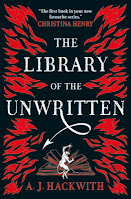
The Library of the Unwritten ('Hell's Library' #1) by A.J. Hackwith        $23
Many years ago, Claire was named Head Librarian of the Unwritten Wing — a neutral space in hell where all stories unfinished by their authors reside. Her job consists mainly of repairing and organising books, but also of keeping an eye on restless stories that risk materialising as characters and escaping the library. When a Hero escapes from his book and goes in search of his author, Claire must track and capture him with the help of former muse and current assistant Brevity and nervous demon courier Leto. But what should have been a simple retrieval goes horrifyingly wrong when the terrifyingly angelic Ramiel attacks them, convinced that they hold the Devil's Bible. The text of the Devil's Bible is a powerful weapon in the power struggle between Heaven and Hell, so it falls to the librarians to find a book with the power to reshape the boundaries between Heaven, Hell...and Earth. 
This exciting and inventive series continues with The Archive of the Forgotten and The God of Lost Words
Colours of Art: The story of art in 80 palettes by Chloe Ashby         $55
Colours of Art takes the reader on a journey through history by pairing 80 artworks with infographic palettes. For these pieces, colour is not only a tool (like a paintbrush or a canvas), but the fundamental secret to their success. Colour allows artists to express their individuality, evoke certain moods and portray positive or negative subliminal messages. And throughout history, the greatest of artists have experimented with new pigments and new technologies to lead movements and deliver masterpieces. But as something so cardinal, we sometimes forget how poignant colour palettes can be, and how much they can tell us. When Vermeer painted The Milkmaid, the amount of ultramarine he could use was written in the contract. How did that affect how he used it? When Turner experimented with Indian Yellow, he captured roaring flames that brought his paintings to life. If he had used a more ordinary yellow, would he have created something so extraordinary? And how did Warhol throw away the rulebook to change what colour could achieve?
>>See inside the book
The Rabbit Hutch by Tess Gunty         $33
An online obituary writer. A young mother with a secret. A woman waging a solo campaign against rodents. Separated by the thin walls of the Rabbit Hutch, a low-cost housing complex in the run-down Indiana town of Vacca Vale, these individual lives unfold. But Blandine is different. Ethereally beautiful and formidably intelligent, she shares an apartment with three teenage boys she neither likes nor understands, all of them like her products of the state foster system. Plagued by her past, let down by the very structures that were supposed to keep her safe, she spends her days reading Dante and dreaming of becoming a female mystic. Until, that is, one sweltering week in July culminates in an act of violence that will change everything, and finally offer her a chance to escape. Blandine is desperate to save a community that has been left behind, but that salvation will come at a terrible price.
"Dense, prismatic and often mesmerizing, a novel of impressive scope and specificity." —The New York Times
Farm: The making of a climate activist by Nicola Harvey            $37
In 2018, Nicola Harvey and her husband, Pat, left their careers and inner-city Sydney life to farm cattle in rural New Zealand. They thought it would be exciting, even relaxing, but soon found themselves in the middle of heated arguments and deep divisions about food, farming, and climate change. Read about how Harvey made her farm into a site for climate activism, and about her attempts to find an alternative the destructive status quo of current food production. 
The Black Atlantic: Modernity and double consciousness by Paul Gilroy      $28
Gilroy proposes that the modern black experience can not be defined solely as African, American, Caribbean or British alone, but can only be understand as a Black Atlantic culture that transcends ethnicity or nationality. 
"It was in this book that Gilroy laid out his concept of the 'black Atlantic', the idea that black culture is essentially a hybrid, a product of centuries of exchange, slavery and movement across the Atlantic. Exploring everything from the lives and work of African American philosophers such as WEB Du Bios, to black popular music, Gilroy demonstrates that black culture is both 'local' and 'global', and cannot be constrained within any single national culture. It flows across the black Atlantic of the book's title." —David Olusoga
>>"Useful violence."
The Wondrous Prune by Ellie Clements          $17
Magic comes from within! Uprooted by her single mum along with her troublesome older brother, eleven-year-old Prune Robinson is trying to settle in a new town. She figures she can't burden her hard-working mother with the fact she's being bullied. Or the fact that her drawings have started coming to life.But with her brother soon in danger, Prune comes to realise that she can't hide her power forever; in fact, it might just be the one thing that brings her family back together and saves them all.
Climate Change as Class War: Building Socialism on a warming planet by Matthew T. Huber          $35
The climate crisis is not primarily a problem of 'believing science' or individual 'carbon footprints' it is a class problem rooted in who owns, controls and profits from material production. As such, it will take a class struggle to solve. Huber argues that the carbon-intensive capitalist class must be confronted for producing climate change. Yet, the narrow and unpopular roots of climate politics in the professional class is not capable of building a movement up to this challenge. For an alternative strategy, he proposes climate politics that appeals to the vast majority of society- the working class. Huber evaluates the Green New Deal as a first attempt to channel working class material and ecological interests and advocates building union power in the very energy system we so need to dramatically transform. In the end, as in classical socialist movements of the early 20th Century, winning the climate struggle will need to be internationalist based on a form of planetary working class solidarity.
"The most powerful missile yet hurled against bourgeois climate politics. With a laser-sharp focus, it strikes at the central fortress: the sphere of production, where one class dominates another and wrecks the planet in the process. A book for every union organiser and every climate activist and everyone who wishes for the two to join forces - to be read, studied, debated, aimed and fired." —Andreas Malm
The Book of Sisters: Biographies of incredible siblings through history by Olivia Meikle and Katie Nelson        $23
Queens. Warriors. Witches. Revolutionaries. History is full of sisters making their mark. Find out why Egyptian ruler Cleopatra went to war against her younger sister Arsinoë; how Native American sisters Maria and Marjorie Tallchief became America’s first star ballerinas; what made samurai sisters Nakano Takeko and Nakano Koko take on an entire army. 
VOLUME BooksNew releases


Is literature a good guide to life? If not, is anything a good guide? In our Book of the WeekEITHER / OR by Elif Batuman, the quasi-protagonist, Selin, is in her second year at university, struggling to comprehend her relationships and life in general in terms of the Great Novels on her syllabus, and following some very dubious advice from friends and others. Can only an exciting and vivid life be transformed into literature, and, if so, is the necessary price of this craziness and loneliness? Batuman's novel grapples with deep issues but never stops being a large amount of fun. 


>> Read all Stella's reviews.


Free Kid to a Good Home by Hiroshi Ito   {Reviewed by STELLA}
Irresistible!  I liked this book so much I’ve read it twice already! From the delightful premise to the simple yet evocative illustrations, this will capture young readers' attention and yours too. Free Kid to Good Home is for all of us who have had to accept the arrival of a younger sibling, for all of us who have thought about running away, wondering about greener pastures or feeling a bit restless at home, and for anyone who’s ever tried to sell themselves or give away surplus goods. Not that this kid is surplus at all — far from it! Recently translated from Japanese, this bestseller first published there in 1995 and now in its 31st edition, is a standout. It has lost nothing in translation nor time and, like Russell Hoban’s A Baby Sister for Frances, remains relevant. Siblings still keep coming along, upsetting the equilibrium. So when Potato Face seems to be taking too much time and attention, our heroine decides it's time to make a move. A good box will do the trick. She positions herself with a well-written sign and waits for someone to notice her. While she’s waiting, she imagines all the great things that will await her in her new home. A great backyard to play in, servants to take her to and from school, amazing parties with lots of friends, no potato-faced brother, and rich and smart and beautiful parents! When a likely new parent (she avoids the ones with other kids — no way!) comes along, she sits up straight with her best smile. No takers. Maybe she needs to be more creative — a fun kid! Oops, too much fun — “No one’s going to feel sorry for a kid who’s dancing.” Waiting isn’t much fun so she’s quite pleased when a lost dog joins her, then a cat, and finally a turtle. (The reaction to the turtle — the looks on the faces of the other three in the box — is perfect). They all talk about their ideal home and one by one they are selected from the box except for the kid until…a young couple come by (with a quiet baby). Hiroshi Ito’s illustrations give great depth and humour to the interactions between the kid and her world, dovetailing and enhancing the text. He says, “ Humour is most important to me. It’s a means of survival. Some issues feel so huge they can crush you if you confront them head on, but humour helps us approach problems from a different angle.” The illustrative style is simple, with its spare use of black lines and details in red and plenty of space to focus your attention on the action. His aim is “for illustrations that might not look special at first glance but invite a closer look…art as a means to make myself happy and other people happy.” The images are sparky and spontaneous — just right for this kid and this story. As I said at the beginning, irresistible — it was a good thing that I wasn’t a character in this book — I would have taken this kid home. Fortunately, I can have the book instead. 


 >> Read all Thomas's reviews. 


Ducks, Newburyport by Lucy Ellmann    {Reviewed by THOMAS}
The fact that the wind is now making the branches scrape against the wall of the house as he sits down to write, though at least they only scrape when the wind blows, he thinks, and even when the wind blows it blows in gusts, so the scraping is not constant, not that it’s any less irritating, he thinks, the fact that this irritation is preventing him from starting to write, the fact that here he is, starting to write his review at the end of the day, despite what he just said, at what is almost the end of the day, at the end of the week, and such a week, the fact there is therefore a deadline of sorts to the completion of his review, the fact that he has not even started to write his review, despite what he just said, the fact that he would prefer to finish reading his book than write his review of the book, the fact that he is enjoying the book, very much, while he is reading it, but if he enjoys reviewing the book the enjoyment will only come when the writing is completed, which seems hardly fair, the fact that the book he is reading and enjoying is over one thousand pages long and is floppy and unwieldy like a paperback dictionary, which seems somehow appropriate, both in that it is floppy and unwieldy, in that it is about the floppiness and unwieldiness of being alive, as a human, in the twenty-first century, conscious and at the mercy of thought, and also in that the book is, in a way, similar to a dictionary in that it could make a fairly good claim to being an exhaustive catalogue of the miseries of consciousness, which is a sort of language, or a field in any case defined by language, the fact that the book is very funny, funny and painful, he thinks, just like consciousness, the fact that nobody should ever publish a paperback dictionary, unless it is a dictionary for incurious people, and there could be a market for that, he thinks, otherwise paperback dictionaries are insufficiently robust to be used more than a very few times, the fact that the floppiness and the unwieldiness of Ducks, Newburyport, the novel by Lucy Ellmann that he is going to review, seem somehow appropriate qualities for this novel of over one thousand pages, being slightly irritating but also in a way comedic and intriguing, just like life in the twenty-first century, the book’s ostensible subject, the fact that Ellmann is “the Proust of modern afflictions”, which quote he made up himself and disposed in speech marks to give it authority, perhaps that should have a capital M, he thinks, that fact that Modernism is a project to undo, or outdo, the strictures of form in order to make literature more resemble thought, the fact that Lucy Ellmann has made her novel resemble thought to the extent that it is both terrifying and compulsive, the fact that thought pops up all over the place, the fact that thought resurges, that is not a good word, he thinks, the fact that we are besieged at all times by thought, the fact that we are submerged in thought at all times, thought from outside our heads, both absolutely us and not us really at all, the fact that we are trying to keep our heads up, above the thoughts, but we can’t, the fact that we think to avoid thinking, the fact that wherever we look there’s a thought, the fact that, if he has to compare Ducks, Newburyport with something, it would be with an itch, as in when you ask yourself, Do I have an itch, then, invariably, you have an itch somewhere, perhaps on your elbow, or at the back of your neck, or an itch on your back, and, if you ask yourself, Do I have another itch, then you have another, and soon, as you know, you will have an itch anywhere you think about, you have itches everywhere, you are one great itch, well Ducks, Newburyport is like that, he thinks, a woman is assailed by her thoughts, she is at the mercy of her thoughts, the thoughts she produces, or, rather, the thoughts that assail her, for, he thinks, obsession is the state of being at the mercy of your own proclivities, the fact that Ducks, Newburyport is written as an endless stream of everything that annoys, or itches, or stimulates, or pains, same thing, a mind in this world, it is, he thinks, a catalogue of thoughts and the thoughts that get in the way of thought, for, he thinks, we all think to avoid thought, we’ve been there before, but, he thinks, not really a catalogue, the opposite of a catalogue, whatever the word for that is, a mishmash perhaps, now there’s a good Yiddish word, a mishmash of thought, linearly recorded, how else, the fact that Ducks, Newburyport is largely a one-thousand-page sentence, no, more than a one-thousand-page sentence, Ducks, Newburyport is a one-thousand-page list, the fact that he had always liked lists, in literature at least, the fact that he had at one time made a list of his favourite lists in literature, though he has lost this, the fact that the one-thousand-page list in Ducks, Newburyport, the one-thousand-page list that is Ducks, Newburyport, except for a short intercut story, told in sentences, about a mountain lion searching for her cubs, told from the mountain lion’s point of view, from a point of bafflement and disgust at humans and their world, which is pretty much an appropriate conclusion, judging from the rest of the text, which is told from a human’s point of view, the fact that the one-thousand-page list that comprises (most of) Ducks Newburyport, uses the phrase “the fact that” to separate its entries, or, rather, to introduce its entries, or, shall we say, to structure its entries, the fact that he finds the fact that the author uses “the fact that” to structure a novel, or a list, if the two forms can be separated, who cares, to structure a novel about living, about striving to live, rather, in a so-called post-factual world, the fact that this post-factual world is overwhelmed with information but short on truth, whatever that is, he thinks, this is the world in which we are all immersed, you’re soaking in it, a meme predating memes, it’s all memes, way back to the beginning of time, that fact that he decided he could write like this, too, in fact it became, as he read Ducks, Newburyport, more and more difficult not to write this way, in a list, like thought, he thinks, the fact that the more he writes in this way, the easier it becomes, and soon, he thinks, the difficulty will not be in writing but in stopping writing, the fact that he might not be able to stop, at least until he has written at least one thousand pages, which would be a remarkable application of method, apart from the fact that Lucy Ellmann has already written one thousand pages in this way, at whatever cost to herself, and to her family, and to her sanity, she had done it, so his achievement in writing his one thousand pages would be a fairly useless and unimpressive achievement, unimpressive on the literary front even if it might remain impressive on the insanity front, the fact that it would still be impressive for its cost to himself, and to his family, and to his sanity, impressive in a negative sense but not impressive in a positive sense, the fact that Lucy Ellmann has already, rightly, appropriated all the benefit from such an enterprise, the fact that Lucy Ellmann was short-listed for the Booker Prize for her one-thousand-page sentence, whereas he would have achieved nothing but the limits of his sanity, the fact that Lucy Ellmann may have achieved the limits of her sanity, though she has nerves of steel, he thinks, and may not even have neared the limits of her sanity, although the book might not have been so good if she had not, the fact that he does not have nerves of steel, he has nerves of tin, the fact that he would soon achieve the limits of his sanity, if he has not already achieved them, the fact that a one-thousand-page review of a one-thousand-page novel would not get him shortlisted for the Booker Prize, or even short-listed for even one person’s attention, the fact that he did not deserve even one person’s attention, the fact that Lucy Ellmann has already appropriated all the available attention for writing in this way, even if this is less attention than she deserves for writing in this way, the fact that she has written an outstanding one-thousand-page novel about human consciousness in the twenty-first century, but that, if he completes his one-thousand-page review of this novel he will be acclaimed as nothing more than a nuisance, if he is acclaimed anything at all, which is unlikely, the fact that benefit is finite but, it seems, detriment is infinite, the fact that negative consequences are inexhaustible, whereas positive consequences are soon exhausted, the fact that Lucy Ellmann’s project is forensic, though forensic about a crime that is infinitely dispersed in both its origins and consequences, the fact that this novel is not only about a woman's life, it is a woman’s life, but not her life only, the fact that a mountain lion’s life has clarity whereas a human life is without clarity, or so it seems, there are too many thoughts, and where do they come from, he thinks, the fact that reading Ducks Newburyport has made him aware of his thoughts, all his thoughts, including the thoughts he represses because they get in the way of his thinking, the fact that, now that he is aware of the mishmash of his thoughts, to use the technical term, his brain will just keep coming up with thoughts, make it stop, a list of thoughts, like in Ducks, Newburyport, structured by the phrase “the fact that”, even at times, such as when he is in the shower, or driving, when it is impossible to record these thoughts, the fact that these thoughts are lost but that the thoughts that arise from these thoughts keep arising, the fact that they show no sign of abating, the fact that this frightens him, at least a little, the fact that there will always be more thoughts is a thought that he finds horrible, the fact that all these thoughts are pushing at him, crowded at the edge of his awareness, waiting their turn, this is a horrible thought, he thinks, the fact that he needs to stop writing before it becomes impossible to stop writing, which has occurred to him before, the fact that he has, in any case, run out of time, there's a deadline after all, and whatever he's written must pass for a review, he'll call it a review, the fact that although he cannot bear to carry on, neither does he want to stop. 


 NEW RELEASES

The Marriage Portrait by Maggie O'Farrell            $38
The new novel from the author of Hamnet is one of the most anticipated books of the year. This one is set in 1560s Florence. Lucrezia, third daughter of Cosimo de' Medici, is free to wander the palazzo at will, wondering at its treasures and observing its clandestine workings. But when her older sister dies on the eve of marriage to Alfonso d'Este, heir to the Duke of Ferrara, Modena and Reggio, Lucrezia is thrust unwittingly into the limelight: Alfonso is quick to request her hand in marriage, and her father to accept on her behalf. Having barely left girlhood, Lucrezia must now make her way in a troubled court whose customs are opaque and where her arrival is not universally welcomed. Perhaps most mystifying of all is her husband himself, Alfonso. Is he the playful sophisticate he appears before their wedding, the aesthete happiest in the company of artists and musicians, or the ruthless politician before whom even his formidable sisters seem to tremble? As Lucrezia sits in uncomfortable finery for the painting which is to preserve her image for centuries to come, one thing becomes worryingly clear. In the court's eyes, she has one duty: to provide the heir who will shore up the future of the Ferrarese dynasty. Until then, for all of her rank and nobility, her future hangs entirely in the balance.
"Finely written and vividly imagined." —Guardian
>>On the inspiration for the novel
99 Interruptions by Charles Boyle           $28
Without a kink in the line there’s no story to tell. The kinks are the story. There is gridlock on the M40 and a banana skin on every pavement. Lovers are disturbed in bed and my father becomes a rain god. Complacency is mocked. Death hovers. Shit happens. How the messiness of life is translated into fiction is considered and no conclusions are reached. Why, anyway, setting out from A, am I so sure that B is where I want to get to? Interruptions push back, disrupting the status quo or derailing progress. 99 Interruptions – a cross-genre exploration of interruptions in both life and literature, and of the relationship between the two – attempts to take them in its stride.
"I can’t think of a wittier, more engaging, stylistically audacious, attentive and generous writer working in the English language right now." —Nicholas Lezard, Guardian 
Bonsai by Alejandro Zambra (translated by Megan McDowell)         $28
Julio and Emilia, two Chilean students, seek truth in great literature but find each other instead. Like all young couples, they lie to each other, revise themselves, and try new identities on for size, observing and analysing their love story as if it's one of the great novels they both pretend to have read. As they shadow each other throughout their young adulthoods, falling together and drifting apart, Zambra spins a formally innovative, metafictional tale that brilliantly explores the relationship among love,art, and memory.
"The 'last truly great book' I read has to be Alejandro Zambra's Bonsai. A subtle, eerie, ultimately wrenching account of failed young love in Chile among the kind of smartypant set who pillow-talk about the importance of Proust. A total knockout.' —Junot Diaz
"Every beat and pattern of being alive becomes revelatory and bright when narrated by Alejandro Zambra. He is a modern wonder." —Rivka Galchen
The Last Colony: A tale of exile, justice, and Britain's colonial legacy by Philippe Sands         $35
After the Second World War, new international rules heralded an age of human rights and self-determination. Supported by Britain, these unprecedented changes sought to end the scourge of colonialism. But how committed was Britain? In the 1960s, its colonial instinct ignited once more: a secret decision was taken to offer the US a base at Diego Garcia, one of the islands of the Chagos Archipelago in the Indian Ocean, create a new colony (the 'British Indian Ocean Territory') and deport the entire local population. One of those inhabitants was Liseby Elysé, twenty years old, newly married, expecting her first child. One suitcase, no pets, the British ordered, expelling her from the only home she had ever known. For four decades the government of Mauritius fought for the return of Chagos, and the past decade Philippe Sands has been intimately involved in the cases. In 2018 Chagos and colonialism finally reached the World Court in The Hague. As Mauritius and the entire African continent challenged British and American lawlessness, fourteen international judges faced a landmark decision: would they rule that Britain illegally detached Chagos from Mauritius? Would they open the door to Liseby Elysé and her fellow Chagossians returning home - or exile them forever? Taking us on a disturbing journey across international law, The Last Colony illuminates the continuing horrors of colonial rule, the devastating impact of Britain's racist grip on its last colony in Africa, and the struggle for justice in the face of a crime against humanity. It is a tale about the making of modern international law and one woman's fight for justice, a courtroom drama and a personal journey that ends with a historic ruling.
"Rarely does a book combine erudition and empathy so eloquently." —Elif Shafak
Unraveller by Frances Hardinge           $30
In a world where anyone can create a life-destroying curse, only one person has the power to unravel them. Kellen does not fully understand his talent, but helps those transformed maliciously — including Nettle. Recovered from entrapment in bird form, she is now his constant companion, and closest ally. But Kellen has also been cursed, and unless he and Nettle can remove his curse, Kellen is in danger of unravelling everything — and everyone — around him. Another gripping and multi-levelled novel from this remarkable author. 
The Tribe: Portraits of Cuba by Carlos Manuel Álvarez (translated by Frank Wynne with Rahul Bery)          $33
Alvarez employs the cronica form — a genre unique to Latin American writing that blends reportage, narrative non-fiction, and novelistic forms — to illuminate a particularly turbulent period in Cuban history, from the re-establishment of diplomatic relations with the US, to the death of Fidel Castro, to the convulsions of the San Isidro Movement. The Tribe shows a society in flux, featuring sportsmen in exile, artists, nurses, underground musicians and household names, dissident poets, the hidden underclass at a landfill, migrants attempting to make their way across Central America, fugitives escaping the FBI, dealers from the black market, as well as revelers and policemen in the noisy Havana night.
"A journalistically rigorous picture of Cuban life, The Tribe is characterized by the gaps between Alvarez's subjects. Using interviews and on-site reportage, Alvarez profiles people from various socioeconomic backgrounds, with contrasting political affiliations. The sketches he compiles demonstrate a wide range of experiences and perceptions of Cuba. Alvarez allows the juxtapositions between these profiles to reveal a country that looks different from person to person. A nation is, after all, nebulous — the only way to make an honest portrait is to approach it from myriad perspectives. In The Tribe, the resulting mosaic is rich for its nuance and contradictions." —Chicago Review of Books
Granta 159: What Do Youi See?                $28
Essays by William Atkins on Sizewell C, the proposed nuclear power station in Suffolk; travel essays by Jason Allen-Paisant and Ishion Hutchinson, memoir by Kevin Childs, Geoff Dyer, Alejandro Zambra (translated from the Spanish by Megan McDowell) and Lars Horn. Fiction by Adam Foulds, Andrew Holleran and Maxim Osipov (translated from the Russian by Alex Fleming) and Rebecca Sollom. Photography by Phalonne Pierre Louis; Raphaela Rosella, introduced by Nicole R. Fleetwood; and Muhammad Salah, introduced by Esther Kinsky.
Own Sweet Time: A diagnosis and notes by Caroline Clark          $28
Where does the body end and the mind begin? Two texts run parallel: on one side the verbatim transcript of a cancer diagnosis, and on the other side fragments of the writer's past and present, catching on the future.
"Caroline Clark summons us, boldly and beautifully, to eavesdrop on a consultation and a life – and in doing this she illuminates the gap, both in understanding and language, between a medical history and the actual stuff of a person." —Sam Guglani, consultant oncologist
"It’s a conversation no-one wants to have: an oncologist explains a new cancer diagnosis, and begins a dialogue over treatment options. From the cool, brisk language of the clinic Caroline Clark has distilled the most extraordinary poetic reflections, creating book of great value for clinicians and patients alike – as well as anyone interested in the language of caring, and how we respond to life-threatening illness." —Gavin Francis
The Shadow of the Coachman's Body (translated by Rosemarie Waldrop) by Peter Weiss             $33
Peter Weiss's first prose work was unanimously praised as an original and perfect work of art by critics when it appeared in 1960. Weiss arranges a dark, vividly alive comedy of inert objects in a dismal boarding house—stones, buttons, hooks, needles, chairs, newspapers in an outhouse, clinking tin cups, celestial orbs, sewing machines, an overwound windup music box—which have oblique characters' shadows as their supporting cast. Described by Weiss as a 'micro-novel', The Shadow of the Coachman's Body can be obscene, trivial and brutal, and yet it is also peculiarly intimate and offers endless possibilities—like a telescope and kaleidoscope rolled into one.
"Exhilaratingly strange, compelling, and original." —Bookforum
Happy Trails to You by Julie Hecht             $40
Our postmodern world, re-examined: With an unwavering gaze on the absurdities and ironies of the larger world, the stories in Happy Trails to You recount the narrator's attempts to find a place of unspoiled nature on the once peaceful island of Nantucket, where power mowers, nail guns, and speeding trucks have blocked out the sounds of birdsong and crickets. A visit to a friend or restaurant touches upon every subject from the color of paint to the world situation and infinity.
"These aren't merely the worries of an eccentric middle-aged East Coast vegetarian; they're the all-too-common concerns of the mainstream liberal consciousness. In the new century, Hecht's narrator is suddenly less alone in her alarm and alienation, finding more kindred spirits than ever before. But Hecht plays with this stereotype on many levels, and the collection's strongest moments describe a frustration with civilization that can't be blamed solely on psychosis." —Bookforum
Māori Moving Image edited by Melanie Oliver and Bridget Reweti     $35
A fully illustrated book of film, animation and video art made by Maori artists. Texts in English and te reo Maori by editors Melanie Oliver and Bridget Reweti, Maree Mills, Ariana Tikao, Nina Tonga and Matariki Williams, as well as interviews with artists Shannon Te Ao, Jeremy Leatinu'u, Nova Paul, Nathan Pohio, Rachael Rakena and Lisa Reihana.
Magnificent Rebels: The first Romantics and the invention of the Self by Andrea Wulf         $40
In 1790s Jena a small group of friends — including Goethe, Schiller, Fichte, Novalis, Schlegel, Schelling and Hegel, and centred around a free-spirited, thrice married, single-mother named Caroline Michaelis-Boehmer-Schlegel-Schelling — began a revolution in thinking that has shaped culture since. Working in poetry, drama, philosophy and science, these first Romantics forged new ways of thinking of ourselves and of our relationship to others and to nature. 
"This is a magnificent book, fascinating in its focus and breathtaking in its scope and sweep. It is a work of formidable scholarship worn lightly; of complex intellectual history told evocatively, absorbingly, compellingly. Wulf's superb prose draws us deeply into the lives and minds of this remarkable circle of people, who together explored the breathtaking possibilities — and tremendous risks — of free will, individual creativity and liberty." —Robert Macfarlane
Before Your Memory Fades by Yoshikazu Kawaguchi           $25
In northern Japan, overlooking the spectacular view Hakodate Port has to offer, Cafe Donna Donna has been serving carefully brewed coffee for more than one hundred years. But this coffee shop offers its customers a unique experience: the chance to travel back in time. From the author of Before the Coffee Gets Cold and Tales from the Cafe comes another story of four new customers, each of whom is hoping to take advantage of the cafe's time-travelling offer. 


The English Text of the Treaty of Waitangi by Ned Fletcher        $70

How was the English text of the Treaty of Waitangi understood by the British in 1840? That is the question addressed by historian and lawyer Ned Fletcher, in this extensive work. With one exception, the Treaty sheets signed by rangatira and British officials were in te reo Māori. The Māori text, Te Tiriti o Waitangi, was a translation by the missionary Henry Williams of a draft in English provided by William Hobson, the Consul sent by the British government to negotiate with Māori. Despite considerable scholarly attention to the Treaty, the English text has been little studied. In part, this is because the original English draft exists only in fragments in the archive; it has long been regarded as lost or ‘unknowable’, and in any event superseded by the authoritative Māori text. Now, through careful archival research, Fletcher has been able to set out the continuing relevance of the English text. The English Text of the Treaty of Waitangi emphasises that the original drafting of the Treaty by British officials in 1840 cannot be separated from the wider circumstances of that time. This context encompasses the history of British dealings with indigenous peoples throughout the Empire and the currents of thought in the mid-nineteenth century, a period of rapid change in society and knowledge. It also includes the backgrounds and motivations of those primarily responsible for framing the Treaty: British Resident James Busby, Consul and future Lieutenant-Governor William Hobson, and Colonial Office official James Stephen. Through groundbreaking scholarship, Fletcher concludes that the Māori and English texts of the Treaty reconcile, and that those who framed the English text intended Māori to have continuing rights to self-government (rangatiratanga) and ownership of their lands. This original understanding of the Treaty, however, was then lost in the face of powerful forces in the British Empire post-1840, as hostility towards indigenous peoples grew alongside increased intolerance of plural systems of government.

The Last Letter of Godfrey Cheathem by Luke Elworthy          $35

Traumatised by his failure to match the creative successes of his precocious younger siblings — early over-achievers in theatre, music and fine arts — Godfrey Cheathem never expects that his baffling experimental pottery will one day lead him to the unlikely heights of international book publishing. There he meets a mysterious artist, a pivotal encounter on a journey of self-discovery that points up some of the many absurdities of New Zealand life and culture, and culminates in Godfrey's comic yet anguished unravelling at a grand reunion at the Cheathem turangawaewae, the farm that has been in his wider family for generations. Godfrey Cheathem died not long after completing his last letter in his cell in Paparua prison, never living to see the publication of his great novel. Cheathem's letter is written to his sister, and tries to explain the events that led to his imprisonment. A tragically funny novel of father figures, bullshit and belonging. 
"A comic novel – and, unusually in New Zealand, a very funny one – with serious themes underlying it. It is terrific, impressively inventive. It is so clever without being clever-dick." —Stephen Stratford
>>Surviving both Centrepoint and Christ's College
Haven by Emma Donoghue           $38
In seventh-century Ireland, a scholar and priest called Artt has a dream telling him to leave the sinful world behind. Taking two monks — young Trian and old Cormac — he rows down the river Shannon in search of an isolated spot on which to found a monastery. Drifting out into the Atlantic, the three men find an impossibly steep, bare island, inhabited by tens of thousands of birds, and claim it for God. In such a place, what will survival mean?
"Haven is a beautiful and timely novel about isolation, passion and the conflict between obedience and self-preservation. The island setting and the characters stayed with me long after I finished reading." —Sarah Moss
"Emma Donoghue combines pressure-cooker intensity and radical isolation, to stunning effect. What is Divine Grace? Purity of soul? Virtue? Not what they think." —Margaret Atwood
When We Were Birds by Ayanna Lloyd Banwo          $37
Darwin is a down-on-his-luck gravedigger, newly arrived in the Trinidadian city of Port Angeles to seek his fortune, young and beautiful and lost. Estranged from his mother, he is convinced that the father he never met may be waiting for him somewhere amid these bustling streets. Meanwhile in an old house on a hill, Yejide's mother is dying. And she is leaving behind a legacy that now passes to Yejide- the power to talk to the departed. Darwin and Yejide's destinies are intertwined, and they will find one another in the ancient cemetery at the heart of the city, where trouble is brewing and destiny awaits.
"Tender and lonely and powerful. A love letter to Trinidad and a vivid debut about romance and loss in the Caribbean. —Guardian
Around the World in 80 Trees by Ben Lerwill and Kaja Kajfez            $33
Where can you find Methuselah, the oldest tree in the world? Why is the baobab's trunk so fat? Can trees really warn each other that something is about to eat them? Including a stunning central gatefold that opens out to reveal all 80 trees and how they relate to each other, this book is a visual celebration of the huge variety of trees found across the world, from those you know to those you almost certainly don't. As the book takes the reader on a journey around the world, it reveals trees that give us food and medicine, trees with ancient legends, record-breaking trees and more.
>>Look inside.
Sunken City by Marta Barone             $37
Newly-bereaved, bookish and lonely in Turin, a young woman sets out to chronicle her father's secret lives — and her struggle to accept his loss. She is startled to discover that the gentle, mercurial doctor was sentenced to jail in 1986 for membership of an armed band. Her father, L.B, lived through the Years of Lead, a time of unrest when extreme factions of left and right took hostages, set bombs and murdered their countrymen. Unable to move on before she can understand her family's past, she goes in search of him — and ultimately of herself too — the only way she knows how, by reading everything she can. Through her search for the truth, a very different picture starts to emerge.
Our fossil fuel driven society has run out of time. Only by rapidly giving up our reliance on carbon can we pay down the debt of fossil capital and buy a liveable future without a mass extinction or global warming. In this manifesto, environmental scholars Vettese and Pendergrass outline the structural, economic, and social changes de-carbonisation will require. Drawing from detailed environmental modeling of our planet's many possible futures, Vettese and Pendergrass argue that we will need to give half of the earth's land, now used for agricultural and meat production, back to nature rewilding half the earth. The only political program that can give us a livable half-earth, they argue, is socialism — a planned socialist society can constrict the destructive industries ravaging our world fossil fuels, cars, aviation, meat, and real estate while expanding renewable energy systems, organic agriculture, public transport, and health and education systems. Half-Earth Socialism argues that we can consciously and democratically direct human society's interaction with nature and in fact, we must, if we want any kind of livable future on this planet.
"The best way to subvert a dystopia is to plan a utopia. In Half-Earth Socialism, Vettese and Pendergrass delve into this vital work of practical dreaming. So what does a better world look like? Blending science, history, philosophy and fiction, the authors thoughtfully chart a possible future to avert the worst impacts of the climate crises. Importantly, beyond climate mitigation and adaptation, this book tackles the critical need to address large-scale system change. Read this book if you not only dream of saving the world, but want a plan for how to do it." —Ziya Tong
A Brief History of Black Holes (And why nearly everything you think you know about them is wrong) by Becky Smethurst            $40
The Moon goes around the Earth, the Earth goes around the Sun, the Sun goes around the centre of the Milky Way: a supermassive black hole. As you read this you are currently orbiting a black hole. Black holes make the universe go round, but what we think we know is largely wrong.


VOLUME BooksNew releases


>> Read all Stella's reviews.


Worn: A people's history of clothing by Sofi Thanhauser   {Reviewed by STELLA}
Worn is a wide-ranging and compelling look at clothing and textiles through the lens of five fabrics: linen, cotton, silk, synthetics and wool. Thanhasuer explores the social, economic, and environmental impacts of one of our most intimate possessions. A material culture history that reveals global links, as well as personal stories and our desire for clothes from ancient to contemporary times. As a maker of objects and a lover of clothes and their construction, with a good dose of interest in history and the social fabric that binds people and things, I loved this book. Each page revealed another fascinating detail in the history of clothing and the people who were engaged in the planting and harvesting of plants, in the processes — natural or chemical — and manufacture of fibre and the twisting, weaving or whatever other method imaginable to make fabric and then those textiles into the clothes we wore (and wear), through necessity and desire. Whether it is the arrival of the ‘season’ as denoted by the French court of Loius XIV or the rise of the factory workers in New York city fueled by the influence of young educated Jewish migrant women or the appalling treatment of workers in the American South, historically (slave and cheap labour) and today (illegal migrants) or the environmental impact of over-production of cotton in both America and China to the detriment of the land, the people and water reserves, you will find something in Thanhuaser's explorations that will surprise, intrigue and pique your curiosity about our relationship with what we wear and the origins of this relationship. The crafting of this book makes the vessel filled with so many facts, geopolitical analysis, fine details, expansive timeframes, technological advances, rich personal stories and empathetic observation, a pleasure to read. The decision by Thanhauser to tell this story through the lens of the five fabrics and the focus on particular (historical as well as contemporary) individuals — its people — makes Worn a lively, empathetic and engaging cultural history. 


 >> Read all Thomas's reviews. 


Autoportrait by Édouard Levé   {Reviewed by THOMAS}
“I am inexhaustible on the subject of myself,” states Édouard Levé in this book which is nothing less than an attempt to exhaust everything that he can think of to say about himself, no matter how banal or embarrassing, with relentless objectivity. In one long string of seemingly random declarative statements without style or development or form (other than the form of the list, if a list can be said to be a form), the details accumulate with very fine grain, but the effect is disconcerting: the author comes no closer to exhausting his observations, and the idea that there is such a thing as a 'person' beyond the details seems more and more implausible. The list is not so much an accumulation as an obliteration: facts obscure that which they purport to represent. “I dream of an objective prose, but there is no such thing.” Levé’s style is deliberately and perfectly and admirably flat throughout (all perfect things should be admired (whatever that means)), like that of a police report. “I try to write prose that will be changed neither by translation nor by the passage of time.” The constructions often feel aphoristic but eschew the pretension of aphorisms to refer to anything other than the particulars of which they are constructed. There is no lens formed by these sentences to ‘see through’, no insight, no intimation of personality other than the jumbled bundling of details and tendencies assembled under the author’s name, no ‘self’ that expresses itself through these details or is approachable through these details, because we are none of us persons other than what we for convenience or comfort (or, rather, out of frustration and fear) bundle conceptually, mostly haphazardly, and treat as an entity or ‘person’. The more fact is compounded (or, rather, facts are compounded), the stronger the intimation that any attempt to exhaust the description of a person will never be approach we usually think of as a person. “If I look in mirrors for long enough, a moment comes when my face stops meaning anything.” As well as demonstrating the impossibility of the task which it attempts, description also cancels itself by implying for each positive statement a complementary negative statement. Each statement of the self-description of Édouard Levé functions to include those of us among his readers who are similar and to exclude those who are dissimilar. We find each statement either in accord or in disagreement with a statement we could similarly (or dissimilarly) make about ourselves. The reader is charted in the text as much as the author. The reader is continually comparing themselves to the author, finding accord or otherwise, exercising the kind of judgement concealed beneath all social interaction but typically hidden by content and mutuality. In Autoportrait, the author’s self-obsession is matched by our fascination with him, with the kinds of details that may or may not come to light in social interchange. Because the author is not aware of us and is not reciprocally interested in us, or feigning reciprocal interest in us, as would be the case in ‘real life’ social interaction, we feel no shame in our fascination, our fascination is dispassionate, clinical. He is likewise unaffected by our interest or otherwise in him. But as well as bundling together an open set of details that we may conveniently think of as facts (“Everything I write is true, but so what?”) about Édouard Levé (or ‘Édouard Levé’), the text also conjures an inverse Édouard Levé (or ‘Édouard Levé’) who is the opposite to him in every way, the person who nullifies him (in the way that all statements call into being their simple or compound opposites, their nullifiers). Levé’s obsession with identity, facsimile and the corrosive effects of representation reappear throughout the book, and towards the end he mentions the suicide of a friend from adolescence, which would form the basis for Levé’s final book, Suicide (after which Levé himself committed suicide). Édouard Levé was born on the same day as me, but on the other side of the planet. In Autoportrait he writes, “As a child I was convinced that I had a double on this earth, he and I were born on the same day, he had the same body, the same feelings I did, but not the same parents or the same background, for he lived on the other side of the planet, I knew that there was very little chance that I would meet him, but still I believed that this miracle would occur.” We never met. 

 NEW RELEASES

The Wall by Marlen Haushofer (translated by Shaun Whiteside)           $40

A woman goes to the Austrian mountains to spend a few days in a hunting lodge with her cousin and his wife. When the couple fail to return from a walk, the woman tries to go into the village to look for them. Instead she comes across a transparent wall behind which there seems to be no life. Trapped behind the wall, a result of a too successful military experiment, she begins the arduous work of not only survival but self-renewal. The Wall is at once a simple document of potatoes and beans, of hoping for a calf, of counting matches, of forgetting the taste of sugar and the use of one's name, and simultaneously a disturbing meditation on our place in the natural world.
"The Wall is a novel that contrives to be, by turns, utopian and dystopian, an idyll and a nightmare. In her isolation behind the wall, together with her animals, the woman discovers a new life, in comparison with which her existence before she came to the mountains seems trivial and pointless. The natural world which it describes with such rapt attention is cupped in the larger receptacle of a vivid and sinister dream, a dream we seem to have had many times before and which on each retelling leads to the same scene of horror at its climax." —Nicholas Spice, London Review of Books
"It is about our reasons for living, self-sufficiency, solitude, men, women, war, and love, and the problem of other minds. And the animals in this book-oh! I don't understand why this book is not considered one of the most important books of the twentieth century. I have been anxiously pushing it on everyone I know, and now I push it on you." —Sheila Heti, The Paris Review
>>Claire Louise Bennett on The Wall.
>>Read Thomas's review

Down with the Poor! by Shumona Sinha (translated by Teresa Lavender Fagan)            $34
Over the course of a night in police custody, a young woman tries to understand the rage that led her to assault a refugee on the Paris metro. She too is a foreigner, now earning a living as an interpreter for asylum seekers in the outskirts of the city. Translating the stories of men and women who come from her country of birth, into the language of her country of citizenship, Sinha’s narrator finds herself caught up in a tangle of lies and truths. 
"A provocative and visceral book about class, caste, fear and self-loathing, exposing the real generational damage Imperialism wreaks on brown minds. Shumona Sinha gets inside the skin of an everyday woman turned monster by the system: her voice grips the imagination and does not let go." —Preti Taneja

Jumping Sundays: The rise and fall of the counterculture in Aotearoa New  Zealand by Nick Bollinger          $50
What transformation was wrought upon society by the counterculture movements of the 1960s and 1970s? Bollinger tells the story of beards and bombs, freaks and firebrands, self-destruction and self-realisation, during a turbulent period.
"A compelling and important history of the counterculture in Aotearoa New Zealand. Meticulously researched and full of vivid details and memorable photographs, this book is an immensely readable and absorbing account of an important era in our recent history." —Sue Kedgley
"Jumping Sundays is a fluent, vivid, coherent and succinct account of a period of turmoil during which major changes took place in New Zealand society, and of the ways we understood what that society was, what it had been, and what it could yet become." —Martin Edmond
"An absorbing and serious account that is also terrific fun. Deft interviews and personal letters provide rollicking recollections together with many amazing new photographs and images. Bollinger puts a personal and personable stamp on this critical decade with words, sights and sounds that surprise and delight." —Bronwyn Labrum
>>The liberation of Albert Park
Autoportrait by Jesse Ball          $48
Taking as its model Édouard Levé's Autoportrait, and written in a single day, Jesse Ball's book is a remarkable memoir in which the important and unimportant details of his life are shown to be equally revelatory not only of the thinking and experiences of one of America's most interesting and nuanced writers, but of life itself (so to call it). How does memory work? What do we think is important to us? Why do we spend so much time and effort on other things? Ball brings focus,, insight and humane curiosity to the circumstances of being alive. 
"The pleasure, here, is in errancy and velocity. Ball's text leans into cold wonder, flirting with a Francis Ponge-like poetry of the mundane and highlighting his predilection for the absurd, the diffuse, the simply odd. Much of the strange delight of reading this book is found in teasing out the precise nature of Ball's writerly persona, variously warm and cold, aloof and sincere." —Bailey Trela, Frieze
"Both Ball and Levé are working in a tradition that falls under the rubric of 'life writing,' encompassing both memoir and the stranger territory known as autofiction. At the heart of each is the tension between experience and memory, or objectivity and subjectivity. These two Autoportraits push back against the familiar narrative arc in favor of something more conditional and authentic. More than merely an act of solipsism or ego, these works attempt to record nothing less than the operation of consciousness itself." —David L. Ulin, The Wall Street Journal
>>Read Thomas's review of Édouard Levé's Autoportrait
The Opposite of a Person by Lieke Marsman (translated by Sophie Collins)           $23
 When Ida, a Dutch climatologist, accepts an internship at a climate research institute in the Italian Alps, it means leaving her girlfriend Robin behind in Amsterdam. As she and her new colleagues prepare to demolish a decommissioned hydropower dam, Ida finds herself grappling with love, loneliness and her place in a society unwilling to confront global warming.
"Stunning. An existentialist, essential story about the world we live in." —Marieke Lucas Rijneveld
"The Opposite of a Person channels its forked curiosity into asking not only how a person should be, what a society should do, but also what a book can and should accomplish. A novel for the end-times, in the best possible way." —Polly Barton

>>The essay, the object, and the re-mix

The Dangerous Journey by Tove Jansson (translated by Sophie Hannah)          $29

A little girl is transported with the help of magic glasses from the tedium of a summer afternoon into an exciting world of mangrove swamps, spluttering volcanoes and sea where birds fly upside down and wild things threaten to pounce. But she is not alone. Old friends from Moomin Valley — Hemulen, Sniff, Snufkin, Thingummy & Bob — have joined her in her journey, and Moomintroll too, who rides to their rescue in a stripy balloon.

>>Have a look inside the book!

Bear Woman by Karolina Ramqvist (translated by Saskia Vogel)          $37
1542. A French noblewoman is left abandoned on a small island north of Nova Scotia. She has a crossbow, arquebuses and gunpowder. The island is populated only by wild beasts. She may be pregnant at this time. Centuries later, whilst mothering her young children, a woman begins writing what she believes to be a television script about the life of Marguerite de la Rocque and her incredible story of survival against the odds. As she draws closer to the nature of Marguerite, the woman begins to question her ability to tell this story, or that of any woman in history, and in so doing exposes a fundamental truth about what it is to be both a writer and mother. This fascinating book combinines historical text, autofiction and essay with the uncertainty of memory. Perfect if you loved A Ghost in the Throat
>>Navigating the silences of women's history.
House Arrest: Pandemic diaries by Alan Bennett           $17
Reflections on Covid and confinement from the humane and perceptive pen of Alan Bennett.
4 March. HMQ pictured in the paper at an investiture wearing gloves, presumably as a precaution against Coronavirus. But not just gloves; these are almost gauntlets. I hope they're not the thin end of a precautionary wedge lest Her Majesty end up swathed in protective get-up such as is worn at the average crime scene.
20 March. With Rupert now working from home my life is much easier, as I get regular cups of tea and a lovely hot lunch.
Shadowlands: A journey through lost Britain by Matthew Green            $45
Britain's landscape is scarred with haunting and romantic remains; these shadowlands that were once filled with life are now just spectral echoes. Peering through the cracks of history, we find Dunwich, a medieval city plunged off a Suffolk cliff by sea storms; the lost city of Trellech unearthed by moles in the Welsh Marches; and the ghostly reservoir that is Capel Celyn, one of the few remaining solely Welsh-speaking villages, drowned by Liverpool City Council. Historian Matthew Green tells the extraordinary stories of how these places met their fate and probes the disappearances to explain why Britain looks the way it does today. Travelling across Britain, Green transports the reader to these places as they teeter on the brink of oblivion, vividly capturing the sounds of the sea clawing away row upon row of houses, the taste of medieval wine, or the sights of puffin hunting on the tallest cliffs in the country. We experience them in their prime, look on at their destruction and revisit their lingering remains later as they are mourned by evictees and reimagined by artists, writers and mavericks.
The Seven Moons of Maali Almeida by Shehan Karunatilaka         $40
Colombo, 1990. Maali Almeida, war photographer, gambler and closet queen, has woken up dead in what seems like a celestial visa office. His dismembered body is sinking in the serene Beira lake and he has no idea who killed him. At a time where scores are settled by death squads, suicide bombers and hired goons, the list of suspects is depressingly long, as the ghouls and ghosts with grudges who cluster round can attest. But even in the afterlife, time is running out for Maali. He has seven moons to try and contact the man and woman he loves most and lead them to a hidden cache of photos that will rock Sri Lanka. A searing satire of contemporary Sri Lanka. 
>>Long-listed for the 2022 Booker Prize
The Shadow Drawing: How science taught Leonardo how to paint by Francesca Fiorani          $43
What was the connection between Leonardo the painter and Leonardo the scientist? And what can a mysterious, long-lost book teach us about how Leonardo truly conceived his art? Shortly after Leonardo’s death, his peers and rivals created the myth of the two Leonardos: there was Leonardo the artist and then, later in life, Leonardo the scientist. In this pathbreaking biographical interpretation, the art historian Francesca Fiorani tells a very different and much more interesting story. Taking a fresh look at Leonardo’s celebrated but challenging notebooks as well as other, often obscure sources, Fiorani shows that Leonardo became fluent in science when he was still a young man. As an apprentice in a Florence studio, he was especially interested in the science of optics, which tells us how we see what we see. For the rest of his life he remained, according to a close observer, obsessed with optics, believing that his art would grow only as his knowledge of light and shadow deepened. 
Exiles: Three island journeys by William Atkins       $45
This is the story of three unheralded nineteenth-century dissidents, whose lives were profoundly shaped by the winds of empire, nationalism and autocracy that continue to blow strongly today: Louise Michel, a leader of the radical socialist government known as the Paris Commune; Dinuzulu kaCetshwayo, an enemy of British colonialism in Zululand; and Lev Shternberg, a militant campaigner against Russian tsarism. In Exiles, William Atkins travels to their islands of banishment — Michel's New Caledonia in the South Pacific, Dinuzulu's St Helena in the South Atlantic, and Shternberg's Sakhalin off the Siberian coast — in a bid to understand how exile shaped them and the people among whom they were exiled. In doing so he illuminates the solidarities that emerged between the exiled subject, on the one hand, and the colonised subject, on the other. Rendering these figures and the places they were forced to occupy in shimmering detail, Atkins reveals deeply human truths about displacement, colonialism and what it means to have and to lose a home.
"One of the best makers of sentences around." —Olivia Lang
Maud Martha by Gwendolyn Brooks            $23
Maud Martha Brown is a little girl growing up on the South Side of 1940s Chicago. Amidst the crumbling taverns and overgrown yards, she dreams: of New York, romance, her future. She admires dandelions, learns to drink coffee, falls in love, decorates her kitchenette, visits the Jungly Hovel, guts a chicken, buys hats, gives birth. But her lighter-skinned husband has dreams too: of the Foxy Cats Club, other women, war. And the 'scraps of baffled hate' — a certain word from a saleswoman; that visit to the cinema; the cruelty of a department store Santa Claus — are always there. Written in 1953, Maud Martha is a poetic collage of happenings that forms an extraordinary portrait of an ordinary life: one lived with wisdom, humour, protest, rage, dignity, and joy.
"Such a wonderful book. Utterly unique, exquisitely crafted and quietly powerful. I loved it and want everyone to read this lost literary treasure." —Bernardine Evaristo
Grumpy Pants by Clare Messer           $17
Have you ever had a grumpy day and not known why? Penguin is having a grumpy day like that. No matter what he does, he just can't shake it! Sometimes the only thing left to do is wash the grumpy day away and start over. The simple text and lively illustrations are the perfect cure for even the grumpiest of days.
Constructing a Nervous System by Margo Jefferson            $33
The author of Negroland fuses cultural analysis and memoir to probe race, class, family and art. Taking in the jazz and blues icons whom Jefferson idolised as a child in the 1950s, ideas of what the female body could be — as incarnated by trailblazing Black dancers and athletes — Harriet Beecher Stowe's Topsy reimagined in the artworks of Kara Walker, white supremacy in the novels of Willa Cather, and more, this account is both a critique and a vindication of the constructed self.
"Jefferson takes vital risks, tosses away rungs of the ladder as it climbs, and offers an indispensable, rollicking account of the enchantments, pleasures, costs, and complexities of 'imagining and interpreting what had not imagined you'." —Maggie Nelson
"She knows everything and has felt it all deeply. If you want to know who we are and where we've been, read Margo Jefferson." —Edmund White
"This is one of the most imaginative—and therefore moving—memoirs I have ever read." —Vivian Gornick
Persiana Everyday by Sabrina Ghayour              $50
Ghayour follows her first hugely popular Persiana cookbook with another 100 superb recipes designed to ensure maximum flavour with the greatest of ease. Try Small Plates Including My Muhammara; Fried feta parcels with honey; My flavour bomb beans on toast Salads for All Seasons Including Chicken & cucumber salad with pul biber & tahini lime dressing; Courgette, apple, peanut & feta salad with basil and pul biber; Jewelled tomato salad Poultry & Meat Including Bloody Mary spatchcocked chicken; Halloumi fatteh; Speedy lamb shawarma Fish & Seafood Including Fragrant roasted haddock; Spicy orange & harissa-glazed cod; Marmalade prawns with barberry, chilli & chive butter Vegetable Love Including Ash-e-Reshteh; Pomegranate & harissa roasted aubergine steak; Sticky tamarind, garlic & tomato green beans Carbs of All Kinds Including Super-quick smoky tomato couscous; Lazy Mantí; Tangy bulgur wheat bake with roasted onions Something Sweet Including Rhubarb, rose & pistachio trifle pots; Orange & dark chocolate rubble cake; Cardamom & mocha rice pudding.


VOLUME BooksNew releases


Whether we read poetry or write it, our Book of the Week is the perfect inducement to both broaden and deepen our engagement. In Actions & Travels: How poetry works, Anna Jackson leads us to consider simplicity and resonance, imagery and form, letters and odes — and much more — and provides insightful readings of 100 poems of all sorts and all eras to show us how to get the most out of words — our own or someone else's. 
>>Openings rather than closures
>>Unpacking
>>Read an extract
>>You don't need research to read poetry
>>Beyond a joke
>>Anna Jackson's reading lists
>>Your Actions & Travels
>>Browse our poetry section
(order 2 or more poetry books and get free delivery (offer ends 29.18)).

Celebrate National Poetry Day
with new books for your shelf.
Buy any two or more
and we'll oblige
with free delivery to your door.
Free delivery offer extends from National Poetry Day (Friday 26 August) to Monday 29 August.


VOLUME Books


>> Read all Stella's reviews.


Diary of a Void by Emi Yagi (translated by Lucy North and David Boyd)  {Reviewed by STELLA}
  
A charming if somewhat absurd novel about office life and maternity expectations in contemporary Japan. Ms Shibata, a thirty-something office worker, is tired of working for a manufacturer of cardboard cores (yes, really!) for paper products. Mostly she’s fed up with the expectation from her predominantly male colleagues that she will empty the rubbish bins, fill the photocopier with paper, empty the ashtrays and wash the coffee cups. So one day she feigns pregnancy to get out of cleaning up after a meeting. Claiming it’s making her feel nauseous, she suddenly finds herself off the hook from these menial tasks, which now fall to the male office junior who has recently started at the company. There’s a problem though — she has to keep up the pretence. And so she does. This is a hilarious tale of subterfuge, interspersed with a surprisingly sharp analysis of impending motherhood, as well as the interest (sometimes intrusive) that being pregnant in the workplace, and, by extension, society, garners for women. Even though she will be a single mother, there is no stigma — more a sense of concern and care. The drawback to pretending to be pregnant is the attention, a different set of expectations, she draws from her office colleagues — some of them, well, one, in particular, are too keen on advice and suggestions of names. On the other hand, she now gets to knock off at 5 pm — a big advantage in the 'long-hours office' world she inhabits: others do the extra tasks and she gets to go to free aerobic classes. There’s a special tag for her bag indicating her status to the world at large, which entitles her to a seat on the train and more consideration as now she’s contributing to the future generation. And, if she pulls it off, there’s a year’s maternity leave — without the overtime: it will be a bit tight but a good budget will ensure it’s enough. Though this is hardly Ms Shibata’s game — there’s no intention of swindling. There’s no plan. In fact, you get the distinct impression that this woman is adrift in a large city, anonymous and ground down by a dull job with few prospects. She’s lonely. The expectant mothers’ fitness class gives her a sense of community, but, of course, she’s also adrift here — not really one of the clan. As she reaches ‘full term’ — she’s been eating for two and stuffing her clothes — there are small moments where she’s so convincing that she’s almost convinced herself. Ms Shibata is in phantom pregnancy territory — it has her slightly derailed, and for a moment the reader worries for her sanity. Emi Yagi's Diary of a Void cleverly takes the concept of time and recording a pregnancy (every expectant mother in Japan is given a government-regulation handbook similar to our Plunket book) to an extreme level — a diary of nothing — in an attempt to highlight the double standards of office culture and the role of motherhood in Japan. Entertaining, ironic and surprisingly endearing. 


 >> Read all Thomas's reviews. 


Multiple Choice by Alejandro Zambra (translated by Megan McDowell)   {Reviewed by THOMAS}

If texts are not completed until they are read, and if the realisation of those texts is largely dependent upon the contexts in which they are read, each reading becomes a test, both of the text and of the reader (the author by this time having taken refuge in the past (a state indistinguishable from death)). In Zambra's clever, ironic and poignant book, a series of increasingly lengthy texts are presented with accompanying multi-choice questions (modelled on the Chilean Academic Aptitude test, a multi-choice university entrance examination [!]) which demand that the reader insert, exclude, suppress, complete or 'interpret' elements of the text. Any provision of choice combined with the restriction to set choices and the impulsion to choose is not only a way of assessing an aspirant but a way of moulding that aspirant's thinking into categories set by whatever is the relevant authority. This thought-moulding, the reader's constant awareness while reading that they will be judged and categorised but not knowing for what, the constant possibility that one's experience may have aspects of it erased or re-ordered by agents of authority (with whom even the reader may be complicit under unforeseen circumstances) but not knowing in advance which aspects these may be have especial resonance with the Chilean dictatorship in which Zambra grew up, but are always all about us for, after all, is not the erasure or addition of detail concerning the past (and these stories are all written in the past tense) an inescapable part of the tussle for reality that takes place constantly all around us at all levels, personal, interpersonal, historical, political? The book is also 'about' writing stories: how does the inclusion, exclusion and ordering of detail affect the reader's understanding of and response to a text? These are considerations a writer is constantly, dauntingly faced with and which they usually in the first instance answer from their own experience as a reader (in this case the author is incapable of benefitting from criticism by being embedded in the past (a state indistinguishable from death) but has made himself immune to judgement by allowing for all possibilities and committing himself to none (or at least seemingly: is this political prevarication or subversive smokescreen?). As well as being 'about' all these sorts of things, the book is fun and funny, and it can also be read with enjoyment on the level of the spectacle.

 NEW RELEASES

Diary of a Void by Emi Yagi (translated by Lucy North and David Boyd)            $35
Thirty-four-year-old Ms Shibata works for a company manufacturing cardboard tubes and paper cores in Tokyo. Her job is relatively secure: she's a full-time employee, and the company has a better reputation than her previous workplace, where she was subject to sexual harassment by clients and colleagues. But the job requires working overtime almost every day. Most frustratingly, as the only woman, there's the unspoken expectation that Ms Shibata will handle all the menial chores: serving coffee during meetings, cleaning the kitchenette, coordinating all the gifts sent to the company, emptying the bins. One day, exasperated and fed up, Ms Shibata announces that she can't clear away her colleagues' dirty cups, because she's pregnant. She isn't. But her 'news' brings results: a sudden change in the way she's treated. Immediately a new life begins. How long can she sustain this deception? 
"Diary of a Void advances one of the most passionate cases I've ever read for female interiority, for women's creative pulse and rich inner life." —The New Yorker
>>Read Stella's review
Marble by Amalie Smith (translated by Jennifer Russell)           $38
Recently unearthed from the ground, Marble leaves her new lover in Copenhagen and travels to Athens. The city is overflowing with colour, steam and fragrance, cats cry like babies at night, the economic crisis is raging. In this volatile landscape, Marble grasps the world by exploring its immediate surfaces. Capturing specks of colour on ancient sculptures in the Acropolis Museum with an infrared camera, she simultaneously traces the pioneering sculptor Anne Marie Carl-Nielsen, who spent several months in the same place 110 years earlier. Far away from her husband and children, Carl-Nielsen showed that Archaic sculptures were originally painted in bright colours — a feat which meant defying Victorian gender roles and jeopardising her marriage. Marble is a galvanizing novel about the materials life is made of, about korai and sponge diving, about looking and looking again.
"A novel that, by virtue of its mix of literary suggestion, aesthetic experience and art historical insight, makes something that is simultaneously straightforwardly concrete and almost incomprehensibly abstract come alive." —Jyllands-Posten
Multiple Choice by Alejandro Zambra (translated by Megan McDowell)               $23
Reader, your life is full of choices. Some will bring you joy and others will bring you heartache. Will you choose to cheat (in life, the examination that follows) or will you choose to copy? Will you fall in love? If so, will you remember her name and the number of freckles on her back? Will you marry, divorce, annul? Will you leave your run-down neighbourhood, your long-suffering country and your family? Will you honour your dead, those you loved and those you didn't? Will you have a child, will you regret it? Will you tell them you regret it? Will you, when all's said and done, deserve a kick in the balls? Will you find, here, in this slender book, fictions that entertain and puzzle you? Fictions that reflect yourself back to you? Will you find yourself? Relax, concentrate, dispel any anxious thoughts. Let the world around you settle and fade. Are you ready? Now turn over your papers, and begin.
>>Read Thomas's review
Concerning My Daughter by Kim Hye-jin (translated by Jamie Chang)            $38
When a mother allows her thirty-something daughter to move into her apartment, she wants for her what many mothers might say they want for their child: a steady income, and, even better, a good husband with a good job with whom to start a family. But when Green turns up with her girlfriend, Lane, in tow, her mother is unprepared and unwilling to welcome Lane into her home. In fact, she can barely bring herself to be civil. Having centred her life on her husband and child, her daughter’s definition of family is not one she can accept. Her daughter’s involvement in a case of unfair dismissal involving gay colleagues from the university where she works is similarly strange to her. And yet when the care home where she works insists that she lower her standard of care for an elderly dementia patient who has no family, who travelled the world as a successful diplomat, who chose not to have children, Green’s mother cannot accept it. Why should not having chosen a traditional life mean that your life is worth nothing at all? 
"I can't help but be moved by a story about women meeting, fighting, helping each other, looking after one another, and raising their voices against the prejudice and criticism they are subject to." —Cho Nam-joo, author of Kim Jiyoung, Born 1982
Dinner with Joseph Johnson: Books and friendship in a revolutionary age by Daisy Hay           $48
Joseph Johnson became a bookseller and a maker of books in an age when books appeared to have the potential to change the world. Between 1760 and 1809, the years of Johnson's adulthood, Britain experienced a period of political, social, scientific, cultural, religious and scientific change during which nothing was certain and everything seemed possible. On paper Johnson's dinner guests charted the evolution of Britain's relationship first with America and then with Europe- several were intimately involved in the struggles that reformed the world order. They pioneered revolutions in medical treatment and scientific enquiry and they proclaimed the rights of women and children. The men and women who gathered around Johnson had no communal name and they never moved as a single group. Some, like Wollstonecraft, Fuseli, Bonnycastle and Lindsey, frequented his shop and his dining room without waiting to be invited, treating his home as an extension of their own. Others, like Priestley and Barbauld, viewed St Paul's Churchyard as their pole star. Paine, Trimmer and Darwin left fewer textual traces of their physical presence in Johnson's house. One man, Johnson's engraver William Blake, came to dinner only rarely. The poet William Cowper never visited London but he made his presence felt in the dining room just as surely as did those who came to Johnson's shop and home. Johnson turned his home into a place where writers of contrasting politics and personalities could come together. The dining room provided space for thinking and talking but it also symbolised and served as a sanctuary at times of crisis. Johnson's guests had to contend with events that threatened their physical security as well as their intellectual liberty. In the tumultuous years either side of the French Revolution they faced riots, fire, exile and prison, alongside the more quotidian but no less serious threats of homelessness, mental collapse, poverty and the exigencies of childbirth. Throughout Johnson's house provided a refuge, and his labours allowed his visitors to make their voices heard even when external forces conspired to silence them.
I'll Keep You Close by Jeska Verstegen             $19
A young girl comes to understand why her mother is so fearful and overprotective when her class starts studying the Holocaust. Jeska doesn't know why her mother keeps the curtains drawn so tightly every day. And what exactly is she trying to drown out when she floods the house with Mozart? What are they hiding from? When Jeska's grandmother accidentally calls her by a stranger's name, she seizes her first clue to uncovering her family's past, and hopefully to all that's gone unsaid. With the help of an old family photo album, her father's encyclopedia collection, and the unquestioning friendship of a stray cat, the silence begins to melt into frightening clarity: Jeska's family survived a terror that they've worked hard to keep secret all her life. And somehow, it has both nothing and everything to do with her, all at once. A true story of navigating generational trauma as a child, I'll Keep You Close is about what comes after disaster: how survivors move forward, what they bring with them when they do, and the promise of beginning again while always keeping the past close.
My Own Worst Enemy: Scenes of a childhood by Robert Edric            $40
An honest and moving memoir of a working-class childhood in 1960s Sheffield, and the relationship between a touchy, overbearing bully of a father and a son whose acceptance to grammar school puts him on another track entirely. With a novelist's eye, Robert Edric vividly depicts a now-vanished era: of working-men's clubs; of tight-knit communities in factory towns; and of a time when a woman's place was in the home. And he brings to colourful life his family, both close and extended - though over all of it hovers the vanity and barely-suppressed anger of his own father.
This Is Not My Memoir by André Gregory and Todd London          $40
This Is Not My Memoir tells the life story of André Gregory, iconic theater director, writer, and actor. For the first time, André shares memories from a life lived for art, including stories from the making of My Dinner with André. Taking on the dizzying, wondrous nature of a fever dream, This Is Not My Memoir includes fantastic and fantastical stories that take the reader from wartime Paris to golden-age Hollywood, from avant-garde theaters to monasteries in India. Along the way we meet Jerzy Grotowski, Helene Weigel, Gregory Peck, Gurumayi Chidvilasananda, Wallace Shawn, and many other larger-than-life personalities.
>>My Dinner with André.
>>Wallace Shawn's Night Thoughts
Motherlands: In search of our inherited cities by Amaryllis Gacioppo         $33
Our creation stories begin with the notion of expulsion from our 'original' home. We spend our lives struggling to return to the place we fit in, the body we belong in, the people that understand us, the life we were meant for. But the places we remember are ever-changing, and ever since we left, they continue to alter themselves, betraying the deal made when leaving. Australian writer Amaryllis Gacioppo has been raised on stories of original homes, on the Palermo of her mother, the Benghazi of her grandmother and the Turin of her great-grandmother. But what does belonging mean when you're not sure of where home is? Is the modern nation state defined by those who flourish there or by those who aren't welcome? Is visiting the land of one's ancestors a return, a chance to feel complete, or a fantasy?
A Little Devil in America: In praise of Black performance by Hanif Abdurraqib          $26
"Hanif Abdurraqib's genius is in pinpointing those moments in American cultural history when Black people made lightning strike. But Black performance, Black artistry, Black freedom too often came at devastating price. The real devil in America is America itself, the one who stole the soul that he, through open eyes and fearless prose, snatches back. This is searing, revelatory, filled with utter heartbreak, and unstoppable joy." —Marlon James
Conquered: The last children of Anglo-Saxon England by Eleanor Parker            $44
The Battle of Hastings and its aftermath nearly wiped out the leading families of Anglo-Saxon England. What happened to the children this conflict left behind?Conquered offers a fresh take on the Norman Conquest by exploring the lives of those children, who found themselves uprooted by the dramatic events of 1066. Among them were the children of Harold Godwineson and his brothers, survivors of a family shattered by violence who were led by their courageous grandmother Gytha to start again elsewhere. Then there were the last remaining heirs of the Anglo-Saxon royal line - Edgar Ætheling, Margaret, and Christina - who sought refuge in Scotland, where Margaret became a beloved queen and saint. Other survivors, such as Waltheof of Northumbria and Fenland hero Hereward, became legendary for rebelling against the Norman conquerors. And then there were some, like Eadmer of Canterbury, who chose to influence history by recording their own memories of the pre-conquest world. From sagas and saints' lives to chronicles and romances, Parker draws on a wide range of medieval sources to tell the stories of these young men and women and highlight the role they played in developing a new Anglo-Norman society. 
Birdgirl by Mya-Rose Craig            $40
"Birdwatching has never felt like a hobby, or a pastime I can pick up and put down, but a thread running through the pattern of my life, so tightly woven in that there's no way of pulling it free and leaving the rest of my life intact."
Meet Mya-Rose — otherwise known as 'Birdgirl'. Birder, environmentalist, diversity activist. To date she has seen over five thousand different types of bird- half the world's species. Every single bird a treasure. Each sighting a small step in her family journey — a collective moment of joy and stillness amidst her mother's deepening mental health crisis. And each helping her to find her voice.
"Lyrical, poignant and insightful." —Margaret Atwood
Tomorrow, and Tomorrow, and Tomorrow by Gabrielle Zevin          $37
Two kids meet in a hospital gaming room in 1987. One is visiting her sister, the other is recovering from a car crash. The days and months are long there. Their love of video games becomes a shared world — of joy, escape and fierce competition. But all too soon that time is over, fades from view. When the pair spot each other eight years later in a crowded train station, they are catapulted back to that moment. The spark is immediate, and together they get to work on what they love — making games to delight, challenge and immerse players, finding an intimacy in digital worlds that eludes them in their real lives. Their collaborations make them superstars. This is the story of the perfect worlds Sadie and Sam build, the imperfect world they live in, and of everything that comes after success: Money. Fame. Duplicity. Tragedy.
"Utterly brilliant. In this sweeping, gorgeously written novel, Gabrielle Zevin charts the beauty, tenacity, and fragility of human love and creativity." —John Green
Atoms by John Devolle                $25
What is an atom? Where did they come from? Were dinosaurs made of atoms too? Atoms combines bold, colourful illustrations with jokes and incredible facts to explain some amazing scientific concepts in terms that a four-year-old can understand-from atomic theory to the Big Bang, evolution and the fact that you, your dog and everyone you know are all actually made of stardust!
Ways of Being: Beyond human intelligence by James Bridle           $50
What does it mean to be intelligent? Is it something unique to humans — or do we share it with other beings? Recent years have seen rapid advances in 'artificial' intelligence, which increasingly appears to be something stranger than we ever imagined. At the same time, we are becoming more aware of the other intelligences which have been with us all along, unrecognised. These other beings are the animals, plants, and natural systems that surround us, and are slowly revealing their complexity and knowledge — just as the new technologies we've built are threatening to cause their extinction, and ours. In Ways of Being, writer and artist James Bridle considers the fascinating, uncanny and multiple ways of existing on earth. What can we learn from these other forms of intelligence and personhood, and how can we change our societies to live more equitably with one another and the non-human world?
The human movement of diseases and pests has affected every corner of the globe, even Antarctica. We need effective management approaches that cause the least possible harm, especially as our population grows and we become increasingly connected. Lester explores the problems of international movement, methodologies designed to limit the unintentional introduction of species across borders, New Zealand’s biosecurity legislation, the limits and possibilities of eradication as a goal, the means of population control, and the management of pathogens in light of the COVID-19 pandemic. Illuminating this discussion are stories of cats on parachutes, angry hippos, cannibalistic cane toads, and a cook who unwittingly gave typhoid to at least 51 other people. 
Men to Avoid in Art and Life by Nicole Tersigni          $30
Uses captioned artworks from the Old Masters and others to highlight common instances of presumption, mansplaining, insensitivity, gaslighting, and gross sexism. 
VOLUME BooksNew releases


>> Read all Stella's reviews.


Granta 158: In the Family edited by Sigrid Rausing  {Reviewed by STELLA}
Granta was a publication which I would seek out in the second-hand bookshop when I was a student. It didn’t matter if it was a recent edition or not, for without fail it would be interesting and introduce me to new writers. Its thematic formula made some issues more appealing than others, but with its combination of fiction, non-fiction and photo essays it was always worth investigating. The latest Granta — Issue 158 — is titled In the Family. It opens with a story from Fatima Bhutto about her pregnant dog during the pandemic when they escaped the city to sit out the worst of the unfolding events of 2020. The vet can’t see her dog unless it’s an emergency. In this piece of writing Bhutto’s experience of helplessness leads her to reflect on the connection between animals and humans. As she explores this she delves into her own family connections (many of her family members have met violent deaths, including her father), to consider the question — what is a good life? Entitled 'The Hour of the Wolf', its nuanced texture keeps giving at an intimate level, is philosophical, draws on political history, and is also right in the moment. It's a clever essay that can hold so much in a few pages. Following on from this is an excerpt from Pure Colour by the excellent Shelia Heti. In this passage, the narrator reflects on a father’s death: the kaleidoscope of emotions, the release, the ambivalence, relief and sadness. “His spirit was sly as a fox, the way it snuck into her — the way it stealthily, like a fox, moved into her. She can still feel it there. sometimes, sneaking about. It is a great joy to have his spirit inside her, like the brightest and youngest fox!”  If you know Heti’s work, you will appreciate this. She never fails to take you somewhere unexpected without leaving you behind. Julie Hecht’s 'The Emperor Concerto' is a sharp story about siblings, mother/daughter relationships, and the tang of memory laced with little pinpricks that sits just right. I haven’t read anything by Hecht before, so here’s my discovery and someone I’ll be following up on. And this is what makes a literary journal like Granta so relevant and excellent. There’s something familiar and always something new. The writing is varied in style and structure, so you can dip in and dip out as your mood takes you. And if you feel like a visual hit, the photo essays add extra flavour. Sometimes dramatic, often quotidian, they capture moments that strike a note of right here, right now — a social document which leaves you to make the connections. Worth picking up, always.