NEW RELEASES

Chasing Homer by László Krasznahorkai (translated by John Batki), illustrated by Max Neumann, with music by Szilveszter Miklós           $45
A hunted being escapes certain death at breakneck speed. Faster and faster, escaping the assassins, the protagonist flies forward, blending into crowds, adjusting to terrains, hopping on and off ferries, always desperately trying to stay a step ahead of certain death—the past did not exist, only what was current existed—a prisoner of the instant, rushing into this instant, an instant that has no continuation. Krasznahorkai's mesmeric prose is accompanied by unsettling paintings by Neumann, and Miklós's percussive accompaniment is accessed via QR codes in each section. Remarkable. 
"Allusive and acerbic: a brilliant work that proves the adage that even paranoiacs have enemies." —Kirkus
i>>Dismiss all questions
>>"I didn't want to be a writer."
>>"I thought that real life was elsewhere."
>>Where to start with Krasznahorkai
>>Other books by Krasznahorkai.
The Dolls by Ursula Scavenius            $36
In the four stories that make up The Dolls, characters are plagued by unexplained illnesses and oblique, human-made disasters and environmental losses. A big sister descends into the family basement. Another sister refuses her younger brother. A third sister with memory loss is on the run and offered shelter by Notpla, a man both an ally and an enemy. A fourth set of siblings travel to Hungary with their late mother in a coffin. They each have a different version of their mother’s story. Drawing on the likes of August Strindberg, Franz Kafka, Andrej Kurkov, Knut Hamsun, T.S. Eliot, Béla Tarr, and Hieronymus Bosch, Scavenius’s universe is chilling and excruciatingly seductive.
>>'Compartment.'
>>In a choked state of mind
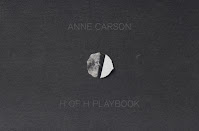
H of H Playbook by Anne Carson             $40
H of H Playbook is an explosion of thought, in drawings and language, about a Greek tragedy called Herakles by the 5th-century BC poet Euripides. In myth Herakles is an embodiment of manly violence who returns home after years of making war on enemies and monsters to find he cannot adapt himself to a life of peacetime domesticity. He goes berserk and murders his whole family. Suicide is his next idea, but, due to the intervention of his friend Theseus, Herakles comes to believe he is not, after all, indelibly stained by his own crimes, nor is his life without value. It remains for the reader to judge this redemptive outcome.
Last Letter to a Reader by Gerald Murnane              $33
In the first days of spring in his eighty-second year, Gerald Murnane began a project which would round off his career as a writer – he would read all of his books in turn and prepare a report on each. His original intention was to lodge the reports in two of his legendary archives, the Chronological Archive, which documents his life as a whole, and the Literary Archive, which is devoted to everything he has written. But as the reports grew, they themselves took on the form of a book, Last Letter to a Reader. The essays on each of his works travel through the capacious territory Murnane refers to as his mind: they dwell on the circumstances which gave rise to the writing, images, associations, reflections on the theory of fiction, and memories of a deeply personal kind. 
>>Read Thomas's reviews of several of Murnane's books
.....and then there were none by Harvey Benge, Jon Carapiet, Lloyd Jones, Haru Sameshima, and Stu Sontier          $40
An outstanding collaborative book by four New Zealand-based photographers and one writer, breaking out of conventional story-telling to play out their anxieties and doubts about the world they see. Developed over the last two years, . . . . . and then there were none grew from conversations and arguments about mortality, our technologically mired existence and the degradation of the environment. The project triggered its own version of flygskam for the collaborators, conflicted by the international travel that made many of the photographs and the writing possible and tainted by knowing the greater price to be paid. Images included from such travels are drenched in sordid human histories that recall the myriad pathways that have led us to now, and to what comes next.
William Blake vs The World by John Higgs               $60
His life passed without recognition and he worked without reward, mocked, dismissed and misinterpreted. Yet from his ignoble end in a pauper's grave, Blake now occupies a unique position as an artist who unites and attracts people from all corners of society. Blake famously experienced visions, and it is these that shaped his attitude to politics, sex, religion, society and art. Thanks to the work of neuroscientists and psychologists, we are now in a better position to understand what was happening inside that remarkable mind, and gain a deeper appreciation of his brilliance. His work has never been more relevant. In William Blake vs the World we return to a world of riots, revolutions and radicals, discuss movements from the Levellers of the sixteenth century to the psychedelic counterculture of the 1960s, and explore the latest discoveries in neurobiology, quantum physics and comparative religion. Taking the reader on wild detours into unfamiliar territory, John Higgs places the bewildering eccentricities of a most singular artist into context. Lively and compelling. 
A Cook's Book by Nigel Slater            $60
Nigel Slater is always superb company in the kitchen. In this substantial new book, he looks back over his life and presents his culinary experiences from childhood to the present alongside 200 of his ever-wonderful recipes. 
"A Cook's Book, all 500 pages and nearly one and a half kilos of it, enters the world as if from the kitchen of someone fresh to the world of food writing, a-brim with ideas, vital and enthusiastic." —Nigella Lawson
"This is a book for life. This, and it's high praise, is Slater's best book. —Diana Henry

Matrix by Lauren Groff             $35
Cast out of the royal court by Eleanor of Aquitaine, deemed too coarse and rough-hewn for marriage or courtly life, seventeen-year-old Marie de France is sent to England to be the new prioress of an impoverished abbey, its nuns on the brink of starvation and beset by disease. At first taken aback by the severity of her new life, Marie finds focus and love in collective life with her singular and mercurial sisters. In this crucible, Marie steadily supplants her desire for family, for her homeland, for the passions of her youth with something new to her: devotion to her sisters, and a conviction in her own divine visions. A historical novel from the author of the outstanding (and very contemporary) Fates and Furies
>>Research and imagination. 
All the Queens Houses: An architectural portrait of New York's most diverse borough by Rafael Herrin-Ferri            $45
Queens is often celebrated as the 'melting pot' of the United States of America. People from all over the world built houses that reflected both their heritages and their aspirations. While All the Queens Houses is mainly a photography book celebrating the broad range of housing styles in New York City's largest and most diverse county, it is also an endorsement of a multicultural community that mixes global building traditions into the American vernacular, and by so doing breathes new life into its architecture and surrounding urban context.
The Book of the Raven: Corvids in art and legend by Angus Hyland and Caroline Roberts            $35
Well illustrated and full of interesting information. 
>>A compendium of literary ravens

The Everyday and Everydayness by Henri Lefebvre and Julie Mehretu           $30
"The character of the everyday has always been repetitive and veiled by obsession and fear." The Everyday and Everydayness takes seriously the everyday as a structure imposed upon all of life in the context of the 'modern'. At a moment of enforced reflection on the everyday, artist Julie Mehretu re-examines and responds to Lefebvre's text, bringing to bear  her own longstanding fascination with questions of time, space and place.

Slippurinn: Recipes and stories from Iceland by Gísli Matt              $90
Matt's book reflects his extensive research into traditional Icelandic dishes to preserve local culinary knowledge while applying a modern approach for a cuisine to be enjoyed both by locals and international foodies.


Silverview by John le Carré          $35
Julian Lawndsley has renounced his high-flying job in the City for a simpler life running a bookshop in a small English seaside town. But only a couple of months into his new career, Julian's evening is disrupted by a visitor. Edward, a Polish émigré living in Silverview, the big house on the edge of town, seems to know a lot about Julian's family and is rather too interested in the inner workings of his modest new enterprise. When a letter turns up at the door of a spy chief in London warning him of a dangerous leak, the investigations lead him to this quiet town by the sea... What happens when public duty and private morals are irreconcilable? This is the last novel from this master of intrigue, whose insider knowledge of the secret service gave his novels a powerful veracity. 
The Geometry of Pasta by Jacob Kenedy and Caz Hildebrand         $50
There are said to be over 300 shapes of pasta, each of which has a history, a story to tell, and an affinity with particular foods. These shapes have evolved alongside the flavours of local ingredients, and the perfect combination can turn an ordinary dish into something sublime. The Geometry of Pasta pairs over 100 authentic recipes from critically acclaimed chef, Jacob Kenedy, with award-winning designer Caz Hildebrand's incredible black-and-white designs to reveal the science, history and philosophy behind spectacular pasta dishes from all over Italy.

Joy Division: Juvenes photography by Kevin Cummins             $70
The iconic images captured by Cummins — from snowy bridges and dark rehearsal rooms to electrifying live performances — helped to define Joy Division and cement their place in music history. Originally published in an limited run of just 226 copies, Juvenes is a book with legendary status. Now comprehensively updated with new material and images, and including interviews with Bernard Sumner, Peter Hook and Stephen Morris, and recollections by David Peace, Pat Nevin, and others. 
>>'Dead Souls.'

Rhyme Hungry by Antonia Pesenti          $23
Some things sound like other things, and those things could be very silly indeed. Pesenti continues the madness of the very popular Rhyme Cordial in this bold and inventive board book. Each page also opens backwards to reveal an illustrated silly sound-alike. Would you fancy instant poodles or a cheese ghostie for lunch? A large amount of fun. 


VOLUME BooksNew releases


Book of the Week: Oscar Mardell's Great Works consists of thirteen poems, each about a different freezing works in Aotearoa New Zealand. Satirising the colonial-pastoral mythologies through which the local landscape has often been interpreted, the collection gives due attention to an industry which, in spite of its centrality to the nation’s economic history, has remained conspicuously absent from its art and literature. Here, as in Bataille, ‘the slaughterhouse is linked to religion’: Great Works offers a darkly comic view of sacrifice and slaughter in ‘God’s Own Country’. 
>>Read Stella's review.
>>Read some of the poems


>> Read all Stella's reviews.


Great Works by Oscar Mardell   {Reviewed by STELLA}

Oscar Mardell's freezing works poems are a clever addition to the tradition of New Zealand gothic literature. Think Ronald Hugh Morrison’s The Scarecrow and  David Ballantyne's Sydney Bridge Upside Down and you’ll get a sense of the macabre that edges its ways through these poems like entrails. There’s the nostalgia for the stink of the slaughter yards, the adherence to the architects of such vast structures on our landscapes, and the pithy analysis of our colonial pastoral history. That smell so evocative of hot summer days cooped up in a car travelling somewhere along a straight road drifts in as you read 'Horotiu' with its direct insult to the yards and its references to offal. In these poems, there is the thrust and violence of killing alongside the almost balletic rhythm of the work — the work as described on the floor as well as the poetic structure of Mardell’s verse. 

“      th sticking knife th steel th saw
        th skinning knife th hook th hammer
        th spreader the chop & th claw   "

“      the dull thud resonates
        through bodies / still
        swings rhythmically & out of time
        pours out of me / equivocal   ”

Most of the poems note the architect and the date of construction for these ominous structures, which had a strange grandeur — simultaneously horrific and glorious. One of the outstanding architects was J.C. Maddison, a designer known for both his slaughterhouses and churches, alongside other stately public buildings. In 'Belfast', Mardell cleverly bridges these divides — the lambs, the worship, the elation.

“      did he who set a compass
        to port levy & amberly
        who traced th wooden hymnhouses
        for st pauls / divided
        & th holy innocents / drowned   ”

There are plenty of other cultural references tucked away in these poems. Minnie Dean makes an appearance in Mataura and James K Baxter in Ngauranga Abattoir. In the latter, Mardell slips in Baxter's line "sterile whore of a thousand bureaucrats". Yet the poems go beyond nostalgia or clever nods to literature, to sharpen our gaze on our colonial relationship. 'Burnside' tells it perfectly:

“      & ws new zealands little lamb
        to britains highest tables led
        & were th final works performed
        out here in godsown killing shed   ”

Mardell’s collection, Great Works, is pithy and ironic with its clever nods to cultural and social history, gothic in imagery, and all wrapped up like a perfectly trussed lamb in our ‘God’s Own Country’ nostalgia, with a large drop of sauce and a knife waiting to slice. 


 >> Read all Thomas's reviews. 


The Faces by Tove Ditlevsen (translated by Tiina Nunnally)   {Reviewed by THOMAS}
After all, he thought, a face is created by the person who sees it, not by the person it is seen upon; our faces belong to those who perceive us just as our identities exist only in the minds of those who perceive us; we rely upon those who perceive us. To see oneself in the mirror, he thought, is at once the most familiar and the strangest thing, possibly even a dangerous thing, now that he thought about it, or a thing anyway not without its dangers. We have no reliable identity, he thought, nothing definitive or stable, except what is achieved, if achieved is the right word, through the extent of laziness that the person who perceives us applies, or does not apply, as the case may be, in falling back upon a previous conception, or preconception, of what they may think of as us. Not entirely a clear thought, he thought. Faces have trouble staying where they belong in Tove Ditlevsen’s The Faces, or, rather, Lise has trouble keeping the faces of others where they belong. “You have to watch over them all the time, thought Lise, full of anxiety, and make them play their roles. … They noticed if you neglected them for a moment and thought your own thoughts. … Then they would take revenge and start to live for themselves.” In the first part of the book, when Lise is living at home with her three children, her partner Gert, and the housekeeper Gitte—who is affordable thanks to a literary prize won by Lise. Gert resents Lise’s independent successes, and is flagrantly unfaithful to her. As Lise is struggling to hold her world together mentally (“Life consisted of a series of minute, imperceptible events, and you could lose control if you overlooked a single one of them.”), the text is full of similes, evidence either of the associative compulsion with which Lise desperately tries to retain conceptual control, or of the associative compulsion which continually assails the stability of that world by likening its contents to things that they are not. Who knows which, he thought, but in any case similes are always a sign of mental instability. After Gert’s lover Grete commits suicide by overdosing on sleeping pills, Lise becomes convinced that Gert and Gitte are conspiring for her to do the same. “Was he still thinking about his dead mistress?” wonders Lise. “She didn’t think so because, all things considered, his strength lay in his lack of imagination.” Lise does overdose, rings the ambulance, and wakes up in a psychiatric hospital, strapped to a bed. At the hospital the similes fall away from the text, no longer of any use in holding off a breakdown (or having done their work in inducing one). At the hospital things are what they are. Lise’s torments as she lies there, the nurses attending to her wearing the faces of Gitte and Gert, speaking sometimes ‘as’ Gitte and Gert, and the voices and faces, also including those of her children, continuing to appear to her through the grilles in the wall of her room (the ‘negotiation’ grille and the ‘torture’ grille), culminate in Lise believing that she is ‘allowing’ acid to be thrown into the face of her youngest son. At this point Lise believes herself to be finally acutally insane, but it is from this point that the doctor considers that she is starting to recover. Indifference is the cardinal property of sanity, after all, and as Lise becomes more indifferent she gets closer to the point of returning home. The faces tell her, after she learns that Gitte has left the household, that Gert is keeping her in the hospital so that he can marry her teenage daughter (not his daughter). Was Lise’s intuition of Gert’s possible sexual intrusion upon her daughter the unfaceable catalyst for her breakdown? After Lise is released, Gert does not clearly deny that such a thing has occurred, but the indifference that Lise has learned in her ‘revovery’ and the doubts that she has been induced to develop in her own judgement and in her own memories in the same process means that she returns to her life in a narrowed and more fragile way, heading into life’s quotidian horrors with no defence but indifference. How and at what cost can that indifference be maintained? 

 NEW RELEASES

The Very Nice Box by Laura Blackett and Eve Gleichman         $48
Ava Simon designs storage boxes for STÄDA, a slick Brooklyn-based furniture company. She's hard-working, obsessive, and heartbroken from a tragedy that killed her girlfriend and upended her life. It's been years since she's let anyone in. But when Ava's new boss—the young and magnetic Mat Putnam—offers Ava a ride home one afternoon, an unlikely relationship blossoms. Ava remembers how rewarding it can be to open up—and, despite her instincts, she becomes enamored. But Mat isn't who he claims to be, and the romance takes a sharp turn... The Very Nice Box is at once a send-up of male entitlement and a big-hearted account of grief, friendship, and trust.
"Laura Blackett and Eve Gleichman are linguistic magicians, and their sparkling debut manages to expose the hollowness of well-being jargon while exploring, with tender care and precision, how we dare to move on after unspeakable loss. They have constructed a mirrored fun house, one that leads us down different paths, each masterfully tied up at the end, yet reflecting and refracting our own quirky selves." —New York Times Book Review
"A very funny debut—and perhaps the most original office satire of the year." —Washington Post
>>
See what happens if you say yes. 
Empty Houses by Brenda Navarro (Translated by Sophie Hughes)          $23
A child has disappeared from the park where he was playing. In the days that follow, his mother is distraught. She is tormented by his absence but also by her own ambivalence: did she even want him in the first place? In a working-class neighbourhood on the other side of Mexico City another woman protects her stolen child. As the novel switches between the voices of these two women, Empty Houses explores the desires, regrets and social pressures of motherhood - from the mother who lost her child to the new mother who risked everything to take him.
The Sea Walks into a Wall by Anne Kennedy       $25
"A new book by Anne Kennedy, one of our most exciting and innovative poets, is always a cause for celebration. These poems, like her mind, are a treasure trove – full of wit, intelligence, innovation, challenge, beauty and a whole lot of heart." —Helen Rickerby
"Anne Kennedy celebrates and memorialises the world in a state of flux, at once dynamic, absurd and magical. Her poems are funny, sceptical and impassioned by turns, and always finely calibrated. Ultimately, she writes about the minor daily miracles of life itself, the narratives of the moment, the human surplus that eludes legal tidiness and finality of judgement." —David Eggleton
The Ark Sakura by Kobo Abe           $26
In anticipation of a coming nuclear apocalypse, Mole has converted a huge underground quarry into an 'ark'. While searching for his crew, he falls for the tricks of a wily insect dealer and his friends. In the surreal drama that ensues, the ark is invaded by first a gang of youths and then a sinister group of elderly people, before Mole himself becomes trapped in the ark's central piece of equipment. Desperate and hilarious.

Across the Pass: A collection of tramping writing edited by Shaun Barnett          $45
Tramping is a journey into mountainous country, across passes, along ridges, beside rivers or through forests. It is a journey also, perhaps, to discovering more about the native plants and animals existing in these wild ecosystems, and a journey into friendship or self-discovery. New Zealand trampers have produced a rich body of literature about their activity, with writing spanning nearly two centuries and ranging from poetry and songs, journals and newspaper pieces to magazine articles and books. These stories may hold drama or tragedy, but more often they are about companionship, enjoying nature and finding challenge in wild environments. Across the Pass includes writing from New Zealanders such as writer John Mulgan, mountaineer Sir Edmund Hillary and adventurer Graeme Dingle. Some writers appreciate the intricacies of nature or the splendour of the mountains, while for others an interest in history encourages them to tread the trails first pioneered by their ancestors. 
The Beatryce Prophecy by Kate DiCamillo, illustrated by Sophie Blackall          $28
In a time of war, a mysterious child appears at the monastery of the Order of the Chronicles of Sorrowing. Gentle Brother Edik finds the girl, Beatryce, curled in a stall, wracked with fever, coated in dirt and blood and holding fast to the ear of Answelica the recalcitrant goat. As the monk nurses Beatryce to health, he uncovers her dangerous secret – one that imperils them all. And so it is that a girl with a head full of stories must venture into a dark wood in search of the castle of a king who wishes her dead. But should she lose her way, Beatryce knows that those who love her – a wild-eyed monk, a man who had once been king, a boy with a terrible sword and a goat with a head as hard as stone – will never give up searching for her. And to know this is to know everything.
The Unseen Body: A doctor's journey through the hidden wonders of human anatomy by Jonathan Reisman           $38
Through his offbeat adventures in healthcare and travel, Reisman discovers new perspectives on the body: a trip to the Alaskan Arctic reveals that fat is not the enemy, but the hero; a stint in the Himalayas uncovers the boundary where the brain ends and the mind begins; and eating a sheep's head in Iceland offers a lesson in empathy. By relating his experiences in far-flung lands and among unique cultures back to the body's inner workings, he shows how our organs live inextricably intertwined lives in an internal ecosystem that reflects the natural world around us.
>>Not this! 
Nioque of the Early-Spring by Francis Ponge (translated by Jonathan Larson)       $34
Written in 1950 during a stay at Le Fleurie in southern France, Ponge's notes record his various attempts to take the poetic pulse of the season just beginning, all the while excluding the human and the societal as much as possible. By the rigour of his thought and the precision of his language, Ponge's various necessarily failed attempts to capture the uncapturable create a poetic cloud that somehow does manage to convey the impossible. 
>>Read a sample. 

After Hours & The Flying Squad by Jeffrey Paparoa Holman           $25
A collection in two halves. The first, 'Pākehā Mōteatea & Southern Shanties', is a poetic evocation of forgotten South Island histories, from all points of the compass, especially those remote and rural backwaters that have long since slipped below the radar of much contemporary urban, identity focussed literary practices. You are more likely to meet miners, shearers, rugby league forwards and fishers, than a digital native surfing cyberspace in search of the next blizzard of pixels. Mythic figures emerge: there are no confessions, no internal monologues; rather, a cast of characters Chaucer would certainly recognise  — the local cop, the publican’s wife, the deckhand stinking of fish, asleep in a homeward bound fishing boat. Each poem in five or six blank verse stanzas attempts to capture a moment, life in a vanished culture, an earthquake, a flood, all in the beating heart of the past. The second part, 'Into the Mist: poems 2009-2021', is completely different, a selection on a wide variety of styles and themes. There are several homages to some of Holman’s favourite writers — Marilynne Robinson, Sebald, Blake amongst others — and salutes to friends and loved ones, tā moko artists, old shearing mates, as well as the birds and animals who are also his whānau members, the wild and the tame. Profit hungry property developers get a serve; the ghettoising of his own generation in retirement compounds comes in for questioning, accelerating the loss of rich family histories as the generations are prised apart. These accounts he was able to absorb, as his feisty grandmother late in her eighties, living with them, regaled him with incredible family legends, of great liners sinking, of bombs raining down.
The Boy Who Drew Auschwitz by Thomas Geve         $45
Thomas Geve was a Birkenau, Auschwitz, Gross Rosen and Buchenwald survivor at just 15 years old. Spending twenty-two months imprisoned at these camps during WW2, Geve was subject to, and forced to observe first-hand, events of the most horrific nature, including the disappearance and eventual murder of his mother. On his release he captured daily life in the death camps in 79 drawings. Scenarios that are synonymous with the camps were covered in brutal but simplistic detail: the ultimate humiliation of being processed into a number and the sheer terror of a selection to the gas chambers were drawn. 


Barbara Hepworth: Art and life by Eleanor Clayton          $55
Barbara Hepworth is one of the most important artists of the 20th century, yet she has been the subject of relatively few monographs in comparison to her male counterparts. This biography moves beyond the traditional narratives of Modernism, truth to materials, and the landscape to provide a penetrating insight into Hepworth's remarkable life, work and legacy. 
Radical Wordsworth: The poet who changed the world by Jonathan Bate         $25
Wordsworth rejoiced in the French Revolution and played a central role in the cultural upheaval that we call the Romantic Revolution. He and his fellow Romantics changed forever the way we think about childhood, the sense of the self, our connection to the natural environment, and the purpose of poetry. But his was also a revolutionary life in the old sense of the word, insofar as his art was of memory, the return of the past, the circling back to childhood and youth. This outstanding biography is purposefully fragmentary, momentary, and selective, opening up what Wordsworth called "the hiding-places of my power."
"The finest modern introduction to Wordsworth's work, life and impact. It shows how and why 'Wordsworth made a difference.'" —Boyd Tonkin
The Movement by Petra Hůlová (translated by Alex Zucker)            $38
The Movement's founding ideology emphasizes that women should be valued for their inner qualities, spirit, and character, and not for their physical attributes. Men have been forbidden to be attracted to women on the basis of their bodies. Some continue with unreformed attitudes but many submit or are sent by their wives and daughters to the Institute for internment and reeducation. However, the Movement also struggles with women and their "old attitudes," with many still undergoing illegal cosmetic surgeries and wearing makeup. Our narrator, an unapologetic guard at one of these re-education facilities, describes how the Movement started, the challenges faced, her own personal journey, and what happens when a program fails. She is convinced the Movement is nearing its final victory, a time when everybody falls in line with its ideals. Outspoken, ambiguous, and terrifying, this is a socio-critical satire of our sexual norms.
"One part Animal Farm, one part The Handmaid’s Tale, one part A Clockwork Orange, and (maybe) one part Frankenstein, Czech writer Hůlová’s novel dismantles the patriarchy and replaces it with a terrifying alternative." —Kirkus
Young focuses on the increasingly endangered resource of freshwater, and what so-called developed societies can learn from the indigenous voices of the Pacific.
The Aotearoa Handbook of Criminology edited by Elizabeth Stanley, Trevor Bradley, and Sarah Monod de Froideville           $90
With chapters by leading scholars of criminology from across the country, The Aotearoa Handbook of Criminology represents a state-of-the-art account of crime and criminal justice in Aotearoa New Zealand. The handbook is structured into four parts that explore the politics of researching and representing crime, key types of crime, the workings of criminal justice, and the differential experiences of crime and justice. The handbook outlines the foundations of current approaches to crime, victims and offenders, alongside critical, decolonising, and feminist perspectives on criminological ideas and practices.
Grown Ups by Marie Aubert (translated by Rosie Hedger)         $28
Ida is a forty-year-old architect, single and struggling with the feeling of panic as she realises her chances of motherhood are rapidly falling away from her. She's navigating Tinder and contemplating freezing her eggs - but tries to put a pause on these worries as she heads out to the family country cabin for her mother's 65th birthday. That is, until some supposedly wonderful news from her sister sets old tensions simmering, building to an almighty clash between Ida and her sister, her mother, and her entire family.

An Evening with Claire by Gaito Gazdanov           $33
Two old friends meet nightly in Paris, trading conversational barbs and manoeuvring around submerged feelings. Throughout the ten years of their separation, thoughts of Claire lingered persistently in Kolya's mind. As the imagined romance finally becomes real, Kolya is thrown into recollections of formative moments from his youth in Russia, from his solitary early years through military school and service in the White Army in the Civil War, all leading to this union with Claire.
"Gazdanov's work is the perfect fusion of the Russian tradition and French innovation." —London Review of Books

Private Gardens of Aotearoa by Suzanne Turley              $60
Suzanne Turley — one of New Zealand's most sought-after landscape designers — has created many of the country's most desirable private gardens, all set against the spectacular backdrop of the natural environment. 
Come Back to Mona Vale: Life and death in a Christchurch mansion by Alexander McKinnon           $40
The book sets about unravelling the mysteries and anomalies behind the public history of a wealthy Christchurch business family in the first half of the 20th century. Researching the book, the author gradually becomes aware that his family heritage isn’t necessarily the norm, nor what he expected. That family members can’t bear to speak to each other about the most private and family-influenced events, facts and atmospheres. That he grew up shielded from aspects of contemporary reality by money and class. The story unfolds like a crime or detective tale, and also delves into the history of the Canterbury colony, contrasting Christchurch’s public values, aspirations and beauty with its murkier private behaviour.  Alexander McKinnon’s explorations of his family’s past is the record of a beautiful and grand (yet gradually crumbling) manor interwoven with social history – with a sense of the Gothic, of obsession, and of a tight-knit circle where secrets wreak a terrible climax leading to a form of inter-generational haunting.
>>Is Mona Vale haunted by more than underemployed stage actors?  
Spark Hunter by Sonya Wilson           $25
Nissa Marshall knows that something is hiding deep in the forests of Fiordland National Park - she's seen their lights in the trees. But what are they, and why does no one else seem to notice them? When Nissa abandons her school camp to track down the mysterious lights, she finds herself lost in a dangerous wonderland. But she's not the only one in danger - the bush and the creatures are under threat too - and she wants to help. What can a school kid do where adults have failed, and can she find her way back? In Fiordland, the lost usually stay lost. 
>>How the book came about

Let's Play Indoors! by Rachel Victoria Hillis and Ryan Eyers           $40
Sometimes the world is encased by four walls, so it's time to get creative. Let's Play Indoors! offers imaginative and resourceful ways to keep kids amused and inspired with games, crafts, and home-styled costumes inside the house. This book encourages children to take the lead in deciding how to spend their time and is a perfect companion for rainy days, lock-downs, or periods spent offline. 


VOLUME BooksNew releases


Our Book of the Week is Crossroads, the much-anticipated new novel from Jonathan Franzen. Franzen's acute and often hilarious observations on the dynamics and dysfunctions of family life reach a sort of apogee in this unsparing but strangely warm and nuanced novel, set in 1971 as the family of American suburban pastor Russ Hildebrandt feels the pressure of change and starts to lose its acceptable veneer. 
>>Read Stella's review
>>"Franzen's best book yet." 
>>"I just write it like I see it, and this gets me in trouble."
>>"The family is at a crossroads."
>>America's most divisive novelist.
>>Young folk in worship (1971).
>>We have some copies signed by the author. Be quick


>> Read all Stella's reviews.


Crossroads by Jonathan Franzen   {Reviewed by STELLA}
Meet the Hildebrandt family and dive right into Jonathan Franzen’s most brilliant novel yet. It’s 1971 and this American family is at a crossroads, figuratively and literally. Russ, the once edgy — “I marched with Stokely Carmichael ''  — young minister is now the middle-aged pastor of a suburban Chicago church and feeling his charm slip away. Especially in contrast to the younger, much hipper Rick Ambrose, youth group leader of Crosslands. The youth group is drawing the spaced out, far out kids with its ‘folk music and honesty’ style of faith. Yet Russ thinks he still has what it takes and his wandering eye is alighting on the attractive widow Frances. Never mind that he is married to Marion and has four children. And what children they are. Clem, Becky, Perry and the youngest Jude. Clem finds his father an embarrassment and is happy to be out and away — a scholarship in hand for college. He finds love — well, sex actually — and is struggling to keep on top of his study. This would all rock along in an oh-so-normal way if it wasn’t for his back-to-front thinking about Vietnam. Exempt from the draft, he decides his privilege of being a university student goes against his principles. His guilt and a perverse wish to piss off his father lead him to drop out, dismiss the wishes of his girlfriend, and sign up. However, by the time he gets around to making his decision, it’s too late and the forces are starting to depart the war, rather than recruit. On a visit home, his disgust towards his father’s hypocrisy is the final straw and he makes a clean break from the family even though he can sense the walls of family cohesion are falling away. Becky, always popular in school and most likely to succeed, is having a mini-crisis. Her favourite brother, Clem, is no longer worth looking up to — in her eyes, he has been corrupted by lust — and an inheritance from her favourite aunt which would have seen her being able to attend the college of her choice is a topic of fraught conversations with her parents, particularly her father, as they struggle financially on his associate pastor’s salary. When she simultaneously falls for the lead guitarist in a local band and has a spiritual epiphany, both highly misguided events, Becky is strangely unanchored from the girl she used to be and her future is no longer mapped out. And then there’s the genius of the family, Perry. A classic too-smart-for-his-own-good tagline would work here, as his curiosity, boredom and obsessive nature propel him on the train wreck of drugs, addiction and dishonesty. (Despite this, he's still my favourite of the siblings). A whirlwind for him and a slow train wreck for everyone around him. And if this isn’t enough of a magnifying glass on family life in the suburbs in 1971, there’s Marion. When the story opens she’s the loyal, underappreciated preacher’s wife, mother to four supposedly wonderful children doing her bit to keep life ticking along, massaging her husband’s ego, encouraging her children and playing her role. Yet she’s desperate to jump out of her frumpy overweight middle-aged self and to find her repressed younger self still screaming at her. This Marion and her past secrets are in need of redemption. And she really does need to surface, in light of Russ’ infidelity, Clem’s withdrawal, Becky’s strange about-turn and Perry’s addiction, and of course, Jude deserves better. Franzen’s Crossroads, the first book in the trilogy about the Hildebrandts is American society seen in the microscope, infused with music, drugs, salvation and damnation. It’s clever, expertly paced (compelling from start to finish in all its 600 pages), a saga by description and enjoyable as such, but really a morality tale; a meditation on goodness and what that might look like from different perspectives. What makes a person — and to a greater extent a society — ‘good’? I’m looking forward to the next instalments and recommend Crossroads for your summer reading pile.


NEW RELEASES

Great Works by Oscar Mardell               $32
Great Works consists of thirteen poems, each about a different freezing works in Aotearoa New Zealand. Satirising the colonial-pastoral mythologies through which the local landscape has often been interpreted, the collection gives due attention to an industry which, in spite of its centrality to the nation’s economic history, has remained conspicuously absent from its art and literature. Here, as in Bataille, ‘the slaughterhouse is linked to religion’: Great Works offers a darkly comic view of sacrifice and slaughter in ‘God’s Own Country’. Limited edition of 100. 
>>Read some of the poems
>>Stella reviews the book on RNZ
>>Neutral spaces

Crossroads by Jonathan Franzen            $38
Franzen's acute and often hilarious observations on the dynamics and dysfunctions of family life reach a sort of apogee in this unsparing but strangely warm and nuanced novel, set in 1971 as the family of American suburban pastor Russ Hildebrandt feels the pressure of change and starts to lose its acceptable veneer. 
"Warm, expansive and funny – a pure pleasure to read." —Guardian
"Crossroads is Franzen's finest novel yet. He has arrived at last as an artist whose first language, faced with the society of greed, is not ideological but emotional, and whose emotions, fused with his characters, tend more toward sorrow and compassion than rage and self-contempt. —BookForum
>>We have signed copies available. Be quick. 
Exteriors by Annie Ernaux (translated by Tanya Leslie)            $32
Taking the form of random journal entries over the course of seven years, Exteriors concentrates on the ephemeral encounters that take place just on the periphery of a person’s lived environment. Ernaux captures the feeling of contemporary living on the outskirts of Paris: poignantly lyrical, chaotic, and strangely alive. Exteriors is in many ways the most ecstatic of Ernaux’s books – the first in which she appears largely free of the haunting personal relationships she has written about so powerfully elsewhere, and the first in which she is able to leave the past behind her.
"I find her work extraordinary."  —Eimear McBride
"Admirable for its quiet grace as well as its audacity in a willingness to note (and thus make noteworthy) the smallest parts of life." —Irish Times
How to Start Writing (and When to Stop): Advide to writers by Wisława Szymborska (translated by Clare Cavanagh)          $34
A very enjoyable collection of brief, witty and frequently ironically precise and  responses to submissions to the writing advice column Szymborska ran anonymously in a Polish literary journal. Illustrated with her own collages. 
>>Learning to write from life. 

Small Bodies of Water by Nina Mingya Powles             $33
Nina Mingya Powles first learned to swim in Borneo - where her mother was born and her grandfather studied freshwater fish. There, the local swimming pool became her first body of water. Through her life there have been others that have meant different things, but have still been, in their own way, home: from the wild coastline of New Zealand to a pond in northwest London. This collection of essays explores the bodies of water that separate and connect us, as well as everything from migration, food, family, earthquakes and the ancient lunisolar calendar to butterflies. 
>>The safe zone
Dark Neighbourhood by Vanessa Onwuemezi          $35
At the border with another world, a line of people wait for the gates to open; on the floor of a lonely room, a Born Winner runs through his life’s achievements and losses; in a suburban garden, a man witnesses a murder that pushes him out into the community. Struggling to realize the human ideals of love and freedom, the characters of Dark Neighbourhood roam instead the depths of alienation, loss and shame. With a detached eye and hallucinatory vision, they observe the worlds around them as the line between dream and reality dissolves and they themselves begin to fragment.
"Dark Neighbourhood is a thrill and a challenge. Vanessa Onwuemezi is her own thing, but reading her I experience the same exciting, destabilizing sense of the world being shown anew – being made anew – that I get from Silvina Ocampo, Clarice Lispector or Dambudzo Marechera." —Chris Power
"In disrupted and disrupting prose, Vanessa Onwuemezi achieves the dissolution of consciousness and slippage of omniscience found in poetry and in life. Her cool authority expresses itself in rigorous, original formal decisions and a detached, exacting lyricism. The seven stories in Dark Neighbourhood construct our condition as a limbo in which neither the waiting nor the waited-for offers satisfaction or resolution, but in which, as the book’s epigraph suggests, Night is also a sun." —Kathryn Scanlan
A Passage North by Anuk Arudpragasam           $33
"Anuk Arudpragasam's masterful novel is an attempt to come to terms with life in the wake of the devastation of Sri Lanka's 30-year civil war. As Krishan makes the long journey by train from Colombo into the war-torn Northern Province to attend a family funeral, so begins an astonishing passage into the innermost reaches of a country. At once a powerful meditation on absence and longing, and an unsparing account of the legacy of Sri Lanka’s 30-year civil war, this procession to a pyre ‘at the end of the earth’ lays bare the imprints of an island’s past, the unattainable distances between who we are and what we seek." —Judges' commendation on short-listing the book for the 2021 Booker Prize
Letters to My Weird Sisters: On autism and feminism by Joanna Limburg          $37
"It seemed to me that many of the moments when my autism had caused problems, or at least marked me out as different, were those moments when I had come up against some unspoken law about how a girl or a woman should be, and failed to meet it." An autism diagnosis in midlife enabled Joanne Limburg to finally make sense of why her emotional expression, social discomfort and presentation had always marked her as an outsider. Eager to discover other women who had been misunderstood in their time, she writes a series of wide-ranging letters to four 'weird sisters' from history, addressing topics including autistic parenting, social isolation, feminism, the movement for disability rights and the appalling punishments that have been meted out over centuries to those deemed to fall short of the norm. 
The Inseparables by Simone de Beauvoir (translated by Lauren Elkin)          $30
Written in 1954, five years after The Second Sex, the novel of the intense relationship between two girls who grow up together and then grow apart was never published in Simone de Beauvoir's lifetime. This first English edition includes an afterword by her adopted daughter, who discovered the manuscript hidden in a drawer, and photographs of the real-life friendship which inspired and tormented the author.
The Last and the First by Nina Berberova (translated by Marian Schwartz)          $28
On a crisp September morning, trouble comes to the Gorbatovs' farm. Having fled the ruins of the Russian Revolution, they have endured crushing labour to set up a small farm in Provence. For young Ilya Stepanovich, this is to be the future of Russian life in France; for some of his Paris-dwelling countrymen, it is a betrayal of roots, culture and the path back to the motherland. Now, with the arrival of a letter from the capital and a figure from the family's past, their fragile stability. 
"A unique, harmonious, and brilliant book. Her language is uncommonly strong and pure; her images are magnificent for their solid and precise power. This is literature of the highest quality, the work of a genuine writer." —Vladimir Nabokov
"'Haunting. As graceful and subtle as Chekhov." —Anne Tyler
>>The translator introduces us to the author
There's a Ghost in this House by Oliver Jeffers           $38
A young girl looks everywhere in the haunted house but cannot find the ghosts that are supposed to live here. The glassine overlays show the reader just where they are hiding (and playing), however. A large amount of lightly spooky fun. 
The Making of Incarnation by Tom McCarthy          $37
Deep within the archives of time-and-motion pioneer Lillian Gilbreth lies a secret. Famous for producing solid light-tracks that captured the path of workers' movements, Gilbreth helped birth the era of mass observation and big data. Did she also, as her broken correspondence with a young Soviet physicist suggests, discover in her final days a 'perfect' movement, one that would 'change everything'? An international hunt begins for the one box missing from her records, and we follow contemporary motion-capture consultant Mark Phocan, as well as his collaborators and shadowy antagonists, across geo-political fault lines and experimental zones- medical labs, CGI studios, military research centres . . . Places where the frontiers of potential — to cure, kill, understand or entertain — are constantly tested and refined. And all the while, work is underway on the blockbuster film Incarnation, an epic space tragedy. Commercial box-office fodder? Or a sublimely mythical exploration of the animation, contemplation and possession of flesh — ours and others' — traumatised, erotic, beautiful, obscene... McCarthy's new novel is disconcerting on a new number of levels. 
>>Everything becomes buffering
>>The most frightening book trailer ever. 
>>Books by Tom McCarthy. 
Tussock by Bruce Hunt          $70
A large-format volume of impressive and evocative photographs of the Canterbury and Otago uplands. 
Maman: The cookbook by Elisa Marshall, Benjamin Sormonte, and Lauren Salkeld         $50
The 100 recipes you need to either run a series of French cafés and bakeries or just really enjoy eating at home. 
Borges and Me: An encounter by Jay Parini                  $37
In this evocative work of what the author in his Afterword calls 'autofiction' or 'a kind of novelised memoir', Jay Parini takes us back fifty years, when he fled the United States for Scotland. He was in frantic flight from the Vietnam War and desperately in search of his adult life. There, through unlikely circumstances, he met famed Argentinian author Jorge Luis Borges. Borges was blind, in his seventies and frail. Parini was asked to look after him while his translator was unexpectedly called away. When Borges heard that Parini owned a 1957 Morris Minor, he declared a long-held wish to visit the Scottish Highlands, where he hoped to meet a man in Inverness who was interested in Anglo-Saxon riddles. As they travelled, the charmingly garrulous Borges took Parini on a grand tour of western literature and ideas while promising to teach him about love and poetry. As Borges's world of labyrinths, mirrors and doubles shimmered into being, their escapades took a surreal turn.
Lyra's Oxford by Philip Pullman, illustrated by Chris Wormell              $35
Two years after the events of 'His Dark Materials', Lyra and her daemon Pantalaimon sit high on the roof of Jordan College, gazing down on the streets of Oxford. But their peace is shattered by a flock of enraged starlings, who seem intent on knocking another bird out of the sky — a bird that Lyra and Pan quickly realise is a witch's daemon. The daemon carries worrying tidings of a terrible sickness spreading in the north, and claims that only Lyra can help him — but is he really friend, or foe? A beautiful colour-illustrated edition. 


VOLUME BooksNew releases


 >> Read all Thomas's reviews. 


Enchantment by Daphne Merkin   {Reviewed by THOMAS}
He gazes at the young man standing in front of the tree, the young man probably, he thinks, between the ages of his own children but not one of his own children. It seems to him that the young man is gazing back at him, but this, of course, is not the case, the young man is gazing, certainly, but not at him, he is gazing, or appears to be gazing, at the least visible person, perhaps even his own father but who knows, hidden at the place in the young man’s gaze that he now occupies, a usurper of another’s place in the gazes, uncomfortable with his intrusion into this moment not or no longer of not yet his yet drawn back yet again to this moment and to his uncomfortableness about it. He feels as if he has some responsibilities towards the young man in the photograph but it is very unclear to him what these responsibilities might be or might have been, different responsibilities, certainly, or possibly, from the responsibilities he has or has had towards his own children, who now approximate the age of the young man in the photograph, rising twenty he would say, making them in some way his peers if not his contemporaries, but responsibilities less clear, at least now, than the responsibilities he has or has had towards his children, which are themselves not exactly clear. He cannot help feeling, as he glances a little embarrassedly at the young man’s gaze, hardly meeting his gaze, a gaze both expectant and accusatory, it seems to him, that this expectation and this accusation are directed at him personally, rather than at the world in general, the gazer is not gazing at him but at the world in general after all, as far as he can tell, but he is convinced that he now knows better than the young man about his own gaze, and that the gaze is somehow directed at him, at least that the expectation and the accusation he identifies in that gaze are directed at precisely him and that he has somehow failed this young man by failing to recognise and fulfill his responsibilities towards him, whatever they might be, in a way that he has not failed in his responsibilities towards his own children, he has failed in his responsibilities towards them no doubt in other ways, although, since his responsibilities towards the young man are unclear, and therefore his failure in these responsibilities is unclear, how can he be certain that he has not failed similarly, or by extension, in these responsibilities towards his own children in addition to the ways he has no doubt failed towards them in other ways. He glances again at the gaze of the young man in the photograph, if a photograph can be said to have a gaze, there is something at once both fascinating and off-putting about that gaze, he thinks, and probably more off-putting than fascinating, he thinks, here is a gaze that pushes away whatever it fixes itself upon, a gaze that repels its object, what you might perhaps but misleadingly call a repellant gaze, a gaze that keeps its object at a safe distance, whatever that means, at a distance from which the object cannot act upon the gazer. There is a tragedy here, he thinks, though it is almost impossible to see and the reasons for this tragedy are impossible to see. The young man, presumably, has hopes and wishes not dissimilar from the hopes and wishes of other persons of his age, though, as is common, perhaps even general, with persons of his age, he is probably unaware of these hopes and wishes in any definite way, they are probably unconscious hopes and wishes, if it is possible to call them hopes and wishes if they are unconscious, anyway he supposes the young man has them, whatever they are, though he might be wrong. With a gaze like that anything hoped or wished for would remain forever safely beyond reach, he thinks, as if safety consists of remaining beyond reach, remaining joined to whatever you are joined to by a rod long enough to prevent contact, so to speak, avoiding failure by presupposing failure and avoiding fulfilment by the same means, for there is nothing that destabilises hopes and wishes more than their fulfillment, he thinks, or he thinks the young man thinks, or, rather, he thinks the young man thinks but is unaware that he thinks, if thinking can be unaware. In any case, the young man does not know either how to take or how to receive, so there is not much hope for him, not that he lives on hope, and perhaps he has no hopes, perhap he does not even know how to formulate a hope, other than perhaps the hope for his own non-existence, if that is something that could sensibly be said to be one’s own, not that any of the various ways by which non-existence may be reached by someone who already exists holds any attraction, at best, for him, or fills him, at worst, with anything other than revulsion or fear. I presume too much, though, upon this young man, he thinks, these last thirty-five years are an unfair burden upon him, no wonder he gazes at me, or seems to gaze at me, with such seeming accusation and also with such seeming expectation, a gaze I can barely meet, could I, and perhaps should I, in the course of those thirty-five years that he is younger than me, have assuaged the threat he feels, or felt, or from then to now will feel, both from taking and from receiving when, I realise now, I am no better at this now than I was at his age? Did he get his hopelessness at the same place I got mine, he thinks, or if not hopelessness, that is not the word, perhaps this reluctance to exist. Or uncertainty how to exist. “Doesn't everyone begin happy? More or less inclined to embrace the world?” asks Daphne Merkin in the novel he has been reading, or, more precisely, asks the novel’s narrator Hannah. “Or are there those who sense the sorrow the world has in store for them already in the cradle, furrowing their infant brows in an adult manifestation of distress?” His life as a child was a happy one, but he was incapable, even at the time, he thinks now, of being happy with it, or was there was perhaps some point at which this incapacity began, but he does not know what point, if there was one. When Merkin writes in this memoir of childhood, a fictional memoir, but one written with the authenticity of a psychoanalytic project, an autofictional memoir of childhood, “Somewhere in this story is a tragedy, but it is almost impossible to see,” he finds this *relatable*, to use a term that he despises, even though there is no instance of ostensible tragedy, even unseen, in his life, although he knows there is, or must be, at least he assumes, in Hannah’s. “No-one has it in for me but my memory,” she says. Hannah’s problems are not his problems, or, rather, not the problems of the young man of whom he writes, nor of the child that came before him, Hannah’s particular problems seemingly concern her mother, who withheld and thus made a thirst in Hannah for her love. “I was stuck forever, immured behind unbreachable walls, my mother’s dominion stretching on as far as I could see. Beyond it I knew was the world, what I needed in order to survive, but how was I to get to it?” says Hannah. “My mother is the source of my unease in the world and thus the only person who can make me feel at home in the world.” He has no such problems, but, perhaps because they are so well written, he feels a certain empathy for hers. Hannah learns to seek the love of those whose love for her is at best uncertain, rather than seek the love of the amiable, and this is also not his problem, but he is completely hooked, if that is not a metaphor, for reasons he has mentioned above, when Hannah describes how “the future falls out of my grasp,” reasons enmeshed, if that is not another metaphor, in his responsibilities, or seeming responsibilities, towards the young man in the photograph about or for or to whom or as whom he writes. “I am not a naturally well-planned person and Sundays aren’t good, I’ve come to think, for people with leanings towards the void,” writes Merkin as Hannah at one point, and, at another, “it is from somewhere around this time that I date the awakening of my impulse to disappear from the scene of my life—what I recognise years later, while sitting on the beach playing with my niece, as a chronic but undramatic wish to die.” Where does his wish come from, this wish without a corresponding wish to act upon this wish, why does Hannah have this wish and not her sisters and her brothers? Where do children disappear to as they age? As the years pass, where does an ungrasped future go? Is there no cure for the young man’s angst but ennui? He, and not the young man, if he can still maintain the distinction, nor the one whose place he occupies when he meets, or does not meet, the young man’s gaze, is the least visible person, but even that is not enough. It is never enough. For better or worse he exists. He exists and cannot achieve invisibility without the gaze of others. 


BOOKS @ VOLUME #251 (15.10.21)


Read our latest newsletter and find out what we've been reading and recommending—and what you'll be reading next!


VOLUME BooksNewsletter


>> Read all Stella's reviews.


Truthmaker ('The Severed Land' #2) by Tony Chapelle    {Reviewed by STELLA}
We are back in the world of the severed lands. Fliss, happy yet restless, enjoys the wonderful wildness and calmness of the north behind the wall. Keeping an eye on the activities outside — the families are still vying for power — but secure with her friend Minnie by her side and Lorna — the Nightingale — holding the wall with her powerful insight, life is just fine. Yet rumours of unification are circulating. A charismatic young man is gathering the people to him, promising a new way forward — peace with the south, and, under the banner of ‘one people, one land’, his followers are growing and rising. When Fliss sees the Truthmaker she is entranced like those around her, but it doesn’t take long for questions to prick her and her fervour is quickly vanquished when she realises that unity means the wall falling and Lorna under threat. To break the spell of the Truthmaker, Fliss must find proof. Lorna entrusts Minnie and Fliss with this task. They are both well equipped to make their way to Galp, to seek out the resistance and find out the truth behind the Maker. Who is helping him and why does he want to alter the peaceful lives of the northerners? The ruling families are stronger than ever, particularly the Morisettes who are determined to conquer all. Minnie's and Fliss’s journey will be more dangerous than ever. To get to Galp they will need help, but who can they trust when anyone could turn them in or sell them as slaves? With the resistance keeping a low profile, is your guide friend or foe? For Minnie and Fliss, help will come from those they least trust and the unexpected will give them hope, but can they complete their task before it’s too late? The Truthmaker is gaining ground and his followers are ready to bring the wall down. The sequel to Maurice Gee’s The Severed Land plunges you right back into the world of adventure and danger, with the feisty Minnie and the thoughtful Fliss. Sequel writer Tony Chapelle has captured the voices of the protagonists and extended the world a little more for us, deepening the relationships between the characters and giving us the promise of more to come with an ending that is satisfying but open-ended. So, luckily for the readers, we may be able to meet Fliss again in this intriguing world where the battle of the people over the repressors and the saving of the land from exploitation is a hopeful story of countering power, greed and corruption.


 >> Read all Thomas's reviews. 


Three by Ann Quin   {Reviewed by THOMAS}
Boredom is a sub-optimal mode, he thinks, but it is at least a functional mode compared with the revulsion it conceals, boredom at least connects one end of the day to the other, boredom is doubtless detrimental but it is by definition tolerable, let us all hope for boredom. That is not a good way to start his review, he thinks, it has some bearing on the book but it is not a good introduction to the book. Two is a situation of stasis, he thinks, three is dynamic, three is the catalyst that reveals the harms hidden in two, the harms that mathematics suppressed mathematics reveals, or not mathematics, physics perhaps, or chemistry, more likely. This also is not a good way to start. Well, he thinks, the review is far enough through not to worry any longer about starting it, a bad start is at least a start, that is something, I can adjust the performance using the choke, or perhaps the throttle, I need to find out the difference between these two obstructions, he thinks, these two forms of respiratory impediment, our relationship with engines is a violent one, he thinks, and this thought stalls the review. There is no access to the interior save through performance, he thinks, restarting, there is perhaps only performance, who can know, a middle class couple converse, the words pass between them but also bounce off their surroundings, language is a force-field, he thinks, a sonar, and a conversation is the pattern of disturbance, the pattern of interference, produced by two emitters, or should that be transmitters, of language. In this book, he thinks, Quin reproduces, well actually produces, that disturbance, those two voices, the Ruth voice and the Leon voice, as they run together as one entity, caught on the page, as if there is anything about a novel that is not on the page. In the Ruth-and-Leon sections of the novel, these verbal slurries, that is not the word, are both Ruth’s and Leon’s, caught on the framework of descriptions as bald and precise and mundane as stage directions, they are stage directions in the past tense, so hardly directions, stage descriptions perhaps. We learn that S, a younger, working-class woman who had lived with them, has committed suicide by drowning, Quin’s fate eventually incidentally, she left a note, but they still hope it might have been an accident. Are they guilty? In S’s room they find some tapes she has recorded, and her journals, and these are transcribed, if that is the word, inscribed is more accurate perhaps but we have to play the fiction game so transcribed is the better word, in other sections of the novel, but Ruth and Leon do not find either the absolution nor the indictment they both hope for and fear in these tapes and these journals, the tapes and the journals merely complicate the picture, add other layers of performance, leave more unsaid than said. The more that is unsaid, the greater the weight of what is unsaid, the stronger its gravity, the more distorted the said, the said, even in its utter mundanity, points always at the source of its distortion. As the book progresses, though progresses is not the word, there is no progress in Quin, we read also a tape made by Ruth and a diary written by Leon as, respectively, Leon and Ruth gain access to them, they take access, if that is the way to put it. There is no progress but the tension increases, tension in the past, if that which is in the past can be said to increase, each mundanity is freighted, that is not the word, with the catalytic action of each one upon each other two, a sexual static that builds and cannot discharge but reveals ultimately the fundamental destructive incompatibility not only of Ruth and Leon but of any combination of Ruth and Leon and S, and, perhaps, of any persons whatsoever, if Quin held this misanthropic view, perhaps she did. The instance of sexual violence eventually revealed is no surprise, but its awfulness floods backwards through all that precedes it in the book. Boredom is all that holds the horrible at bay, but the horrible is no less horrible for that. 


Our Book of the Week this week, is Nadifa Mohamed's The Fortune Men, shows that innocence is no protection in the face of prejudice. Based on the true story of a British Somali dock-worker in 1950's Cardiff who was wrongfully hanged for the murder of a local shopkeeper, Mohamed's novel is full of resonant detail and explores issues full of relevance today. 
>>The book is short-listed for the 2021 Booker Prize

 NEW RELEASES

She's a Killer by Kirsten McDougall          $30
The world’s climate is in crisis and New Zealand is being divided and reshaped by privileged immigrant wealthugees. Thirty-something Alice has a near-genius IQ and lives at home with her mother with whom she communicates by Morse code. Alice’s imaginary friend, Simp, has shown up, with a running commentary on her failings. The last time Simp was here was when Alice was seven, on the night a fire burned down the family home. Now Simp seems to be plotting something. When Alice meets a wealthugee named Pablo, she thinks she’s found a way out of her dull existence. But then she meets Pablo’s teenage daughter, Erika – an actual genius full of terrifying ambition.
"A claustrophobic eco-thriller with a gloriously unreliable narrator, She’s a Killer is tense and sharp, and feels unnervingly prescient." –Brannavan Gnanalingam
"Equipped with an exhilaratingly badly-behaved protagonist, She’s a Killer builds from a slice of very strange life into a thriller by way of a succession of stunning comic set pieces. You’ll laugh—a lot. And then you’ll cry and be really surprised about it since you were laughing so much." –Elizabeth Knox
>>The first person
Speak, Silence: In search of W.G. Sebald by Carole Angier              $65
Through books such as The Emigrants, Austerlitz and The Rings of Saturn, Sebald pursued an original literary vision that combined fiction, history, autobiography and photography and addressed some of the most profound themes of contemporary literature: the burden of the Holocaust, memory, loss and exile. The first biography to explore his life and work, Speak, Silence pursues the 'true' Sebald through the memories of those who knew him and through the work he left behind. 
>>Ensnaring Sebald
Fight Night by Miriam Toews           $48
You are a small thing, and you must learn to fight. Swiv has taken her grandmother's advice too literally. Now she's at home, suspended from school. Her mother is pregnant and preoccupied — and so Swiv is in the older woman's charge, receiving a very different form of education from a teacher with a style all her own. Grandma likes her stories fast, troublesome and funny. She's known the very worst that life can throw at you - and has met it every time with a wild, unnamable spirit, fighting for joy and independence every step of the way. But will maths lessons based on Amish jigsaws and classes on How to Dig a Winter Grave inspire the same fire in Swiv, and ensure it never goes out? Time is running short. Grandma's health is failing, the baby is on the way, as a family of three extraordinary women prepare to face life's great changes together.
The Fortune Men by Nadifa Mohamed          $37
Mahmood Mattan is a father, a chancer, a petty thief. Many things, in fact, but he is not a murderer. So when a shopkeeper is brutally killed and all eyes fall on him, Mahmood isn’t too worried — secure in his innocence in a country where justice is served. But as the trial nears, it starts to dawn on him that he is in a fight for his life — against conspiracy, prejudice and the ultimate punishment. In the shadow of the hangman’s noose, he realises that the truth may not be enough to save him.
Bewilderment by Richard Powers               $35
Theo Byrne is an astrobiologist. He is also the widowed father of a most unusual nine-year-old. Robin is loving, funny and full of plans to save the world. He is also about to be expelled, for smashing his friend’s face in with a metal thermos. What can a father do, when the only solution offered is to put his boy on psychoactive drugs? What can he say, when his boy asks why we are destroying the world? The only thing to do is to take the boy to other planets, while helping him to save this one.
On an unnamed archipelago off the east coast of Britain, women control the civic institutions, decide how the islands' money is spent, run the businesses, tend to their families, teach the children hope for a better world. They say that this gynotopia is Eva Levi's life's work, and that now she has disappeared, it will be destroyed. But they don't know about Cwen. Cwen has been here longer than the civilisation she has returned to haunt. The clouds are her children, and the waves. Her name has ancient roots, reaching down into the earth and halfway around the world. The islands she inhabits have always belonged to women. And she will do anything she can to protect them...
"A clever, strange and wonderful book, which brims with mystery. A group of women recount their past and present stories, revealing their visions of the future. Cwen is a rare book, bold and powerful." —Xiaolu Guo
"A wild, original, sure-footed feminist reimagining of the present and the past that brushes up against the mythical. It reminds us, eloquently and passionately, what is or can be possible, and in its depiction of a revolution becomes a revolutionary book itself. Beautiful work." —Neel Mukherjee
The Woman in the Purple Jacket by Natsuko Imamura           $33
The Woman in the Purple Skirt seems to live in a world of her own. She appears to glide through crowded streets without acknowledging any reaction her presence elicits. Each afternoon, she sits on the same park bench, eating a pastry and ignoring the local children who make a game of trying to get her attention. She may not know it, but the Woman in the Purple Skirt being watched. Someone is following her, always perched just out of sight, monitoring which buses she takes; what she eats; whom she speaks to. But this invisible observer isn't a stalker — no, it's much more complicated than that. Beautifully written and darkly comic, this novel tells the stories of two women whose lives become strangely entwined. 
>>Read and extract. 
The Architect and the Artists: Hackshaw, McCahon, Dibble—The collaborative projects, 1965—1979 by Bridget Hackshaw           $65
A nicel presented book about the remarkable collaboration between the modernist architect James Hackshaw (a member, for a time, of the famous Group Architects), the painter Colin McCahon, and the then young sculptor Paul Dibble on 12 New Zealand buildings — from churches to school halls. Drawing on interviews with James Hackshaw before his death and on the McCahon archive, this book brings into the light a body of work and a collaboration that has hitherto been little known or examined. Illustrated with Hackshaw's plans, McCahon's drawings, letters and journal entries, and contemporary images of the surviving buildings and artworks, the book includes essays by Peter Simpson, Julia Gatley, Peter Shaw and Alexa Johnston.
The Penguin Book of Spanish Short Stories edited by Margaret Jull Costa        $65
A beautifully presented selection of over fifty short stories, from established names to new discoveries, from the nineteenth century to today. 
>>Other books in this series
No Time for Silence: Words of survival, resilience and hope edited by Ash Brockwell        $35
An international anthology of poetry by trans and non-binary writers, including Nelson's Te Urukeiha Tuhua. 
On Freedom: Four songs of care and constraint by Maggie Nelson              $40
So often deployed as a jingoistic, even menacing rallying cry, or limited by a focus on passing moments of liberation, the rhetoric of freedom both rouses and repels. Does it remain key to our autonomy, justice, and well-being, or is freedom's long star turn coming to a close? Does a continued obsession with the term enliven and emancipate, or reflect a deepening nihilism (or both)? On Freedom examines such questions by tracing the concept's complexities in four distinct realms—art, sex, drugs, and climate.
>>Nelson in conversation with Hari Kunzru
And the Band Played On: People, politics, and the AIDS epidemic by Randy Shilts             $28
Randy Shilts was the first openly gay journalist dealing with gay issues for the San Francisco Chronicle. In 1981, the year when AIDS came to international attention, he quickly devoted himself to reporting on the developing epidemic, one which devastated his community and eventually took his life as well. Shilts interviewed over 1,000 people, weaving together extensive research in the form of personal stories and political reportage. He was perfectly placed to understand the cultural, medical and political impact of the disease on the gay community and United States society as a whole. And the Band Played On exposes why AIDS was allowed to spread while the medical and political authorities ignored and even denied the threat.
"A heroic work of journalism on what must rank as one of the foremost catastrophes of modern history." —The New York Times
Truthmaker ('The Severed Land' #2) by Tony Chapelle         $20
"This sequel captures the essence of my novel and takes my characters on a tense and dangerous journey through the world of The Severed Land." —Maurice Gee. Picking up where The Severed Land left off, this suspense-filled novel continues the story of the brave ex-slave Fliss. Despite her idyllic life behind the safety of the wall, she can't help longing for someone special to fill the vague sense of loneliness that nags at her. That is until a young man appears, preaching peace and unity. His arrival, however, is about to send Fliss and her friend Minnie back through the wall on a hazardous mission. 

Walking the Invisible: Following in the Brontës' footsteps by Michael Stewart          $38
This walking tour of the north of England is a celebration of the Brontës’ work and a love letter to the windy places that inspired them—and others.

The Web of Meaning: Integrating science and traditional wisdom to find our place in the universe by Jeremy Lent          $55
As our civilisation careens toward climate breakdown, ecological destruction, and gaping inequality, people are losing their existential moorings. The dominant worldview of disconnection, which tells us we are split between mind and body, separate from each other, and at odds with the natural world, has been invalidated by modern science. Lent investigates humanity's age-old questions — Who am I? Why am I? How should I live? — from a fresh perspective, weaving together findings from modern systems thinking, evolutionary biology, and cognitive neuroscience with insights from Buddhism, Taoism, and Indigenous wisdom. Jeremy Lent is the author of The Patterning Instinct
A Farewell to Gabo and Mercedes: A son's memoir of Gabriel García Márquez and Mercedes Barcha by Rodrigo Garcia            $35
In March 2014, Gabriel García Márquez, one of the most acclaimed writers of the twentieth century, came down with a cold. The woman who had been beside him for more than fifty years, his wife Mercedes Barcha, was not hopeful; her husband, affectionately known as 'Gabo', was then nearly 87 and battling dementia. I don't think we'll get out of this one, she told their son Rodrigo. Hearing his mother's words, Rodrigo wondered, “Is this how the end begins?” To make sense of events as they unfolded, he began to write the story of García Márquez's final days. The result is this intimate and honest account that not only contemplates his father's mortality but reveals his remarkable humanity.
Kaleidoscope by Brian Selznik            $30
A ship. A garden. A library. A key. Using pictures and words, Brian Selznick presents the story of two people bound to each other through time and space, memory and dreams. At the center of their relationship is a mystery about the nature of grief and love which will look different to each reader.
In the Kitchen: Essays on food and life                 $25
In these essays thirteen writers consider the subjects of cooking and eating and how they shape our lives, and the possibilities and limitations the kitchen poses. Rachel Roddy traces an alternative personal history through the cookers in her life; Rebecca May Johnson considers the radical potential of finger food; Ruby Tandoh discovers a new way of thinking about flavour through the work of writer Doreen Fernandez; Yemisi Aribisala remembers a love affair in which food failed as a language; and Julia Turshen considers food's ties to community, Nina Mingya Powles considers the various food traditions of her family. 
It's Not What You Thought It Would Be by Lizzy Stewart            $48
A remarkable graphic novel, 
"This brilliant debut collection explores the intensity of teenage ennui and female friendship, with a deft feel for its slights and tensions. Almost without exception, the gorgeous, clever short stories in Lizzy Stewart’s It’s Not What You Thought It Would Be are preoccupied with girlhood, as seen through the eyes of women who are now old enough and wise enough to understand all the stuff that was once beyond their comprehension. Several touch on place and the idea of escape, and at least one explores, quite brilliantly, how women are both seen, and not seen, out in the world. The very best of them, however, encompass both teenage boredom, the fretful ennui that we tend to mourn as adults even as we recall how we longed to escape it, and the special intensity of female friendships, particularly those that go all the way back to the awkward, geeky years before we reinvented ourselves." —Rachel Cooke, The Guardian
The Happy Reader: Issue 16          $12
Includes an interview with Moses Sumney by Jia Tolentino, and features on Madonna in a Fur Coat by Sabahattin Ali.

When the log princess goes missing, her brother, the little wooden robot, sets out on an epic adventure to find her. He will encounter goblins, magic puddings, a mushroom queen and a very intimidating wood pile as he seeks to bring his sister home.
"Tom Gauld has created a masterful classic fairytale of a picture book that hits in all the right ways. In his inimitable style, he has squeezed royalty, robots, witches, inventors, trolls, sea-captains, forests, ghosts, and... beetles(!) into a beautiful, odd, adventurous and satisfying story. All wrapped up, of course, with the bow of sibling love. " —Oliver Jeffers


VOLUME BooksNew releases


>> Read all Stella's reviews.


The Hard Crowd by Rachel Kushner  {Reviewed by STELLA}
Rachel Kushner’s essays in The Hard Crowd read both like edgy youthful memories giving us a window into a life lived on the edge of danger, as well as intelligent analyses of political structures and cultural output. From the daring of her motorcycle racing days and obsessions with classic cars (it’s not surprising the opening scene in The Flamethrowers kicks such adrenaline on the page), in the opening essay 'Girl on a Motorcycle' to her conversations about literary intrigues Marguerite Duras, Clarice Lispector and Denis Johnson to mention a few, to her knowledge of Italian 1970s politics and prison reform which play a major role respectively, in The Flamethrowers and The Mars Room, to her connections and interest in the New York art scene, the collected essays are varied in style. Some are self-effacing and gritty, in line with the popular 'personal essay' trend, yet Kushner’s memories remain dark, honest and absorbing without the cloyingness of the self-reflective and sometimes self-satisfied elements of this form. In her essays about writers, she is endlessly fascinating, almost finding her way through the writing — through description, analysis and the anecdotal to an understanding or a reflective essence of the writer and their work — giving us, the reader, an insight that makes us wish to seek out not more about the said author, but their output — to delve for ourselves into their words. There’s also a great essay with accompanying images (film stills, photographs and other ephemera), 'Made to Burn', which considers the influences and research for her novel The Flamethrowers. It’s filled with quirky snippets of information, as many of the essays are, which cast small surprises like flitting shadows and light bulb moments — observations that rub up against each other creating a texture that marries guns and art, writers and alcohol, and the adrenaline of competitive danger with fierce loyalty. And in pure juxtaposition to this hard-arse style are essays that will stop you in your tracks: a heartbreaking visit to a Palestinian refugee camp that is so established that it is functionally a dysfunctional town, and a conversation with an American prison abolitionist that raises some hard questions about incarceration. In The Hard Crowd, Kushner describes herself as the soft one, but these punchy essays make me think there are different kinds of softness, and Kushner's is one that has a core of steel, unafraid to look with intent.


 >> Read all Thomas's reviews. 


Autoportrait by Édouard Levé   {Reviewed by THOMAS}
“I am inexhaustible on the subject of myself,” states Édouard Levé in this book which is nothing less than an attempt to exhaust everything that he can think of to say about himself, no matter how banal or embarrassing, with relentless objectivity. In one long string of seemingly random declarative statements without style or development or form (other than the form of the list, if a list can be said to be a form), the details accumulate with very fine grain, but the effect is disconcerting: the author comes no closer to exhausting his observations, and the idea that there is such a thing as a 'person' beyond the details seems more and more implausible. The list is not so much an accumulation as an obliteration: facts obscure that which they purport to represent. “I dream of an objective prose, but there is no such thing.” Levé’s style is deliberately and perfectly and admirably flat throughout (all perfect things should be admired (whatever that means)), like that of a police report. “I try to write prose that will be changed neither by translation nor by the passage of time.” The constructions often feel aphoristic but eschew the pretension of aphorisms to refer to anything other than the particulars of which they are constructed. There is no lens formed by these sentences to ‘see through’, no insight, no intimation of personality other than the jumbled bundling of details and tendencies assembled under the author’s name, no ‘self’ that expresses itself through these details or is approachable through these details, because we are none of us persons other than what we for convenience or comfort (or, rather, out of frustration and fear) bundle conceptually, mostly haphazardly, and treat as an entity or ‘person’. The more fact is compounded (or, rather, facts are compounded), the stronger the intimation that any attempt to exhaust the description of a person will never be approach we usually think of as a person. “If I look in mirrors for long enough, a moment comes when my face stops meaning anything.” As well as demonstrating the impossibility of the task which it attempts, description also cancels itself by implying for each positive statement a complementary negative statement. Each statement of the self-description of Édouard Levé functions to include those of us among his readers who are similar and to exclude those who are dissimilar. We find each statement either in accord or in disagreement with a statement we could similarly (or dissimilarly) make about ourselves. The reader is charted in the text as much as the author. The reader is continually comparing themselves to the author, finding accord or otherwise, exercising the kind of judgement concealed beneath all social interaction but typically hidden by content and mutuality. In Autoportrait, the author’s self-obsession is matched by our fascination with him, with the kinds of details that may or may not come to light in social interchange. Because the author is not aware of us and is not reciprocally interested in us, or feigning reciprocal interest in us, as would be the case in ‘real life’ social interaction, we feel no shame in our fascination, our fascination is dispassionate, clinical. He is likewise unaffected by our interest or otherwise in him. But as well as bundling together an open set of details that we may conveniently think of as facts (“Everything I write is true, but so what?”) about Édouard Levé (or ‘Édouard Levé’), the text also conjures an inverse Édouard Levé (or ‘Édouard Levé’) who is the opposite to him in every way, the person who nullifies him (in the way that all statements call into being their simple or compound opposites, their nullifiers). Levé’s obsession with identity, facsimile and the corrosive effects of representation reappear throughout the book, and towards the end he mentions the suicide of a friend from adolescence, which would form the basis for Levé’s final book, Suicide (after which Levé himself committed suicide). Édouard Levé was born on the same day as me, but on the other side of the planet. In Autoportrait he writes, “As a child I was convinced that I had a double on this earth, he and I were born on the same day, he had the same body, the same feelings I did, but not the same parents or the same background, for he lived on the other side of the planet, I knew that there was very little chance that I would meet him, but still I believed that this miracle would occur.” We never met. Perhaps I am not that person. 


Our Book of the Week, The Lobster's Tale, plays remarkable water-themed photographs by Bruce Foster against a text by Chris Price ostensibly 'about' the natural and cultural history of lobsters — but actually encompassing musings on ambition, perfectionism, authorship, control, heroism, individualism, and other hazards of human endeavour (hazards that we may at times mistake for virtues). Another voice, below the waterline, threads along the foot of each page and shows a different, more lyrical way of thinking. The book is beautifully produced, and provides ample space for the reader/viewer to make their own thoughts. 
>>Have a look inside.
>>Foster and Price talk about their collaboration
>>"Uplifted from the mind of a dreamer."
>>"Watching my climate nightmare come true."
>>Bruce Foster's 'Postcards from New Zealand.'
>>Books by Chris Price.  
>>Your copy of The Lobster's Tale. 
>>Other books in the Kōrero series:
High Wire by Lloyd Jones and Euan Macleod
Shining Land: Looking for Robin Hyde by Paula Morris and Haru Sameshima.