NEW RELEASES

A Sunday in Ville-d'Avray by Dominique Barbéris (translated by John Cullen)     $23
It's a Sunday in early September and a woman is going to visit her sister in the suburbs outside Paris. She remembers their childhood, when they had 'tender hearts and lots of imagination' and a shared infatuation with Mr Rochester. They reminisce about their past and Claire Marie tells her sister about an encounter that took place over ten years earlier. Set against the backdrop of the Corot ponds, Fausses-Reposes forest, and the footbridge above the Sevres-Ville-d'Avray station, this haunting novel explores half-shared truths and desires that can never be fully expressed.
"A little book filled with big questions. Barbéris’s cautious but tense novel is a subtle game of hide and seek with that void." —Guardian
On Tyranny: Twenty lessons from the twentieth century by Timothy Snyder, illustrated by Nora Krug             $38
This graphic edition of Snyder's insightful manual uses the darkest moments in twentieth-century history, from Nazism to Communism, to teach twenty lessons on resisting modern-day authoritarianism. Among the twenty include a warning to be aware of how symbols used today could affect tomorrow ("4: Take responsibility for the face of the world"), a point to use personalised and individualised speech rather than clichéd phrases for the sake of mass appeal ("9: Be kind to our language"), and more. Nora Krug's illustrations add extra depth, colour and urgency to the text.
>>Around the cat's tail
>>Snyder and Krug discuss the book
>>How the cover illustration was made
>>Heimat
Germs: A memoir of childhood by Richard Wollheim            $36
Germs is about first things, the seeds from which a life grows, as well as about the illnesses it incurs, the damage it sustains. Written at the end of the life of Richard Wollheim, a major British philosopher of the second half of the twentieth century, this memoir is not the usual story of growing up, but very much about childhood, that early world we all share in which we do not not know either the world or ourselves for sure, and in which things—houses, clothes, meals, parents, the past—loom large around us, seeming both inevitable and uncontrollable. Richard Wollheim's remarkable, moving, and entirely original book recovers this formative moment that makes us who we are before we really are who we are and that haunts us all our lives. Introduction by Sheila Heti. 
"Frighteningly good." —Andrew O’Hagan
"A great book, strange and beautifully written, candid yet ornate, as if Rousseau were being rewritten by Proust, with interpolations by another author familiar with Beckett." —Frank Kermode
"A radiant masterpiece, by turns exquisite, appalling, mysterious, and very, very funny. Brought this close up to what it feels like to be a child, or for that matter an adult, Wollheim helps us see with awful clarity what an emotional and moral predicament it is to be alive." —John Banville
Greek Myths: A new retelling by Charlotte Higgins            $40
A retelling, reassessment and resuscitation of the myths for a new generation. Taking her cue from Ovid, Charlotte Higgins has an intriguing structural device to thread her stories together. Inspired by the many moments in Greek myths in which women are seen to weave stories on to textiles (such as Helen of Troy in Homer, and Arachne and Minerva in Ovid), the tales are told as if they are scenes in the act of being woven onto textiles. And, while not operating as an explicitly feminist retelling, this adds a new dimension to her myths, bringing women narrators and characters into the foreground. With drawings by Chris Ofili. 
"The book would make a perfect introduction to the entrancing world of Greek myth for any secondary school student. Its thoughtful introduction, ample notes pointing to the ancient sources, bibliography of accessible further reading, maps, genealogies and glossary make it a useful resource for far more advanced adult readers. And Higgins’s simple yet sonorous style contains treats even for those lucky enough, like her, to have read her ancient sources in the original languages. She includes deft Homeric epithets, unobtrusive embedded quotations of resonant couplets from Sophoclean tragedy, and luscious Homeric similes at unexpected moments. This excellent book should delight many generations of story lovers to come." —Guardian
On a Sunbeam by Tillie Walden             $48
A ragtag crew travels to the deepest reaches of space, rebuilding beautiful, broken structures to piece the past together. Two girls meet in boarding school and fall deeply in love—only to learn the pain of loss. With interwoven timelines and stunning art, graphic novelist Tillie Walden creates an inventive world, breathtaking romance, and an epic quest for love.
"Tillie Walden is the future of comics, and On a Sunbeam is her best work yet. It's a 'space' story unlike any you've ever read, with a rich, lived-in universe of complex characters." —Brian K. Vaughan
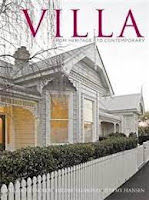
Villa: From classic to contemporary by Patrick Reynolds, Jeremy Salmond and Jeremy Hansen          $65
At last, a new edition of this book capturing something essential in New Zealand's domestic architectural history. 
A Feminist Mythology by Chiara Bottici         $44
A Feminist Mythology takes us on a poetic journey through the canonical myths of femininity, testing them from the point of view of our modern condition. A myth is not an object, but rather a process, one that Chiara Bottici practises by exploring different variants of the myth of "womanhood" through first- and third-person prose and poetry. We follow a series of myths that morph into each other, disclosing ways of being woman that question inherited patriarchal orders. In this metamorphic world, story-telling is not just a mix of narrative, philosophical dialogues and metaphysical theorizing: it is a current that traverses all of them by overflowing the boundaries it encounters. In doing so, A Feminist Mythology proposes an alternative writing style that recovers ancient philosophical and literary traditions from the pre-Socratic philosophers and Ovid's Metamorphoses to the philosophical novellas and feminist experimental writings of the last century.
The Eight Gifts of Te Wheke by Steph Matuku, illustrated by Laya Mutton-Rogers           $20
Te Wheke the octopus loves to collect things – pirate coins, glossy pearls, sparkly lamps, old toys, broken toasters. But one day, he wants to get eight treasures all at once, and that gets him into trouble. 
Ngā Taonga e Waru mā Te Wheke by Steph Matuku, illustrated by Laya Mutton-Rogers           $20
He tino rawe ki a Te Wheke te kohikohi taonga, he moni kaitiora, he peara muramura, he rama pīataata, he taonga tawhito, ērā momo mea katoa. Engari i tētahi rangi, ka kaiponu ia ki ngā taonga e waru, kāre e kore . . . he raru kei te haere.


The Sinner and the Saint: Dostoyevsky, a crime and its punishment by Kevin Birmingham          $65
In the summer of 1865, the former exile Dostoevsky found himself trapped in a cheap hotel in Wiesbaden, unable to leave until he'd paid the bill. Having lost the last of his money at the roulette table, his debts hung heavy over his head, his epileptic seizures were worsening, and his wife and beloved brother were dead. Desperate, a story came to him, a way to write himself out of his predicament: the murderer Rasolnikov, the hot, disorienting swirl of St Petersburg, the axe, the terrible crime, and the murderer's paranoia. The book was Crime and Punishment. The book also examines Pierre François Lacenaire, a notorious murderer and glamorous egoist who charmed and outraged Paris in the 1830s and whose sensational story provided the germ of the novel.
>>What about 1867? 
London Clay: Journeys in the deep city by Tom Chivers             $48
The past is below the present. Tom Chivers follows hidden pathways, explores lost islands and uncovers the geological mysteries that burst up through the pavement and bubble to the surface of our streets. From Roman ruins to a submerged playhouse, from an abandoned Tube station to underground rivers, Chivers leads us on a journey into the depths of London.
 From sofa suppers and comfort food to celebration meals and festive feasts, Victoria Moore helps you choose the wine that will taste most delicious with whatever you're eating.
Paul by Daisy Lafarge       $33
Frances is a young English woman spending a summer volunteering in rural France, hoping that picking vegetables and making honey will distract her from a scandal that drove her out of Paris, her degree unfinished and her sense of self unmoored. At Noa Noa, named for the ranch owner's adventures in Tahiti, she comes under the influence of Paul, a charismatic, dominant older man. As his hold over her tightens, Frances watches her plans fragment, and she finds herself entangled in a strange, uneven relationship

The World Turner Upside Down: A history of the Chinese Cultural Revolution by Yang Jisheng              $70
As a major political event and a crucial turning point in the history of the People's Republic of China, the Great Proletarian Cultural Revolution (1966-1976) marked the zenith as well as the nadir of Mao Zedong's politics. Reacting in part to the Soviet Union's 'revisionism' that he regarded as a threat to the future of socialism, Mao mobilized the masses in a battle against what he called 'bourgeois' forces within the Chinese Communist Party (CCP). This ten-year-long class struggle on a massive scale almost obliterated traditional Chinese culture as well as the nation's economy.
The Interest: How the British establishment resisted the abolition of slavery by Michael Taylor          $26
In 1807, Parliament outlawed the slave trade in the British Empire, but for the next quarter of a century, despite heroic and bloody rebellions, more than 700,000 people in the British colonies remained enslaved. And when a renewed abolitionist campaign was mounted, making slave ownership the defining political and moral issue of the day, emancipation was fiercely resisted by the powerful 'West India Interest'. Supported by nearly every leading figure of the British establishment - including Canning, Peel and Gladstone, The Times and Spectator - the Interest ensured that slavery survived until 1833 and that when abolition came at last, compensation worth billions in today's money was given not to the enslaved but to the slaveholders, entrenching the power of their families to shape modern Britain to this day. Now in paperback (but also in hardcover).
Stigma: The machinery of inequality by Imogen Tyler        $30
Stigma is a corrosive social force by which individuals and communities throughout history have been systematically dehumanised, scapegoated and oppressed.

Violeta by Isabelle Allende          $37
From pandemic to pandemic, Allende's latest novel covers a century of South American history as narrated through the life of one woman to her grandson. 
Fire and Ice: The volcanoes of the Solar System by Natalie Starkey          $37
Earth isn't the only planet to harbour volcanoes. In fact, the Solar System, and probably the entire Universe, is littered with them. Our own Moon, which is now a dormant piece of rock, had lava flowing across its surface billions of years ago, while Mars can be credited with the largest volcano in the Solar System, Olympus Mons, which stands 25km high. While Mars's volcanoes are long dead, volcanic activity continues in almost every other corner of the Solar System, in the most unexpected of locations. We tend to think of Earth volcanoes as erupting hot, molten lava and emitting huge, billowing clouds of incandescent ash. However, it isn't necessarily the same across the rest of the Solar System. For a start, some volcanoes aren't even particularly hot. Those on Pluto, for example, erupt an icy slush of substances such as water, methane, nitrogen or ammonia, that freeze to form ice mountains as hard as rock. While others, like the volcanoes on one of Jupiter's moons, Io, erupt the hottest lavas in the Solar System onto a surface covered in a frosty coating of sulphur.
Work: A history of how we spend our time by James Suzman            $25
The work we do brings us meaning, moulds our values, determines our social status and dictates how we spend most of our time. But this wasn't always the case: for 95% of our species' history, work held a radically different importance. How, then, did work become the central organisational principle of our societies? How did it transform our bodies, our environments, our views on equality and our sense of time? And why, in a time of material abundance, are we working more than ever before? New edition. 

Hegel in a Wired Brain by Slavoj Žižek         $30
Zizek gives us a reading of philosophical giant G.W.F. Hegel that changes our way of thinking about the new posthuman era. This work investigates what he might have had to say about the idea of the 'wired brain' — what happens when a direct link between our mental processes and a digital machine emerges. Zizek explores the phenomenon of a wired brain effect, and what might happen when we can share our thoughts directly with others. He hones in on the key question of how it shapes our experience and status as 'free' individuals and asks what it means to be human when a machine can read our minds.
A glimpse of post-war France through the eyes and words of 14 mostly expatriate journalists including Mavis Gallant, James Baldwin, A.J. Liebling, S.N. Behrman, Luc Sante, Joseph Mitchell, and Lillian Ross; plus, portraits of their editors William Shawn and New Yorker founder Harold Ross. Together they invented modern magazine journalism. Includes an introductory interview by Susan Morrison with Anderson about transforming fact into a fiction and the creation of his homage to these exceptional reporters, the film The French Dispatch
Us: A compendium        $30
This journal is filled with creative, enagaging prompts—both silly and serious—to help parents  and children learn more about each other and get everyone giggling. Shared journaling opens lines of communication, providing opportunities for self-expression. Through messages, sketches, and lists, you'll share memories, compare perspectives, uncover similarities, and celebrate uniqueness. And it's fun. 


VOLUME BooksNew releases


>> Read all Stella's reviews.


Azadi: Freedom, fascism, fiction by Arundhati Roy   {Reviewed by STELLA}
Azadi is a cry for freedom. It’s a chant originating in the struggle for a self-determined Kashmir, and the title of a collection of nine essays from the perceptive and passionate pen of Arundhati Roy. Famous for winning the Booker Prize for The God of Small Things and then not writing another novel until twenty years later, Roy has never stopped voicing her views on India, its politics and social constraints or excesses, depending on where you fall in this hugely various society. And she has never shied from the criticism she has encountered from some quarters — including from the ruling elites. Being accused of sedition in 2010 has not silenced her one bit. In Azadi, the essays, some previously published as long-form essays, others originally lectures, are urgent, demanding of your attention, and incredibly informative. Here she addresses the continuing rise of Hindu nationalism, the fascist traits of Modi, and the treatment of Kashmir (where an estimated 70,000 individuals have been killed in this conflict). She looks at the tensions between Pakistan and India, and the threat of nuclear weapons escalation. The essays vary in approach and style. 'The Language of Literature and 'The Graveyard Talks Back' both draw on her fiction work, analysing the thematic content of her novels, explaining particular social and cultural contexts or expressing her thoughts on the power of words and story to reach readers and to express the views of those who are often disadvantaged or maligned by society. Other essays, 'Election Season in a Dangerous Democracy' and 'There is Fire in the Ducts, the System is Failing', are more urgent and specific to political situations. In her final essay, written during the first wave of Covid, Roy likens the pandemic to a portal — otherworldly but also an opportunity for change. A slightly hopeful take in ‘the early days'. Since this collection went to print, she has continued to comment on India’s response and much of this has been fraught with anger and dismay. Azadi is a door into 21st century India, a country which Roy describes as a continent rather than a country — a place of 780 languages, different religions and various cuisines. Yet this is the same place where Modi and his supporters push the doctrine of "One Nation, One Language, One Religion, One Constitution”. Whether you read her fiction or essays, all Arundhati Roy’s writing is urgent, thoughtful and forceful. This collection is a welcome addition and a great introduction to her non-fiction.


 >> Read all Thomas's reviews. 


Nostalgia Has Ruined My Life by Zarah Butcher-McGunnigle    {Reviewed by THOMAS}
There is nothing funnier than depression, he thought, at least nothing funnier to me than my own depression. There is nothing more ludicrous than my inability to do even the simplest things, the kind of inability you would ordinarily expect to belong to the most difficult things, but really the simplest things are for me the most difficult, or at least indistinguishable from the most difficult, there is no difference between the simplest and the most difficult, but not in a way that would make the most difficult things achieveable, though really there is no reason why this should not be the case, other than my inability to imagine myself as the person who has achieved even the simplest, let alone the most difficult, things, he thought. There is nothing more ludicrous and perforce nothing funnier than that, he thought. There is a rupture of some kind, he thought, between me and my fortunate place in the world, making one of those self-obsessed, self-indulgent, grandiloquent statements that he found intolerable when others made them and so usually pretended not to hear them, which probably made him appear unsympathetic when he was in fact oversympathetic, which is just as useless. Is there any point in being oversympathetic to the self-revulsion of others, he wondered, no, this is just as pointless as my own self-revulsion, experience is disjoined from reality, neither revulsion is reasonable or appropriate, these revulsions are entirely ludicrous and perforce funny. That there is nothing funnier than my own self-revulsion should make my self-revulsion tolerable, but then it would hardly be self-revulsion and therefore not ludicrous enough to be funny, he thought. If I could find relief in this way from my suffering, he thought, recognising the self-obsession, self-indulgence and grandiloquence of this statement about suffering even as he made it, if I could find relief in this way from my suffering it wouldn’t be suffering and therefore wouldn’t be ludicrous enough to qualify as a relief. There is no relief, which only makes my suffering all the more ludicrous and perforce all the more funny. The more pathetic my suffering, the more inappropriate and ludicrous my suffering, the more self-obsessed and self-indulgent and grandiloquent and entirely pointless and unreasonable my suffering, the more I perforce suffer, and the funnier it is. Nothing funnier, he thought. Is this why I enjoyed this book, Nostalgia Has Ruined My Life, he wondered, this book he had read almost inadvertently, this book concerning a depressed young woman’s heroic efforts to achieve not very much and the degrees of shortness to which those efforts fall, this book concerning the disjunction between this young woman and her place in the world, this book at once funny and pathetic and, he supposed, terribly sad, written in the first person by Zarah Butcher-McGunnigle but, as it says on the front cover, fiction, just like what he is writing now. He could not decide if he was oversympathetic or undersympathetic when he found this supposedly fictional woman’s depression so funny, but, he thought with a ludicrously grandiose thought, the tragic is only more tragic for not existing in the context of a tragedy, and it is this disjunction, he thought, that makes depression so ludicrous. Taking it seriously would increase the disjunction and make it more ludicrous still. 


Our Book of the Week is THE DAWN OF EVERYTHING: A NEW HISTORY OF HUMANITY by David Graeber and David Wengrow. This remarkable book challenges our received narratives of historical determinism and the myths of cultural ‘progress’ devised to justify the status quo. If we unshackle ourselves from these preconceptions and look more closely at the evidence, we find a wide array of ways in which humans have lived with each other, and with the natural world. Many of these could provide templates for new forms of social organisation, and lead us to rethink farming, property, cities, democracy, slavery, and civilisation itself.

 NEW RELEASES

Mothers, Fathers, and Others by Siri Hustvedt             $33
Siri Hustvedt's relentlessly curious mind and expansive intellect are on full display in this new collection of essays, whose subjects range from the nature of memory and time to what we inherit from our parents, the power of art during tragedy, misogyny, motherhood, neuroscience, and the books we turn to during a pandemic. Drawing on family history as well as her own life and experiences, she examines the porousness of borders of all kinds in an intellectual journey that is at once personal and universal.
"It is Hustvedt's gift to write with exemplary clarity of what is by necessity unclear." —Hilary Mantel
To Paradise by Hanya Yanagihara            $38
From the author of A Little Life, a remarkable novel spanning three centuries and three different versions of the American experiment. In an alternative version of 1893 America, New York is part of the Free States, where people may live and love whomever they please (or so it seems). The fragile young scion of a distinguished family resists betrothal to a worthy suitor, drawn to a charming music teacher of no means. In a 1993 Manhattan besieged by the AIDS epidemic, a young Hawaiian man lives with his much older, wealthier partner, hiding his troubled childhood and the fate of his father. And in 2093, in a world riven by plagues and governed by totalitarian rule, a powerful scientist’s damaged granddaughter tries to navigate life without him – and solve the mystery of her husband’s disappearances. Yanagihara sets up resonances between the three stories, enriching them all. 
"A masterpiece for our times." —The Guardian
Magma by Thora Hjörleifsdóttir            $40
20-year old Lilja is in love. As a young university student, she is quickly smitten with the intelligent, beautiful young man from school who quotes Derrida and reads Latin and cooks balanced vegetarian meals. Before she even realises, she’s moved in with him, living in his cramped apartment. As the newfound intimacy of sharing a shower and a bed fuels her desire to please her partner, his acts of nearly imperceptible abuse continue to mount undetected. Lilja desperately tries to be the perfect lover, attempting to meet his every need. But in order to do so, she gradually lets go of her boundaries and starts to lose her sense of self. Hjörleifsdóttir sheds light on the commonplace undercurrents of violence that so often go undetected in romantic relationships. 
>>Read an extract
Until Proven Safe: The history and future of quarantine by Geoff Manaugh and Nicola Twilley            $50
Quarantine has shaped our world, yet it remains misunderstood. It is our most powerful response to uncertainty, but it operates through an assumption of guilt: in quarantine, we are considered infectious until proven safe. An unusually poetic metaphor for moral and mythic ills, quarantine means waiting to see if something hidden inside of us will be revealed. Until Proven Safe tracks the history and future of quarantine around the globe, chasing the story of emergency isolation through time and space – from the crumbling lazarettos of the Mediterranean to the hallways of the corporate giants hoping to disrupt the widespread quarantine imposed by Covid-19 before the next pandemic hits through surveillance and algorithmic prediction. Yet quarantine is more than just a medical tool: Manaugh and Twilley drop deep into the Earth to tour a nuclear-waste isolation facility beneath the New Mexican desert, strip down to nothing but protective Tyvek suits to see plants stricken with a disease that threatens the world’s wheat supply, and meet NASA’s Planetary Protection Officer tasked with saving the Earth from extraterrestrial infections. 
In My Mother's Footsteps: A Palestinian refugee returns home by Mona Hajjar Halaby               $28
When Halaby moved from California to Ramallah to teach conflict resolution in a school for a year, she kept a journal. Within its pages, she wrote her impressions of her homeland, a place she had only experienced through her mother's memories. As she settled into her teaching role, getting to know her students and the challenges they faced living in a militarised, occupied town, Halaby also embarked on a personal pilgrimage to find her mother's home in Jerusalem. Halaby had dreamed of being guided by her mother down the old souqs, and the leafy streets of her neighborhood, listening to the muezzin's call for prayer and the medley of church bells. But after fifty-nine years of exile, it was Halaby's mother who needed her daughter's guidance as they visited Jerusalem together, walking the narrow cobblestone alleys of the Old City. 
About Time: A history of civilisation in twelve clocks by David Rooney            $40
From the city sundials of ancient Rome to the era of the smartwatch, clocks have been used throughout history to wield power, make money, govern citizens and keep control.
The Goddess Chronicle by Natsuo Kirino             $23
On an island in the shape of a teardrop live two sisters. One is admired far and wide, the other lives in her shadow. One is the Oracle, the other is destined for the Underworld. But what will happen when she returns to the island? Based on the Japanese myth of Izanami and Izanagi.

Forecast: A diary of the lost seasons by Joe Shute       $35
The changing seasons have shaped all of our lives, but what happens when the weather changes beyond recognition? Shute has spent years unpicking Britain's long-standing love affair with the weather. He has pored over the literature, art and music our weather systems have inspired and trawled through centuries of established folklore to discover the curious customs and rituals created in response to the seasons. But in recent years Shute has discovered a curious thing: the seasons are changing far faster and far more profoundly than we realise. Even the language we use to describe them is changing.

The False Rose by Jakob Wegelius           $28
In this much-anticipated sequel to The Murderer's Ape, Sally Jones and The Chief discover a curious rose-shaped necklace hidden onboard their beloved Hudson Queen, and it's the start of another perilous adventure for the seafaring gorilla and her faithful friend. Determined to get to the bottom of the mystery, they set sail for Glasgow, but there fall into the clutches of one of the city's most ruthless gangs, commanded by a fearsome smuggler queen who will stop at nothing to snatch the necklace for herself. Held prisoner hundreds of miles from friendship and safety, Sally Jones must use all her strength, determination and compassion to escape and unravel the mysterious story of the False Rose.
Move! The new science of body over mind by Caroline Williams         $33
Exercise changes the brain. But which exercises have what effect? Did you know that walking can improve your cognitive skills? That strengthening your muscular core reduces anxiety? That light stretching can combat a whole host of mental and bodily ailments, from stress to inflammation? We all know that exercise changes the way you think and feel. But scientists are just starting to discover exactly how it works.

Terrific! by Sophie Gilmore            $30
Mandrill, Owl, Badger, Turtle, and Anteater want to do something terrific together. Anteater suggests climbing—but that is not terrific for them all. Mandrill suggests hanging upside down, but that is not terrific for them all, either. And so it goes, until Snake slithers into the group and nearly upends the whole lovely afternoon.
From the author/illustrator of Little Doctor and the Fearless Beast


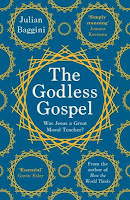
The Godless Gospel by Julian Baggini         $25
Stripping away the religious elements, Baggini, an atheist, asks how we should understand Jesus's attitude to the renunciation of the self, to politics or to sexuality. Do Jesus's teachings add up to a coherent moral system? If so, could this still be relevant today?

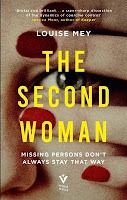
The Second Woman by Louise Mey       $33
Missing persons don't always stay that way... Sandrine lives alone, rarely speaking to anyone other than her colleagues. She is resigned to her solitary life, until she sees on TV a man despairing for his wife who has mysteriously disappeared. Sandrine is drawn to him and eventually the two strike up a relationship. When the man's wife reappears, Sandrine is forced to confront the truth about him. Is he all she thought he was, or is he hiding an abusive and manipulative character? Who can she trust—the man she loves now, or the woman he loved first?
The Secret Doctor: What really goes on inside your GP's surgery by Max Skittle        $25
Spilt urine bottles, the patients who should have been in hospital months ago, existential crises, utterly unexplainable health problems, awkward silences...

Lockwood travels the world, often by bicycle, collecting first-person accounts of climate change. She talks to indigenous elders and youth in Fiji and Tuvalu about drought and disappearing coastlines, attends the UN climate conference in Morocco, and bikes the length of New Zealand and Australia, interviewing the people she meets about retreating glaciers, contaminated rivers, and wildfires. She rides through Thailand, Laos, and Cambodia to listen to marionette puppeteers and novice Buddhist monks. From Denmark and Sweden to China, Turkey, the Canadian Arctic, and the Peruvian Amazon, she finds that ordinary people sharing their stories does far more to advance understanding and empathy than even the most alarming statistics and studies.


VOLUME BooksNew releases

Our Book of the Week is monumental both in scope and in content. Nobel Prize-winner Olga Tokarczuk's novel The Books of Jacob surrounds the historical figure of Jacob Frank, whose iconoclastic mysticism saw him either condemned as a heretic by the establishment or lauded as a messiah by his various Jewish, Islamic or Catholic followers, with a vast cloud of often bizarre historical detail, demonstrating the Enlightenment as a pivotal period in the development of many of the social, intellectual and aesthetic ills that have beset Europe since and also now. Tokarczuk is against fixity, limitation, authority and prejudice, and her magnum opus is an exhilarating and transforming experience. 


>> Read all Stella's reviews.


The Hotel by Sophie Calle   {Reviewed by STELLA}
This book is exquisite. It’s not just the packaging, even though this is a great start: cloth-covered, gilt-edged, and excellent layout make this a pleasure to hold in the hand and eye. The cover is a triptych of patterns, reminiscent of wallpaper, fabric sheets or curtains and the golden edges are just the right touch of tack and glamour. The endpapers are the perfect hotel green. For this is a book about hotels, or rather those who stay in them through, the eyes of a chambermaid. In fact, a not-a-chambermaid. French artist Sophie Calle spent a few months in 1981 employed at a Venetian hotel. Here she conducted a series of observations in photography and text of the rooms she cleaned when the guests were absent. She was a voyeur, an explorer into what is both intimate and anonymous. She cleaned rooms and took photographs, read guests postcards, noted their underwear, the way in which they slept in the beds. She opened suitcases and clicked her camera. She pried. The result was an exhibition and later a book — a book which until now has been available only in French. This new English-language edition from Silglo is a welcome addition to Calle’s other artist books. The photographs are a mix of black and white and stunning colour. The elaborate decor (the floral glitz and the formal wooden furniture) of the hotel rooms is lovingly juxtaposed with the personal effects of the visitors: some drab, commonplace; others surprising and cumulatively interesting. Why does this guest have a letter from 16 years ago on holiday with them? What can it be but nostalgia? The two women in Room  26 have near-matching pyjamas, porn magazines and cigarettes — they leave behind the two coke bottles, mostly empty and the magazines in the rubbish. The family in Room 47 have a balloon tied to a drawer handle, towels piled up in the bidet, repetitive postcards, and Calle’s assessment on day one, “On the luggage stand, a second suitcase. It is full. I don’t go through it; I just look. I am bored with these guests already.” And what do they leave behind — a deflated balloon and stale biscuits. Some guests are neat, others unpack everything. Calle notes their nightclothes, whether they use them, the arrangement of their pillows — the different approaches between couples. What medicines and cosmetics do they carry with them? She leaves us to draw our own conclusions as to the why. The photographs are intriguing — the objects, the angles with which Calle captures these fleeting moments, these ‘peepings’ into others’ lives through things and the way in which they interact with their environment — the hotel room. The careful calculations of light that cross these rooms, highlighting a crease in the sheet, or a slight rucking of the carpet, or the shine of new luggage or the wear and tear of old, is testament to Calle's skill behind the lens. And the text adds another dimension. It tells us what Calle does, how she sees the guests and what she does in the rooms. Each episode is recorded by Room, date and time. The best episodes straddle multiple days — with each visit to a room (with the same occupants) Calle seems bolder and more intrigued with the evidence of the guests. This isn’t merely reportage — Calle laces her words with droll humour and a storyteller’s gift, taking us, the readers, into our own imagination as we become voyeurs alongside her. Somehow it never seems that she is stepping over a border, although she trends very closely to the edge. We are briefly submerged in the lives of others while remaining at a distance, remote, despite this most intimate experience.


 >> Read all Thomas's reviews. 


Strange Hotel by Eimear McBride  {Reviewed by THOMAS}
To ‘stay’ in a hotel (as opposed to ‘staying’ home) does not mean to remain but merely to await departure. A hotel is not a home away from home but is the opposite of a home, a place where, as McBride puts it, “nothing is at stake,” a place where action and inaction begin to resemble each other, a place where the absence of context allows or invites unresolved pasts or futures to press themselves upon the present without consequence. There is no plot in a hotel; everything is in abeyance. The protagonist in Strange Hotel is present (or presented) in a series of hotels — in Avignon, Prague, Oslo, Auckland, and Austin (all hotels are, after all, one hotel) — over a number of years in what we could term her early middle age. She spends the narrated passages of time mainly not doing something, choosing not to sleep with the man in the room next door, not to throw herself from the window as she waits for a man to leave her room, not to stay in the room of the man with whom she has slept until he wakes up, not to meet a man at the hotel bar, not to let in the man with whom she has slept and who she almost fails to keep at the distance required by her rigour of hotel behaviour. Her ritual self-removal from the stabilising patterns of her ordinary existence — about which we learn little — in the hotels seems designed to reconfigure herself following the death of her partner without either wearing out the memory she has of him or being worn out by it. Slowly, through the series of hotels, she becomes capable of reclaiming herself from her loss, moving from instances where even slight resemblances to experiences associated with her dead partner close down thought (as with the speaker in Samuel Beckett’s Not I) to a point where memory begins to not overwhelm the rememberer, when the hold on the present of the past begins to loosen, when the path to grief loses its intransigence and coherence and no longer precludes the possibility that things could have been and could be different. McBride’s linguistic skill and introspective rigour in tracking the ways in which her protagonist negotiates with her memories through language is especially effective and memorable. Language is a way of avoiding thought as much as it is a way of achieving it: “Even now, she can hear herself doing it. Lining words up against words, then clause against clause until an agreeable distance has been reached from the original unmanageable impulse which first set them all in train.” Her self-interrogation and her “interrogating her own interrogation” “serves the solitary purpose of keeping the world at the far end of a very long sentence,” but as her ‘hotel-praxis’ (so to call it) starts to erode the structures of her ‘grief-taxis’ (so to call it), language is no longer capable of — or, rather, no longer necessary for and therefore no longer capable of — buffering her from loss: “I do like all these lines of words but they don’t seem to be helping much with keeping the distance anymore.” At the start of the the book she feels as if she has “outlived her use for feeling” and clinically observes that, in another, “sentiment must be at work somewhere, unfortunately”; in Prague she observes of the man whose departure from her room she awaits on the balcony: “She hadn’t intended to hurt his feelings. To be honest, she’s not even sure she has. His feelings are his business alone. She just wishes he hadn’t presumed she possessed quite so many of her own. She has some, naturally, but spread thinly around—with few kept available for these kinds of encounters.” By the end of the process, though — “to go on is to keep going on” — the possibility of feeling begins to emerge from beneath her grief, the present is no longer overwhelmed by actual or even possible alternative pasts, and she begins to sense that she can “turn too and return again from this most fitly resolved past that was never really an option — to the life which, in fact, exists.”  


 Hotel by Joanna Walsh  {Reviewed by THOMAS}
As a relief from an unhappy marriage, Walsh got a job as a hotel reviewer and spent a period of time living only in places that are intended to be alternatives to home. In this series of short pieces, with occasional appearances by Freud, Dora (the subject of Freud’s early work on hysteria), Katherine Mansfield, KM (her alter ego), and the Marx brothers, Walsh plays rigorously with the idea of the hotel and with the idea of home that is its complement and shadow. Throughout the book, she does such a thorough job of picking away at ideas that vertiginous spaces open up within them, terrifying emptinesses in what had seemed like smooth and continuous thought. She is, understandably, intent on the mechanisms and ellipses by which her marriage has disintegrated: is the fault in the idea of marriage, in her husband or in herself, or is this “only ordinary unhappiness”? Walsh is adept at the re-flexing of banal tropes into fresh and sturdy thought: “We went into marriage to fulfil our individual desires, but we found ourselves required to be fulfilled by what we found there. The marriage problem is the same as the hotel problem. I have second-guessed your desires, and those of others. I have made myself into a hotel.” She is under no illusion that thinking can provide resolution (indeed the benefits of thought are magnified when resolution is impossible or eschewed), aware that problems will remain problems (we may at best hope for them to be problems we to some extent understand): “Plot is good in books but bad in life. There is no plot in a hotel. When I am in a hotel, the bad thing in abeyance but it is waiting to happen outside the hotel nevertheless.” 

NEW RELEASES

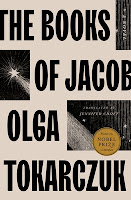
The Books of Jacob by Olga Tokarczuk          $40
In the mid-eighteenth century, as new ideas begin to sweep the continent, a young Jew of mysterious origins arrives in a village in Poland. Before long, he has changed not only his name but his persona; visited by what seem to be ecstatic experiences, Jacob Frank casts a charismatic spell that attracts an increasingly fervent following. In the decade to come, Frank will traverse the Hapsburg and Ottoman empires, throngs of disciples in his thrall as he reinvents himself again and again, converts to Islam and then Catholicism, is pilloried as a heretic and revered as the Messiah, and wreaks havoc on the conventional order, Jewish and Christian alike, with scandalous rumours of his sect’s secret rituals and the spread of his increasingly iconoclastic beliefs. The Nobel Prize in Literature laureate writes the story of Frank through the perspectives of his contemporaries, capturing Enlightenment Europe on the cusp of precipitous change, searching for certainty and longing for transcendence.
"A visionary novel. Tokarczuk is wrestling with the biggest philosophical themes: the purpose of life on earth, the nature of religion, the possibility of redemption, the fraught and terrible history of eastern European Jewry. With its formidable insistence on rendering an alien world with as much detail as possible, the novel reminded me at times of Paradise Lost. The vividness with which it’s done is amazing. At a micro-level, she sees things with a poetic freshness. The Books of Jacob, which is so demanding and yet has so much to say about the issues that rack our times, will be a landmark in the life of any reader with the appetite to tackle it." —Marcel Theroux, Guardian
>>
The rise and fall of a messiah. 
Night Train: Very short stories by A.L.Snijders (translated by Lydia Davis)            $29
The miniature stories of A. L. Snijders might concern a lost shoe, a visit with a bat, fears of travel, a dream of a man who has lost a glass eye: uniting them is their concision and their vivacity. Lydia Davis in her introduction delves into her fascination with the pleasures and challenges of translating from a language relatively new to her. She also extols Snijders's "straightforward approach to storytelling, his modesty and his thoughtfulness."
Selected from many hundreds in the original Dutch, the stories gathered here—humorous, or bizarre, or comfortingly homely--are something like daybook entries, novels-in-brief, philosophical meditations, or events recreated from life, but—inhabiting the borderland between fiction and reality—might best be described as autobiographical mini-fables.
The Hotel by Sophie Calle               $80
A compellingly intrusive photographic project from this forensically conceptual artist. In 1981, Calle took a job as a chambermaid at a Venetian hotel and used her access to the rooms she cleaned to photograph and catalogue the evidence of the gusts lives as presented in their personal belonging and use of the rooms. The results are fascinating, the ordinary lives of strangers are rendered extraordinary. Recommended. 
Ypi grew up in one of the most isolated countries on earth, a place where communist ideals had officially replaced religion. Albania, the last Stalinist outpost in Europe, was almost impossible to visit, almost impossible to leave. It was a place of queuing and scarcity, of political executions and secret police. To Lea, it was home. People were equal, neighbours helped each other, and children were expected to build a better world. There was community and hope. Then, in December 1990, a year after the fall of the Berlin Wall, everything changed. The statues of Stalin and Hoxha were toppled. Almost overnight, people could vote freely, wear what they liked and worship as they wished. There was no longer anything to fear from prying ears. But factories shut, jobs disappeared and thousands fled to Italy on crowded ships, only to be sent back. Predatory pyramid schemes eventually bankrupted the country, leading to violent conflict. As one generation's aspirations became another's disillusionment, and as her own family's secrets were revealed, Lea found herself questioning what freedom really meant.
Being a Human: Adventures in 40,000 years of consciousness by Charles Foster            $40
Foster sets out to understand what a human is, inhabiting the sensory worlds of humans at three pivotal moments in our history. Foster begins his quest in a wood in Derbyshire with his son, shivering, starving and hunting, trying to find a way of experiencing the world that recognises the deep expanse of time when we understood ourselves as hunter-gatherers, indivisible from the non-human world, and when modern consciousness was first ignited. From there he travels to the Neolithic, when we tamed animals, plants and ourselves, to a way of being defined by walls, fences, farms, sky gods and slaughterhouses, and finally to the rarefied world of the Enlightenment, when we decided that the universe was a machine and we were cogs within it.
Caliban and the Witch: Women, the body, and primitive accumulation by Sylvia Federici           $26
Caliban and the Witch is Silvia Federici's history of the body in the transition to capitalism. Moving from the peasant revolts of the late Middle Ages through the European witch-hunts, the rise of scientific rationalism and the colonisation of the Americas, it gives a panoramic account of the often horrific violence with which the unruly human material of pre-capitalist societies was transformed into a set of predictable and controllable mechanisms. It is a study of indigenous traditions crushed, of the enclosure of women's reproductive powers within the nuclear family, and of how our modern world was forged in blood.
The Transgender Issue: An argument for justice by Shon Faye           $40
Trans people have become a culture war 'issue'. Despite making up less than one per cent of the population, they are the subjects of a toxic and increasingly polarised 'debate' which generates reliable controversy for newspapers and talk shows. This media frenzy conceals a simple fact — that we are having the wrong conversation, a conversation in which trans people themselves are reduced to a talking point and denied a meaningful voice. Faye reclaims the idea of the 'transgender issue' to uncover the reality of what it means to be trans in a transphobic society. In doing so, she provides a compelling, wide-ranging analysis of trans lives from youth to old age, exploring work, family, housing, healthcare, the prison system and trans participation in the LGBTQ+ and feminist communities.
"An inspiring call for coalition. Shon Faye shows with courage and clarity that the struggle of trans people is the struggle of us all. This book is a game-changer." —Owen Jones
Leonard Cohen: The mystical roots of genius by Harry Freedman            $33
Shows how Cohen's songs are full of reference to Jewish, Kabbalistic, Christian and Zen Buddhist traditions. 
>>'The Story of Isaac'. 
Author of the acclaimed postpunk history Rip It Up and Start Again, Reynolds became a rave convert in the early nineties. He experienced first-hand the scene's drug-fuelled rollercoaster of euphoria and darkness. He danced at Castlemorton, the illegal 1992 mega-rave that sent spasms of anxiety through the Establishment and resulted in the Criminal Justice and Public Order Bill. Mixing personal reminiscence with interviews and ultra-vivid description of the underground's ever-changing sounds as they mutated under the influence of MDMA and other drugs, Energy Flash is the definitive chronicle of electronic dance culture. From rave's origins in Chicago house and Detroit techno, through Ibiza, Madchester and the anarchic free-party scene, to the pirate-radio underworld of jungle and UK garage, and then onto 2000s-shaping genres such as grime and electro, Reynolds documents with authority, insight and infectious enthusiasm the tracks, DJs, producers and promoters that sound tracked a generation. A substantial final section, added for this new edition, brings the book up to date, covering dubstep's explosive rise to mass popularity and America's recent but ardent embrace of rave.
The 1619 Project: A new American origin story edited by Nikole Hannah-Jones             $40
In 1619 a ship arrived in the British colony of Virginia bearing a first cargo of twenty to thirty enslaved people from Africa. Slavery persisted for 250 years, and its consequences shape the present. The New York Times Magazine's award-winning '1619 Project' issue reframed understanding of American history by placing slavery and its continuing legacy at the center of the national narrative. This new book substantially expands on that work, weaving together eighteen essays that explore the legacy of slavery in present-day America with thirty-six poems and works of fiction that illuminate key moments of oppression, struggle, and resistance. The essays show how the inheritance of 1619 reaches into every part of contemporary American society, from politics, music, diet, traffic, and citizenship to capitalism, religion, and democracy itself.
Istria: Recipes and stories from the hidden heart of Italy, Slovenia and Croatia by Paola Bacchia          $65
Istria is the heart-shaped promontory at the northern crux of the Adriatic Sea, where rows of vines and olives grow in fields of red earth. Here, the cuisine records a history of changing borders — a blend of the countries (Italy, the Republic of Venice, Austria, Hungary and now Slovenia and Croatia) that have shared Istria's hills and coasts and valleys. This book is a record of traditions, of these cultures and of Bacchia's family: recipes from her childhood, the region's past, and family and friends who still live beside the Adriatic coast. 

Giften by Leyla Suzan           $19
Ever since The Darkening, survival has been a struggle. The people of the Field toil on parched earth, trying to forge a life amid dwindling resources. As one of the Giften, Ruthie is a saviour to her isolated community: her hands hold the rare ability to raise food from dead soil. But she is also its greatest danger. In the City lurks a dark army, intent on hunting Giften to harness their power, destroying all who stand in their way. With the threat growing ever stronger, Ruthie and her friends must leave behind all they have ever known and embark on a quest that will pitch them towards the City, and unknowable danger.
Crying in H Mart by Michelle Zauner              $38
Zauner tells of growing up the only Asian-American kid at her school in Oregon; of struggling with her mother's particular, high expectations of her; of a painful adolescence; of treasured months spent in her grandmother's tiny apartment in Seoul, where she and her mother would bond, late at night, over heaping plates of food. As she grew up, moving to the east coast for college, finding work in the restaurant industry, performing gigs with her fledgling band-and meeting the man who would become her husband — her Koreanness began to feel ever more distant, even as she found the life she wanted to live. It was her mother's diagnosis of terminal pancreatic cancer, when Michelle was twenty-five, that forced a reckoning with her identity and brought her to reclaim the gifts of taste, language, and history her mother had given her.
Dante by Alessandro Barbero (translated by Allan Cameron)       $45
Dante Alighieri's Divine Comedy has defined how people imagine and depict heaven and hell for over 700 years. However, outside of Italy, his other works are not well-known, and less still is generally known about the context he wrote them in. 
"A richly informative biography of a man who can seem so reticent and aloof that at times it feels as if he's hiding behind the 14,233 verses of The Divine Comedy." —New York Times 

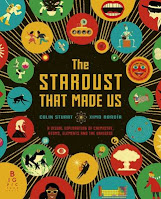
Imagine that Nature has an unseen cookbook full of different recipes for making everything you've ever encountered, from fish to fingernails and sand to Saturn. The 'ingredients' are known as chemical elements and there are 118 that we know about so far, which are organised in a grid called the periodic table. Some occur in nature, some are human-made, some are dangerous, some even glow blue.
Dog Park by Sofi Oksanen (translated by Owen F. Witesman)        $33
Helsinki, 2016. Olenka sits on a bench, watching a family play in a dog park. A stranger sits down beside her. Olenka startles; she would recognize this other woman anywhere. After all, Olenka was the one who ruined her life. And this woman may be about to do the same to Olenka. Yet, for a fragile moment, here they are, together - looking at their own children being raised by other people. Moving between modern-day Finland and Ukraine in the early days of its post-Soviet independence, Dog Park is a propulsive novel set at the intersection of East and West, centered in a web of exploitation and the commodification of the female body. 
"A remarkably ambitious story. Oksanen has much to say about the price of parenthood and the cost for young women who, with few other options to escape poverty, become egg donors or surrogates." —The New York Times
Spacecraft by Timothy Morton           $23
Science fiction is filled with spacecraft. On Earth, actual rockets explode over Texas while others make their way to Mars. But what are spacecraft, and just what can they teach us about imagination, ecology, democracy, and the nature of objects? Why do certain spacecraft stand out in popular culture? If ever there were a spacecraft that could be detached from its context, sold as toys, turned into Disney rides, parodied, and flit around in everyone's head-the Millennium Falcon would be it. Springing from this infamous Star Wars vehicle, Spacecraft takes readers on an intergalactic journey through science fiction and speculative philosophy, revealing real-world political and ecological lessons along the way. 
>>More than you need to know


VOLUME BooksNew releases


Our Book of the Week, Claire Fuller's Unsettled Ground, has just won the 2021 Costa Novel Award. 
When their elderly mother dies suddenly, 51-year-old twins, Jeanie and Julius are entirely unprepared for life without her in their rundown, rural cottage. Raised in isolation away from the complexities of the modern world, within days they find themselves facing eviction and a landslide of debt, as the web of secrets their mother wove around them, since the death of their father 40 years ago, threatens to tear apart.
>>Read Stella's review
>>An affinity for atmospheric places
>>Not exactly a happy ending. 
>>Across the pond
>>Little atoms


>> Read all Stella's reviews.


Unsettled Ground by Claire Fuller   {Reviewed by STELLA}
Reading the premise of this book on the back cover immediately brought to mind the Maysles brothers’ documentary, Grey Gardens, about an eccentric mother and daughter living in a decaying manor and their increasingly perilous financial situation. In Claire Fuller’s Unsettled Ground, the relationship is focused on twins Jeanie and Julius. The sudden death of their mother Dot throws their lives into chaos. The story of their lives — the one told to them and by them — is a fabrication, one which can only harm even while it could be seen as a notion of a romantic idyll: living off the land in a rent-free cottage without the distractions and pressures, nor convenience, of the modern world — no internet or computers (although Julius does have a cell), very little focus on money, no car nor useful appliances. Dot has cared for her children alone, managing to scrape together just enough from the sale of produce from the abundant garden to the village deli, since a fatal accident killed her husband, an accident that the landowner, Rawson, seems to take responsibility for. ‘The Arrangement’ — to live rent-free at the cottage — is often referred to in the children’s lives, but has never been fully explained. It’s a given. And here’s the kicker, the twins are 51, never left home, let alone ventured far from the village or their small plot of land. Julius does odd jobs and labouring on the surrounding farms, while Jeanie, who must take care due to her weak heart, has helped Dot in the garden and house. They have few friends, yet the village knows more about the twins and their history than the twins themselves. Why were there secrets, and what was Dot trying to hide? The twins are a strange mix of naive and resourceful, but Dot’s choices have left them with few options for managing without her. When Dot dies, the true state of her finances come to light — the power has been cut off, she is in debt rather than credit to her deli supplier, having borrowed against her future produce, and she owes a large sum of money to her friend’s husband. Why she needed the cash no one knows. and the money isn’t anywhere to be found. Add to their financial peril, a knock on the cottage door from Mrs Rawson saying they owe thousands of pounds in rent arrears, and the monies are due in a week or they face eviction. A stunned Julius and Jeanie are reeling from their mother’s death, completely unprepared for a life without her, let alone the immediate need to bury her and deal with the various bureaucratic arrangements, and confront the different emotional responses they endure as the true nature of their relationship with their mother surfaces. For Julius, his desire for a relationship, increasingly begrudging responsibility for his sister and delusional actions are taking a toll on his ability to cope. For Jeanie, her lack of schooling (she is unable to read or write), nervousness and fear of her weak heart, paired with her naivety and contempt for contemporary society, creates a perfect storm for further isolation. Yet it is Jeanie who has a tough core — one which may save or suffocate them both. Fuller writes evocatively — as some things are buried, others rise from their beds, their voices loud. The land is alive with rot and renewal, and the past will not be held down. Lush, tense and angry — a portrait of poverty, love and remarkable lies. Shortlisted for the 2021 Women's Prize, and winner of the Costa Novel Award.


 >> Read all Thomas's reviews. 


The Dolls by Ursula Scavenius (translated by Jennifer Russell)   {Reviewed by THOMAS}
“The disasters that befall you are always different from the ones you imagine,” states a character in one of the stories in Ursula Scavenius’s riveting and unsettling collection The Dolls, a collection suffused with unidentifiable or unquantifiable threats, threats that leave the narrators transfixed by the mundane details of lives distorted by unbearable forces that they cannot comprehend or name. It is hard to make a case that 'real life', so to call it, operates any differently. Is it the case that the unbearable arises from the mundane, that the unbearable is inherent in the mundane but suppressed to make the mundane bearable, or, rather, is it that by suppressing the unbearable we are left with the mundane, the only evidence we have, perhaps, of the forces set against us? Is the mundane therefore the surest point of access to the unbearable? Is the most unbearable closest to the most mundane? The potentising restraint of Scavenius’s prose, the withholding of all but the most resonant details, gives great power to that which is excluded, to that which it is impossible to include. Just as the universe is, supposedly, comprised mostly of dark matter, which we cannot sense and for which the only evidence is the effect it has upon that portion of the universe that we can sense, so too literature is most effective when attending to the effects upon the mundane of forces that cannot otherwise be directly or adequately addressed. The total, comprised primarily of dark matter, cannot be expressed. Any idea of 'the total' comes at the expense of the parts, by the suppression of some parts and the magnification of other parts. Any idea of 'the total' is a distortion of that which it purports to represent. A ‘story’, a ‘development’, likewise, is a totalitarian concept. Naturalism is a totalitarian concept. Scavenius has Kafka’s gift of being able to allow her details to resonate in the spaces that surround them, echoing in spaces that cannot otherwise be delineated, intimating the complex forces seething beneath her deceptively simple prose. Her characters move about in worlds strangely sloped, the familiar becoming unfamiliar and revealed as evidence of the unbearable. Time slips, the past is seen to be a threat, even an idyllic past is a threat because it contains the circumstances out of which the problematic present arose. “Birds chirp in the bushes outside. I laugh, realising it’s only a memory.” Every detail, every occurrence is a point of pressure, a point at which the mundane is assailed by dark matter. In the title story, ‘The Dolls’, the arrival of some refugees reveals the fascistic potential latent in the local community, including in the narrator’s father, and the distorting effect of that force upon thought and language: “There is no way to prove whether the scream was real, someone on the radio says. … It sounds real, but these days anything could be propaganda.” The force of the unbearable is always felt first upon language. 

 NEW RELEASES

Choose from these new titles and click through to have them delivered to your door!

Natural History by Carlos Fonseca (translated by Megan McDowell)       $40
Just before the dawn of the new millennium, a curator at a New Jersey museum of natural history receives an unusual invitation from a celebrated fashion designer. She shares the curator's fascination with the secrets of the animal kingdom—with camouflage and subterfuge—and she proposes that they collaborate on an exhibition, the nature of which remains largely obscure, even as they enter into a strange relationship marked by evasion and elision. Seven years later, after the designer's death, the curator recovers the archive of their never-completed project. During a long night of insomnia, he finds within the archive a series of clues about the true history of the designer's family, a mind-bending puzzle that winds from Haifa, Israel, to bohemian 1970s New York to the Latin American jungles. As he follows this trail, the curator discovers a cast of characters whose own fixations interrogate the unstable frontiers between art, science, politics, and religion. An aging photographer, living nearly alone in an abandoned mining town where subterranean fires rage without end, creates miniature replicas of ruined cities. A former model turned conceptual artist becomes the star defendant in a trial over the very soul and purpose of art. A young indigenous boy receives a vision of the end of the world. Reality is a curtain, the curator realises, and to draw it back is to reveal the theater of the obsessed.
The Luminous Novel by Mario Levrero (translated by Annie McDermott)            $35
A writer attempts to complete the novel for which he has been awarded a large Guggenheim grant, though for a long time he succeeds mainly in procrastinating — getting an electrician to rewire his living room so he can reposition his computer, buying an armchair, or rather, two: "In one, you can't possibly read: it's uncomfortable and your back ends up crooked and sore. In the other, you can't possibly relax: the hard backrest means you have to sit up straight and pay attention, which makes it ideal if you want to read."
>>Read an excerpt
>>Levrero hunting. 
Kāinga: People, land, belonging by Peter Tapsell                               $15
"Dare we elevate kāinga as a way of achieving regionalised ecological accountability, and in the process can we bring humanity back into balance with the universe?" Through his own experience and the stories of his tīpuna, Paul Tapsell (Te Arawa, Tainui) charts the impact of colonisation on his people. Alienation from kāinga and whenua becomes a wider story of environmental degradation and system collapse. This book is an impassioned plea to step back from the edge. It is now up to the Crown, Tapsell writes, to accept the need for radical change. The ecological costs of colonisation are clear, and yet those same extractive and exploitative models remain foundational today. Only a complete step-change, one that embraces kāinga, can transform our lands and waterways, and potentially become a source of inspiration to the world.
October Child by Linda Boström Knausgård (translated by Saskia Vogel)        $33
From 2013 to 2017, Linda Boström Knausgård was periodically interned in a psychiatric ward where she was subjected to electroconvulsive therapy. As the treatments at this 'factory' progressed, the writer’s memories began to disappear. What good is a writer without her memory? This book, based on the author’s experiences, is an eloquent and profound attempt to hold on to the past, to create a story, to make sense, and to keep alive ties to family, friends, and even oneself. Moments from childhood, youth, marriage, parenting, and divorce flicker across the pages of October Child. This is the story of one woman’s struggle against mental illness and isolation. It is a raw testimony of how writing can preserve and heal.
Karearea by Māmari Stephens       $15
"My journey into law and mātauranga is one more defined by absence, understanding of loss, whakamā, accident and a sense of coming in from the cold, than by any programmatic acquisition of expertise. " This collection of writing from Māmari Stephens (Te Rarawa) travels through introspection, loss and doubt, to present striking moments of insight into the world around us. From a perceptive legal scholars, these are words that question neat categorisations and easy assumptions. Kārearea returns, always, to the ground, the people, the experiences that make up a life of learning, and to the stories that we tell ourselves.
Against the Loveless World by Susan Abulhawa         $28
Nahr has been confined to the Cube: nine square metres of glossy grey cinderblock, devoid of time, its patterns of light and dark nothing to do with day and night. Journalists visit her, but get nowhere; because Nahr is not going to share her story with them. The world outside calls Nahr a terrorist, and a whore; some might call her a revolutionary, or a hero. But the truth is, Nahrhas always been many things, and had many names. She was a girl who learned, early and painfully, that when you are a second class citizen love is a kind of desperation; she learned, above all else, to survive. She was a girl who went to Palestine in the wrong shoes, and without looking for it found what she had always lacked in the basement of a battered beauty parlour: purpose, politics, friends. She found a dark-eyed man called Bilal, who taught her to resist; who tried to save her when it was already too late. Nahr sits in the Cube, and tells her story to Bilal. Bilal, who isn't there; Bilal, who may not even be alive, but who is heronly reason to get out.
Feeling and Knowing: Making minds conscious
 by Antonio Damasio        $50
Damasio is convinced that recent findings in neuroscience, psychology and artificial intelligence have given us the necessary tools to the mystery of consciousness. He explores the relation between consciousness and the mind; why being conscious is not the same as either being awake or sensing; the central role of feeling; and why the brain is essential for the development of consciousness.
>>Making minds conscious. 

Woman Made: Great women designers by Janet Hill         $80
Featuring more than 200 designers from more than 50 countries, this well-documented book records and illuminates the often overlooked history of women pre-eminent in the field — shining a vital spotlight on the most extraordinary objects made by female designers but, more importantly, offering a compelling primer on the best in the field of design.
Metamorphosis by Penelope Lively            $50
The definitive selection of short stories from the collections by Penelope Lively. 
"A sublime storyteller, Lively has us riveted with curiosity as to what will happen next, yet also keeps us consistently aware of the nature of the illusion." —Guardian
To Walk Alone in the Crowd by Antonio Muñoz Molina       $45
"I want to live on foot, by hand, by pencil, at ease, responsive to whatever I meet, loose like the air that moves around my body as I walk or like a graceful swimming stroke. I want to remain astonished." Join Antonio Munoz Molina for a walk through Madrid, Paris, London and New York, where the past and the present live side by side in the literature of newspaper headlines, billboards, casual glances and overheard conversation. This is the digital metropolis, captured in notebooks, recorded on the iPhone, where Edgar Allan Poe, Herman Melville, Charles Baudelaire, Thomas de Quincey, Fernando Pessoa and Walter Benjamin step beside us, all of us writing the unfinished poem of the crowded city.

Great Demon Kings: A memoir of poetry, sex, art, death, and enlightenment by John Giorno           $43
When he graduated from Columbia in 1958, John Giorno was handsome, charismatic, ambitious, and eager to soak up as much of Manhattan's art and culture as possible. Poetry didn't pay the bills, so he worked on Wall Street, spending his nights at the happenings, underground movie premiers, art shows, and poetry readings that brought the city to life. An intense romantic relationship with Andy Warhol—not yet the global superstar he would soon become—exposed Giorno to even more of the downtown scene, but after starring in Warhol's first movie, Sleep, they drifted apart. Giorno soon found himself involved with Robert Rauschenberg and later Jasper Johns, both relationships fueling his creativity. He quickly became a renowned poet in his own right, working at the intersection of literature and technology, freely crossing genres and mediums alongside the likes of William Burroughs and Brion Gysin.
Murder: The biography by Kate Morgan      $40
Behind historical changes to murder law lie very human stories and sad cases. There's Richard Parker, the cannibalised cabin boy whose death at the hands of his hungry crewmates led the Victorian courts to decisively outlaw a defence of necessity to murder. Dr Percy Bateman, the incompetent GP whose violent disregard for his patient changed the law on manslaughter. Ruth Ellis, the last woman hanged in England in the 1950s, played a crucial role in changes to the law around provocation in murder cases. And Archibald Kinloch, the deranged Scottish aristocrat whose fratricidal frenzy paved the way for the defence of diminished responsibility. These, and many more, are the people — victims, killers, lawyers and judges — who unwittingly shaped the history of that most grisly and storied of laws.
The Italian Bakery: Step-by-step recipes with Silver Spoon         $70
Dishes found in bakeries throughout Italy's diverse regions come to life in 140 accessible classic and contemporary patisserie recipes with step-by-step photography, geared toward novices and experienced bakers alike. Includes cakes, pastries, pies, cookies, sweets and chocolates, and frozen puddings.
The history of humanity's relationship with other species is baffling. Without animals there would be no us. We are all fellow travellers on the same evolutionary journey. By charting the love-hate story of people and animals, from their first acquaintance in deep prehistory to the present and beyond, Richard Girling reveals how and where our attitudes towards animals began — and how they have persisted, been warped and become magnified ever since.


The Nordic Baker: Plant-based bakes and seasonal stories from a bakery in the heart of Sweden by Sofia Nordgren          $45
From Thumbprint cookies, Kladdkaka and Rhubarb galette in springtime, Raspberry and cardamom cupcakes when the weather begins to warm up, and a Midsommar cake for summer celebrations, through to Lingonberry roll cake, pear tart and cardamom rolls for cosy autumn nights and Gingerbread bundt cake, Saffron buns and Semlor for snowy winter days.

The Hidden Case of Ewan Forbes by Zoe Playdon          $33
Ewan Forbes was born Elizabeth Forbes to a wealthy landowning family in 1912. It quickly became clear that the gender applied to him at birth was not correct, and from the age of six he began to see specialists in Europe for help. With the financial means of procuring synthetic hormones, Ewan was able to live as a boy, and then as man, and was even able to correct the gender on his birth certificate in order to marry. Then, in 1965, his older brother died and Ewan was set to inherit the family baronetcy. After his cousin contested the inheritance on the grounds that it could only be inherited by a male heir, Ewan was forced to defend his male status in an extraordinary court case, testing the legal system of the time to the limits of its understanding. In The Hidden Case of Ewan Forbes, Zoe Playdon draws on the fields of law, medicine, psychology and biology to reveal a remarkable hidden history, uncovering for the first time records that were considered so threatening that they had been removed from view for decades.


VOLUME BooksNew releases


Welcome to our 
SUMMER BOOK SELECTOR
We recommend these books for summer reading. Click through to our website to reserve or purchase your copies—we will have them delivered anywhere. 
If you don't find what you're looking for here, browse our website, or e-mail us: we have many other interesting books on our shelves.
List #1:  FICTION
List #3:  SOCIETY


>> Read all Stella's reviews.


We Run the Tides by Vendela Vida  {Reviewed by STELLA}

Eulabee lives in Sea Cliff, a coastal neighbourhood of San Fransisco with an enviable view of the Golden Gate. She attends a private all-girls school and is part of a group of teenage girls with her best friend, the enchanting Maria Fabiola, at its centre. All is perfect and desirable, on the surface. Yet the fog that rolls in, literally, over the bay, and metaphorically over the teens, obscuring and confusing the landscape, of the neighbourhood and the girls' behaviour, is quietly threatening. In We Run the Tides, the girls own the streets: they know who lives where and why, who the strange ones are, and what goes on behind closed doors in the skimpiest sense. What it hides, as the girls come to discover as they move through that time between child and adulthood, is both blindingly obvious and indeterminately deceptive: a vagueness that can’t be resolved with the lifting of the murk. Life is golden for Eulabee: her mother, a nurse and her father, an antique dealer, who scored their home through hard work and good fortune — theirs was the doer-upper in the street, a warm, culturally rich home; she has the best friend with a ‘laugh that sounded like a reward’, and is free to enjoy her privileged life. As adolescence raises her head and the gang of girls shift around each other in different patterns, the blinkers slowly lift. Shifts overlaid by the landscape, the tides that rise and fall, creating beauty as well as danger. An incident on the way to school will change her relationship with Maria Fabiola in a way she could never have imagined. Perception is everything, and what one sees and another does not escalates a situation from the trivial to the dramatic, not helped by the enchanting Maria Fabiola and her penchant for attention and excitement. Under this coming-of-age story are deeper issues of coming womanhood, body image and sexual awakening, deception, pretension and power. A missing girl and a body on the beach shake the neighbourhood at its core. Against this backdrop, Eulabee, now isolated and confused after being ousted from the group, edges towards a new understanding of herself and a realisation that her best friend is not the girl she thought she was — and even meeting years later will reveal further truths that the teenage girl had failed to see. Vendela Vida’s compulsively attractive writing and vivid portrayal of growing up in 1980s San Francisco make We Run the Tides captivating and subtly played.