>> Read all Thomas's reviews. 


Chasing Homer by László Krasznahorkai (translated by John Batki), with paintings by Max Neumann and music by Szilveszter Miklós   {Reviewed by THOMAS}
It seemed sometimes that they were even wanting the worst to happen, if only to be relieved of the terrible anticipation that the worst may happen. It seemed sometimes that the worst thing sucks everything else towards it, even our resistance to the worst thing, and the closer we get to the worst thing it seems the less we resist it, just when we would be better to resist it more, until we are drawn over the acquiescence horizon, so to call it, until we are drawn past the point at which the possibility of relief from the effort to resist is stronger than our exhausting effort to resist, the point at which we either try to resist more, which just increases the degree of relief offered by giving up, or we resist less, which draws us closer to giving up. We give up. Of course, we don’t want to be seen to be giving up, not even by ourselves, what we want is a way to be seen to be resisting when in fact we are giving up, what we want is some mechanism that will make it appear that, when the worst happens, it might not have been as bad as it could have been even though it is worse than we could have imagined. How could that *they* have become a *we* so easily? A threat presses unrelentingly on the narrator of Krasznahorkai’s text, the threat of the worst thing, the nullification of that narrator, the narrator *knows* there are assassins on the narrator’s trail, they from whom the narrator flees, they whom the narrator has never seen and may never see, no matter, this just makes the fleeing more urgent, the threat more imminent, the worst that could happen always just on the point of happening if never actually happening. “I know they’ll never relent,” the narrator writes, “it’s as if their orders aren’t to make quick work of me … but rather to keep pursuing me.” The narrator must keep fleeing so as to continue being what a narrator is, the narrator must flee nullification, the narrator must flee into the new. “I have no memories whatever … the past doesn’t exist for me, only what’s current exists … and I rush into this instant, an instant that has no continuation.” The narrator flees in the present tense, the narrator flees by narrating. The text we read is the result of the narrator’s resistance to their own nullification, or, rather, the text *is* the narrator’s resistance to their own nullification. Obviously. “Life is forever merely the incalculable consequence facing the oncoming process, because there’s nothing that lurks behind the process … for me nothing exists that goes beyond the situation that happens to be at hand,” states the narrator, and if fate, or, rather, the causal mechanisms that we mistakenly label as *fate*, is nothing but an ineluctable process of destruction, if nullification is a corrolary of being, then we can only exist in our errors, we can only exist to the extent that we make a mistake. “The decisions I make must be the utterly wrong ones.” the narrator states, “that’s how I can confound my pursuers.” Great forces grapple through the text, through the narrator caught within themselves. We all share this pressure upon us that many would mistake for paranoia, no such luck, we all share this problem with time, this snagging in the moment, this agony of being forced on but this terror of no longer going on. “If I were to divine a plan of action of some kind, it would be all over for me,” the narrator states, though, really, is the threat coming from within or from without? But the narrator *does* divine a plan of action, the narrator *is* seduced by story, the narrator *does* start to abrade against their surroundings and against the people in those surroundings by the very fact of their interaction with those surroundings and with those people. The narrator passes the acquiescence horizon without being aware that they are passing the acquiescence horizon. All is lost. Giving up is no less fatal for looking like merely a change of plan. 


Book of the Week: Always Italicise: How to write while colonised by Alice Te Punga Somerville       

"Always italicise foreign words," a friend of the author was advised. In her first book of poetry, Māori scholar and poet Alice Te Punga Somerville does just that. In wit and anger, sadness and aroha, she reflects on how to write in English as a Māori writer, and how to trace links between Aotearoa and wider Pacific, Indigenous and colonial worlds.
>>Writing while colonised
>>English has broken my heart.
>>English has broken my heart on the radio
>>Two Hundred and Fifty Ways to Start an Essay About Captain Cook.
>>Our stories about Cook.
>>(Not quite) 250 ways.
>>250 ways.
>>Writing the new world.
>>Interconnections.
>>Te Punga Somerville wrote a standout essay in Ngā Kete Mātauranga.
>>Environment and identity. 
>>Challenging stories. 
>>A bibliography of writing by Māori in English.
>>Your copy of Always Italicise

 NEW RELEASES

Always Italicise: How to write while colonised by Alice Te Punga Somerville       $28
"Always italicise foreign words," a friend of the author was advised. In her first book of poetry, Māori scholar and poet Alice Te Punga Somerville does just that. In wit and anger, sadness and aroha, she reflects on 'how to write while colonised' — how to write in English as a Māori writer; how to trace links between Aotearoa and wider Pacific, Indigenous and colonial worlds; how to be the only Māori person in a workplace; and how — and why — to do the mahi anyway.
>>Writing while colonised
>>English has broken my heart
>>English has broken my heart on the radio.  
>>Find out more
Fight Night by Miriam Toews              $33
You are a small thing, and you must learn to fight. Swiv has taken her grandmother's advice too literally. Now she's at home, suspended from school. Her mother is pregnant and preoccupied — and so Swiv is in the older woman's charge, receiving a very different form of education from a teacher with a style all her own. Grandma likes her stories fast, troublesome and funny. She's known the very worst that life can throw at you - and has met it every time with a wild, unnamable spirit, fighting for joy and independence every step of the way. But will maths lessons based on Amish jigsaws and classes on How to Dig a Winter Grave inspire the same fire in Swiv, and ensure it never goes out? Time is running short. Grandma's health is failing, the baby is on the way, as a family of three extraordinary women prepare to face life's great changes together. From the author of Women Talking and All My Puny Sorrows
Ti Amo by Hanne Ørstavik (translated by Martin Aitken)      $36
A woman is in a deep and real, but relatively new relationship with a man from Milan. She has moved there, they have married, and they are close in every way. Then he is diagnosed with cancer. It’s serious, but they try to go about their lives as best they can. But when the doctor tells the woman that her husband has less than a year to live – without telling the husband – death comes between them. She knows it’s coming, but he doesn’t – and he doesn’t seem to want to know. Ti Amo is a beautiful and harrowing novel, filled with tenderness and grief, love and loneliness. It delves into the complex emotions of bereavement, and in less than 100 pages manages to encapsulate both scope and depth, asking how and for whom we can live, when the one we love best is about to die.
Duck's Backyard by Ulrich Hub, illustrated by Jörg Mühle          $20
A duck spends her days limping around her backyard with the help of a crutch until one day a blind hen stumbles in, lost, and persuades the duck to embark on an adventurous journey. The duck will guide the hen; the hen will steady the duck's wonky leg. They leave together for a place where their most secret wishes will come true. The pair come upon astonishing obstacles along the way—a wild forest, a cavernous gorge and many differences of opinion. The hen starts to wish she’d taken a guide dog rather than a duck! When the two finally arrive at their destination after all the hardships, they realise that their own backyard plus a little imagination offers as much adventure as a whole world.
Great Women Painters edited by Alison Gingeras           $120
Featuring over 300 artists and covering almost 500 years, this well presented and well illustrated book gives depth to familiar works and delivers many surprises. 
Immanuel by Matthew McNaught           $28
At what point does faith turn into tyranny? Blending essay, memoir and reportage, this exceptional debut explores community, doubt, and the place of faith in the twenty-first century. In Immanuel, McNaught explores his upbringing in an evangelical Christian community in Winchester. As McNaught moved away from the faith of his childhood in the early 2000s, a group of his church friends were pursuing it to its more radical fringes. They moved to Nigeria to join a community of international disciples serving TB Joshua, a charismatic millionaire pastor whose purported gifts of healing and prophecy attracted vast crowds to his Lagos ministry, the Synagogue Church of All Nations (SCOAN). Years later, a number of these friends left SCOAN with accounts of violence, sexual abuse, sleep deprivation and public shaming. In reconnecting with his old friends, McNaught realised that their journey into this cult-like community was directly connected to the teachings and tendencies of the church of their childhood. Yet speaking to them awakened a yearning for this church that, despite everything, he couldn't shake off. Was the church's descent into hubris and division separable from the fellowship and mutual sustenance of its early years? Was it possible to find community and connection without dogma and tribalism? Blending essay, memoir and reportage, Immanuel is about community, doubt, and the place of faith in the twenty-first century.
Towards a Grammar of Race in Aotearoa New Zealand edited by Anisha Sankar, Lana Lopesi and Arcia Tecun      $40
A search for new ways to talk about the social construct of race in Aotearoa brought together this powerful group of scholars, writers and activists. For these authors, attempts to confront racism and racial violence often stall against a failure to see how power works through race, across our modern social worlds. The result is a country where racism is all too often left unnamed and unchecked, voices are erased, the colonial past ignored and silence passes for understanding. By ‘bringing what is unspoken into focus’, Towards a Grammar of Race seeks to articulate and confront ideas of race in Aotearoa New Zealand – an exploration that includes racial capitalism, colonialism, white supremacy, and anti-Blackness. A recurring theme across the book is the inescapable entanglement of local and global manifestations of race. Each of the contributors brings their own experiences and insights to the complexities of life in a racialised society, and together their words make an important contribution to our shared and future lives on these shores. Contributors: Pounamu Jade Aikman, Faisal Al-Asaad, Mahdis Azarmandi, Simon Barber, Garrick Cooper, Morgan Godfery, Kassie Hartendorp, Guled Mire, Tze Ming Mok, Adele Norris, Nathan Rew, Vera Seyra, Beth Teklezgi, Selome Teklezgi and Patrick S. Thomsen.
On the Farm: New Zealand's invisible women by David Hall          $40
This interesting book tells the stories of Kiwi farm women largely in their own words, drawing from the vast archive of letters written to New Zealand farming magazines throughout the 20th century. It reveals the daily routines, the various roles women held on farms: from mother to teacher, baker to accountant, cleaner to farm worker, and how their extraordinarily busy work loads were carried out largely unacknowledged and unseen. It shows how women struggled for greater recognition for their contributions to farming, tracing a time from when it was impossible for a woman to get a bank loan to own or operate a farm, to a period when women were often considered equal partners in the running of a farm and regularly became individual farm owners.
The Collectors by Philip Pullman, illustrated by Tom Duxbury          $25
A Gothic-feeling, atmospheric mystery story set in the world of 'His Dark Materials' and 'The Book of Dust', and revealing the early life of the complex pivotal character Mrs Coulter. On a dark winter's night in 1970, Horley and Grinstead huddle for warmth in the Senior Common Room of a college in Oxford. Conversation turns to the two impressive works of art that Horley has recently added to his collection. What the two men don't know is that these pieces are connected in mysterious and improbable ways; and they are about to be caught in the cross-fire of a story which has travelled time and worlds.

More Zeros and Ones: Digital technology, maintenance and equity in Aotearoa New Zealand edited by Anna Pendergrast and Kelly Pendergrast           $15
Many of today's digital technologies inadvertently amplify the power structures and prejudices of wider society. By examining the way digital tools and platforms are designed, built, and maintained, this BWB Text aims to identify where and what we can do better for everyone in Aotearoa. Following on from the success of Shouting Zeros and Ones, this fresh collection includes writers with specific expertise in applying topics such as environmental science, law and Te Tiriti o Waitangi to recent developments in technology. More Zeros and Ones continues the exploration of emerging issues for digital technology and society in Aotearoa New Zealand. Contributors include Dr Nessa Lynch, Amber Craig, Hiria Te Rangi, Dr Sarah Bickerton, Sarah Pritchett, Hannah Blumhardt, Dr Paul Smith, Professor Graeme Austin, Siobhan McCarthy, Dr Karaitiana Taiuru, Dr Andrew Chen, Dr Karly Burch, Dr Moana Nepia, Nicholas Jones, Dr Marama Muru-Lanning, Dr Henry Williams, Mira O'Connor and Professor Anna Brown.
Bushline by Robbie Burton            $40
Nelson publisher and tramper Robbie Burton shows us the paths that led him to publish some of Aotearoa's best and pivotal non-fiction books, and to love the mountains. 
>>On publishing Nicky Hager and hitting a political nerve

Culture in a Small Country: The arts in New Zealand by Roger Horrocks          $45
A wide-ranging account of the state of the arts in Aotearoa, combining new perspectives on the past with a view of the situation today and considering the impact of the pandemic on the sector. It includes interviews with writers, painters, composers, filmmakers and other artists, who accepted the challenge of making a creative career in a country which is often blind to the value of the arts. The book looks not only at artistic innovations but also at practical problems, public scandals, and the struggle in a small society to reach critical mass.
“Like so many others, I have been waiting for this book. Horrocks’s big picture history is convincing and revelatory because his insider’s knowledge of the arts is so uniquely broad and deep.” — Wystan Curnow
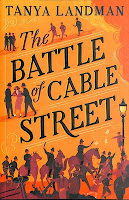
The Battle for Cable Street by Tanya Landman         $17
In 1936 the British Union of Fascists staged a provocative march through London's Jewish East End. They were met by a massive antifascist counter-protest, which fought the fascists and the police until Mosley was instructed by the police to leave the area. This important but overlooked piece of history is told for younger readers in the context of the lives of young people in the area. 
McKinnon takes readers on a vegetable-by-vegetable journey, packed with clever and inventive ways to combine ingredients, flavours and texture. With practicality, accessibility and economy in mind, Hetty devotes one chapter to each of her 22 favourite everyday vegetables, from Asian greens to zucchini. As is Hetty's signature, the flavours are globally inspired, with an emphasis on simple yet inventive weeknight cooking. 

This Devastating Fever by Sophie Cunningham          $37
Alice had not expected to spend the first twenty years of the twenty-first century writing about Leonard Woolf. When she stood on Morell Bridge watching fireworks explode from the rooftops of Melbourne at the start of a new millennium, she had only two thoughts. One was: the fireworks are better in Sydney. The other was: was the world's technology about to crash down around her? The world's technology did not crash. But there were worse disasters to come: Environmental collapse. The return of fascism. Wars. A sexual reckoning. A plague. Uncertain of what to do she picks up an unfinished project and finds herself trapped with the ghosts of writers past. What began as a novel about a member of the Bloomsbury set, colonial administrator, publisher and husband of one the most famous English writers of the twentieth century becomes something else altogether. 
One Hundred Havens: The settlement of the Marlborough Sounds by Helen Beaglehole        $60
History has played out in the many coves of the Marlborough Sounds in complex ways - Maori and Pakeha, land and sea, boom and bust, locals and tourists. It's a glorious but challenging environment, and generations of farmers, miners and tourism operators have faced obstacles that range from the merely difficult to the nearly impossible. Well illustrated. 

Rooms of Their Own: Where great writers write by Alex Johnson, illustrated by James Oses        $45
The perennial question asked of all authors is How do you write? What do they require of their room or desk? Do they have favourite pens, paper or typewriters? And have they found the perfect daily routine to channel their creativity? Crossing centuries, continents and genres, Alex Johnson has pooled 50 of the best writers and transports you to the heart of their writing rooms - from attics and studies to billiard rooms and bathtubs. Discover the ins and outs of how each great writer penned their famous texts, and the routines and habits they perfected. Meet authors who rely on silence and seclusion and others who need people, music and whisky. Meet those who travel half-way across the world to a luxury writing retreat, and others who just need an empty shed at the bottom of the garden. Some are particular about pencils, inks, paper and typewriters, and others will scribble on anything - including the furniture. But whether they write in the library or in cars, under trees, private islands, hotel rooms or towers - each of these stories confirms that there is no best way to write. 
A Message for Nasty by Roderick Fry            $40
December 8, 1941. Marie Broom wakes in her home on Hong Kong’s Fortress Hill to the sound of bombs falling nearby. Within days, Japanese soldiers have seized the surrounding ​buildings. Soon afterwards they take over the whole island. Most of its British residents are forcibly interned. Marie’s husband Vincent, a New Zealander, is away on business, trapped in Singapore as it too comes under Japanese attack. Macau-born Marie, 27, her three young daughters, baby son and the family’s amahs must face Hong Kong’s increasingly brutal occupation alone. A well-researched novel based on actual events and experiences. 
"The most chilling depiction of the Japanese occupation of Hong Kong and the particular horrors facing young women unprotected I have ever come across" —Peter Graham
"Change your life today. Don't gamble on the future, act now, without delay." So said Simone de Beauvoir. In this galvanising tour of her existentialist philosophies for life, we learn how de Beauvoir can teach us to free ourselves of fears and stereotypes and live more authentically. 


VOLUME BooksNew releases


Book of the WeekConversātiō: In the company of bees. Photographer Anne Noble has become increasingly fascinated with bees: their social complexity, their otherness, their long importance to humans, and the clarity with which they raise the alarm over environmental stress and degradation. This beautifully presented and idiosyncratic book displays Noble's bee photographs, at once sensitive and stunning, and helps us to think in new ways about the bees with which we share our world.
>>Look inside.
VOLUME BooksBook of the week


>> Read all Stella's reviews.


Best of Friends by Kamila Shamsie    {Reviewed by STELLA}
It’s Karachi, 1988, and best friends Zahra and Maryam are negotiating their teenage years alongside dynamic political change. Each has a dream: one to inherit the family business, the other to study abroad. Private school girls — Zahra there for her academic prowess, Maryam on the basis of class and her family name — their lives are ones of privilege, but tentatively so. Being young women in this society brings with it expectations and restrictions for both. For Zahra with her school-teacher mother and her cricket commentator father, nothing can be taken for granted. To win a place at an overseas university, she must be better, academically and socially, than all the other students. Pressures from the military regime loom large in her psyche and on the eve of the downfall of General Zia, luck averts a moral crisis for her family. For Maryam, her grandfather’s favourite, taking on the family leatherworks business is never a given, but she’s confident of winning what she sees as her rightful position, female or not. When Maryam returns from summer with her family in London, Zahra notices a shift in her bearing. Maryam is changing and Zahra is confronted by this new bolder young woman aware of her physical presence in the world. Change is in the air. The election of Benazir Bhutto is a pivotal moment for the friends and they feel like they are invincible as they celebrate. Under this breakthrough, though, lie all the issues of gender and class inequality, which won’t be easily undone. On the micro-scale, Maryam is attracting the attention of an older teen boy, Hammad — all leather jacket and slicked back hair — and this creates a fissure in the girls’ friendship, one which will have repercussions in their adult lives, decades on. When a ride in a car goes drastically wrong, both Zahra and Maryam’s lives are turned upside down. Maryam is sent away to boarding school in the UK and Zahra carries with her a sense of guilt and shame she can’t throw off. The second half of the novel is set in 2019. Zahra is a successful civil liberties advocate, and Maryam the CEO of an entrepreneurial investment company. While their friendship has endured, the differences between them are stark. Yet they are also bound by their shared history, personal and cultural. Here Shamsie uses the tensions in their relationship to tease out political and cultural issues, such as facial recognition technology and state control, migration and deportation. Here also, the novel starts to unpick Zahra’s complex sexual repression and Maryam’s alienation from her partner. It examines the role power has in personal, as well as political, relationships. There’s an impending sense of doom, as each of the friends’ behaviours and choices set off a ricochet of events which require them to face each other and themselves. Another powerful novel from the award-winning author of Home Fire
VOLUME BooksReview by Stella


 >> Read all Thomas's reviews. 


The Notebook by Ágota Kristóf  {Reviewed by THOMAS}

In an unnamed country [Hungary] during an unnamed war [WWII], twin brothers from the Big Town are deposited with their unknown grandmother in the Little Town [near the German border]. Their belongings are immediately taken and sold by their grandmother, apart from their father’s big dictionary, which they use to write their story in the big notebook they demand from the local bookseller on the basis of ‘absolute need’. They set rules for their writing: “The composition must be true. We must describe what is, what we see, what we hear, what we do. For example, it is forbidden to write, ‘Grandmother is like a witch,’ but we are allowed to write ‘People call Grandmother a witch’. We would write, ‘We eat a lot of walnuts’, and not, ‘We love walnuts,’ because the word ‘love’ is not a reliable word. Words that define feelings are very vague. It is better to avoid using them and stick to the description of objects, human beings, and oneself, that is to say, to the faithful description of facts.” The twins describe how they perform ‘exercises to toughen the body’ – hurting themselves and each other until they no longer cry when they are hit, and ‘exercises to toughen the mind’ – subjecting each other to verbal abuse until they no longer blush and tremble when people insult them, and also repeating the words of affection their mother used to use to them until their eyes no longer fill with tears: “By force of repetition, these words gradually lose their meaning, and the pain they carry in them is assuaged.” Unable to be separated, controlled or opposed, the twins practise the only virtue left in a world rendered amoral by war: survival. ‘Absolute need’ is the basis of their interactions with others: they demand boots from the cobbler so they can go about in the winter, they blackmail the priest on behalf of the unfortunate Harelip, they comply with the masochistic requests of the Foreign Officer because of his ‘absolute need’ (which is no less absolute for being psychological), they wreak disfiguring revenge on the priest’s housekeeper because of her mocking of the passing [Jewish] Human Herd’s absolute need for bread. The narrators’ dual identity, the pared-back matter-of-fact prose without metaphor or superfluity, the rigour with which small and horrendous matters are treated with flat equivalence make this book powerful, moving (while remaining unsentimental) and memorable.

VOLUME BooksReview by Thomas

 NEW RELEASES

Sylvia and the Birds: How the Bird Lady saved thousands of birds, and how you can too by Joanna Emeny and Sarah Laing          $40
Part graphic biography, part practical guide to protecting our bird wildlife, this remarkable book for young readers and their families is fully committed to detailing the wonders of our native birds, the threats they face and how we can help them. Based on the life of 'The Bird Lady', Sylvia Durrant, who helped over 140,000 sick, injured and lost birds during her lifetime, it inspires a reverence for the natural world and is a call to action to all young ecologists and environmentalists. With charming illustrations by Sarah Laing, an engrossing text, mātauranga Māori insights, activities and how-tos, it offers hours of enchantment and engagement.
>>Look inside
Diego Garcia by Natasha Soobramanien and Luke Williams         $33
A collaborative fiction about grief, friendship, and how to tell stories that are not yours to tell. Edinburgh, 2014: N. and L., two writer friends arrive from London, a city they believe killed L.'s brother. Every day they try to get to the library to write their blocks, but every day they get distracted, bickering over everything from whether or not it's going to rain, to their Bitcoin tanking, trying and failing to resist the sadness which follows them as they drift around the city. It's on a day like this that they make a new friend, Diego. They go out drinking and swap stories. Diego tells them he is named after his mother's island in the Indian Ocean, part of the Chagos Archipelago, which she and her community were forced to leave by armed soldiers in 1973. The writers become obsessed with this shameful episode in British history and the continuing exile of the Chagossian people. Angry and sad and funny, this collaborative fiction set in Edinburgh, London and Brussels is about grief and friendship, and about trying to work out how, as a writer, you share a story that needs to be heard if it is not your story to tell. But ultimately this is a novel about the true fact of a collaborative fiction authored by the US and British governments, created to maintain military power and to dispossess a people of their homeland.
"As an experiment in 'fictive criticism', this is a new type of social novel, one that avoids stable conclusions. Instead it demands the reader's own critique." —TLS
"Intimate yet expansive, heartbroken but unbowed, and a book about writing that is anything but solipsistic, it's a stirring novel that lights a way forward for politically conscious fiction." —Observer
"Focusing on the ongoing atrocity of the Anglo-American occupation of the Chagos Islands and displacement of their native people, Diego Garcia is a subtle contemplation of the uses of fiction and narrative (for good and bad) and how, where and why individual and collective narratives meet. Taking in artists from Kader Attia to Sophie Podolski, as well as depictions of the Chagossians in poetry, documentaries and essay films, it is a moving study of friendship, allyship and creative forms of political struggle." —Juliet Jacques
"As affecting as it is intellectually agile, Diego Garcia achieves what few novels even aim at - it opens up fresh ways of reading both history and fiction." —Pankaj Mishra
"Diego Garcia is an important and highly original work, incredibly well-researched and thought-through." —Philippe Sands, author of The Last Colony
>>See also: The Last Colony by Philippe Sands.
Dandelions by Thea Lenarduzzi            $38
Where, or what, is home? What has it meant, historically and personally, to be ‘Italian’ or ‘English’, or both in a culture that prefers us to choose? What does it mean to have roots? Or to have left a piece of oneself somewhere long since abandoned? In Dandelions, Thea Lenarduzzi pieces together her family history through four generations’ worth of migration between Italy and England, and the stories scattered like seeds along the way. At the heart of this book is her grandmother Dirce, a former seamstress and a repository of tales that are by turns unpredictable, unreliable, significant. Through the journeys of Dirce and her relatives, from the Friuli to Sheffield and Manchester and back again, a different kind of history emerges. 
"Dandelions is a book of hauntings, intensely experienced, pierced by occasional terrors, yet irradiated throughout by passionate attachment. Generations of family ghosts wander between Italy and England, their lives summoned from a beloved grandmother’s long memories and the author’s own wide-roaming, often poetic reflections on botany, history and language. Thea Lenarduzzi has spread out before us a feast of sensuous and sensitive, nuanced and deeply appealing testimony to migration, survival, and complicated identities at a time when such thoughtfulness is desperately needed." —Marina Warner
Leaving: A poem from the time of the virus by Cees Nooteboom (translated by David Colmer), illustrations by Max Neumann              $48
Approaching ninety, Nooteboom studies his garden and is thrown back into memories of World War 2. With the outbreak and spread of the covid virus, he feels the pull of death even more more strongly, and wonders just how many things are coming to their end. Nooteboom's mesmerising poems are perfectly matched with Neumann's unsettling illustrations. 
>>See some of the artwork
My Mind To Me A Kingdom Is by Paul Stanbridge             $34
Paul Stanbridge tells us about remarkable things. He tells us about the plains of Doggerland, lost under the North Sea. He tells us about ancient horses, carved into chalk hillsides. He tells us about the mysteries and wonders of trees, the beauty of equations. My Mind To Me A Kingdom Is is a book bursting with knowledge. It is a novel about the joy of discovery, the beauty of the world, the rich, warm pulse of life. It is also a book about death. In 2015, Paul's brother took his own life, leaving behind pitifully few possessions and an irreducible complex of questions. In his search for answers, Paul discovers that facts can be the opposite of truth, and that to see something fully, we must sometimes look away. In the end, sifting through a chaos of fragmentary remains — both personal and historical — Paul begins to piece together a sense of the value of living, and to understand what cannot be known. Blending fiction and memoir, knowing and unknowing, love and loss, My Mind To Me A Kingdom Is is a heartbreaking and generous exploration of grief, and a beautiful and painful tribute to Paul's brother. 
Kāwai: For such a time as this by Monty Soutar               $40
In this novel from the notable historian, a young Māori man, compelled to learn the stories of his ancestors, returns to his family marae on the east coast of the North Island to speak to his elderly grand-uncle, the keeper of the stories. What follows is the enthralling account of the young man's tipuna, the legendary warrior Kaitanga, after whom his marae's whare puni has been named. Tracing the author's own ancestral line, Kāwai reveals a picture of an indigenous Aotearoa in the mid-18th century, through to the first encounters between Maori and Europeans. It describes a culture that is highly sophisticated with an immense knowledge of science, medicine and religion; proud tribes who live harmoniously within the natural world; a highly capable and adaptable people to whom family and legacy are paramount. However, it is also a culture illuminated by a brutal undercurrent of inter-generational vengeance, witchcraft and cannibalism.
>>“It’s like a history of New Zealand through Māori eyes.
Fossil Treasures of Foulden Maar: A window into Miocene Zealandia by Uwe Kaulfuss, Daphne Lee and John Conran          $60
A paleontological site of international significance, Foulden Maar in Otago is home to an amazing record of life on Earth. Formed by a volcanic eruption 23 million years ago, the Maar’s undisturbed sedimentary layers are the resting places for countless rare, well-preserved fossils. The site is unsurpassed in the Southern Hemisphere as a scientific record of changing life and ecosystems at the beginning of the Miocene. In recent years, the fossil treasures of Foulden Maar have been threatened by a proposal to mine the site’s rich diatomite deposits. Local and national scientific researchers rallied to call for the protection of this unique location, sparking an international debate about the importance of the preservation of paleontological sites worldwide. Very well presented and illustrated.
He Reo Tuku Iho: Tangata whenua and te reo Māori by Awanui Te Huia        $30
Awanui Te Huia focuses on the lived experiences of tangata whenua and explores ways in which they can reclaim te reo. Drawing upon findings from the national research project Manawa ū ki te reo Māori, which surveyed motivations and barriers for Māori language acquisition and use, Te Huia encourages readers to explore how they can journey back towards te reo Māori in daily life. We hear from tangata whenua learning te reo, and from those who are fluent, while considering challenges to language reclamation – such as experiences with racism, whakamā, historical trauma and resourcing – and ways to overcome these.
Perfume by Megan Volpert              $23
Our sense of smell is crucial to our survival. We can smell fear, disease, food. Fragrance is also entertainment. We can smell an expensive bottle of perfume at a high-end department store. Perhaps it reminds us of our favorite aunt. A memory in a bottle is a powerful thing. Megan Volpert's Perfume carefully balances the artistry with the science of perfume. The science takes us into the neurology of scent receptors, how taste is mostly smell, the biology of illnesses that impact scent sense, and the chemistry of making and copying perfume. The artistry of perfume involves the five scent families and symbolism, subjectivity in perfume preference, perfume marketing strategies, iconic scents and perfumers, why the industry is so secretive, and Volpert's own experiments with making perfume. 
Fono: The contest for the governance of Sāmoa by Peter Swain           $40
The story of the development of Sāmoa’s unique system of governance, and of those who have fought for power and shaped the development of the Independent State of Sāmoa, from first settlement through German colonisation and New Zealand’s administration, to indigenous governance, including the hard-fought 2021 General Election and its dramatic outcome.
"This book, based on a wide range of historical sources and original research, provides us with fresh insights into the history of Sāmoa and the struggles our leaders and people went through in their search for the ideal form of governance for Sāmoans to live their own way of life. Fono is essential reading for all Sāmoans, and for all those interested in the good governance of small island states." —Tuila‘epa Dr Sa‘ilele Malielegaoi
Ritual: How seemingly senseless acts make life worth living by Dimitris Xygalatas         $45
Ritual is one of the oldest, and certainly most enigmatic, threads in the history of human culture. It presents a profound paradox: people ascribe the utmost importance to their rituals, but few can explain why they are so important. Apparently pointless ceremonies pervade every documented society, from handshakes to hexes, hazings to parades. Before we ever learned to farm, we were gathering in giant stone temples to perform elaborate rites and ceremonies. And yet, though rituals exist in every culture and can persist nearly unchanged for centuries, their logic has remained a mystery. An anthropologist helps us to understand. 
>>The power of ritual
What We Owe the Future: A million-year view by William MacAskill           $35
We are remarkably early in the story of human civilisation. We are still five hundred million years away from the sterilisation of the Earth by the Sun, and one hundred trillion years away from the dying of the last stars. Leaving a shard of broken glass on the ground, for instance, may harm someone tomorrow or one hundred thousand years hence. Our duty of care to each of those individuals is the same. Positively influencing the long-term future is a key moral priority of our time. Future peoples are completely disenfranchised — they can't lobby or vote for change. As we lock in today global values and systems that will outlast us by eons, let's not forget the many left to come whose quality of life is in our hands. How does morality change when we consider all the people who have not yet been born?
The Con Artists by Luke Healy            $40
Frank only wanted three things this year- to perform stand-up comedy, go to therapy, and to keep his house plants alive. Then Giorgio got hit by a bus. As Frank moves in with Giorgio to help him recover, he begins to suspect that the perfect life Giorgio has been sharing online may be nothing more than a web of lies and scams. Finding himself unable to disentangle himself from his friend's complicated life, has Frank become Giorgio's unwitting accomplice?
"A beautifully observed masterpiece." —Observer (graphic novel of the month)
"I loved it — it’s quiet and funny and anxious, most of all it’s dreadfully human." —Evie Wyld

Dance Move by Wendy Erskine          $45
In the new collection of stories from Wendy Erskine we meet characters who are looking to wrest control of their lives, only to find themselves defined by the moment in their past that marked them. Meet Drew Lord Haig, called upon to sing the obscure hit from his youth at a paramilitary event. Or Max, who recalls an eventful journey to a Christian film festival. Meet Mrs Dallesandro, in the tanning salon on her wedding anniversary, dreaming of a teenage sexual experience. And Sonya, who scours the streets of Belfast for the 'missing' posters of her dead son.
"There are few short story writers I look forward to reading as much as Wendy Erskine. Humane, funny, surprising, profound; in Dance Move she does it all." — Chris Power
The Stupefying by Nick Ascroft               $35
"The Stupefying is a bruised arm firmly removed from its sling. It isn’t funny ha-ha but funny that-can’t-be-true-but-I-know-it-is. In poems of eavesdropping and invention, deflation and elation, Nick Ascroft’s poetic sensibilities and craft are always surprising, sometimes morally questionable, always a delight. His fifth collection may be his most personal yet, with a sweetness that stings us repeatedly. The Stupefying is not to be missed."
Sridhar highlights lessons learned from outbreaks past and present in a narrative that traces the COVID-19 pandemic - including her personal experience as a scientist - and sets out a vision for how we can better protect ourselves from the inevitable health crises to come. Why did deadlier variants emerge? Why did countries with weak health systems like Senegal and Vietnam fare better than countries like the US and UK (which were consistently ranked as the most prepared)? Why were the benefits of the quickest development of game-changing vaccines in history squandered by unfair distribution? 
"The sensational story of how a disaster was turned into a catastrophe, with the clarity, precision and humanity that you would expect from one of the most important voices of reason of the COVID era. A brutally compelling reminder that if voices like Devi's had been listened to, so many more could have lived." —Owen Jones
"Fair, clear and compelling. And like all of Devi's contributions over the course of the pandemic, very accessible." —Nicola Sturgeon
Poemas / Moteatea / Poems by Gabriela Mistral (translated by Jessica Sequeira, Leonel Alvarado and Hone Morris)           $35
A trilingual selection from the deeply loved Chilean poet, with versions in Spanish, te reo Maori, and English. 

The Sidekick by Benjamin Markovits           $45
At his high school basketball try-outs, nerdy sports-obsessed Brian Blum meets new kid Marcus Hayes. What neither of them knows when they line up at the end of practice to shoot free throws is that Marcus will soon be living with the Blums, following his parents' messy break-up, and that he will go on to become an NBA star, the next Michael Jordan. As sportswriter Brian spends the following twenty years tracking his friend's career, he remains Marcus's only link to his pre-fame life. And, as Marcus mounts his comeback after a couple of years out of the game, both men must face the tensions and disappointments of getting older.
Special Delivery: A book's journey around the world by Polly Faber and Klas Fahlen       $23
When a book comes off a printing press, it is just starting a journey that ends when it is delivered into a child's hand. This appealing book looks at all the people involved along the way. 

Rewilding the Sea: How to save our oceans by Charles Clover         $40
Clover chronicles how determined individuals are proving that the crisis in our oceans can be reversed, with benefits for both local communities and entire ecosystems. Rewilding the Sea celebrates what happens when we step aside and let nature repair the damage- whether it is the overfishing of bluefin tuna across the Atlantic, the destruction of coral gardens by dredgers in Lyme Bay or the restoration of oysters on the East Coast of America. The latest scientific research shows that trawling and dredging create more CO2 than the aviation industry and damage vast areas of our continental shelves, stopping them soaking up carbon. We need to fish in different ways, where we fish at all. We can store carbon and have more fish by stepping aside more often and trusting nature.
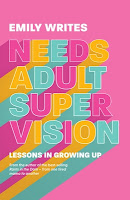
Needs Adult Supervision: Lessons in growing up by Emily Writes           $35
This book looks at the growing pains of kids and their parents and their attempts to navigate a world that's changing by the minute. Emily paints a vivid picture of all the feelings, fortunes and failures that come with trying to parent when you don't always feel up for the task. What it feels like to be learning at the same time your kids are. What happens when we get radically honest about the challenges parents are facing.  Funny, sad, thoughtful, inspiring and ultimately up-lifting for parents at all stages of life.
Cold the Night, Fast the Wolves by Meg Long          $26
A lone girl determined to survive. The feral wolf she must learn to trust. Only one chance to escape their icy planet: a race across the deadly tundra. Seventeen-year-old Sena Korhosen hates the sled race, especially after it claimed both her mothers' lives five years ago. Alone on her frozen planet, she makes money any other way she can--until she double-crosses a local gangster. Desperate to escape, Sena flees with his prized fighting wolf, Iska, and takes an offer from a team of scientists. They'll pay her way off-world, on one condition--that she uses the survival skills her mothers taught her to get them to the end of the race. But the tundra is a treacherous place. When the race threatens their lives at every turn, Sena must discover whether her abilities are enough to help them survive the wild, and whether she and Iska together are strong enough to get them all out alive. As the girl and the wolf forge a tenuous bond and fight to escape ice goblins, giant bears, and the ruthless gang leader intent on trapping them both, one question drives them relentlessly forward: Where do you turn when there is nowhere to hide?
The Enlightenment: The pursuit of happiness, 1680—1790 by Ritchie Robertson         $48
The Enlightenment is one of the formative periods of Western history, yet more than 300 years after it began, it remains controversial. It is often seen as the fountainhead of modern values such as human rights, religious toleration, freedom of thought and evidence-based argument. Others accuse the Enlightenment of putting forward a scientific rationality which ignores the complexity and variety of human beings. Answering the question 'what is Enlightenment?' Kant famously urged men and women above all to 'have the courage to use your own understanding'. Robertson shows how the thinkers of the Enlightenment did just that, seeking a rounded understanding of humanity in which reason was balanced with emotion and sensibility. His book goes behind the controversies about the Enlightenment to return to its original texts and to show that above all it sought to increase human happiness in this world. 
Blind Bay Hookers: The little ships of early Nelson, and colonial times by Fred Westrupp          $55
From 1841 to 1925, central New Zealand's Blind Bay (now Tasman Bay) was enlivened by the white sails of a 'mosquito fleet' plying local waters and beyond. The earliest of these seagoing little ships were often built from the bush, some only about 30 feet in length. All were able to 'take the mud' to discharge and load on beaches and in estuaries. For the pioneer settlers, struggling to cope in difficult terrain, these little ships were their lifeline. Embedded within this meticulously researched book is the social and economic colonial history of central New Zealand, viewed from the perspective of the working-class seafarers who owned and operated vessels in the trading fleet. Updated edition. 
Football by Mark Yakich           $23

When is the "beautiful game" at its most beautiful? How does football function as a lens through which so many view their daily lives? What's right in front of fans that they never see? Football celebrates and scrutinizes the world's most popular sport-from top-tier professionals to children just learning the game. As an American who began playing football in the 1970s as it gained a foothold in the States, Mark Yakich reflects on his own experiences alongside the sport's social and political implications, its narrative and documentary depictions, and its linguistic idiosyncrasies. Illustrating how football can be at once absolutely vital and only a game, this book will be surprising and insightful for the casual and diehard fan alike.
>>Other 'Object Lessons'.

The Cold Inside: A story of mountains, friendship, and doubt by Paul Hersey         $35
Mountains may inspire or repel. For climbers, they offer an opportunity for extreme adventure, as well as elusive, precious moments of feeling truly alive. The Cold Inside takes an intimate look at what it takes to climb. With a unique focus on New Zealand’s breathtaking, unparalleled landscape, seasoned mountaineer and award-winning author Paul Hersey is profoundly introspective, and his passion for his crafts — storytelling and climbing — is evident from the first pages. A mix of adventure narrative, prose, and memoir, this book explores the psyche of climbers. It’s as much an unflinching recount of risk and loss as it is a love letter to nature, both facets heightened through the deep connection that climbing provides. 
“Part mountaineering adventure, part meditation on the meaning of mountain climbing, Paul Hersey explores ways in which being among mountains can guide us towards a better understanding of ourselves. Drawing on decades of experience, Paul goes beyond simply asking ‘Why do I climb?’ to address issues of self-belief and doubt, teamwork and individualism, emotional wellbeing and pressure to succeed.” —Laurence Fearnley
Chess for Children by Sabrina Chevannes           $20
A new edition of this international chess classic, with all-new illustrations. Aimed at children aged 7 and up, this appealing book is a complete guide to chess for those starting out in the game. In straightforward, animated language, Jess and Jamie explain everything you need to know, from first sitting down at the board to sneaky tricks to help you beat your opponents. The book explains who the pieces are and how they move, how to reach checkmate (or, in Jess's words, 'how to kill the king'), and the concept of the opening, middlegame and endgame. It also introduces the idea of chess etiquette — and explains why sometimes no one wins and a game ends in stalemate. Friendly and fun. Recommended. 


VOLUME BooksNew releases

Book of the Week. Alan Garner's TREACLE WALKER is a spare and moving story of a lonely boy who strikes up a friendship with a wandering rag-and-bone man who opens his eyes to new depths of experience. Melding myth, folklore and quantum physics, Treacle Walker is a novel about the acquisition of human depth, and an exploration of the possibilities and limitations of our understanding of time (“time is ignorance.” —Carlo Rovelli).
"Treacle Walker crams into its 150-odd pages more ideas and imagination than most authors manage in their whole careers." —Alex Preston, The Guardian
>>Where did all the children go?
>>Blackden and beyond
>>Myth meets modern science. 
>>Knowing your place
>>"You don't want to have a brilliant idea for a novel at the age of 87.
>>"Age, in itself, is irrelevant."
>>Read an extract
>>Short-listed for the 2022 Booker Prize


VOLUME BooksBook of the week


>> Read all Stella's reviews.


Sea of Tranquility by Emily St. John Mandel  {Reviewed by STELLA}
Emily St John Mandel’s Sea of Tranquility is a book to be lost in. It’s a book about time, living and loving. Superbly constructed, it stretches from 1912 to 2401; from the wildness of Vancouver to a moon colony of the future. A remittance man, Edwin St.John St.Andrew, is sent abroad. He’s completely at sea in this new world — he has no appetite for work nor connection — and makes a haphazard journey to a remote settlement on a whim. Here, he has an odd experience which leaves him shaken. He will return to England only to find himself derailed in the trenches of the First World War and later struck down by the flu pandemic. It’s 2020 and Mirella (some readers will remember her from The Glass Hotel) is searching for her friend Vincent (who has disappeared). She attends a concert by Vincent’s brother Paul and afterwards waits for him to appear, along with two music fans at the backstage door. It’s here, on the eve of our current pandemic, that she discovers that Vincent has drowned at sea. Yet it is an art video that Vincent had recorded and been used in Paul’s performance which is at the centre of the conversation for one of the music fans. The film is odd — recounting an unworldly experience in the Vancouver forest. A short clip — erratic and strangely out of place, out of time. It’s 2203 and Olive Llewellyn, author, is on a book tour of Earth. She lives on Moon Colony Two and is feeling bereft — missing her husband and daughter. It’s a gruelling schedule of talks, interviews and same-same hotel rooms; and, if this wasn’t enough, there’s a new virus on the loose. Her bestselling book, Marienbad is about a pandemic. Within its pages is a description of a strange occurrence which takes place in a railway station. When an interviewer questions her about this passage, she’s happy to talk about it, as long it is off the record. It’s 2401, and detective Gaspery-Jacques Roberts from the Night City has been hired to investigate an anomaly in time. Drawing on his experiences and the book, Marienbad, and finding connections between the aforementioned times and people, will lead him to a place where he will make a decision that may have disruptive consequences. A decision which will cause upheaval. Emily St.John Mandel is deft in her writing, keeping the threads of time and the story moving across and around themselves without losing the reader, and making the knots — the connections — at just the right time to engage and delight intellect and curiosity. Moving through time and into the future makes this novel an unlikely contender to be a book of our time, but in so many ways it is. Clever, fascinating, reflective and unsettling, it’s a tender shout-out to humanity. 
VOLUME BooksReview by Stella


 >> Read all Thomas's reviews. 


The Years by Annie Ernaux   {Reviewed by THOMAS}

“She will go within herself only to retrieve the world,” writes Annie Ernaux in this astounding work of what she terms “impersonal autobiography”. Conspicuously not a memoir, unless it is a memoir of time itself, the book takes the form of a ‘flat’, rigorous and unsentimental serial accumulation of moments that would otherwise be lost from human experience, moments shorn of interpretation or context, impressions that the author has resisted the expectation to turn into a narrative. Thus preserved in the nearest possible state to experience, the memories retain the power of memories without being condensed into fact, they retain the power to resonate in the reader in the way in which the reader's own memories resonate. Although the memories are often very personal and specific, covering every detail of Ernaux’s life from childhood to old age, Ernaux never presents them as belonging to an ‘I’, always to a ‘she’ or a ‘we’. She does not presume a continuity of self other than the self that exists in the moment of experience, a moment that will continue until that memory is extinguished. The distancing of the memory from the ‘I’, the clipping free of the experience from its subject, the creation of a text that is at once impersonal and personal, becomes a machine for the conversion of the particular into the universal, or, rather, for erasing the distinction between the two. “By retrieving the collective memory in an individual memory, she will capture the lived dimension of History.” At the moment that Ernaux severs her attachment from the memories that she records, she saves them from plausible extinction, she makes them the memories of others. When such responses are awakened in the reader, the reader becomes the rememberer (the rememberer in this case of living in France between 1941 and 2006). Any emotional response comes from the reader’s experience, not the author’s, or, rather, from the collective human experience that includes both reader and author. There are separate narratives, or separate modes, for what one remembers and what one knows to have happened. What is the relationship between these two kinds of memory? “Between what happens in the world and what happens to her, there is no point of convergence. They are two parallel series: one abstract, all information no sooner received than forgotten, the other all static shots,” she writes. As Ernaux reaches old age, witnessing a series of “burials that foreshadow her own,” she casts back from an imperative somewhere beyond her death, recording the rush of memory towards its ultimate forgetting. “All the images will disappear. They will vanish all at the same time, like the images that lay hidden behind the foreheads of the grandparents, dead for half a century, and of the parents, also dead. Thousands of words will suddenly be deleted the ones that were used to name things, faces, acts and feelings, to put the world in order. Everything will be erased in a second, the dictionary of words amassed between cradle and deathbed, eliminated.” But it is not only death that can extinguish memory: “The future is replaced by a sense of urgency that torments her. She is afraid that her memory will become cloudy and silent. Maybe one day all things and their names will slip out of alignment and she’ll no longer be able to put names to reality. All that will remain is the reality that cannot be spoken. Now’s the time to give form to her future absence through writing.” Her book is an attempt to “save something from the time where we will never be again.” By her method of conjuring and recording the raw material of her life, Ernaux “finds something that the image from her personal memory doesn’t give her on its own: a kind of vast collective sensation that takes her consciousness, her entire being, into itself.” The passage of time is made tangible, subjects are dissolved in their experiences, the intimate is revealed as the universal, moments are, in the act of writing, both held and relinquished.
VOLUME BooksReview by Thomas

 NEW RELEASES

Treacle Walker by Alan Garner           $25
"When Treacle Walker appears off the Cheshire moor one day – a wanderer, a healer – an unlikely friendship is forged and the young boy is introduced to a world he could never have imagined. Treacle Walker is a stunning fusion of myth and folklore, an exploration of the fluidity of time, a mysterious, beautifully written and affecting glimpse into the deep work of being human. Treacle Walker confronts the issues that anyone who ever lived has had to confront. The transition out of childhood. The transition into old age. The gaining and loss of personal agency. What we can expect to know about the world – and our life in it – and what we can’t; and how we face up to that. One of the central themes of the book is how – and from whom – we get our knowledge: that would seem to be a very important question, given the information environment in which people now live. Alan Garner’s novel draws you relentlessly into its echoing metaphysical and emotional space." —judges' citation
Short-listed for the 2022 Booker Prize
"Treacle Walker crams into its 150-odd pages more ideas and imagination than most authors manage in their whole careers." —Alex Preston, The Guardian

Lessons by Ian McEwan          $37
When the world is still counting the cost of the Second World War and the Iron Curtain has closed, eleven-year-old Roland Baines's life is turned upside down. 2,000 miles from his mother's protective love, stranded at an unusual boarding school, his vulnerability attracts piano teacher Miss Miriam Cornell, leaving scars as well as a memory of love that will never fade. As an adult, when his wife vanishes, leaving him alone with his tiny son, Roland is forced to confront the reality of his restless existence. As the radiation from Chernobyl spreads across Europe, he begins a search for answers that looks deep into his family history and will last for the rest of his life.
"Lessons marks a significant new phase in McEwan's already astonishingly productive career — and may well be remembered as one of the finest humanist novels of its age." —New Statesman
"The author has woven multiple versions of himself into his 500-page masterpiece." —The Times
Getting Lost by Annie Ernaux (translated by Alison L. Strayer)          $38
Getting Lost is the diary kept by Annie Ernaux during the year and a half she had a secret love affair with a younger, married man, an attaché to the Soviet embassy in Paris. Her novel, Simple Passion, was based on this affair, but here her writing is immediate and unfiltered. In these diaries it is 1989 and Annie is divorced with two grown sons, living in the suburbs of Paris and nearing fifty. Her lover escapes the city to see her there and Ernaux seems to survive only in expectation of these encounters. She cannot write, she trudges distractedly through her various other commitments in the world, she awaits his next call; she lives merely to feel desire and for the next rendezvous. When he is gone and the moment of desire has faded, she feels that she is a step closer to death. Celebrated for her spare prose, Ernaux here removes all artifice, her writing pared down to its most naked and vulnerable. 
"Annie Ernaux is one of my favourite contemporary writers, original and true. Always after reading one of her books, I walk around in her world for months." —Sheila Heti
"Annie Ernaux writes memoir with such generosity and vulnerable power that I find it difficult to separate my own memories from hers long after I’ve finished reading." —Catherine Lacey
>>Read Thomas's reviews of The Years and Exteriors
Stone Blind: Medusa's story by Natalie Haynes        $40
Medusa is the only mortal in a family of gods. Growing up with her sisters, she quickly realizes that she is the only one who gets older, experiences change, feels weakness. Her mortal lifespan gives her an urgency that her family will never know. When the sea god, Poseidon, commits an unforgivable act in her sacred temple the goddess, Athene, takes her revenge on an innocent — and Medusa's life is changed forever. Appalled by her own reflection: snakes have replaced her hair and she realises that her gaze can now turn any living creature to stone. Medusa can no longer look upon anyone she loves without destroying them, and so condemns herself to a life lived in shadow and solitude to limit her murderous rage. That is, until Perseus embarks upon a fateful quest to fetch the head of a Gorgon. From the author of A Thousand Ships.
"Brilliant and compellingly readable." —Guardian
All the Broken Places by John Boyne        $37
1946. Three years after a cataclysmic event which tore their lives apart, a mother and daughter flee Poland for Paris, shame and fear at their heels, not knowing how hard it is to escape your past. Nearly eighty years later, Gretel Fernsby lives a life that is a far cry from her traumatic childhood. When a couple moves into the flat below her in her London mansion block, it should be nothing more than a momentary inconvenience. However, the appearance of their nine-year-old son Henry brings back memories she would rather forget. One night, she witnesses a violent argument between Henry's mother and his domineering father, one that threatens Gretel's hard-won, self-contained existence. Gretel is faced with a chance to expiate her guilt, grief and remorse and act to save a young boy — for the second time in her life. But to do so, she will be forced to reveal her true identity to the world. Will she make a different choice this time, whatever the cost to herself? Boyne's insightful new novel follows the life of Gretel from The Boy in Striped Pyjamas, and shows how the experiences of childhood are very difficult to escape in adulthood. 
"Compulsively readable." —Irish Independent
Tripticks by Ann Quin                                      $33
First published in 1972, Ann Quin's fourth and final novel was a radical break from the introspective style she had developed in Three and Passages : a declaration of independence from all expectations. Brashly experimental, ribald, and hilarious, Tripticks maps new territories for the novel. Splattering its pages with the story of a man being chased across a nightmarish America by his 'first X-wife', and her 'schoolboy gigolo', Tripticks was ground zero for the collision of punk energy with high style.
"Quin's spare prose line—delphic, obscure and hauntingly suggestive-—creates a comparably vertiginous kind of enchantment. To submit to this unique book's spell is to experience, in language, a 'fantastic dance of images, shapes, forms'." —Sam Sack, Wall Street Journal
"Quin works over a small area with the finest of tools. Every page, every word gives evidence of her care and workmanship." —New York Times
"I suspect that Ann Quin will eventually be viewed, alongside B. S. Johnson and Alexander Trocchi, as one of the few mid-century British novelists who actually, in the long term, matter." —Tom McCarthy
"Rare enough is a book that begins by stating its intention--rarer still one that proceeds to do seemingly everything it can to avoid following the path its intention has laid." —Danielle Dutton
>>Read Thomas's review of Three
Super-Infinite: The transformations of John Donne by Katherine Rundell          $40
Sometime religious outsider and social disaster, sometime celebrity preacher and establishment darling, John Donne was incapable of being just one thing. In his myriad lives he was a scholar of law, a sea adventurer, a priest, an MP — and perhaps the greatest love poet in the history of the English language. Along the way he converted from Catholicism to Protestantism, was imprisoned for marrying a sixteen-year old girl without her father's consent; struggled to feed a family of ten children; and was often ill and in pain. He was a man who suffered from black surges of misery, yet expressed in his verse many breathtaking impressions of electric joy and love.
"To read Donne is to grapple with a vision of the eternal that is startlingly reinvented in the here and now, and Rundell captures this vision alive in all its power, eloquence and strangeness." —Guardian
Homesick by Jennifer Croft            $36
Sisters Amy and Zoe grow up in Oklahoma where they are homeschooled for an unexpected reason: Zoe suffers from debilitating and mysterious seizures, spending her childhood in hospitals as she undergoes surgeries. Meanwhile, Amy flourishes intellectually, showing an innate ability to glean a world beyond the troubles in her home life, exploring that world through languages first. Amy's first love appears in the form of her Russian tutor Sasha, but when she enters university at the age of 15 her life changes drastically and with tragic results. The renowned translator's first novel is based on her own life. 
“Jennifer Croft writes with an extraordinary intensity that ensures this exceptional Bildungsroman will stay etched in the reader’s mind for a very long time to come.”  —Olga Tokarczuk
"Stunning and surprising." —New York Times
"A tribute to the deep bond of sisterhood: how, over years navigating life, it stretches apart and snaps back." —The Scotsman
Malarkoi by Alex Pheby             $45
The jaw-dropping sequel to the remarkable fantasy Mordew. Nathan Treeves is dead, murdered by the Master of Mordew, his remains used to create the powerful occult weapon known as the Tinderbox. His companions are scattered, making for Malarkoi, the city of the Mistress, the Master's enemy. They are hoping to find welcome there, or at least safety. They find neither — and instead become embroiled in a life and death struggle against assassins, demi-gods, and the cunning plans of the Mistress. Only Sirius, Nathan's faithful magical dog, has not forgotten the boy, and, bent on revenge, he returns to the shattered remains of Mordew, newly deformed into an impossible mountain, swarming with monsters. He senses something in the Manse at its pinnacle — the Master is there, grieving the loss of his manservant, Bellows — and in the ruins of the slums he finds a power capable of destroying his foe, if only he has the strength to use it. 
Orlam by P.J. Harvey            $45
Nine-year-old Ira-Abel Rawles lives on Hook Farm in the village of Underwhelem. Next to the farm is Gore Woods, Ira's sanctuary, overseen by Orlam, the all-seeing lamb's eyeball who is Ira-Abel's guardian and protector. Here, drawing on the rituals, children's songs, chants and superstitions of the rural West Country of England, Ira-Abel creates the twin realm through which she can make sense of an increasingly confusing and frightening world. Orlam follows Ira and the inhabitants of Underwhelem month by month through the last year of her childhood innocence. P.J. Harvey's poem sequence is the first book published in the Dorset dialect for several decades. 
High: A journey across the Himalayas through Pakistan, India, Bhutan, Nepal and China by Erika Fatland          $40
The Himalayas meander through five very different countries, where the world religions of Islam, Buddhism and Hinduism are mixed with ancient shamanic religions. Countless languages and vastly different cultures live in the secluded mountain valleys. Modernity and tradition collide, while the great powers fight for influence. We have read about mountain climbers on their way up Mount Everest and about travellers on the spiritual quest for Buddhist monasteries. But how much do we know about the people living in the Himalaya? Fatland invites us into close encounters with the many peoples of the region, and at the same time takes us on a dizzying journey at altitude through incredible landscapes and dramatic, unknown world histories - all the way to the most volatile human conflicts of our times.
Michael Rosen's Sticky McStickstick: The friend who helped me walk again by Michael Rosen, illustrated by Tony Ross           $19
After almost dying and spending over a month in an induced coma after being admitted to hospital with coronavirus, Michael Rosen had to learn to walk again. With the support of doctors and nurses and a walking stick he named 'Sticky McStickstick', he managed to embark on the slow steps to recovery. A moving picture book about the importance of persistence, support, and caring about and for others.
The Light in the Darkness: Black holes, the universe and us by Heino Falcke and Jorg Romer        $28
10th April 2019: a global sensation. Heino Falcke, a person "working at the boundaries of his discipline and therefore at the limits of the universe" had used a network of telescopes spanning the entire planet to take the first picture of a black hole. Light in the Darkness examines how mankind has always looked to the skies, mapping the journey from millennia ago when we turned our gaze to the heavens, to modern astrophysics. Falcke and Romer chart the breakthrough research of the team, an unprecedented global community of international colleagues developing a telescope complex enough to look directly into a black hole — a hole where light vanishes, and time stops.
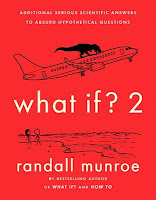
What If? 2: Additional serious scientific answers to absurd hypothetical questions by Randall Munroe          $35
WHAT IF... one person decided to answer all the unanswerable questions, using science? Randall Munroe is here to provide the best answers yet to the important questions you probably never thought to ask. The  people around the world who read and loved What If? still have questions, and those questions are getting stranger. Planning to ride a fire pole from the moon back to Earth? The hardest part is sticking the landing. Hoping to cool the atmosphere by opening everyone's freezer doors at the same time? Maybe it's time for a brief introduction to thermodynamics. Want to know what would happen if you rode a helicopter blade, built a billion-storey building, made a lava lamp out of lava, or jumped on a geyser as it erupted? Read Munroe's advice before you try these things yourself.
Planta Sapiens: Unmasking plant intelligence by Paco Calvo and Natalie Lawrence          $40
What is it like to be a plant? It's not a question we might think to contemplate, even though many of us live surrounded by plants. Science has long explored the wonderful ways in which plants communicate, behave and shape their environments: from chemical warfare to turning their predators to cannibalism. But they're nevertheless often just the backdrop to our frenetic animal lives. While plants may not have brains or move around as we do, cutting-edge science is revealing that they have astonishing inner worlds of an alternate kind to ours. They can plan ahead, learn, recognise their relatives, assess risks and make decisions. They can even be put to sleep. Innovative new tools might allow us to actually see them do these things — from electrophysiological recordings to MRI and PET scans. Calvo challenges us to make an imaginative leap into a world that is so close and yet so alien. It is one that will expand our understanding of our own minds.
The Bullet that Missed ('Thursday Murder Club' #3) by Richard Osman           $37
It is an ordinary Thursday and things should finally be returning to normal. Except trouble is never far away where the Thursday Murder Club is concerned. A decade-old cold case leads them to a local news legend and a murder with no body and no answers. Then, a new foe pays Elizabeth a visit. Her mission? Kill . . . or be killed. As the cold case turns white hot, Elizabeth wrestles with her conscience (and a gun), while Joyce, Ron and Ibrahim chase down clues with help from old friends and new. But can the gang solve the mystery and save Elizabeth before the murderer strikes again?

African Europeans: An untold history by Olivette Otele          $30
Otele uncovers the untold history of Europeans of African descent, from Saint Maurice who became the leader of a Roman legion and Renaissance scholar Juan Latino, to abolitionist Mary Prince and the activist, scholars and grime artists of the present day. Tracing African European heritage through the complex, and often brutal experiences of individuals both ordinary and extraordinary, she sheds new light not only on the past but also on questions very much alive today — about racism, identity, citizenship, power and resilience. African Europeans is a landmark celebration of this integral, vibrantly complex slice of European history, and will redefine the field for years to come.
"This is a book I have been waiting for my whole life. It goes beyond the numerous individual black people in Europe over millennia, to show us the history of the very ideas of blackness, community and identity on the continent that has forgotten its own past. A necessary and exciting read." —Afua Hirsch
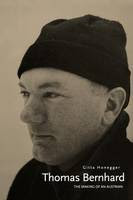
Thomas Bernhard by Gitta Honegger           $57
Bernhard's writings and indeed his own biography reflect Austria's fraught efforts to define itself as a nation following the collapse of the Habsburg monarchy and the trauma of World War II. His novels, plays, and public statements exposed the convoluted ways Austrians were attempting to come to terms with their Nazi past—or defiantly avoiding doing so. While Bernhard was the scourge of his native culture, Honegger explains, he was also a product of that same culture. 
>>Read Thomas's reviews of some of Bernhard's novels. 


VOLUME BooksNew releases


The 2022 BOOKER PRIZE
Short List

What do the judges think of the books? 

Order your reading now and tell us what you think.
The winner will be announced on 17 October.

The Seven Moons of Maali Almeida by Shehan Karunatilaka          $40
"Colombo, 1990: Maali Almeida is dead, and he’s as confused about how and why as you are. A Sri Lankan whodunnit and a race against time, Seven Moons is full of ghosts, gags and a deep humanity. The voice of the novel – a first-person narrative rendered, with an astonishingly light touch, in the second person – is unforgettable: beguiling, unsentimental, by turns tender and angry and always unsparingly droll. This is Sri Lankan history as whodunnit, thriller, and existential fable teeming with the bolshiest of spirits. ‘You have one response for those who believe Colombo to be overcrowded: wait till you see it with ghosts.’ This is a deeply humane novel about how to live in intolerable circumstances, about whether change is possible, and how to set about coping if it’s not."

Treacle Walker by Alan Garner           $25
"When Treacle Walker appears off the Cheshire moor one day – a wanderer, a healer – an unlikely friendship is forged and the young boy is introduced to a world he could never have imagined. Treacle Walker is a stunning fusion of myth and folklore, an exploration of the fluidity of time, a mysterious, beautifully written and affecting glimpse into the deep work of being human. Treacle Walker confronts the issues that anyone who ever lived has had to confront. The transition out of childhood. The transition into old age. The gaining and loss of personal agency. What we can expect to know about the world – and our life in it – and what we can’t; and how we face up to that. One of the central themes of the book is how – and from whom – we get our knowledge: that would seem to be a very important question, given the information environment in which people now live. Alan Garner’s novel draws you relentlessly into its echoing metaphysical and emotional space."
Small Things Like These by Claire Keegan         $29
"Keegan is measured and merciless as she dissects the silent acquiescence of a 1980s Irish town in the Church’s cruel treatment of unmarried mothers – and the cost of one man’s moral courage. It is the tale, simply told, of one ordinary middle-aged man – Bill Furlong – who in December 1985, in a small Irish town, slowly grasps the enormity of the local convent’s heartless treatment of unmarried mothers and their babies (one instance of what will soon be exposed as the scandal of the Magdalene laundries). We accompany Furlong, and we feel – and fear – for him as he realises what is happening, decides how he must in conscience act, and accepts what that action, in a small church-dominated town, will cost him, his wife and his children. The book is not so much about the nature of evil as the circumstances that allow it. More than Furlong’s quiet heroism, it explores the silent, self-interested complicity of a whole community, which makes it possible for such cruelty to persist. It forces every reader to ask what they are doing about the injustices that we choose not to think about too closely."
The Trees by Percival Everett        $34
"Part southern noir, part something else entirely, The Trees is a dance of death with jokes – horrifying and howlingly funny – that asks questions about history and justice and allows not a single easy answer. The Trees is a mash-up of genres – murder mystery, southern noir, horror, slapstick comedy – handled with such skill that it becomes a medieval morality play spun through 20th-century pop culture to say something profound and urgent about the present moment. It’s an irresistible page-turner, hurtling headlong with swagger, humour, relish and rage. Everything about The Trees is relevant to today’s world. Everett looks at race in America with an unblinking eye, asking what it is to be haunted by history, and what it could or should mean to rise up in search of justice. Everything between the horror of the first murder scene and the last sentence is an adrenaline rush."
Oh William! by Elizabeth Strout         $24
"Oh William! is one of those quietly radiant books that finds the deepest mysteries in the simplest things. Strout’s gentle reflections on marriage, family, love and loneliness are utterly piercing. Has there ever been a character quite like Lucy Barton? Unassuming and yet profound, entirely ordinary and yet deeply moving. A woman in her later life, full of doubt and regret, Lucy’s reflections illuminate the reader, too. Strout’s writing is steeped in compassion for human beings, damaged and disappointed, full of follies and frailties, but capable, too, of deep understanding. Lucy Barton is an older woman, divorced, with grown-up children, and yet still coming to terms with her own childhood and learning how little she has understood the people closest to her. Strout writes her with a capacious empathy and probing insight."
Glory by NoViolet Bulawayo            $37
"A magical crossing of the African continent with its political excesses and its wacky characters. Here, the fable is never far from the reality. NoViolet Bulawayo describes her characters will make you think that there are no boundaries between our world and the world of animals. Destiny has returned to Jidada from a long exile. She witnesses the tumult, the revolution in the country and how the women are fighting against the regime. She is the symbol of the young African women in the continent. The Old Horse — it inevitable to see behind him the despotic president of Zimbabwe, Robert Mugabe — has a strange cabinet: a Minister of the Revolution, a Minister of Things, a Minister of Nothing, and so on. This political satire goes beyond Zimbabwe and could relate to nations with despotic regimes around the world. It is also a book about feminism and power sharing."


VOLUME BooksBook lists


>> Read all Stella's reviews.


Looking, Writing, Reading, Looking edited by Georgi Gospodinov    {Reviewed by STELLA}
The place where words and art intersect is always interesting. In this collection, writers take on contemporary works at the Louisiana Museum of Modern Art in Denmark, and the results are various and wonderfully unexpected. These are not theory-heavy nor filled with art speak. They are critiques of a literary nature — personal responses through the observant eyes of each writer: the looking (and the looking again); and the thoughts, memories or ideas which spring from these observations. Here you will find writers you have read, others you have heard of (but maybe not encountered their writings) and some that haven’t crossed your radar yet. There are memoir pieces, poems, more direct descriptions and interpretations, fictional interviews or reportage, and creative short stories. The writing sometimes takes us further into the particular artwork. Other pieces edge us towards a deeper understanding of elements springing from the work, with cascading ideas that will lead you to future interpretations. Others reveal more about the writer, taking the reader into a more internal world with an experience revealed. Experiences that sit alongside their chosen artwork tell us something about them as well as the power of art to spark this exploration. What draws us to a particular artwork? Why does one painting or sculpture capture us — ask us to stop, to look, to read — while another will hardly leave an imprint: we will see, but merely glide by? Writers are keen observers and this writer/art project at the gallery is refreshing as it does not require us to ‘know’ or have some insider information about the objects, which are interacted with rather than described. Each artwork is photographed and sits alongside the written text, and each author has a portrait taken, in the same place, by the water’s edge, revealing something quite special about each. All 26 writers had been attendees at the museum’s writers’ festival. In this collection, Anne Carson cleverly pulls together an unofficial transcript (with notes) of contemporary philosophers on Ragnar Kjartansson’s 'Me and My Mother'. Colm Toibin explores 'La Double Face' of Asger Jorn with his assured and thoughtful considerations of all that can be held in a face — vulnerability, ambiguity and energy. Domenico Starnone introduces us to 'Museo del Prado 5' by photographer Thomas Struth, expounding on the meta meta nature of this painting/photography/writing exposure. Yoko Tawada quietly, in her storytelling style, asks us to contemplate the role of our lives while viewing Nobuo Sekine’s 'Phases of Nothingness'. Guadalupe Nettel reveals how the 'On Stone Sculptures' by Henry Heerup call to her with a delightful short essay that perfectly embraces the artist’s relationship with stone. And Delphine de Vigan, as she reencounters Louise Bourgeois’s 'Spider Couple', reminds us that our relationship with artworks change, our interpretations are sometimes unintentionally faulty (driven by a desire for an artwork to speak to us of our own experience), and the artist’s intention is not necessarily at the forefront of our understanding — and that is all fine! All the contributions have something to recommend them and there are sharp as well as emotional responses. An interesting collection (handsomely produced), worth having on your shelf for the writing and the selected artworks.
VOLUME BooksReview by Stella


 >> Read all Thomas's reviews. 


99 Interruptions by Charles Boyle   {Reviewed by THOMAS}
1.   I sit down to write a review of Charles Boyle’s 99 Interruptions, but I no sooner put finger to keyboard than I urgently need the right word to describe the book’s appealing smallness. Is it a duodecimo or a sextodecimo, I wonder. I count the leaves, check the binding, trawl the internet. This is an out-of-date question, I realise eventually, and not really an interesting question anyway.
2.   To any given task the potential interruptions are infinite, but they do seem to fall into two categories: interruptions with an external source (family members, a cat fight in the back garden, a caller from Porlock) and interruptions with an internal source (useless questions about book format, random alerts from some malfunctioning mental appointments calendar, concerns about the underlying cause of various pains, the endless rephrasing of an imperfect conversation). Not that I really think there is a distinction between an internal and an external, I don’t believe in either after all, but it helps to halve infinity sometimes. 
3.   I will just interrupt the practical demands of my life to read this book, I thought, but the practical demands of my life, so to call them and so to call it, repeatedly interrupt my reading, even though the book is short. Two sets of interruptions grapple with each other over my attention. There are perhaps only interruptions (and interruptions to the interruptions).
4.   Sometimes the interruptions come even before whatever it is that they interrupt, in which case they are perhaps not interruptions to that activity but interruptions to the preconditions of that activity, to the preparations that are I suppose themselves some sort of activity but not identifiable as any activity in particular. Is most of my life these days lived in this state of velleity? 
5.   The first time I sat down to read read this book, 99 Interruptions, I was interrupted by finding a surprising quotation on the first page I came to, and then by finding that I had to check the source and context of that quotation.
6.   Without interruptions there is no story, Boyle shows. The interruptions are the story. An interruption disrupts the natural tendency to oversimplification (which is indistinguishable from nonexistence). 
7.   An interruption is the assertion of the particular against the pull of the general and the abstract. It is the prime quality of fiction. 
8.   An interruption breaks a continuum and causes two realities to mingle. I frequently find this irritating but at least my irritation is real irritation.  
9.   Is the fragment the only authentic contemporary literary form?
10.   Boyle remarks that, although most fiction is written in the past tense, a reader or critic invariably relates the narrative as happening in the present, “as if everything … is still happening and there’s no end in sight.” I hadn’t thought about this before, and thinking about it now is interrupting my progress through the book. 
11.   Fiction interrupts time by the introduction of a completely other thread of time, allowing the reader to jump between the two as inclination or interruption dictates. Before it is anything else, fiction is a sin against time, an interruption or eruption.
12.   In most situations I tend to feel that my presence is an interruption of whatever would otherwise be the case. This is probably not a very healthy way to think, but I cannot find a way in which it is not true. 
13.   I am actually writing a review, if you can call it that, but I am interrupted by that little repeated stifled sound coming from the headphones that S is wearing so that I am not interrupted by the music she is listening to. I won’t interrupt what she is busy doing over there on account of this; it is about time I accepted that the membrane between writing and real life (so to call it) is always entirely permeable. No wonder I never get anything done. 
14.   Would it be possible to welcome every interruption into the work itself? To create a work entirely of interruptions? (Like Boyle’s!)
15.   Be that as it may (does this construction even make sense?), the work is ultimately interrupted by its deadline. 

VOLUME BooksReview by Thomas