NEW RELEASES

by Cheon Myeong-Kwan (translated by Chi-Young Kim)       $38
An adventure-satire of epic proportions, which sheds new light on the changes Korea experienced in its rapid transition from pre-modern to post-modern society. Set in a remote village in South Korea, Whale follows the lives of three linked characters: Geumbok, an extremely ambitious woman who has been chasing an indescribable thrill ever since she first saw a whale crest in the ocean; her mute daughter, Chunhui, who communicates with elephants; and a one-eyed woman who controls honeybees with a whistle. A fiction that brims with surprises and wicked humour, from one of the most original voices in South Korea.  
"A carnivalesque fairy tale that celebrates independence and enterprise, a picaresque quest through Korea’s landscapes and history, Whale is a riot of a book. Cheon Myeong-Kwan’s vivid characters are foolish but wise, awful but endearing, and always irrepressible. This is a hymn to restlessness and self-transformation." —judges' citation, 2023 International Booker Prize
 by Alice Vincent         $45
Women have always gardened, but their stories have so often been buried with their work. Alice Vincent explores what encourages women to go out, work the soil, plant seeds and nurture them, even when so many other responsibilities sit upon their shoulders. This book emerged from a deeply rooted desire to share the stories of women who are silenced and overlooked. In doing so, Alice fosters connections with gardeners that unfurl into a tender exploration of women's lives, their gardens and what the ground has offered them, with conversations (with Ali Smith, Hazel Gardiner, Cosey Fanni Tutti, and others) spanning creation and loss, celebration and grief, power, protest, identity and renaissance. 
"Alice Vincent has written something wonderful. Why Women Grow is a book that not only presents us with the beauty of the earth but asks one of the most fundamental questions to the human condition: what does it mean to create? I loved the way she wrote about the ambivalent power of the maternal question. I was delighted to travel around the country with her, digging into people's lives, private spaces and plants. We need more books about women, wombs and our role in the world; Alice has done that with charm, humour and an impressive depth of knowledge." —Nell Frizzell
Deranged As I Am by Ali Zamir (translated by Alice Banks)             $38
Set on the island of Anjouan, Comoros, Deranged As I Am follows the story of a humble dock worker. With his ramshackle cart and patched-up clothes, he spends his days trying to find enough work to feed himself. This whirlwind of a novel takes place over just a few days, yet Ali Zamir's poetic and energetic prose transports readers to the docks, its noises, colors, and smells. This lively and often darkly humorous story does not draw away from the more serious themes of class, poverty, and exploitation that Zamir explores. A rich and significant text that questions literature and language itself.
The South Island of New Zealand from the Road by Robin Morrison             $75
In 1979 the photographer Robin Morrison and his family spent seven months on the road in the South Island, where Morrison photographed people and places. The resulting book was published in 1981 by Alister Taylor and became an overnight success. Alas, conflict between Taylor and the printer, and the later loss of some images, meant it was never reprinted once it had sold out. It now has near legendary status and sells for hundreds of dollars in the used-book market. Now this groundbreaking book is back in a new edition. Morrison's original Kodachrome slides have been digitised using the latest technology, and his friend and fellow journalist Louise Callan has written a major essay on the book and its legacy, including assessments and recollections by Robin White, Laurence Aberhart, Grahame Sydney, Owen Marshall, Ron Brownson, Dick Frizzell, Alistair Guthrie and Sara McIntyre. 
The Birthday Party by Laurent Mauvignier (translated by Daniel Levin Becker)                $45
Buried deep in rural France, little remains of the isolated hamlet of the Three Lone Girls, save a few houses and a curiously assembled quartet: Patrice Bergogne, inheritor of his family’s farm; his wife, Marion; their daughter, Ida; and their neighbour, Christine, an artist. While Patrice plans a surprise for his wife’s fortieth birthday, inexplicable events start to disrupt the hamlet’s quiet existence: anonymous, menacing letters, an unfamiliar car rolling up the driveway. And as night falls, strangers stalk the houses, unleashing a nightmarish chain of events. Told in rhythmic, propulsive prose that weaves seamlessly from one consciousness to the next over the course of a day, The Birthday Party is a deft unravelling of the stories we hide from others and from ourselves, a gripping tale of the violent irruptions of the past into the present. 
"The Birthday Party is a strange and marvellous thing: a thriller in slow motion. The tension builds so patiently that you almost miss it, with the result that when shocking events occur it’s too late to turn away. This is a dark and discomfiting work of beauty and violence, made all the more disturbing by its idyllic setting." —Jon McGregor
"This impressive and fascinating book reconciles two primal feelings: empathy and dread. It is a very scary book, rooted in the traditions of horror. It is as scary as when we listened to stories about ogres and wolves as children." —judges' citation on listing the book for the 2023 International Booker Prize
by Sven Lindqvist            $45
Whatever your job is, it is part of a web of relations that affect other people, and the environment too. But how can you know the effects of your work? Who holds the power of the work that you do, and what do they use it for? Dig Where You Stand is a rallying cry for workers to become researchers, to follow the money, take on the role as experts on their job, and 'dig' out its hidden histories in order to take a vital step towards social and economic transformation. This how-to guide makes the case that everyone — not just academics — can learn how to critically and rigorously explore history, especially their own history, and in doing so find a blueprint for how to transform society for the better. In a world where the balance of power is overwhelmingly stacked against the working-class, Dig Where You Stand's manifesto for the empowerment of workers through self-education, historical research and political solidarity is urgent, important and relevant..
“This pioneering work is as relevant today as it was on first publication, as capital continues to unceasingly move around the world, desperate to avoid accountability for its disastrous social and environmental consequences.” —Ken Worple
"Lindqvist’s book shows with vivid clarity how capitalism permeates society, our homes, lungs, and children’s future. And yet, at the end, there is not despair and hopelessness but an empowering sense that things can and will be changed.” —Catharina Thörn
Chinatown by Thuận (translated by Nguyen An Ly)         $36

The Métro shudders to a halt: an unattended bag has been found. For the narrator, a Vietnamese woman teaching in the Parisian suburbs, a fantastical interior monologue begins, looking back to her childhood in early ‘80s Hanoi, university studies in Leningrad, and the travails and ironies of life in France as an immigrant and single mother. But most of all she thinks of Chinese-Vietnamese Thụy, who she married in the aftermath of the Sino-Vietnamese war, much to her parents’ disapproval, and whom she has not seen now for eleven years. The mystery around his disappearance feeds her memories, dreams and speculations, in which the idea of Saigon’s Chinatown looms large. There’s even a novel-in-progress, titled I’m Yellow, whose protagonist’s attempts to escape his circumstances mirror the author-narrator’s own. Interspersed with extracts from I’m Yellow, the narrator's book-length monologue is an attempt, at once desperate, ironic, and self-deprecating, to come to terms with the passions that haunts her.

by Peter Frankopan              $45
 Following his Silk Roads books, Frankopan turns his attention to our ancestors who, like us, worshipped, exploited and conserved the natural environment — and draws salutary conclusions about what the future may bring. In this book, Frankopan shows that engagement with the natural world and with climatic change and their effects on us are not new — exploring, for instance, how the development of religion and language and their relationships with the environment; tracing how growing demands for harvests resulted in the increased shipment of enslaved peoples; scrutinising how the desire to centralise agricultural surplus formed the origins of the bureaucratic state; and seeing how efforts to understand and manipulate the weather have a long and deep history. Understanding how past shifts in natural patterns have shaped history, and how our own species has shaped terrestrial, marine and atmospheric conditions is not just important but essential at a time of growing awareness of the severity of the climate crisis.
Stagioni: Modern Italian cooking to capture the seasons by Olivia Cavalli           $54
Stagioni, meaning 'seasons' in Italian, will take you on a journey through the culinary year with recipes for every craving and occasion. Chef and food writer Olivia Cavalli brings together traditional recipes and contemporary creations with an enthusiastic aim to put fruit and vegetables centre stage. From refreshing summer salads to steaming bowls of wintery pasta, you'll find classics such as aubergine parmigiana, stuffed tomatoes and amaretti peaches alongside more unusual combinations of chestnut gnocchi, grape focaccia and courgette cake. Nicely done. 
The Remains by Margo Glantz (translated by Ellen Jones)           $38
The way you hold a cello, the way light lands on a Caravaggio, the way the castrati hit notes like no one else could—a lifetime of conversations about art and music and history unfolds for Nora García as she and a crowd of friends and fans send off her recently deceased ex-husband, Juan. Like any good symphony, there are themes and repetitions and contrapuntal notes. We pingpong back and forth between Nora's life with Juan (a renowned pianist and composer, and just as accomplished a raconteur) and the present day (the presentness of the past), where she sits among his familiar things, next to his coffin, breathing in the particular mix of mildew and lilies that overwhelm this day and her thoughts. In Glantz's hands, music and art access our most intimate selves, illustrating and creating our identities, and offering us ways to express love and loss and bewilderment when words cannot suffice. As Nora says, "Life is an absurd wound: I think I deserve to be given condolences." Glantz fuses Yiddish literature, Mexican culture, and French tradition to create an experimental new work of literature.
"An erudite meditation on the link between mortality and the nature of art." —Publishers Weekly
"Reading Margo Glantz's virtuoso novel is like letting oneself go while listening to Glenn Gould interpret Mozart." —Ilan Stavans
Iris and Me by Philippa Werry          $25
In January 1938 Iris Wilkinson—better known by her pen name Robin Hyde— left New Zealand for England. On the way, intrigued by glimpses of China, she ventured inland despite the war raging there, becoming one of the first female war correspondent—a feat that was all the more remarkable because she struggled with mental health and suffered a disability that meant she had a lifelong limp. Her story—here presented in verse form—is narrated by a loyal but mysterious companion who asks the reader to guess their secret.


Arabesques by Anton Shammas (translated by Vivian Eden)          $46
Arabesques engages with history and politics not as propaganda but as literature. That engagement begins with the language in which the book is written: Anton Shammas, from a Palestinian Christian family and raised in Israel, wrote in Hebrew, as no Arab novelist had before. The choice was provocative to both Arab and Jewish readers. Arabesques (first published in 1988) is divided into two sections: 'The Tale' and 'The Teller'. 'The Tale' tells of several generations of family life in a rural village, of the interplay of past and present, of how memory intersects with history in a part of the world where different people have both lived together and struggled against each other for centuries. 'The Teller' is about the writer's voyage out of that world to Paris and the United States, as he comes into his vocation as a writer, and raises questions about the authority of the storyteller and the nature of the self. Shammas's tour de force is both a personal and a political narrative—a reinvention of the novel as a way of envisioning and responding to historical and cultural legacies and conflicts.
"Intricately conceived and beautifully written. A crisp, luminous, and nervy mixture of fantasy and autobiography and an elegant example of postmodern baroque." —John Updike, The New Yorker
"If Hebrew literature is at all destined to have its Conrads, Nabokovs, Becketts and Ionescos, it could not have hoped for a more auspicious beginning." —Muhammad Siddiq, Los Angeles Times 
How to Get Fired by Evana Belich             $37
Wry and astute, these linked short stories all deal with work in Aotearoa — how to get it, avoid it, or lose it. In 'BurgerKai', Mel is given a motivational talk on what she says is "failing at a stupid, screwed-up sales job, selling stupid plastic shelving". Her days at Pacific Wave Plastics are numbered. Meanwhile, in the next story, Vic bikes through Christchurch collecting mementoes from the houses she has lived in, while her ex-partner Emma makes the decision to move to Auckland to work at a plastics factory... And so the chain continues — characters walk from one story to the next, often oblivious to each other, perhaps related through colleagues, or having once attended the same school, or simply crossed paths on a beach that offers escape from work. Oblique connections unite them, as does their daily struggle to negotiate relationships while they try to survive employment, or avoid it, or face getting fired.
"Reading these stories was an utterly absorbing experience. Belich demonstrates insider knowledge of unions and working conditions in real peoples' everyday lives with a profound compassion that is never sentimental. Her characters are deeply observed as they thread their way in and out of loosely linked narratives. I was reminded of Elizabeth Strout's wonderful Olive Kitteridge. I kept catching my breath as I came across familiar detail presented with a fresh and loving eye; this is simply a must-read." —Fiona Kidman
Millions of people climb the grand marble staircase to visit the Metropolitan Museum of Art every year. But only a select few have unrestricted access to every nook and cranny. They're the guards who roam unobtrusively in dark blue suits, keeping a watchful eye on the two million square foot treasure house. Caught up in his glamorous fledgling career at The New Yorker, Patrick Bringley never thought he'd be one of them. Then his older brother died of cancer and he found himself needing to escape the mundane clamor of daily life. So he quit The New Yorker and sought solace in the most beautiful place he knew. To his surprise and the reader's delight, this temporary refuge becomes Bringley's home away from home for a decade. We follow him as he guards delicate treasures from Egypt to Rome, strolls the labyrinths beneath the galleries, wears out nine pairs of company shoes, and marvels at the beautiful works in his care. Bringley enters the museum as a ghost, silent and almost invisible, but soon finds his voice and his tribe—the artworks and their creators and the lively subculture of museum guards—a mosaic of artists, musicians, blue-collar stalwarts, immigrants, cutups, and dreamers. As his bonds with his colleagues and the art grow, he comes to understand how fortunate he is to be walled off in this little world, and how much it resembles the best aspects of the larger world to which he gradually, gratefully returns.
Stolen by Ann-Helen Laestadius          $37
Nine-year-old Elsa lives just north of the Arctic Circle. She and her family are Sami, Scandinavia's indigenous people and make their living herding reindeer. One morning when Elsa goes skiing alone, she witnesses a man brutally killing her reindeer calf, Nastegallu. Elsa recognises the man but refuses to tell anyone least of all the Swedish police force about what she saw. Instead, she carries her secret as a dark weight on her heart. Elsa comes of age fighting two wars- one within her community, where male elders expect young women to know their place; and against the ever-escalating wave of prejudice and violence against the Sami. When Elsa finds herself the target of the man who killed her reindeer calf all those years ago, something inside of her finally breaks. The guilt, fear, and anger she's been carrying since childhood come crashing over her like an avalanche, and will lead Elsa to a final catastrophic confrontation.
"Stolen is an extraordinary novel. A coming-of-age-story you'll get lost in, about youth and heritage and the never-ending struggle to be allowed to exist. Although set in the coldest and most northern part of Scandinavia, I'm convinced it's a universal story to be loved everywhere in the world." —Frederik Backman
The Hotel Witch by Jessica Miller          $21
Sometimes the simplest spells are the most powerful. Sibyl is the apprentice hotel witch at the splendid Grand Mirror Hotel. She is busy each day, under the watchful eye of her grandmother, drawing useful spell patterns to keep the hotel guests happy — spells to shine shoes, spells to make the pastry chef's cakes rise, spells to remove dust and spells to return lost things like hats and gloves to their owners. But Sibyl dreams of other possibilities-possibilities like her mother returning from the Black Mountains, and like Grandma letting her draw spell patterns from the Book of Advanced and Dangerous Magic. When Grandma gets stuck in last Tuesday, somewhere on the hotel's thirteenth floor, Sibyl must perform all the magic herself. Just when a very mysterious and perplexing problem arises and a very important guest must be taken care of. With the help of her friend Ahmed, the lift attendant, an aloof cat called Alfonso and Dora the concierge, Sibyl must solve the mystery of the missing shadows and find the right spell pattern to get them back. Will she open the Book of Advanced and Dangerous Magic? And will it contain the answers she needs?


>> Read all Stella's reviews.


Up the Mountain by Marianne Dubuc     {Reviewed by STELLA} 

Marianne Dubuc’s children’s books are delightful: wonderful stories, excellent characters, humour as well as heart; and charming illustrations, where there is always more to find on the page. You may already have The Lion and the Bird on your shelf, or gifted the excellent 'Mr Postmouse' titles. Up the Mountain is another to add to your or a child’s collection. Mrs Badger every Sunday heads outdoors and walks up the mountain. She loves walking through the fields, past the apple trees, across the streams and climbing higher and higher. To get to the top, to see the world, is for her the best place to be. On the way, she greets her friends — various animals that live on the mountain and in the trees. One day, a shy cat, Leo, is watching her. Leo thinks he is too small to climb the mountain, but, with some encouragement and help from Mrs Badger (and a few rests along the way) and a dose of curiosity about what’s at the top, he makes it. After that, every Sunday Leo joins his friend Mrs Badger, and they enjoy the wonders of the mountain, both the journey and the destination. As the days go by, Mrs Badger is the one who needs the rest and encouragement, until one day it’s just Leo venturing out and then returning to Mrs Badger’s house with stories and treasures. Eventually, Mrs Badger’s mountain becomes Leo’s mountain and the cycle of discovery and wonder continues. This is a charming story about friendship, and aging; about sharing and curiosity — a story of looking out at the world with wonder and care. This edition is translated and published by the excellent children’s press Book Island.

>>Some other Book Island titles


 >> Read all Thomas's reviews. 


In the Dark Room by Brian Dillon   {Reviewed by THOMAS}
Unless we are wrested by a pervasive trauma from the entire set of circumstances which constitute our identities, which are always contextual rather than intrinsic, our memories are never kept solely within the urns of our minds, so to call them, but are frequently prodded, stimulated and remade by elements beyond ourselves, or, indeed, are outsourced to these elements. Brian Dillon’s In the Dark Room is thoughtful examination of the way in which his memories of his parents, who both died as he was making the transition into adulthood, are enacted through the interplay of interior and exterior elements (the book is divided into sections: ‘House’, ‘Things’, ‘Photographs’, ‘Bodies’, ‘Places’). It is the physical world, rather than time, that is the armature of memory: time, or at least our experience of it, is contained in space, is, for us, an aspect of space, of physical extension, of objects. It is through objects that the past reaches forward and grasps at the present. And it is through the dialogue with objects that we call memory that these objects lose their autonomy and become mementoes, bearers of knowledge on our behalf or in our stead. Memory both provides access to and enacts our exclusion from the spaces of the past to which it is bound. In many ways, when the relationship between the object and the memory seem closest, this relationship is most fraught. Photographs, which Dillon describes as “a membrane between ourselves and the world,” are not so much representations as obscurations of their subjects. The subjects of photographs both inhabit an immediate moment and are secured by them in the “debilitating distance” of an uninhabitable past. When Dillon is looking at a photograph of his mother, “the  feeling that she was manifestly present but just out of reach was distinctly painful. … Photography and the proximity of death tear the face from its home and memory and set it adrift in time.” All photographs (and, indeed, all associative objects) are moments removed from time and so are equivalents, contesting with interior memories to be definitive. Photographs, even more than other objects, but other objects also, are mechanisms of avoidance and substitution as much as they are mechanisms of preservation. Memory, illness, death all distort our experience of time, but so does actual experience, and it is this distortion that generates memory, that imprints the physical with experience “spreading itself everywhere like a disease of the retina” (in the words of George Eliot). Intense experience, especially traumatic experience, death, illness, loss, violence, occlude the normal functions of memory and push us towards the edges of consciousness, touching oblivion as they also imprison us in the actual. As Dillon found, if experience cannot be experienced all at once, the context of the experience can bear us through, but it must be revisited in memory, repeatedly, until the experience is complete, if this is ever possible. Memory will often co-opt elements of surroundings to complete itself, and, especially if associative objects are not present, it will magnify its trauma upon unfamiliar contexts, increasing the separation and isolation it also seeks to overcome. Must the past be faced as directly as possible so that we may at last turn away from it? 

>>Brian Dillon's new book, 
Affinities, is available now


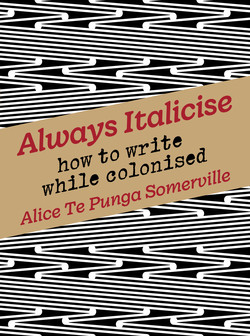
Book of the WeekAlways Italicise: How to write while colonised by Alice Te Punga Somerville       

"Always italicise foreign words," a friend of the author was advised. In her first book of poetry, Māori scholar and poet Alice Te Punga Somerville does just that. In wit and anger, sadness and aroha, she reflects on how to write in English as a Māori writer, and how to trace links between Aotearoa and wider Pacific, Indigenous and colonial worlds.

>>Always Italicise has been short-listed for the Mary and Peter Biggs Award for Poetry at the 2023 Ockham New Zealand Book awards
>>Writing while colonised
>>English has broken my heart.
>>English has broken my heart on the radio
>>Two Hundred and Fifty Ways to Start an Essay About Captain Cook.
>>Our stories about Cook.
>>(Not quite) 250 ways.
>>250 ways.
>>Writing the new world.
>>Interconnections.
>>Te Punga Somerville wrote a standout essay in Ngā Kete Mātauranga.
>>Environment and identity. 
>>Challenging stories. 
>>A bibliography of writing by Māori in English.
>>Your copy of Always Italicise


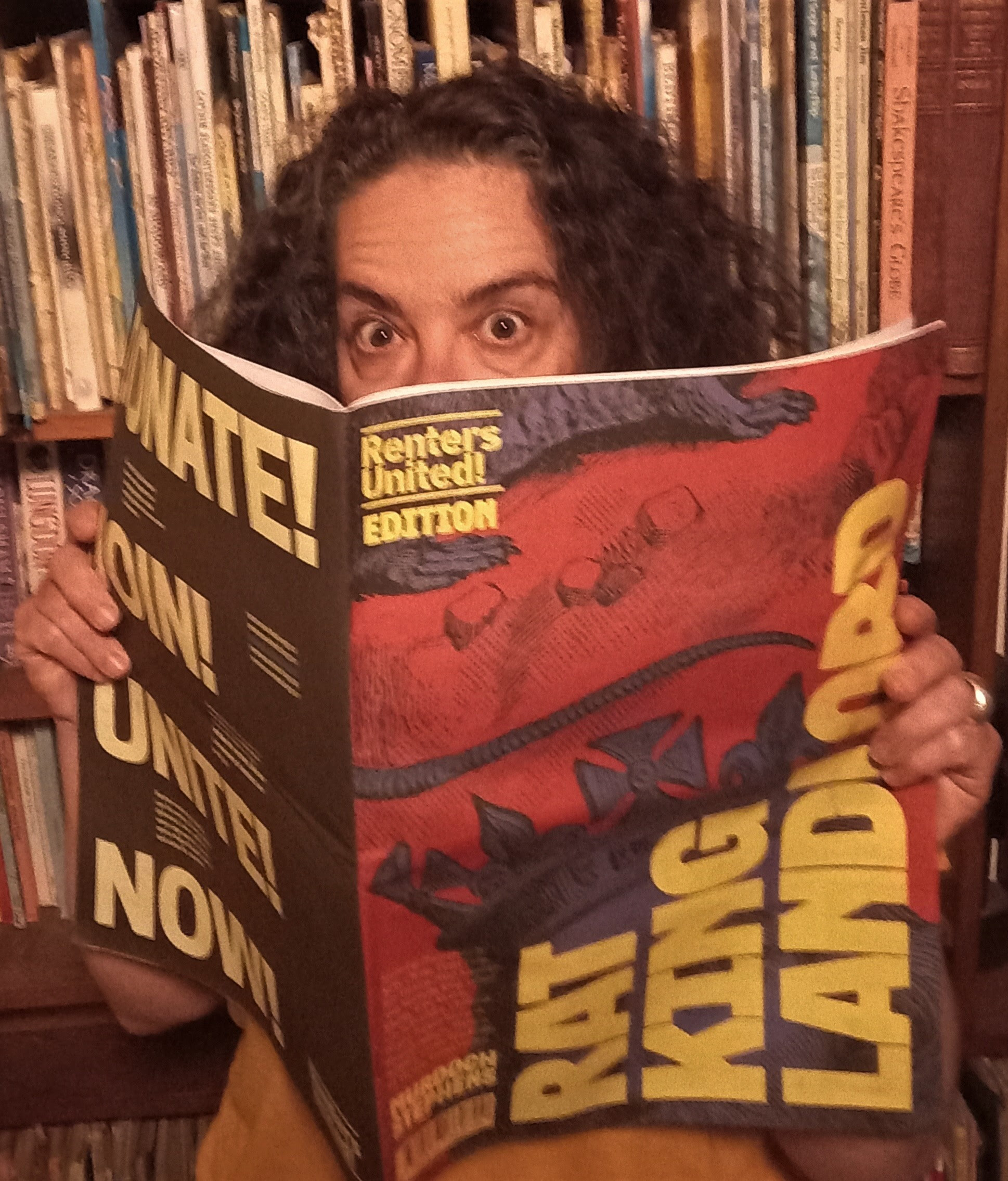
We will be giving away a copy of the remarkable Renters United! / Lawrence & Gibson Publishing tabloid-format! illustrated! edition of Murdoch Stephens's biting and hilarious RAT KING LANDLORD with every book order we dispatch (until supplies are exhausted). And if you order a Lawrence & Gibson book we will put in a bonus copy!
>>Read Stella's review of RKL
>>Books from L&G.

VOLUME Books


 The short lists for the 2023 Ockham New Zealand Book Awards highlight sixteen of the finest books published in Aotearoa in the last year.
The winners will be announced on 12 May.
Find out what the judges think of the books, and secure your copies now: 


JANN MEDLICOTT ACORN PRIZE FOR FICTION

  • book

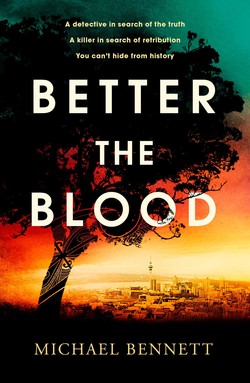
    Better the Blood

    Michael Bennett (Ngāti  Pikiao, Ngāti Whakaue) 
    (Simon & Schuster)

    Michael Bennett’s finely tuned thriller opens with an historical atrocity before moving to a contemporary series of murders. Detective Hana Westerman is caught between being a good cop or a kupapa collaborator, and the cases become frighteningly personal. Excellently paced and populated by complex characters, this intricate novel centres on conflict between utu and on the aroha, hūmarie and manaaki needed to move forward.
    >>Your copy

  • book

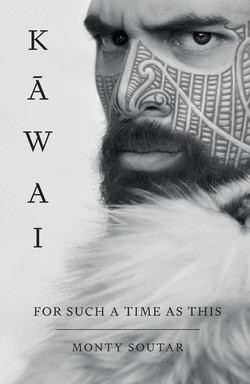
    Kāwai: For Such a Time as This

    Monty Soutar (Ngāti Porou, Ngāti Awa, Ngāi Tai ki Tāmaki, Ngāti Kahungunu)

    (Bateman Books)
    In senior Māori historian Monty Soutar’s powerful novel we learn histories that transport us across place, time, and generations. We become wrapped in the passion and honour of a mid-18th century ao Māori. Tikanga and mātauranga Māori, rangatiratanga, and love for the whenua and the iwi immerse us; butchery, enslavement, and spiritual curses smash. Mana foments the fires of war. Can later generations reassert balance?
    >>Your copy

  • book

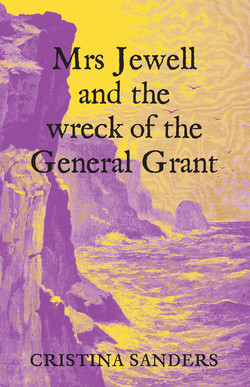
    Mrs Jewell and the Wreck of the General Grant

    Cristina Sanders 
    The Cuba Press

    Based on the true story of an 1866 shipwreck, this re-telling of the endurance of the survivors on a sub-Antarctic island is impeccably researched and peopled by rounded, realistic and complex characters. Dramatic and well paced, it is rich with vivid descriptions of sea, land and weather, and Cristina Sanders offers insight into the physical and psychological effects of being stranded in an inhospitable environment. Historical fiction at its best.
    >>Your copy.

  • book

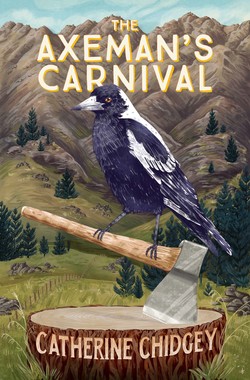
    Catherine Chidgey 
    Te Herenga Waka University Press
    Catherine Chidgey’s novel is a rich mix of humour and tragedy, suspenseful, insightful and compelling. It’s a contemporary down-on-the-failing-farm tale with a highly inventive and entertaining twist: the narrator is a sentient magpie, Tama, who flies from its pages fully formed and loveable. The story unfolds with many laugh-aloud moments coupled with an overriding sense of dread. Chidgey’s writing is masterful, abounding with poetic language and intensely descriptive settings.
    >>Your copy.

MARY AND PETER BIGGS AWARD FOR POETRY

  • book

    Always Italicise: How to Write While Colonised

    Alice Te Punga Somerville (Te Āti Awa, Taranaki)
     
    Auckland University Press

    Alice Te Punga Somerville’s meticulously crafted collection resonates with aroha, wit, sadness and anger. Advice to “italicise all of the foreign words in her poems” becomes a catalyst to exploring the dynamics of racism, colonisation, and writing in English as a Māori writer. Poems float like gourds strung with musings and personal recounts. English words incline as foreign words, but te reo syllables evade linguistic ambushes, camouflaged soundscapes and erasure. They stand upright, mark Space-Time like pou.
    >>Your copy

  • book

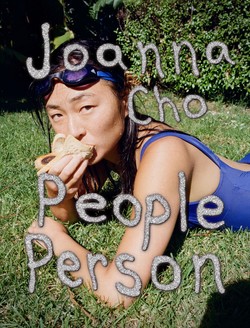
    People Person

    Joanna Cho 
    Te Herenga Waka University Press

    Joanna Cho explores relationships, identity and survival with an aching, ironic honesty. A people person may have a name bought from a fortune-teller, drive battered cars, light up rooms with their hearts, or miss the smell of kawakawa ointment. Cho navigates expectations and choices in imagined and recalled stories, skilfully connecting folklore with autobiographical snapshots from South Korea and Aotearoa. Whimsical, surreal, magical and mundane elements meld and clash in poetic vignettes.
    >>Your copy

  • book

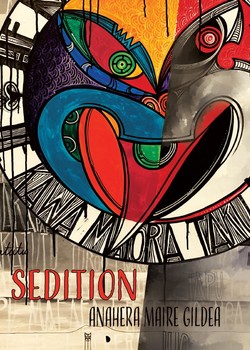
    Sedition

    Anahera Maire Gildea (Ngāti Tukorehe)  
    Taraheke | Bush Lawyer

    Sedition flows through generations of dis-ease, enlivens tongues stilled by loss and trauma, excavates a genealogy of resistance. It’s a contemplative, defiant collection that resists the commodification of culture and whenua, and the ongoing perversity of neo-colonialism. Poems float upon the notion that we walk into the future facing our past, which embodies and shapes us. Anahera Maire Gildea agitates, untangles and reweaves threads of outrage, dystopia and anguish as she resolutely redraws detrimental power.
    >>Your copy.

  • book

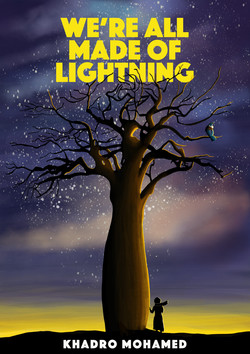
    We’re All Made of Lightning

    Khadro Mohamed 
    We Are Babies Press, Tender Press

    Khadro Mohamed’s elegiac collection features a speaker torn between multiple worlds. Pendulating from prose to lyric, it is a ghostly work in which dreams and memory bleed into each other, as do its places: Egypt, Somalia, Newtown and Kilbirnie. Even time becomes concurrent, and for Mohamed, the past is right there in the present. In this collision of languages and worlds, the possibility and impossibility of home is both grieved and celebrated.
    >>Your copy

BOOKSELLERS AOTEAROA NEW ZEALAND AWARD FOR ILLUSTRATED NON-FICTION

  • book

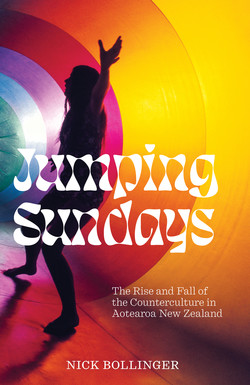
    With its distinctive cover, bold typography and risograph hues on uncoated stock, this book demands to be read from page one. Weaving original sources into an engaging narrative, Nick Bollinger has crafted a considered and fitting history. Photographs from private collections add to its rich production, balancing text and illustration in ways that belie its size. Like the period it surveys, Jumping Sundays is a game-changer.
    >>Your copy.

  • book

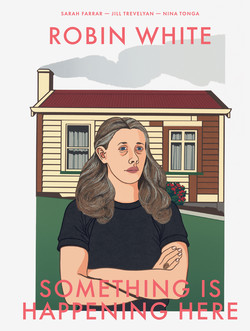
    Robin White: Something is Happening Here
    Edited by Sarah Farrar, Jill Trevelyan and Nina Tonga 

    Te Papa Press and Auckland Art Gallery Toi o Tāmaki

    This is more than an exhibition turned art book. Stunning reproductions, historical essays and the insights of two dozen contributors do justice to the institution that is Robin White. As iconic screenprints flow seamlessly into large format barkcloth, White’s border-crossing practice is temporally divided with the savvy use of typographic spreads. Space, too, is given to the voices of her Kiribati, Fijian and Tongan collaborators. Strikingly elegant yet comprehensive, excellence is what’s happening here.
    >>Your copy.

  • book

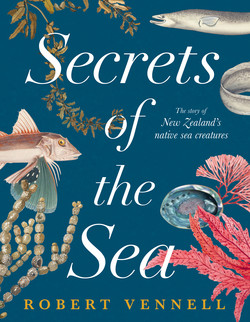
    Secrets of the Sea is a treasury of interesting facts, beautiful photography and remarkable prose. Beyond the luscious illustrations is a perfect blend of science, history and mātauranga Māori that gives the text depth and relevance and reveals in fascinating (and urgent) ways the interconnectedness of the human and extra human world. Visually compelling and hugely accessible, this impactful book will delight the marine biologist, sea aficionado and general reader alike.
    >>Your copy

  • book

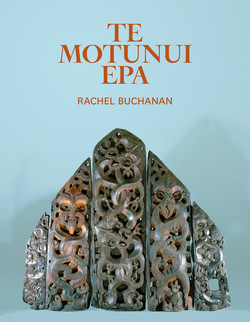
    Te Motunui Epa

    Rachel Buchanan (Taranaki, Te Ātiawa) 
    Bridget Williams Books

    Innovative and immensely topical, Te Motunui Epa is a triumph of storytelling and a challenge to the confines of traditional historiography. Rachel Buchanan’s meticulous research and compelling writing is complemented by the very best in graphic design – from its light-catching cover to the black-bordered array of archival documents. Generous while unafraid to confront the colonial hurt at the heart of the story, this is a deceptively powerful and enduring work.
    >>Your copy

GENERAL NON-FICTION AWARD

  • book

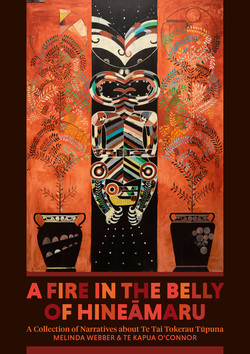
    A Fire in the Belly of Hineāmaru: A Collection of Narratives about Te Tai Tokerau Tūpuna

    Melinda Webber (Ngāti Kahu, Ngāti Hau, Ngāti Hine, Ngāpuhi, Ngāti Whakaue) and Te Kapua O’Connor (Ngāti Kurī, Pohūtiare)  
    Auckland University Press

    An exquisite and innovative book that uses a form of storytelling, pūrākau, to construct further stories that elucidate and challenge. It adds a layer of narrative truth to what we know about Te Tai Tokerau and, more importantly, shifts existing perceptions. It reveals the richness of knowledge in whakapapa which, especially for Te Tai Tokerau rangatahi, will spark significant personal and collective inspiration.
    >>Your copy

  • book

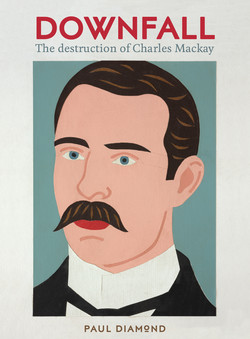
    Downfall: The Destruction of Charles Mackay

    Paul Diamond (Ngāti Hauā, Te Rarawa, Ngāpuhi)  
    Massey University Press

    This beautifully produced and generous book is a fascinating account of an extraordinary moment in small-town colonial New Zealand with its vivid line-up of characters, a revenge plot, blackmail and local Pākehā political intrigue. Alongside gripping, skilled and elegant popular historical storytelling, readers will find well-researched and closely observed insights into aspects of our national character, and our struggles with social decency.
    >>Your copy

  • book

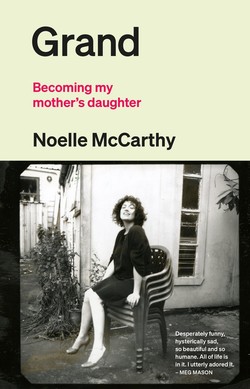
    Grand: Becoming my Mother’s Daughter

    Noelle McCarthy 
    Penguin Random House

    This memoir presents both a woman confronting her own shame and the shame of generations with visceral honesty. It offers a treatise on forgiveness and a light of hope. Noelle McCarthy’s command of language imbues readers with sight, sound, smell and taste. It is complete as an individual narrative, while the centrality of the mother-daughter relationship and the weight that loads onto the process of knowing oneself offers much to our collective emotional intelligence.
    >>Your copy

  • book

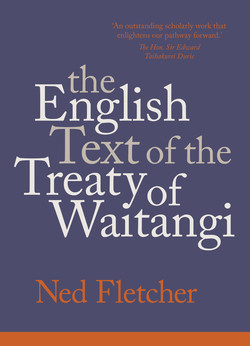
    The English Text of the Treaty of Waitangi

    Ned Fletcher 
    Bridget Williams Books

    Ned Fletcher’s extensively researched and meticulously constructed book provides a valuable contribution to scholarship, history and law, and makes a timely and evolved interjection into the conversations of this country. Readers are led to evidenced conclusions via Fletcher’s clear hypotheses, structural commitment to reason and thorough examination of the characters and context involved in the creation of the English text of Aotearoa’s founding document.
    >>Your copy. 

VOLUME BooksBook lists


>> Read all Stella's reviews.


Rat King Landlord by Murdoch Stephens  {Reviewed by STELLA}

I’m re-reading Rat King Landlord in tabloid format complete with illustrations — it’s the Renters United! edition. Bravo, publishers Lawrence & Gibson! We are giving away a copy with every book order

Here’s my review of the paperback edition (2020):

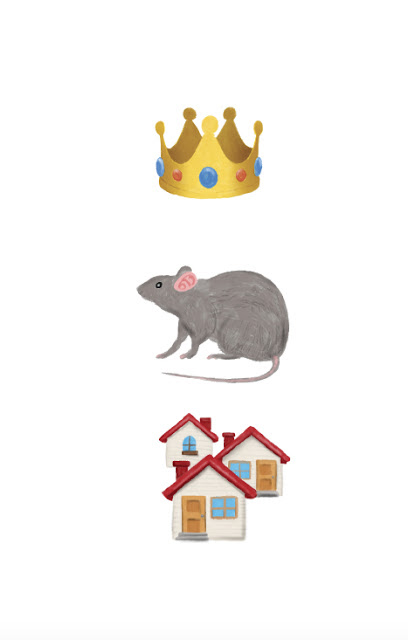
Ever wanted a crash course in Marxist theory, class structure, exploitation and capitalist advantage through property ownership, but found the reading a little too onerous? Well, then this novel is for you. Rat King Landlord, newly out of the excellent Lawrence & Gibson stable from the pen of Murdoch Stephens, is a satire that places you squarely in the continuing saga of our housing crisis — specifically the rental dilemma. Looked for a flat in Wellington lately; lived in an overpriced damp and mouldy house with strange flatmates and yet stranger landlord? — you need to look no further than here for a slice of almost-truth. Meet our flatmate, getting up early to make coffee in his haze of infatuation for Freddie, before she heads to work at the hip Broviet Brunion cafe located at the edgy end of the city, while flattie number three, Caleb, sleeps on, or whatever else he does, behind his closed door. So typical flatting life? Think again! Everyone wants to get on the property ladder, including the rats. Maligned and misunderstood, the rats are taking back the yard and the house. They are no longer content to live off your scraps while avoiding your traps. Rats have rights too! At the same time, strange posters are popping up all over the city advertising an event unlike any other — The Night of the Smooth Stones. Unauthorised and taking over billboard space owned by a corporate in cahots with the council, the posters resist being painted over or torn down. The message is oblique and the word on the street — well, on social media and in the huddled conversations of the politically leveraged hipsters — is that a revolution is about to hit the streets. Targets: property agents (loud hiss), landlords (hiss) and house owners (half-hearted small hiss). While the street is heating up, at home the temperature is rising too. The human landlord has died falling off a shonky ladder and his will results in the ownership of the house ending up in the hands (paws) of the Rat — the last being to witness him alive. Don’t even think about being animalist. As the Rat adjusts to his newfound status, learning English through texting (specifically with Caleb — the reclusive — who has an odd fascination with his Rat associate and an employer/employee relationship in due course — one that favours him over his flatmates), upgrading his shed, and making a slippery agreement to get himself into the house as a flatmate/landlord (alarm bells!), our protagonist becomes more agitated by the situation. Fire in the backyard, vigilantes on the street, pseudo-rebellion in the streets — who’s a landlord and who’s a renter? Have you got proof of your status or lack of? And the nights of rebellion just keep getting stranger. Who's behind the call to arms, and why is Freddie's boss acting weird? Rat King Landlord is a hilarious trip with a serious underbelly. Shitty houses, rip-off rents, exploitative agencies and landlords funded by the structure of the capitalist system fueling the beast we call the housing market. Satisfying satire — mad, fast-paced and audacious. 


 >> Read all Thomas's reviews. 


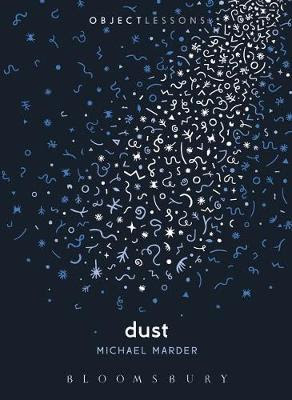
Dust by Michael Marder   (Reviewed by THOMAS}
Dust: substance without form, or, rather, substance post-form, matter without identity, matter that has relinquished, or has been forced to relinquish, by abrasion perhaps, or fatigue, whatever identity it has most recently had, matter now adrift, out of place, bereft of form, bereft of nameability, other than as dust, not taking on another form, nor moving towards taking on another form, not taking on any of the set of identities that we associate with form, applying, as we do, identities to forms rather than to substance, matter that cannot be defined even as anything other than dust, a kind of dirt, but not a dirty dirt, a clean dirt, in other words a non-dirt, a self-negation, an oxymoron, a substantial nothing, an accumulation of entitilessness on the surface of an entity, a nonentity seeking to overwhelm an entity, evidence of entropy, evidence of the action of time upon everything our lives are made of, evidence that our world is contingent rather than ideal, that things slip away from under the ideas we fit to things, that ideas will always be disappointed in the actualities to which they are applied, even the relatively simple ideas that we call nouns, evidence that our ways of thinking and the ways of the world of which we think are not subject to the same laws, or to the same processes if what they are subject to are not laws, evidence that matter seeks release from time, release from form, for it is form that makes us vulnerable to time, evidence that matter above all grows tired and seeks to rest. Years ago I made notes towards what I intended to be a short book on dust, but this, fortunately for everyone, is now little more than e-dust among all the other e-dust in the world. Fortunately (in a positive sense), Michael Marder has written this interesting book, so, if you have any interest in dust, or in the universal processes that are evidenced in dust, I recommend you read it.


Book of the WeekAffinities by Brian Dillon. Why is it that some things seem particularly to resonate with us personally, causing such a feeling of attunement that they seem to be telling us something about ourselves? Why these things and not others? Brian Dillon, whose books are always deeply thoughtful and nicely written, considers different photographs, artworks, texts and objects with which he feels an affinity (something akin to longing but without the separation), looks closely into his own life for the reason for this connection, and speculates a web of affinities that circulates the aesthetic lifeblood of our world. (This book is also an excellent way of discovering new affinities of your own.) 
 

  NEW RELEASES

We will be giving away a copy of the remarkable Renters United! / Lawrence & Gibson Publishing tabloid-format! illustrated! edition of Murdoch Stephens's biting and hilarious RAT KING LANDLORD with every book order we dispatch (until supplies are exhausted). And if you order a Lawrence & Gibson book we will put in a bonus copy!
>>Read Stella's review of RKL
>>Books from L&G.

Affinities by Brian Dillon             $40
What do we mean when we claim affinity with an object or picture, or say affinities exist between such things? Affinities is a critical and personal study of a sensation that is not exactly taste, desire, or allyship, but has aspects of all. Approaching this subject via discrete examples, this book is first of all about images that have stayed with the author over many years, or grown in significance during months of pandemic isolation, when the visual field had shrunk. Some are historical works by artists such as Julia Margaret Cameron, Dora Maar, Claude Cahun, Samuel Beckett and Andy Warhol. Others are scientific or vernacular images: sea creatures, migraine auras, astronomical illustrations derived from dreams. Also family photographs, film stills, records of atomic ruin. And contemporary art by Rinko Kawauchi, Susan Hiller and John Stezaker. Written as a series of linked essays, interwoven with a reflection on affinity itself, Affinities is an extraordinary book about the intimate and abstract pleasures of reading and looking.
"This is a deeply personal enterprise but Dillon goes to great lengths to keep at a distance. The collection may amount to a sort-of autobiography but each essay is about the life of the artist or the work itself, not about him. He is careful of his subjects and scrupulous in neither over-interpreting them nor projecting his emotions on to them. Nevertheless, each means something profound to him and each is a pixel that builds into a creative work of his own: a picture of his own aesthetic and the constituent parts of its canon." —Michael Prodger, New Statesman
The Rest Is Slander: Five stories by Thomas Bernhard (translated by Douglas Robertson)           $40
"The cold increases with the clarity," said Thomas Bernhard while accepting a major literary prize in 1965. That clarity was the postwar realisation that the West's last remaining cultural reference points were being swept away by the ever-greater commodification of humankind. Collecting five stylistically transitional tales by Bernhard, all of which take place in sites of extreme cold, this volume extends his bleak vision.
In 'Ungenach', the reluctant heir of an enormous estate chooses to give away his legacy to an assortment of oddballs as he discovers the past of his older brother, who was murdered during a career in futile colonialist philanthropy. In 'The Weatherproof Cape', a lawyer tries to maintain a sense of familial solidarity with a now-dead client with the help of an unremarkable piece of clothing. 'Midland in Stilfs' casts a jaundiced eye on the laughable efforts of a cosmopolitan foreigner to attain local authenticity on a moribund Alpine farmstead. In 'At the Ortler', two middle-aged brothers—one a scientist, the other an acrobat—meditate on their unusual career paths while they climb a mountain to reclaim a long-abandoned family property. And in 'At the Timberline', the unexpected arrival of a young couple in a mountain village leads to the discovery of a scandalous crime that casts a shadow on the personal life of the policeman investigating it.
Ten Planets by Yuri Herrera (translated by Lisa Dillman)          $34
The characters that populate Yuri Herrera's remarkable collection of stories inhabit imagined futures that reveal the strangeness and instability of the present. Drawing on science fiction, noir, and the philosophical parables of Borges's Fictions and Calvino's Cosmicomics, these very short stories signal a new dimension in the work of this significant writer. In Ten Planets, objects can be sentient and might rebel against the unhappy human family to which they are attached. A detective of sorts finds clues to buried secrets by studying the noses of his clients, which he insists are covert maps. A meagre bacterium in a human intestine gains consciousness when a psychotropic drug is ingested. Monsters and aliens abound, but in the fiction of Herrera, knowing who is the monster and who the alien is a tricky proposition. This collection of stories, which ranges from philosophical flights of fancy to the gritty detective story continues to develop Herrera's exploration of the mutability of borders, the wounds and legacy of colonial violence, and a deep love of storytelling in all its forms.
Owlish by Dorothy Tse (translated by Natascha Bruce)            $40
In the mountainous city of Nevers, there lives a professor of literature called Q. He has a dull marriage and a lacklustre career, but also a scrumptious collection of antique dolls locked away in his cupboard. And soon Q lands his crowning acquisition: a music box ballerina named Aliss who tantalizingly springs to life. Guided by his mysterious friend Owlish and inspired by an inexplicably familiar painting, Q embarks on an all-consuming love affair with Aliss, oblivious to the sinister forces encroaching on his city and the protests spreading across the university that have left his classrooms all but empty. Thrumming with secrets and shape-shifting geographies, Dorothy Tse’s extraordinary novel is a boldly inventive exploration of life under repressive conditions.
"Beguilingly eerie, richly textured, the pages of Owlish are drenched in strange beauty and menace. Like all the best fairy tales, it reveals the dark truths that we would rather not look at directly, and does so with a surreal and singular clarity." —Sophie Mackintosh
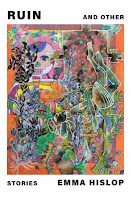
Ruin, And other stories by Emma Hislop          $30
Women and girls walk a perilously thin line between ruin and redemption in these stories as they try-with varying degrees of success-to outmanouver the violence that threatens to define their lives.There's the physical violence of men against their bodies—and sometimes the violence they exact in revenge. While doubts about a romantic partner, an abandonment by a sister, the fallout of a parent's pornography addiction, the betrayal of a friend, even the desire to touch a stranger's fur-like body are subtler aggressions that pack their own kinds of punches. Moving between contemporary New Zealand and London, and a dreamlike landscape that isn't quite real, this debut collection shimmers with a brutal kind of hope, exploring power and its contortions, powerlessness and its depravities, and the ends to which we will go to claim back agency.
Still Life by Zoë Wicomb            $36
Juggling with our perception of time and reality, Still Life tells the story of an author struggling to write a biography of long-forgotten Scottish poet and abolitionist Thomas Pringle. A multitude of voices across time, place and the lines of fiction and history—from the spectre of Mary Prince to Virginia Woolf's own Sir Nicholas Green—vie for the reader's attention. Their adventures through time and space, from Victorian South Africa and London to the author's desk in Glasgow in the present day, offer a poignant exploration of colonial history and racial oppression.
"An intriguingly metatextual novel that addresses some of the silences and omissions of South African history, and the broader relationship of historiography, reputation, writing and memory to power.” —Simon Lewis, The Post and Courier
For Thy Great Pain Have Mercy on My Little Pain by Victoria MacKintosh          $33
A meeting of mystics. In the year of 1413, two women meet for the first time in the city of Norwich. Margery Kempe has left her fourteen children and husband behind to make her journey. Her visions of Christ which have long alienated her from her family and neighbours, and incurred her husband's abuse  and have placed her in danger with the men of the Church, who have begun to hound her as a heretic. Julian, an anchoress, has not left Norwich, nor the cell to which she has been confined, for twenty-three years. She has told no one of her own visions and knows that time is running out for her to do so.The two women have stories to tell one another. Stories about girlhood, motherhood, sickness, loss, doubt and belief; revelations more the powerful than the world is ready to hear. 
Two Sherpas by Sebastián Martínez Daniell (translated by Jennifer Croft)            $38
A British climber has fallen from a cliffside in Nepal, and lies inert on a ledge below. Two sherpas kneel at the edge, stand, exchange the odd word, waiting for him to move, to make a decision, to descend. In those minutes, the world opens up to Kathmandu, a sun-bleached beach town on another continent, and the pages of Julius Caesar. Mountaineering, colonialism, obligation—in Sebastián Martínez Daniell's prose each breath is crystalline, and the whole world is visible from here.
>>The author's voice
A Case with a Bang ('Detective Gordon #5) by Ulf Nilsson, illustrated by Gitte Spee          $20
Inspector Gordon and Detective Buffy are back (and not just for the cake) in the final story in this fun and funny series for young readers. Night brings a horrible humming, scraping sound in the forest. Someone has wrecked the badger’s trash can. Later, three large creatures are spotted up on the mountain. Detective Buffy discovers this seemingly small case really is a dangerous mystery—she comes back from her first investigation flat as a gingerbread, rolled over by something huge and terrifying. Back at the station, retired Detective Gordon is training a new young police assistant, and the cakes have run out in the forest bakery! While all the animals cower at the police station, Buffy remembers Gordon’s stories about trolls. Is it possible they do exist? Taking Gordon’s advice about how everyone thinks differently, she finds a way to communicate with the giant creatures—perhaps not so terrifying after all. The book leaves readers with a memorable Gordon message: Everyone thinks differently, strangers are welcome, cakes for everybody! 
The Drinking Game by Guyon Espiner            $37
Four years ago, investigative journalist Guyon Espiner gave up drinking alcohol. He had been a heavy yet controlled drinker since his teens — abstaining three nights a week but making up for it the other four. One morning he woke up after a big night and decided he'd had enough and he quit — no AA, no support groups. Not drinking has given Guyon a new perspective on our relationship with alcohol in Aotearoa, and a lot of it is disturbing. The Drinking Game investigates the alcohol industry: the power, politics and lobbying behind our most harmful drug. Weaving together personal experience, hard research and interviews, it examines why New Zealand has such a heavy drinking culture, the harm it causes and how our attitudes to alcohol are changing. This is a sobering look into how the way you drink is shaped not only by your individual choice, but also by government, media and big business.
>>Alcohol and identity. 
Catfish Rolling by Clara Kumagai          $20
Sora hates the catfish whose rolling caused an earthquake so powerful it cracked time itself. It destroyed her home and took her mother. Now Sora and her scientist father live close to the zones the wild and abandoned places where time runs faster or slower than normal. Sora is sensitive to these shifts, and her father recruits her help in exploring these liminal spaces.But it's dangerous there and as she strays further inside in search of her mother, she finds that time distorts, memories fracture and shadows, a glimmer of things not entirely human, linger. 
After Sora's father goes missing, she has no choice but to venture into uncharted spaces within the time zones to find him, her mother and perhaps even the catfish itself.
Old God's Time by Sebastian Barry            $37
Retired policeman Tom Kettle is enjoying the quiet of his new home, a lean-to annexed to a white Victorian Castle in Dalkey overlooking the sea. For months he has barely seen a soul, but his peace is interrupted when two former colleagues turn up at his door to ask questions about a decades-old case. A traumatic case which Tom never quite came to terms with. His peace is further disturbed by a young mother and family who move in next door, a woman on the run from her own troubles. And what of Tom's family, his wife June and their two children?
"Sebastian Barry faces down the most challenging of subjects with an unflinching pen, using blood for ink. Yet at its heart, Old God's Time is also a love story, of two souls bonded by trauma. Narrated by a retired guard who begins to lose control of his fragile senses as his past clashes with the present, it is shocking, stunning and extraordinarily brave. Barry has once again written a character for the ages." —Liz Nugent


Enjoy browsing our annual VISUAL CULTURE SALE. This is your opportunity to pile up a selection of superb books on art, architecture, photography, design, theory, illustration, film, textiles, craft, and graphic novels, from both Aotearoa and overseas — all at satisfyingly reduced prices. Judging from previous years, our advice is: be quick — there are single copies only of most titles and many of them cannot be reordered (even at full price). >>Click through to start choosing


This week we are featuring the books of the remarkable Norwegian writer Jon Fosse, who has developed a method he calls 'slow prose' to explore the depths and subtleties of memory and experience and to grapple with the complex predicaments of human existence, language, time, and personhood. His prose is hypnotic, looping, emotionally resonant, philosophical, and often also funny. 
>>It's not me who's seeing
>>The mystical realist. 
>>A search for peace
>>Pure prose
>>Frames and levels
>>Revisions and the ear. 
>>A new name.
>>Thomas reviews The Other Name. 
>>Septology (also available as The Other NameI Is Another, and A New Name). 
>>Trilogy
>>Aliss at the Fire
>>Scenes from a Childhood. 
>>Melancholy 1—2. 


 >> Read all Thomas's reviews. 


The Other Name (Septology I—II) by Jon Fosse (translated from Norwegian by Damion Searls)  {Reviewed by THOMAS}

and I see myself sitting and reading the thick blue book of two parts, not that thick, actually, and I have reached that point in the book, though it is not in fact a point in the book for there is nothing in the book that would mark such a point, but rather a point in my reading of the book, which just happens to be around page seventy-five, that I came to realise that the book is written entirely in one sentence, one slow, patient, uninterrupted flow of words, no, I think, that is not correct, the book is written in two parts, though each begins with the word And, but neither part ends, each rather just leaves off, so it would not be correct that the book is written in one sentence, or in two sentences, one for each part, but rather in no sentences, one, or two, slow, patient, uninterrupted flow, or flows, of words, that much at least I got right, I think, just the kind of thing I like, but done with such virtuosity and with such little display of virtuosity that I had not realised until page seventy-five or thereabouts that there are no full stops to be found in this book, or no full stop, I am uncertain if this absence should be singular or plural, possibly both, this Jon Fosse and his translator Damion Searles having built these words without one misstep, or missomething, the metaphor seems mixed and I has not even realised that it was a metaphor, I must be more careful, capturing the flow of thought, so to call it, and speech, realistically, seemingly of the narrator, a middle-aged painter named Asle, living, I am almost tempted to put, as such people do, in a small town in western Norway, driving in the snow to and from a city on the western coast of Norway, the city of the gallery which shows, which is a euphemism of sorts for sells, his paintings, but also the city in which lives a middle-aged painter named Asle, resembling both in looks and clothing, if clothing is not part of looks, the narrator, the narrator narrating in the first person and this other Asle, the alter-Asle if you like, this alter-Asle to the thoughts and memories of whom the narrator-Asle has extraordinary access, though there is no evidence of any reciprocal mechanism, we are, I am sure, never given an instance of the alter-Asle even being aware of the existence of such a person as the narrator, this alter-Asle, being confined to the third person, and, I wonder, what sort of trauma confines a person to an existence only in the third person? presumably a trauma, I think, this alter-Asle being also an alcoholic and a person who “most of the time, doesn’t want to live any more, he’s always thinking that he should go out into the sea, disappear into the waves,” but not doing so because of his love for his dog, there is, I think as I am reading, some relationship between the two Asles, well, obviously there is, my thought, or the thought I have, being that the alter-Asle is the actual Asle and the narrator-Asle is the Asle that the alter-Asle-who-is-actually-the-actual-Alse would have been if he was not the Asle he became, which, I think, I have made sound a bit confusing, and the opposite of an explanation, not that that matters, on account of whatever trauma, or whatever it is that I speculate is a trauma, that confined him to a third-person existence, the characters being one character, all characters being one character as they are in all books, I speculate, though in this book The Other Name, almost all the characters have, if not the same name, almost the same name, which tightens the knot somewhat, if I can be forgiven another metaphor, though I will not forgive myself for it at least, I will try to avoid, I think, thinking of the relationships between these persons-who-are-one-person, or, in any rate, describing the relationships between these persons-who-are-one-person, in any way other than a literary way, whatever that means, nothing, I think, the person that Asle could have been sees the Asle that Asle became, though Alse cannot know him, the person that Asle could have been rescues Asle when he has collapsed in the snow and takes him to the Clinic and to the Hospital, and takes the dog to look after, who knows, though, if the third-person Asle, the one I was calling the alter-Asle until that became too confusing, at least for me, survives, neither we nor the first-person Asle know that, but after the first-person Asle goes to the city and rescues the third-person Asle from the snowdrift, how could he know where to find him, I wonder, he begins, in the second part of the book, to have access to some deeply buried memories of the Asle that perhaps they once both were, memories all in the third person, for safety, I think, memories firstly of Asle’s and his sister’s disobedience of their parents in straying along the shore and to the nearby settlement, a narrative in which threat hums in every detail, a narrative in which colour impresses itself so deeply upon Asle that, I think, he could have become nothing other than a painter, a narrative that seems searching for a trauma, for a misfortune, a narrative assailed by an inexplicable motor noise as they approach the settlement but which resolves with a misfortune that is anticlimactic, at least for Asle, a trauma but not his trauma, what has this narrative avoided, I wonder at this point, what has not been released, or what has not yet been released, I wonder, Fosse is a writer who writes to be rid of his thoughts, I think, just as his narrator says, “when I paint it’s always as if I’m trying to paint away the pictures stuck inside me, to get rid of them in a way, to be done with them, I have all these pictures inside me, yes, so many pictures that they’re a kind of agony, I try to paint away these pictures that are lodged inside me, there’s nothing to do but paint them away,” and, yes, when the narrator lies in bed at the end of the book and is unable to sleep, he does recover the memory, a third person memory, the memory of the trauma that split the Asles and trapped one thereafter in the third person, the memory that explains the awful motor noise that intruded on the previous narrative of disobedience as the children approached the locus of the trauma, and, I think, all the sadness of the book leads from here and to here


>> Read all Stella's reviews.


Between the Flags by Rachel Fenton  {Reviewed by STELLA}
A girl, a drowning, a rescue, a comic. Rachel Fenton’s teen novel explores the difficult territory of trauma with tenderness, humour, and humility. She cleverly leads you into what seems to be a story about striving, peer pressure, competitive sports, and being a teenager in today’s world which presents a plethora of ‘big issues’ to young people (climate change, racism, class, body image). And it is all these things, but it is at its core a gripping and emotional observation of grief and the many faces this can wear. At first, you are unaware that the main character is carrying or, more precisely, hiding a burden that is too big to be named. Mandy is a member of the Surf Lifesavers' club at Soldier Tree Bay, North Shore, and the book begins with her, face down in the sand, one of six other fourteen-year-olds waiting to compete in the race for the flag. Here you are in Mandy’s head, having the action described in blow-by-blow picture frames. A perfect comic strip in the making. This is disconcerting and intriguing, visually (through the text) pulling you into this place, this moment. It also, subtly, tells you something about Mandy. She has this coping mechanism for a reason. But what won’t be revealed for quite a few chapters. She’s an outsider, partly pushed away by the other girls, partly holding herself separate. At school she’s stopped speaking, ostracising herself further, and she’s falling behind, and not through a lack of ability. Casey, her little brother, loves her stories and wants to see what she’s drawing, but he’s not always around. And her big brother, Dan, has long flown the coop. Mandy’s loneliness drives her further into herself. And to make it worse, it looks like her Mum and Dad are breaking up. She’s angry with both of them. And she’s fed up with the nasty Jen and her friends, and the boys, especially Oliver, who are always making fun of her. Why couldn’t she be more like Mako, instead of nicknamed Orca? Seeing the psychologist helps, but the turning point is when she accidentally hands in her comic instead of her English essay. Mako may be the comic book hero but Mandy Malham is the unforgettable character of this novel as she shows us how we do and don’t cope with difficult situations and how we can overcome trauma and move forward. Between the Flags is a powerful, affecting novel with a comic strip at its centre.