NEW RELEASES

Shy by Max Porter            $28
Things keep slipping up for Shy. All he wants is sex, spliffs and his own turntables, and for all the red noise in his mind to disappear. But again and again he spirals past his senses and ends up with his head in his hands and carnage around him. You mustn't do that to yourself Shy. You mustn't hurt yourself like that. He's been kicked out of two schools, been cautioned, arrested, stabbed his stepdad in the finger and bottled a former Tumble Tots playmate, but it's the taunts and teasing of his new schoolmates that haunt Shy. Shy's got no armpit hair / Shy needs fake ID to buy fags / Got your special meds, nutcase? At Last Chance — a home for 'very disturbed young men' — he is surrounded by people who want to help him, but his night terrors aren't getting any better. The night is huge and it hurts. So tonight he's stepping into it, with the haunted beginnings of a plan. Again, Porter shows an incredible ability to get completely inside the head of his narrator, his spare and unconventionally effective prose delivering us an experience that enlarges our empathy and understanding. A beautiful hardback. 
"An act of humanity and grace, heightened by its distinctive form and artistry." —Telegraph
"Shy is the strangest, most beguiling and affecting of all his books." —Ian Rankin
>>Absolute horror at the political present
>>Men and masculinity.
>>Entering the hinterland
>>Read our reviews of Lanny.
>>Read Thomas's review of The Death of Francis Bacon
>>Grief Is the Thing With Feathers

Pirate Enlightenment; or, The Real Libertalia by David Graeber        $40
The Enlightenment did not begin in Europe. Its true origins lie thousands of miles away on the island of Madagascar, in the late seventeenth century, when it was home to several thousand pirates. This was the Golden Age of Piracy, a period of violent buccaneering and rollicking legends - but it was also, argues anthropologist David Graeber, a brief window of radical democracy, as the pirate settlers attempted to apply the egalitarian principles of their ships to a new society on land. For Graeber, Madagascar's lost pirate utopia represents some of the first stirrings of Enlightenment political thought. In this jewel of a book, he offers a way to 'decolonise the Enlightenment', demonstrating how this mixed community experimented with an alternative vision of human freedom, far from that being formulated in the salons and coffee houses of Europe. Its actors were Malagasy women, merchants and traders, philosopher kings and escaped slaves, exploring ideas that were ultimately to be put into practice in by Western revolutionary regimes a century later.
>>How enlightened were the pirates? 
>>Other books by David Graeber

Fate of the Land | Ko ngā Ākinga a ngā Rangatira: Māori Political Struggle in the Liberal Era, 1891-1912 by Danny Keenan          $65
In the second half of the nineteenth century, settlers poured into Aotearoa demanding land. Millions of acres were acquired by the government or directly by settlers; or confiscated after the Land Wars. By 1891, when the Liberal government came to power, Maori retained only a fraction of their lands. And still the losses continued. For rangatira such as James Carroll, Wiremu Pere, Paora Tuhaere, Te Keepa Te Rangihiwinui, and many others, the challenges were innumerable. To stop further land loss, some rangatira saw parliamentary process as the mechanism; others pursued political independence. For over two decades, Maori men and women of outstanding ability fought hard to protect their people and their land. How those rangatira fared, and how they should be remembered, is the story of Maori political struggle during the Liberal era.
>>Ten questions

OK (Object Lessons') by Michelle McSweeney             $23
OK as a word accepts proposals, describes the world as satisfactory (but not good), provides conversational momentum, or even agrees (or disagrees). OK as an object, however, tells a story of how technology writes itself into language, permanently altering communication. OK is a young word, less than 200 years old. It began as an acronym for "all correct" when the steam-powered printing press pushed newspapers into the mainstream. Today it is spoken and written by nearly everyone in the world. Drawing on linguistics, history, and new media studies, Michelle McSweeney traces OK from its birth in the Penny Presses through telephone lines, grammar books, and television signals into the digital age. Nearly ubiquitous and often overlooked, OK illustrates the never-ending dance between language, technology, and culture, and offers lessons for our own techno-historical moment.
Face to the Sky by Michele Leggott           $35
.In her latest collection, Michele Leggott speaks to the art and writings of nineteenth-century New Zealand painter Emily Cumming Harris. Face to the Sky tells stories of love and loss from two woman in the shadow the same mountain, more than a century apart.
"Voices sing from the archive: a choir of breakers on a North Taranaki beach. Two women born more than a hundred years apart tell stories of love and loss in the shadow of the mountain that is always there. One of them becomes a painter of botanically accurate native flora, and writes all her life. The other, now without sight, lives in a world of sounds caught into expanding webs of memory. She listens for the other, tracing the delicate shapes of what she cannot see, taking her cue from the words of others. She listens and travels, picking up connections over time and place. Mothers and fathers come and go, adding their voices to the tumult on the beach, the shadow of the mountain, the hills above Nelson where the first woman comes to rest. The second, living between two small volcanos in a northern city, waits for a miracle that might cure the lymphoma that has been tracking her days. Through it all, the familiar phrases of the weather forecast sound their ever-hopeful, ever-changing predictions." —Michele Leggott
The Penguin Book of French Short Stories, Volume 1: From Marguerite de Navarre to Marcel Proust edited by Patrick McGuinness          $75
"Impeccably edited by Patrick McGuinness. The first volume stretches from the 16th century to the early 20th century and features classics by Gustave Flaubert and Guy de Maupassant. But we also have Charles Perrault's folktale 'Bluebeard', a prose poem by Charles Baudelaire, and a darkly satirical tale by Emile Zola about a man driven insane by advertising. Volume two takes us from there to the early 21st century, featuring more women and non-white authors than the first volume. Treat yourself: buy both." —Tomiwa Owolade, Sunday Times 
A beautiful hardback. 
>>Volume 2 due soon!
Dr. No by Percival Everett             $35
Wala Kitu is an expert on nothing. That is to say, he is an expert, and his area of study is nothing, and he does nothing about it. This makes him the perfect partner for the aspiring villain John Sill, who wants to break into Fort Knox to steal, well, not gold bars but a shoebox containing nothing. With the help of the brainy and brainwashed astrophysicist-turned-henchwoman Eigen Vector, our professor tries to foil the villain while remaining in his employ. In the process, Wala Kitu learns that Sill's desire to become a literal Bond villain originated in some real all-American villainy related to the murder of Martin Luther King Jr. As Sill says, 'Professor, think of it this way. This country has never given anything to us and it never will. We have given everything to it. I think it's time we gave nothing back.' Dr. No is a caper with teeth, a wildly mischievous novel from one of America's most inventive, provocative, and productive writers. That it is about nothing isn't to say that it's not about anything. In fact, it's about villains. Bond villains. And that's not nothing.
"Everett continues to be an endlessly inventive, genre-devouring creator of thoughtful, tender, provocative, and absolutely unpredictable literary wonders." —Booklist
Courting India: England, Mughal India, and the origins of empire by Nandini Das                $39
When Thomas Roe arrived in India in 1616 as James I's first ambassador to the Mughal Empire, the English barely had a toehold in the subcontinent. Their understanding of South Asian trade and India was sketchy at best, and, to the Mughals, they were minor players on a very large stage. Roe was representing a kingdom that was beset by financial woes and deeply conflicted about its identity as a unified 'Great Britain' under the Stuart monarchy. Meanwhile, the court he entered in India was wealthy and cultured, its dominion widely considered to be one of the greatest and richest empires of the world. In Nandini Das's fascinating history of Roe's four years in India, she offers an insider's view of a Britain in the making, a country whose imperial seeds were just being sown. It is a story of palace intrigue and scandal, lotteries and wagers that unfolds as global trade begins to stretch from Russia to Virginia, from West Africa to the Spice Islands of Indonesia. The book explores the art, literature, sights and sounds of Jacobean London and Imperial India, revealing Thomas Roe's time in the Mughal Empire to be a turning point in history and offering a rich and radical challenge to our understanding of Britain and its early empire.
"A triumph of writing and scholarship. For Das the Roe mission is the lens through which to give sharp focus to a remarkably wide-ranging study that does much to illuminate the bigger story of the unpromising origins of British power — and initial powerlessness — in India. Her style, while nuanced and erudite, is also jaunty and often witty. The book is as full of lovely passages of prose and finely shaded pen portraits as it is of new archival research, of which there is a great deal. It is hard to imagine anyone ever bettering Das's account of this part of the story." —William Dalrymple
A System so Magnificent it is Blinding by Amanda Svensson (translated from Swedish by Nicola Smalley)              $35
In October 1989, triplet babies are born into chaos in a Swedish hospital. Over two decades later, the siblings are scattered around the world, barely speaking. Sebastian is in London working for a mysterious scientific organisation and falling in love. Clara has travelled to Easter Island to join a doomsday cult. And the third triplet, Matilda, is in Sweden, practising being a stepmother. Then something happens that forces them to reunite. Their mother calls with worrying news: their father has gone missing and she has something to tell them, a twenty-five-year secret that will change all their lives. 
"Amanda Svensson’s raucous, sprawling novel takes on the enigmas of our origins, riddles of human consciousness and animal cognition, doomsday cults, and the most bedevilling of mysteries – the minds and choices of our closest intimates." —judges' citation on listing the book for the 2023 International Booker Prize
>>Read an extract.
>>Six years of fun. 
>>A funny book taken seriously
>>Other books listed for the 2023 International Booker Prize
>>Where to begin?
The Other Side: A journey into women, art, and the spirit world by Jennifer Higgie           $40
Higgie explores the lives and work of a group of extraordinary women, from the twelfth-century mystic, composer and artist Hildegard of Bingen to the nineteenth-century English spiritualist Georgiana Houghton, whose paintings swirl like a cosmic Jackson Pollock; the early twentieth-century Swedish artist, Hilma af Klint, who painted with the help of her spirit guides and whose recent exhibition at New York's Guggenheim broke all attendance records; the 'Desert Transcendentalist', Agnes Pelton, who painted her visions beneath the vast skies of California; the Swiss healer, Emma Kunz, who used geometric drawings to treat her patients; and the British surrealist and occultist, Ithell Colquhoun, whose estate of more than 5,000 works recently entered the Tate gallery collection. While the individual work of these artists is unique, the women loosely shared the same goal: to communicate with, and learn from, other dimensions. Weaving in and out of these myriad lives, sharing her own memories of otherworldly experiences, Jennifer Higgie discusses the solace of ritual, the gender exclusions of art history, the contemporary relevance of myth, the boom in alternative ways of understanding the world and the impact of spiritualism on feminism and contemporary art.
"In effervescent and atmospheric prose, Jennifer Higgie explores some of history's most innovative artists and their spiritual investigations into this realm and the next. I was entranced from start to finish, as she takes us on both a personal and artistic journey across time and across the globe. The Other Side is an exhilarating read." —Katy Hessel
Beyond the Wall: East Germany, 1949—1990 by Katja Hoyer               $40
In 1990, a country disappeared. When the iron curtain fell, East Germany simply ceased to be. For over forty years, from the ruin of the Second World War to the cusp of a new millennium, the GDR presented a radically different German identity to anything that had come before, and anything that exists today. Socialist solidarity, secret police, central planning, barbed wire — this was a Germany forged on the fault lines of ideology and geopolitics. In Beyond the Wall, historian Katja Hoyer offers a kaleidoscopic new vision of this vanished country. Beginning with the bitter experience of German Marxists exiled by Hitler, she traces the arc of the state they would go on to create, first under the watchful eye of Stalin, and then in an increasingly distinctive German fashion. From the building of the Berlin Wall in 1961, to the relative prosperity of the 1970s, and on to the creaking foundations of socialism in the mid-1980s, Hoyer argues that amid oppression and frequent hardship, East Germany was yet home to a rich political, social and cultural landscape, a place far more dynamic than the Cold War caricature often painted in the West.
Time Shelter by Georgi Gospodinov (translated from Bulgarian by Angela Rodel)                $33
A 'clinic for the past' offers a promising treatment for Alzheimer's sufferers: each floor reproduces a decade in minute detail, transporting patients back in time.  An unnamed narrator is tasked with collecting the flotsam and jetsam of the past, from 1960s furniture and 1940s shirt buttons to scents, and even afternoon light. But as the rooms become more convincing, an increasing number of healthy people seek out the clinic as a ‘time shelter’, hoping to escape the horrors of modern life — a development that results in an unexpected conundrum when the past begins to invade the present.
"A wide-ranging, thought-provoking, macabre and humorous novel about nationality, identity and ageing, and about the healing and destructive power of memory." —judges' citation, International Booker Prize 2023
:The most exquisite kind of literature. I've put it on a special shelf in my library that I reserve for books that demand to be revisited every now and then." —Olga Tokarczuk
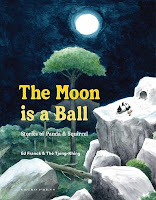
The Moon is a Ball: Stories of Panda and Squirrel by Ed Franck, illustrated by The Tjong-Khing           $30
Panda and Squirrel can't live without each other and do everything together: lie on the rocks to look at the moon, take walks, play games. One of their journeys lasts for only two steps, another day they discover a newly hatched duckling. Sometimes they argue but they always make up again. This a friendship for any day: roaring, quiet, grumbling, snoring . . . always.
A Forager's Life: Finding my heart and home in Nature by Helen Lehndorf            $40
A memoir about belonging and motherhood, told through the author's lifelong passion for wild food. When Helen Lehndorf moves to the city after a childhood living off the land in rural Taranaki, she can't help but feel different from her peers and professors - peculiar, poor. She finds solace in long walks foraging weeds and plants along the river, but something inside her still longs for home. Chasing a feeling of ancestral belonging, she travels to England with her new husband. There they learn about nature as the commons, something shared between all who encounter it - a source of delight, food, medicine, and connection with something greater than the forest in which it's found. An unexpected pregnancy in Aotearoa changes everything. Times are tight and motherhood takes over Helen's identity. When her son is diagnosed with autism, foraging becomes a space for selfhood and calm in a chaotic world.
Nothing Special by Nicole Flattery            $33
In the late 1960s, Pop artist Andy Warhol set out to make an unconventional novel by following a cast of his most famous characters around New York, recording their conversations with his tape recorder. The twenty-four one-hour tapes were transcribed by four women — The Velvet Underground's drummer Maureen Tucker, a Barnard student Susan Pile, and two young women. Flattery imagines the lives of those two high school students — precocious and wise beyond their years but still only teenagers, living with their mothers but working all day in the surreal and increasingly dangerous world of Andy Warhol's Factory, and learning to shape and reshape their identities as they navigate between their low-paid, grueling jobs and their lives at home, in a time of social change for girls and women in America. This blistering, mordantly funny debut interrogates the nature of fantasy and reality, voyeurism and language, and celebrity and the construction of identity. Within the framework of Andy Warhol's surreal world, Flattery asks us to consider at what point does the creation, and consumption, of our public selves turn us into something we don't recognise?
The Art and Life of Hilma af Klint by Ylva Hillström and Karin Eklund       $35
The first children's picture book on Hilma af Klint. Hilma af Klint (1862-1944) began painting her abstract and highly symbolic images as early as 1906, long before Kandinsky and Malevich arrived at what is generally regarded as the birth of modern abstract art. She was heavily influenced by spiritual ideologies and claimed that she painted on instruction from the spirit world, for the future. Includes reproductions of several of her works.
>>Look inside!
>>Other books on Hilma af Klint.

It's OK To Be Angry About Capitalism by Bernie Sanders         $40
"How can we accept an economic order that allows three billionaires to control more wealth than the bottom half of our society? How can we accept a political system that allows the super-rich to buy elections and politicians? How can we accept an energy system that rewards the fossil fuel corporations causing the climate crisis? How can we let it happen any longer? We must demand fundamental economic and political change. This is where the path forward begins."
Philosophy and Life: Exploring the great questions of how to live by A.C. Grayling           $40
How should I live my life? What values shall I live by? What sort of person should I be? What shall I aim for? Grayling enlists the help of philosophers, writers and other thinkers ancient and modern (and everything in between) to explore what gives life meaning. 

Alarm ('Object Lessons') by Alice Bennett            $23
Alarms are alarming. They wake us up, demand our attention and force us to attend to things we've preferred to ignore. But alarms also allow us to feel secure, to sleep and to retreat from alertness. They take over vigilance on our behalf. From the alarm clock and the air-raid siren to the doorbell and the phone alert, the history of alarms is also the history of work, security, technology and emotion. Alarm responds to culture's most urgent calls to attention by examining all kinds of alarms, from the restless presence of the alarm clock in modernist art to the siren — the sound of the police — in classic hip hop. More than just bells and whistles, alarms are objects that have defined sleeping and waking, safety and danger, and they have fundamentally shaped our understanding of the mind and its capacity for attention.
I, OBJECT by Stella Chrysostomou

I, Object is a collection of short texts by jewellery objects, as told to jeweller Stella Chrysostomou.
In these 38 stories, jewellery objects reflect on their relationship to the world, to each other, and with their human acquaintances (their makers, wearers, viewers, and owners). 
These texts ask us to reconsider our attitudes to, and our thinking about, jewellery, and — the tables turned — to experience jewellery afresh. 

Stella Chrysostomou is a jeweller and writer (and co-owner of VOLUME). As editor of I, Object, she is immensely grateful to the jewellery objects for their co-operation and contributions. Any errors in translation are her own.

BUY

Reviews

"What?" — Steve Braunias, NewsRoom

"Whimsical and delightful." — Alyson Baker (>>read the full review here)


Listen to Stella read some of the stories:

BUY
volume editions

>>Also available by Stella Chrysostomou: LIKE: An experiment in interpretation.


The Apartment by Alexandra Litvina (translated by Antonina Bouis), illustrated by Anna Desnitskaya

I’ve had my eye on this book for a while now, and happily, I can now slip it out from my own shelf to browse whenever I wish. (Luckily for you, we can order you a copy). I like history for its stories as well as the knowledge it can impart about how we live now and how we should behave in the future. It’s always a pleasure to find a book that approaches history in a different and accessible way. This children’s book, just as enjoyable and fascinating for adults, tells the story of a Russian century through one apartment and one family over several generations. The narratives are in the voices of various children and while this gives us a child’s viewpoint and interests, the author Alexandra Litvina manages to tie in major events without shirking from contentious issues of protest, purges, hardships, and dictators. These are cleverly revealed through snippets of conversation, newspaper cuttings, and a succinct yet informative paragraph for each of the years highlighted. We follow the Muromstev family from 1902 to 2002. In 1902, Irina tells us about the new apartment in Moscow. The paint is still fresh, and the floors just polished. The nursery is big, Papa has his own study, and there is plenty of room for everyone. We can look into each room as the family moves in and meet the family as they organise their new home.  Moving forward to 1914, it’s her brother Nikolai’s turn to tell us what is happening in the apartment. It’s Christmas and Papa is on the frontlines tending to the wounded, but everyone thinks that this war will be over soon. The younger sister, Marusya, takes up the story next. 1919 — food, medicine, and fuel are in short supply — revolution has turned the country on its head. Jump to 1927 and the apartment is looking very different. More people live in the same building and the Muromstev family’s lives have changed remarkably over the last three decades, not least the size of their apartment. And so it goes. We meet their friends, enjoy their discussions about politics, dabble in art and literature a little, and follow the ups and downs of this Russian century through the eyes of a family. It’s well told and wonderfully illustrated. Anna Desnitskaya's cut-away apartment illustrations are fascinating on every spread and the intervening pages are filled with details in text and drawings of quotidian culture showing us typical foods, toys, and clothes of each period alongside the more poignant mementos of ration cards, war victims, and propaganda. Here you’ll find Stalin, the Cold War, and father’s bag packed just in case of arrest, as well as family celebrations, the excitement of the race to the moon, and the significance of the fall of the Berlin Wall. Excellent!

>>Look inside the book.


Old Masters by Thomas Bernhard (translated by Ewald Osers)  {Reviewed by THOMAS}

It is very tiring to get everything done properly, he said, it is exhausting and, really, a waste of time to get everything done properly, but it is just as exhausting and just as much a waste of time to get everything done not properly, to do a mediocre job, so to speak, he said. As not doing anything at all does not seem to be an option available to me, despite its attractions, he said, as doing nothing is fraught with its own existential dangers, so to call them, I may as well do everything properly, he said. This is a terrible trap. I will exhaust myself and waste my time whether I do things properly or not, nobody will notice whether I do things properly or not, I am uncertain if I can tell whether I am doing things properly or not myself, but they would notice if I do nothing at all. Perhaps what I call properly is in fact mediocre, I aspire to the mediocre but fall short, or I aspire to excellence and fall short, it makes no difference, I fall to the same point, somewhere below the mediocre, far below excellence, I fall to my place in the order of things whether I aspire to the mediocre or to the excellent, I may as well aspire to excellence, whatever that means, and fail more grandly, he said, though he was unsure if this failure was more grand or more pathetic. He had, he said, entertained the intention, at least briefly, of writing a proper review of Old Masters by Thomas Bernhard, he had been rereading Old Masters not merely but at least partly for the purposes of writing this review, and he had even, while researching this review or this book, discovered what seemed to him to be a video game in which he could move around the  galleries of the Kunsthistorisches Museum in Vienna, although there were some galleries he could not enter for some reason, perhaps he had to advance to another level or perhaps he was just clumsy, avoiding the gallery attendants, searching for the location in which almost the entire book is set: the bench facing the painting White-Bearded Man by Tintoretto. Using the navigation arrows provided for the purpose by Google, he found, the player of the game can become well acquainted with the endless parquet flooring of the Kunsthistorisches Museum, with the marble staircases and gilded cornices and door-frames of the Kunsthistorisches Museum, and with much of what Reger, the dominant voice if not the narrator of Bernhard’s book, dismisses as its collection of “Habsburg-Catholic state art. The Kunsthistorisches Museum is entirely in line with the artistic taste of the Habsburgs, who, at least where painting is concerned, had a revolting, totally brainless Catholic artistic taste,” writes Bernhard as Atzbacher quoting Reger, Atzbacher being the book’s narrator, even though pretty much all he does is quote what Reger has at some time said. He must concentrate on his review, he thought, I am determined to write a proper review, he said aloud, forgetting that he had already reviewed the book with a proper review, or in any case something slightly closer to a proper review than what he felt himself now capable of, not that that is saying much, some years before. Old Masters is an entirely musical book, he wrote, starting at last in a sensible way, despite being set in a painting gallery it is entirely musical both in its phrasing and in its structure, if there is a difference between the two, he thought, drifting from the task, the musical form of the book is what matters, he wondered if he could say the form is all that matters, that form is all that ever matters. Old Masters is narrated in one unbroken paragraph by Atzbacher, about whom we learn little, he wrote, but the voice that reaches us is the voice of Reger, an elderly music reviewer, who has arranged to meet Atzbacher on their regular bench in front of the White-Bearded Man but on an irregular day, they normally meet there on alternate days only. Atzbacher arrives early in order to watch Reger waiting for him from the next room, and the first half of the book consists of Atzbacher telling us what Reger has previously told him, of Reger speaking through Atzbacher, so it seems, just as Reger also speaks, as Atzbacher notes, through the museum attendant Irrsigler: “Irrsigler has, over the years, appropriated verbatim many, if not all, or Reger’s sentences. Irrsigler is Reger’s mouthpiece, nearly everything that Irrsigler says has been said by Reger, for over thirty years Irrsigler has been saying what Reger has said. If I listen attentively I can hear Reger speak through Irrsigler.” As with Irrsigler so with Atzbacher, he thinks, Atzbacher seemingly unaware of the irony. Old Masters is a very funny book, he thinks, Reger’s reported opinions amount to a stream of invective against pretty much everything held in esteem in the society in which Reger lives, and in which Bernhard lived, separated as they are only by tense, admiration, after all, being for Bernhard a form of mental weakness. “There has virtually been no culture in Vienna for a long time, and one day there will really be no culture of any kind left in Vienna, but it will nevertheless be a cultural concept even then. Vienna will always be a cultural concept, it will more stubbornly be a cultural concept the less culture there is in it,” writes Benhard as Atzbacher as Reger and perhaps again as Bernhard. Well, he thought, as with Vienna so with Nelson, though I will not write that down, he thought. Heidegger, Stifter, Bruckner, Vienna’s public lavatories, restaurants, politicians, all are derided in the most amusing fashion and at length, he wrote, in this first section, in the words of Reger as remembered by Atzbacher as he watches Reger waiting for him to arrive. This might even be Bernhard’s funniest book, he thought, the way Reger’s ridicule surges through it, builds and collapses. When Atzbacher keeps his appointment with Reger, Reger’s rants continue via Atzbacher, but at one step less remove, the rants continue but the tone changes, subtly, Old Masters might be Bernhard’s both least and most subtle book, he thought, the least subtle because of Reger’s ranting but the most subtle because of the modulation in that ranting, all in this one paragraph, the rant no longer filtered by Atzbacher’s memory is more extreme, nastier, less enjoyable, clumsier, is the fact that I can go along with Reger’s rants in the first half a mark against me, he wondered, and if so am I redeemed by being put off when we meet Reger himself in the second, so to speak, when we meet Reger in the raw, so to speak, he wondered, and Atzbacher intercuts what Reger says to him at this time in the gallery with recollections of what Reger has said to him previously at the Ambassador cafe, and the depth of Reger’s unhappiness since the death of his wife is expressed in sequences of sentences, each ending “...Reger said at the Ambassador then,” repeated like sobs, and the unhappiness flows through and gives depth to the rest of the book, which principally concerns the difficulties of carrying on living is a world devoid of value, Old Masters is perhaps Bernhard’s funniest book and his saddest. “Oh yes, Reger said, the logical conclusion would invariably be total despair about everything. But I am resisting this total despair about everything, Reger said. I am now eighty-two and I am resisting this total despair about everything tooth and nail, Reger said.” Reger’s vitriol is a survival mechanism, he wrote, to despise is to survive, that is clumsily put, he thought, too clumsily put to write down. “One’s mind has to be a searching mind, a mind searching for mistakes, for the mistakes of humanity, a mind searching for failure. The human mind is a human mind only when it searches for the mistakes of humanity, Reger said. A good mind is a mind that searches for the mistakes of humanity and an exceptional mind is a mind that finds the mistakes of humanity, and a genius’s mind is a mind which, having found these mistakes, points them out and with all the means at its disposal shows up these mistakes.” Reger despises nothing more than old masters, so Reger says, and this is why he has sat on his bench at the Kunsthistorisches Museum every other day for thirty years. “Art altogether is nothing but a survival skill, we should never lose sight of this fact, it is, time and again, just an attempt to cope with this world and its revolting aspects, which, as we know, is invariably possible only by resorting to lies and falsehoods, to hypocrisy and self-deception, Reger said. … All these pictures, moreover, are an expression of man’s absolute helplessness in coping with himself and with what surrounds him all his life. … All these so-called old masters are really failures, without exception they were all doomed to failure.” Our obsession with art, he thought, if we have an obsession with art, or with celebrity, if we have that, or with sport performers, so to call them, or with wealthy people, or actors, or singers, is not with how these apogees of achievement are more successful than us, more skilled, more wonderful, more spiritual even, whatever we mean by that, but with the flaws, the weaknesses, vices and misfortunes that make them like us after all, failures, and we are reassured that not even great success, however that is measured, not even great skill, not even great fame would stop us from being failures, and so we need not therefore even strive for these things, they would not in any case save us, so to speak. When the worst happens, though, we are devastated but it is not true to say that we do not also feel relief, and this is the saddest thing of all, he thought. “Reger was looking at the White Bearded Man and said, the death of my wife has not only been my greatest misfortune, it has also set me free. With the death of my wife I have become free, he said, and when I say free I mean entirely free, wholly free, completely free, if you know, or if at least you surmise, what I mean. I am no longer waiting for death, it will come by itself, it will come without my thinking of it, it does not matter to me when. The death of a beloved person is also an enormous liberation of our whole system, Reger now said. I have lived for some time now with the feeling of being totally free. I can now let anything approach me, really anything, without having to resist, I no longer resist anything, that is it, Reger Said.” Atzbacher accepts the ticket Reger offers him to attend a performance of Kleist’s The Broken Jug, a work also mocking human faillings, at the Bergtheater that evening, but, Atzbacher says, “The performance was terrible,” ending the book with the first opinion he has expressed that might be his own, though, given the formative influence of Reger upon him, can any opinion be his own, can anyone’s opinion anyway be considered their own, he wondered. I will give up on this review, he decided, I cannot write the review properly he realised, whatever could constitute properly, perhaps I could have done so once but I can do so no longer, at least not today, the only day I have to write it, he thought, my mind no longer performs in that way. He had spent a long time playing the Kunsthistorische Museum game but he could not find the painting of the White Bearded Man

Book of the Week: Ninth Building by Zou Jingzhi (translated by Jeremy Tiang) is a memorable, sparely written and often darkly funny set of vignettes based on the author’s experiences during China’s Cultural Revolution, first as a child in Beijing and then as a teenager sent to work in the countryside. The book captures the unseen and usually unrecalled aspects that actually comprise the majority of history, even in dramatic times; the tedium, the uncertainty, the strange acceptance, the perspective limited to the immediate time and place, the eruptions of humanity or brutality into otherwise unresolved and seemingly irresolvable circumstances.
>>”I wrote this book to let go of my childhood.”
>>Read an extract.
>>”Everyone should translate.”
>>Everything is taken for granted.
>>Your copy of Ninth Building.
>>Other books listed for the 2023 International Booker Prize.
>>Which book should you read first?


Our Book of the Week is Cheon Myeong-Kwan's lively and inventive novel WHALE, translated from Korean by Chi-Young Kim. On listing the book for the 2023 International Booker Prize, the judges described it as "a carnivalesque fairy tale that celebrates independence and enterprise, a picaresque quest through Korea’s landscapes and history, Whale is a riot of a book. Cheon Myeong-Kwan’s vivid characters are foolish but wise, awful but endearing, and always irrepressible. This is a hymn to restlessness and self-transformation." 
>>Read an extract. 
>>Part of the world. 
>>Revenge plays. 
>>The news in Korea
>>Your copy of Whale
>>Other books long-listed for the 2023 International Booker Prize.


>> Read all Stella's reviews.


And the Ocean Was Our Sky by Patrick Ness, illustrated by Rovina Cai  {Reviewed by STELLA}

“Call me Bathsheba,” are the first lines of this inventive novel mimicking another famous story.  Patrick Ness’s And the Ocean Was Our Sky is a stunning wonder of a story. In this inverse Moby-Dick, we are introduced to a pod of whales that hunt man. In this world, the sea is the right way up and our sky is the Abyss. The action takes place in and on the ocean as we travel with the whales. Our narrator Bathsheba is the Third Apprentice under the lead of Captain Alexandra — a fearless giant of a whale, a harpoon embedded in her head, survivor of numerous battles with man. When the pod come across a wrecked human ship, bodies afloat, drowned, it is difficult to tell whether this is the work of man or whale. If whale, it is messy — wasteful — the bodies haven’t been harvested for their teeth nor bone. If man, why? As they approach the ship, a hand clutching a disc protruding from the capsized hull is spied: a hand that belongs to a young man — a prisoner — called Demetrius, and he has a message about (or from) Toby Wick - the nemesis of the whales. Toby Wick, feared and hated by man and whale, is a mysterious and vicious hunter — a legend. None who have seen him live to tell the tale of who he is and the powers he can summon to win every battle. Alexandra, obsessed with overcoming Toby Wick, is determined to fulfill a prophecy — one that has been passed down through generations. The great Toby Wick will be confronted. Demetrius is kept alive under the ocean and Bathsheba is commanded to interrogate him. A relationship builds between man and whale - for centuries prejudice and hatred have reigned supreme between the species, each hunting the other, each having just cause for revenge. Yet Bathsheba is intrigued by this meeting with Demetrius, who is merely a pawn in Toby Wick’s game — not a hunter, not an enemy. As Bathsheba’s loyalty is tested, the pod swim closer to their meeting with the mythic Toby Wick. What awaits them is fearsome and surprising. And the Ocean Was Our Sky is an epic journey for Bathsheba — physically but even more so philosophically and emotionally. Her interactions with Demetrius and the encounter with Toby Wick will change her forever, and the relationship between man and whale will create a new prophecy. This mind-bending story about fear, prejudice, loyalty and legend is brilliantly and beautifully illustrated by Rovina Cai.  It’s a tale for any age much like Ness’s excellent A Monster Calls.   

>>This wonderful book is just one of the superb titles to be found in our Children's Book Sale. Browse the sale now.


 >> Read all Thomas's reviews. 


Poetics of Work by Noémi Lefebvre (translated from French by Sophie Lewis)  {Reviewed by THOMAS}
How should we occupy ourselves, he wondered, whatever that means, lest we be occupied by someone else, or something else, how do we keep our feet, if our feet at least may be said to be our own to keep, by leaning into the onslaught or by letting it wash through us? Too many metaphors, if they’re even metaphors, he thought, too much thought thought for us by the language we use to think the thoughts, he thought, too many ready-made phrases, who makes them and why do they make them, and what are their effects on us, he wondered, where is the power that I thought was mine, where is the meaning that I meant to mean, how can I reclaim the words I speak from those against whom I would speak them? No hope otherwise. The narrator of Noémi Lefebvre’s Poetics of Work happens to be reading Viktor Klemperer’s Language of the Third Reich, in which Klemperer demonstrates that the success of, and the ongoing threat from, Nazism arose from changes wrought on the ways in which language was used and thus upon the ways people thought. Whoever controls language controls thought, he thought, Klemperer providing examples, authority exerts its power through linguistic mutation, but maybe, he thought, power can be resisted by the same means, resistance is poetry, he shouted, well, perhaps, or at least a bit of judicious editing could be effective in the struggle, he thought, rummaging in the draw of his desk for his blue pencil, it’s in here somewhere. Fascism depends on buzzwords, says Klemperer, buzzwords preclude thought, and the first step in fighting fascism, says Klemperer, is to challenge the use of these buzzwords, to re-establish the content of discourse, to rescue the particular from the buzzword. Could he think of some current examples of such buzzwords, he wondered, and he thought that perhaps he could, perhaps, he thought, if terms such as the buzzword ‘woke’ or the buzzword ‘cancel’ were removed from discourse and the wielders of these buzzwords had no recourse but to say in plain language what they meant, these once-were-wielders would be revealed to be either ludicrous or dangerous or both ludicrous and dangerous and the particulars of a given situation could be more clearly discussed. That is a subversive thought, he thought, to edit is to unpick power. “There isn’t a lot of poetry these days, I said to my father,” says the narrator at the beginning of Poetics of Work. A state of emergency has been declared in France, it is 2015, terror attacks have resulted in a surge of nationalism, intolerance, police brutality, the narrator, reading Klemperer as I have already said, is aware of the ways in which language has been mutated to control thought, power acts first through language and then turns up as the special police, it seems. What purchase has poetry in a language also used to describe police weaponry, the narrator wonders. “I could feel from the general climate that imagination was being blocked and thought paralysed by national unity in the name of Freedom, and freedom co-opted as a reason to have more of it.” Freedom has become a buzzword, it no longer means what we thought it meant, but even, perhaps, well evidently, its opposite. “Security being the first of freedoms, according to the Minister of the Interior, for you have to work.” You have to work, is this the case, the narrator wonders, you have to work and by working you become part of that which harms you. The book progresses as a series of exchanges between the narrator and their father, the internal voice of their father, of all that is inherited, of Europe, of the compromise between capital and culture, of all that takes things at once too seriously and nowhere near seriously enough. “He’s there in my eyes, he hunches my shoulders, slows my stride, spreads out before me his superior grasp of all things,” the narrator says, embedded in their father, struggling to think a thought not thought for them by their father, their struggle is a struggle for voice, as all struggles are. “I am like my father but much less good, my father can do anything because he does nothing, while I do nothing because I don’t know how to defend a person who’s being crushed and dragged along the ground and kicked to a pulp with complete impunity, nor do I know how to get a job or write a CV or any biography, nor even poetry, not a single line of it.” What hope is there? Is it possible to find “non-culture-sector poetry”, the narrator wonders, or even to write this “non-culture-sector” poetry if there could be such a thing? What sort of poetry can be used to come to grips with even the minor crises of late capitalism, for instance, if any of the crises of late capitalism can be considered minor? “I watched the water flow south, and the swans driven by their insignificance, deaf and blind to the basic shapes of the food-processing industry, ignorant that they, poor sods, were beholden to market price variation over the kilo of feathers and to the planned obsolescence of ornamental fowls.” The book sporadically and ironically gestures towards being some sort of treatise on poetry, it even has a few brief “lessons,” or maxims, but these are too half-hearted and impermanent to be either lessons or maxims, perhaps, he thought, they might qualify as antilessons or antimaxims, if such things could be imagined, though possibly they ironise an indifference to both. “Indifference is a contemplative state, my father said one day when he’d been drinking.” Doing nothing because there is nothing to be done, or, rather, because one cannot see what can be done, is very different from doing nothing from indifference, but the effect is the same, or the lack of effect, so something must be done, the narrator thinks, even if it is the case that nothing can in the end be done. For those to whom language is at once both home and a place of exile, the struggle must be made in language, or for language, resistance is poetry, or poetry is resistance, I have forgotten what I shouted, I will sharpen my blue pencil, after all one must be “someone among everyone,” as the narrator says. “There’s a fair bit of poetry at the moment, I said to my father,” the narrator says at the end of Poetics of Work. “He didn’t reply.”
 

  NEW RELEASES

Chicanes by Clara Schulmann (translated from French by Anna Clement, Ruth Diver, Lauren Elkin, Jennifer Higgins, Natasha Lehrer, Sophie Lewis, Naima Rashid, and Jessica Spivey)          $38
As she tries to collect them for an essay she is planning to write, other women’s words begin interfering in Clara Schulmann’s life — heard on the radio, in podcasts, songs, and films; words of novelists, feminist intellectuals, friends or strangers overheard in the street. They invade her psyche, reshaping the essay that she once had in mind into a picaresque adventure which investigates the fault lines around women’s voices: and in particular those moments of overflow and excess where wayward words take seed. Chicanes heralds a new French feminism through a meticulously orchestrated chorus of the wildest female voices, from figures in the history of feminist writing to the stranger on the street, blurring the boundaries between body and art; personal and political. A poly-translation, by eight female translators, from established to emerging, Chicanes brings the individual voice of each translator into subtle relief.
"This is a book to treasure and love." —Deborah Levy
>>The voice that cannot be controlled
Ninth Building by Zhou Jingzhi (translated from Chinese by Jeremy Tiang)          $38
Revisiting his experiences as a boy in Beijing and then as a teenager exiled to the countryside, Zou captures a side of the Cultural Revolution that is seldom talked about — the sheer tedium and waste of young life under the regime, as well as the gallows humour that accompanies such desperate situations. 
"A kaleidoscopic and understated collection of interlocking tales of life in an apartment building under the Cultural Revolution – the daily tedium of its inhabitants, lit by brief and tenuous moments of shared humanity." —judges' citation, The International Booker Prize 2023
>>Read an extract. 
>>Other books long-listed for the 2023 International Booker Prize.
Why Read: Selected writings, 2001—2021 by Will Self               $37
Self's intellectual acumen and verbal prowess have always protruded well beyond his fiction, and he never shies away from provoking whatever or whoever needs to be provoked. These essays all test the interplay between 'reality' and 'fiction', and ask how literature can help us be sharper about the problems of contemporary life.  Contents: 1: Why Read? 2: The Death of the Shelf; 3: Absent Jews and Invisible Executioners: W. G. Sebald and the Holocaust; 4: Chernobyl; 5: Kafka's Wound; 6: A Care Home for Novels: The Narrative Art Form in the Age of Its Technical Supersession; 7: The Last Typewriter Engineer; 8: Isenshard; 9: How Should We Read? 10: Junky; 11: Being a Character; 12: Australia and I; 13: The Rise of the Machines; 14: Literary Time; 15: The Printed Word in Peril; 16: The Secret Agent; 17: What to Read? 18: On Writing Memoir; 19: Apocalypse Then; 20: The Technology of Journalism; 21: St George for the French; 22: Will Self-Driving Cars Take My Job? 23: Reading for Writers.
"The finest essays here are incisive, perceptive and provocative. But they are also wildly entertaining." —Washington Examiner
"Self is the most daring and delightful novelist of his generation, a writer whose formidable intellect is mercilessly targeted on the limits of the cerebral as a means of understanding. Yes, he makes you think, but he also insists that you feel." —Guardian 
"Self often enough writes with such vividness it's as if he is the first person to see anything at all." —New York Times 
"Self has indeed been a goat among the sheep of contemporary English fiction, a puckish trickster self-consciously at odds with its middle-class politeness." —New York Review of Books 
While We Were Dreaming by Clemens Meyer (translated from German by Katy Derbyshire)       $45

Rico, Mark, Paul and Daniel were 13 when the Berlin Wall fell in autumn 1989. Growing up in Leipzig at the time of reunification, they dream of a better life somewhere beyond the brewery quarter. Every night they roam the streets, partying, rioting, running away from their fears, their parents and the future, fighting to exist, killing time. They drink, steal cars, feel wrecked, play it cool, longing for real love and true freedom. Startlingly raw and deeply moving, While We Were Dreaming is an extraordinary coming of age novel by one of Germany's most ambitious writers, full of passion, rage, hope and despair.
"The cumulative power of the well-constructed, pitiless and unflinching dispatches from the underbelly of society is remarkable. Historical events often pass unnoticed by those living through them, unaware even of how much their lives have been changed. It is Meyer’s achievement to capture the profound effects those events had on the lives of those at the bottom of German society." — David Mills, Sunday Times
"A book like a fist. German literature has not seen such a debut for a long time, a book full of rage, sadness, pathos and superstition. —Felicitas von Lovenberg, Frankfurter Allgemeine Zeitung
"Clemens Meyer’s great art of describing people takes the form of the Russian doll principle: a story within a story within a story. So much is so artfully interwoven that his work breaks the mould of the closed narrative." —Katharina Teutsch, Die Zeit
>>Read an extract.
>>Other books long-listed for the 2023 International Booker Prize.

Trench Coat ('Object Lessons' series) by Jane Tynan            $23

We think we know the trench coat, but where does it come from and where will it take us? From its origins in the trenches of WW1, this military outerwear came to project the inner-being of detectives, writers, reporters, rebels, artists and intellectuals. The coat outfitted imaginative leaps into the unknown. Trench Coat tells the story of seductive entanglements with technology, time, law, politics, trust and trespass. Readers follow the rise of a sartorial archetype through media, design, literature, cinema and fashion. Today, as a staple in stories of future life-worlds, the trench coat warns of disturbances to come.
>>Other books in the 'Object Lessons' series


Anaximander and the Nature of Science by Carlo Rovelli           $40
Over two millennia ago, a Greek philosopher had a number of wondrous insights that paved the way to cosmology, physics, geography, meteorology and biology, setting in motion a new way of seeing the world. Anaximander's legacy includes the revolutionary idea that the earth floats in a void, that the world can be understood in natural rather than supernatural terms, that animals evolved, and that universal laws govern all phenomena. He introduced a new mode of rational thinking with an openness to uncertainty and to the progress of knowledge.  Rovelli brings to light the importance of Anaximander's overlooked legacy to modern science. He examines Anaximander as a scientist interested in shedding light on the deep nature of scientific thinking, which Rovelli locates in his rebellious ability to reimagine the world again and again. 
Artificial Hells: Participatory art and the politics of spectatorship by Claire Bishop          $25
Since the 1990s, critics and curators have broadly accepted the notion that participatory art is the ultimate political art: That by encouraging an audience to take part an artist can promote new emancipatory social relations. Around the world, the champions of this form of expression are numerous, ranging from art historians such as Grant Kester, curators such as Nicolas Bourriaud and Nato Thompson, to performance theorists such as Shannon Jackson. Artificial Hells is the first historical and theoretical overview of socially engaged participatory art, known in the US as 'social practice'. Claire Bishop follows the trajectory of twentieth-century art and examines key moments in the development of a participatory aesthetic. This itinerary takes in Futurism and Dada; the Situationist International; Happenings in Eastern Europe, Argentina and Paris; the 1970s Community Arts Movement; and the Artists Placement Group. It concludes with a discussion of long-term educational projects by contemporary artists such as Thomas Hirschhorn, Tania Bruguera, Pawel Althamer and Paul Chan. Claire Bishop has been one of the few to challenge the political and aesthetic ambitions of participatory art. In Artificial Hells, she not only scrutinises the emancipatory claims made for these projects, but also provides an alternative to the ethical (rather than artistic) criteria invited by such artworks. Artificial Hells calls for a less prescriptive approach to art and politics, and for more compelling, troubling, and bolder forms of participatory art and criticism.

>>Where are we now? 

Tekebash and Saba: Recipes from the Horn of Africa by Saba Alemayoh               $50
A celebration of the food of Ethiopia's northernmost state Tigray, interweaved with the compelling story of author Saba Alemayoh and her mother Tekebash Gebre, who came to Australia as refugees and have nurtured a connection to their beloved homeland through shared recipes and rituals.

Victory City by Salman Rushdie          $37
In the wake of an insignificant battle between two long-forgotten kingdoms in fourteenth-century southern India, a nine-year-old girl has a divine encounter that will change the course of history. After witnessing the death of her mother, the grief-stricken Pampa Kampana becomes a vessel for the goddess Parvati, who begins to speak out of the girl's mouth. Granting her powers beyond Pampa Kampana's comprehension, the goddess tells her that she will be instrumental in the rise of a great city called Bisnaga - literally 'victory city' - the wonder of the world. Over the next two hundred and fifty years, Pampa Kampana's life becomes deeply interwoven with Bisnaga's, from its literal sowing out of a bag of magic seeds to its tragic ruination in the most human of ways: the hubris of those in power. Whispering Bisnaga and its citizens into existence, Pampa Kampana attempts to make good on the task that Parvati set for her: to give women equal agency in a patriarchal world. But all stories have a way of getting away from their creator, and Bisnaga is no exception. As years pass, rulers come and go, battles are won and lost, and allegiances shift, the very fabric of Bisnaga becomes an ever more complex tapestry - with Pampa Kampana at its center. 
The Dollhouse by Charis Cotter         $21
Alice's world is falling apart. Her parents are getting a divorce, and they've cancelled their yearly cottage trip — the one thing that gets Alice through the school year. Instead, Alice and her mother are heading to some small town where Alice's mother will be a live-in nurse to a rich elderly woman. The house is huge, imposing and spooky, and everything inside is meticulously kept and perfect — not a fun place to spend the summer. Things start to get weird when Alice finds a dollhouse in the attic that's an exact replica of the house she's living in. Then she wakes up to find a girl asleep next to her in her bed — a girl who looks a lot like one of the dolls from the dollhouse... When the dollhouse starts to change when Alice isn't looking, she knows she has to solve the mystery. Who are the girls in the dollhouse? What happened to them? And what is their connection to the mean and mysterious woman who owns the house?
Stroller ('Object Lessons' series) by Amanda Parrish Morgan         $23
Among the many things expectant parents are told to buy, none is a more visible symbol of status and parenting philosophy than a stroller. Although its association with wealth dates back to the invention of the first pram in the 1700s, in recent decades, four-figure strollers have become not just status symbols but cultural identifiers. There are sleek jogging strollers for serious athletes, impossibly compact strollers for parents determined to travel internationally with pre-ambulatory children, and those featuring a ride-on kick board or second, less "babyish" seat, designed with older siblings in mind. Despite the many models available, we are all familiar with the image of a harried mother struggling to use a stroller of any kind in a public space that does not accommodate it. There are anti-stroller evangelists, fervently preaching the gospel of baby wearing and attachment parenting. All of these attitudes, seemingly about an object, are also revealing of how we believe parents and children ought to move through the world.
Children of the Rush by James Russell            $23
It's 1861, and gold fever is sweeping the world. Otherwise sensible adults have gone mad and will do anything to get their hands on the precious metal. But two children have been caught up in the rush. Michael and Atarangi couldn't be more different, but they share one thing: each has a remarkable and magical talent. Circumstances conspire to bring the children together in the remote and inhospitable goldfields, and they're thrust into a world where lawlessness, greed, and cruelty reign. When the children find out that a cut-throat gang stalks the goldfields, preying upon the innocent, they have a choice to make: turn a blind eye, or fight back?


{STELLA}>> Read all Stella's reviews.


As a child, I would go to the library every Friday. It was the highlight of my week, and I managed to read my way around the shelves (some books several times). The small bookcase at home had a few treasures — my own books. And I still remember most of these titles vividly. Reading them into the small hours of the morning with my torch or making a den among the trees, hidden away with my books was my special pleasure and a secret world only I could enter. Joining my friends on the page and discovering worlds outside my own, reading books was a surprise, a wonder, company and solace. The school holidays are fast approaching, as well as the Easter break, so now is a good time to stock up for yourself, the children in your family, or to give a gift to someone who would appreciate the wonder of a new book for their special shelf. We have many beautiful and excellent children’s books in stock, and because we would like to see these books in homes, we are offering a selection at reduced prices.
Here are some picks from our sale that would captivate young readers: I would recommend Still Stuck — learning to dress oneself is hilarious fun;  The Witches of Benevento: The Secret Janara — this delightful series features stand-alone stories of history and mischief with a gaggle of curious children; the thoughtful (and stunningly illustrated) And the Ocean Was Our Sky. For excellent teen fantasy, try A Winter’s Promise. And then there are the large, beautiful, illustrated non-fiction books — hours, days, years of looking and learning — highlights: The SkyAnimalium and A World of Art to just mention a few.
Happy browsing! And let us know if you would like your purchases gift-wrapped. 

>>Browse our Children's Book Sale now.


 >> Read all Thomas's reviews. 


Tropisms by Nathalie Sarraute (translated by Maria Jolas)   {Reviewed by THOMAS}
In biology, the
 directional response of a plant’s growth either towards or away from an external stimulus that either benefits or harms it is termed tropism. Nathalie Sarraute, in this subtly astounding book, first published in 1939, applies the term to her brief studies of ways in which humans are affected by other humans beneath the level of cognitive thought. In these twenty-four pieces she is interested in describing “certain inner ‘movements’, which are hidden under the commonplace, harmless appearances of every instant of our lives. These movements, of which we are hardly cognisant, slip through us on the frontiers of consciousness, in the form of undefinable, extremely rapid sensations. They hide behind our gestures, beneath the words we speak. They constitute the secret source of our existence.” We are either attracted or repulsed by the presence of others, though attraction and repulsion are indistinguishable at least in the degree of connection they effect, we are either benefitted or harmed by others, or both at once, but we cannot act upon or even acknowledge our impulses without making intolerable the life we have striven so hard to make tolerable in order to survive. Neurosis may be a sub-optimal functional mode, but it is a functional mode all the same. We wish to destroy but we fear, rightly, being also destroyed. We sublimate that which would overwhelm us, preferring inaction to action for fear of the reaction that action would attract, but we cannot be cognisant of the extent to which this process forms the basis of our existence for such awareness would be intolerable. We must deceive ourselves if we are to make the intolerable tolerable, and we must not be aware that we so deceive ourselves. Such devices as character and plot, which we both apply to ‘real life’ and practise in the reading and writing of novels, are “nothing but a conventional code that we apply to life” to make it liveable. Sarraute’s brilliance in this book, which is the key to her other novels, and which constitutes an object lesson for any writer, is to observe and convey the impulses “constantly emerging up to the surface of the appearances that both conceal and reveal them.” Subliminal both in its observations and in its effects, the book suggests the urges and responses that form the understructure of relationships, unseen beneath the effectively compulsive conventions, expectations and obligations that comprise our conscious quotidian lives. Many of the pieces suggest how children are subsumed, overwhelmed and harmed by adults: “They had always known how to possess him entirely, without leaving him an inch of breathing space, without a moment’s respite, how to devour him down to the last crumb.” Sarraute is not interested here in character or plot, but in the unacknowledged impulses and responses that underlie our habits, attitudes and actions. Each thing emerges from, or tends towards, its opposite. All that is beautiful moves towards the hideous. Against what is hideous, something inextinguishable moves to rebel, to survive. ‘Tropism’ also suggests the word ‘trop’ in French, in the sense of ‘too much’. The ideas we have of ourselves are flotsam on surging unconscious depths in which there is no individuality, only impulse and response. Sarraute’s tropisms give insight into the patterns, or clustering tendencies, of these impulses and responses, and are written in remarkable, beautiful sentences. “And he sensed, percolating from the kitchen, squalid human thought, shuffling, shuffling in one spot, going round and round, in circles, as if they were dizzy but couldn’t stop, as if they were nauseated but couldn’t stop, the way we bite our nails, the way we tear off dead skin when we’re peeling, the way we scratch ourselves when we have hives, the way we toss in our beds when we can’t sleep, to give ourselves pleasure and to make ourselves suffer, until we are exhausted, until we’ve taken our breath away.”


Book of the Week. Alice Vincent suspected that the histories of women who gardened had been buried, and she set out to dig them up. As she was doing so, she met some interesting people (including Ali Smith and Cosey Fanni Tutti) and began to speculate on a relationship between women and the soil, a relationship that sometimes pushes other relationships into the background. Vincent 's book, Why Women Grow: Stories of soil, sisterhood and survival, is beautifully presented and a joy to read. 
>>A host of new friends
>>The joy of growing things
>>Read an extract
>>Compost and nasturtiums
. 
>>Rootbound
>>Other books on gardening
>>
Your copy of Why Women Grow.  

  NEW RELEASES

by Cheon Myeong-Kwan (translated by Chi-Young Kim)       $38
An adventure-satire of epic proportions, which sheds new light on the changes Korea experienced in its rapid transition from pre-modern to post-modern society. Set in a remote village in South Korea, Whale follows the lives of three linked characters: Geumbok, an extremely ambitious woman who has been chasing an indescribable thrill ever since she first saw a whale crest in the ocean; her mute daughter, Chunhui, who communicates with elephants; and a one-eyed woman who controls honeybees with a whistle. A fiction that brims with surprises and wicked humour, from one of the most original voices in South Korea.  
"A carnivalesque fairy tale that celebrates independence and enterprise, a picaresque quest through Korea’s landscapes and history, Whale is a riot of a book. Cheon Myeong-Kwan’s vivid characters are foolish but wise, awful but endearing, and always irrepressible. This is a hymn to restlessness and self-transformation." —judges' citation, 2023 International Booker Prize
 by Alice Vincent         $45
Women have always gardened, but their stories have so often been buried with their work. Alice Vincent explores what encourages women to go out, work the soil, plant seeds and nurture them, even when so many other responsibilities sit upon their shoulders. This book emerged from a deeply rooted desire to share the stories of women who are silenced and overlooked. In doing so, Alice fosters connections with gardeners that unfurl into a tender exploration of women's lives, their gardens and what the ground has offered them, with conversations (with Ali Smith, Hazel Gardiner, Cosey Fanni Tutti, and others) spanning creation and loss, celebration and grief, power, protest, identity and renaissance. 
"Alice Vincent has written something wonderful. Why Women Grow is a book that not only presents us with the beauty of the earth but asks one of the most fundamental questions to the human condition: what does it mean to create? I loved the way she wrote about the ambivalent power of the maternal question. I was delighted to travel around the country with her, digging into people's lives, private spaces and plants. We need more books about women, wombs and our role in the world; Alice has done that with charm, humour and an impressive depth of knowledge." —Nell Frizzell
Deranged As I Am by Ali Zamir (translated by Alice Banks)             $38
Set on the island of Anjouan, Comoros, Deranged As I Am follows the story of a humble dock worker. With his ramshackle cart and patched-up clothes, he spends his days trying to find enough work to feed himself. This whirlwind of a novel takes place over just a few days, yet Ali Zamir's poetic and energetic prose transports readers to the docks, its noises, colors, and smells. This lively and often darkly humorous story does not draw away from the more serious themes of class, poverty, and exploitation that Zamir explores. A rich and significant text that questions literature and language itself.
The South Island of New Zealand from the Road by Robin Morrison             $75
In 1979 the photographer Robin Morrison and his family spent seven months on the road in the South Island, where Morrison photographed people and places. The resulting book was published in 1981 by Alister Taylor and became an overnight success. Alas, conflict between Taylor and the printer, and the later loss of some images, meant it was never reprinted once it had sold out. It now has near legendary status and sells for hundreds of dollars in the used-book market. Now this groundbreaking book is back in a new edition. Morrison's original Kodachrome slides have been digitised using the latest technology, and his friend and fellow journalist Louise Callan has written a major essay on the book and its legacy, including assessments and recollections by Robin White, Laurence Aberhart, Grahame Sydney, Owen Marshall, Ron Brownson, Dick Frizzell, Alistair Guthrie and Sara McIntyre. 
The Birthday Party by Laurent Mauvignier (translated by Daniel Levin Becker)                $45
Buried deep in rural France, little remains of the isolated hamlet of the Three Lone Girls, save a few houses and a curiously assembled quartet: Patrice Bergogne, inheritor of his family’s farm; his wife, Marion; their daughter, Ida; and their neighbour, Christine, an artist. While Patrice plans a surprise for his wife’s fortieth birthday, inexplicable events start to disrupt the hamlet’s quiet existence: anonymous, menacing letters, an unfamiliar car rolling up the driveway. And as night falls, strangers stalk the houses, unleashing a nightmarish chain of events. Told in rhythmic, propulsive prose that weaves seamlessly from one consciousness to the next over the course of a day, The Birthday Party is a deft unravelling of the stories we hide from others and from ourselves, a gripping tale of the violent irruptions of the past into the present. 
"The Birthday Party is a strange and marvellous thing: a thriller in slow motion. The tension builds so patiently that you almost miss it, with the result that when shocking events occur it’s too late to turn away. This is a dark and discomfiting work of beauty and violence, made all the more disturbing by its idyllic setting." —Jon McGregor
"This impressive and fascinating book reconciles two primal feelings: empathy and dread. It is a very scary book, rooted in the traditions of horror. It is as scary as when we listened to stories about ogres and wolves as children." —judges' citation on listing the book for the 2023 International Booker Prize
by Sven Lindqvist            $45
Whatever your job is, it is part of a web of relations that affect other people, and the environment too. But how can you know the effects of your work? Who holds the power of the work that you do, and what do they use it for? Dig Where You Stand is a rallying cry for workers to become researchers, to follow the money, take on the role as experts on their job, and 'dig' out its hidden histories in order to take a vital step towards social and economic transformation. This how-to guide makes the case that everyone — not just academics — can learn how to critically and rigorously explore history, especially their own history, and in doing so find a blueprint for how to transform society for the better. In a world where the balance of power is overwhelmingly stacked against the working-class, Dig Where You Stand's manifesto for the empowerment of workers through self-education, historical research and political solidarity is urgent, important and relevant..
“This pioneering work is as relevant today as it was on first publication, as capital continues to unceasingly move around the world, desperate to avoid accountability for its disastrous social and environmental consequences.” —Ken Worple
"Lindqvist’s book shows with vivid clarity how capitalism permeates society, our homes, lungs, and children’s future. And yet, at the end, there is not despair and hopelessness but an empowering sense that things can and will be changed.” —Catharina Thörn
Chinatown by Thuận (translated by Nguyen An Ly)         $36

The Métro shudders to a halt: an unattended bag has been found. For the narrator, a Vietnamese woman teaching in the Parisian suburbs, a fantastical interior monologue begins, looking back to her childhood in early ‘80s Hanoi, university studies in Leningrad, and the travails and ironies of life in France as an immigrant and single mother. But most of all she thinks of Chinese-Vietnamese Thụy, who she married in the aftermath of the Sino-Vietnamese war, much to her parents’ disapproval, and whom she has not seen now for eleven years. The mystery around his disappearance feeds her memories, dreams and speculations, in which the idea of Saigon’s Chinatown looms large. There’s even a novel-in-progress, titled I’m Yellow, whose protagonist’s attempts to escape his circumstances mirror the author-narrator’s own. Interspersed with extracts from I’m Yellow, the narrator's book-length monologue is an attempt, at once desperate, ironic, and self-deprecating, to come to terms with the passions that haunts her.

by Peter Frankopan              $45
 Following his Silk Roads books, Frankopan turns his attention to our ancestors who, like us, worshipped, exploited and conserved the natural environment — and draws salutary conclusions about what the future may bring. In this book, Frankopan shows that engagement with the natural world and with climatic change and their effects on us are not new — exploring, for instance, how the development of religion and language and their relationships with the environment; tracing how growing demands for harvests resulted in the increased shipment of enslaved peoples; scrutinising how the desire to centralise agricultural surplus formed the origins of the bureaucratic state; and seeing how efforts to understand and manipulate the weather have a long and deep history. Understanding how past shifts in natural patterns have shaped history, and how our own species has shaped terrestrial, marine and atmospheric conditions is not just important but essential at a time of growing awareness of the severity of the climate crisis.
Stagioni: Modern Italian cooking to capture the seasons by Olivia Cavalli           $54
Stagioni, meaning 'seasons' in Italian, will take you on a journey through the culinary year with recipes for every craving and occasion. Chef and food writer Olivia Cavalli brings together traditional recipes and contemporary creations with an enthusiastic aim to put fruit and vegetables centre stage. From refreshing summer salads to steaming bowls of wintery pasta, you'll find classics such as aubergine parmigiana, stuffed tomatoes and amaretti peaches alongside more unusual combinations of chestnut gnocchi, grape focaccia and courgette cake. Nicely done. 
The Remains by Margo Glantz (translated by Ellen Jones)           $38
The way you hold a cello, the way light lands on a Caravaggio, the way the castrati hit notes like no one else could—a lifetime of conversations about art and music and history unfolds for Nora García as she and a crowd of friends and fans send off her recently deceased ex-husband, Juan. Like any good symphony, there are themes and repetitions and contrapuntal notes. We pingpong back and forth between Nora's life with Juan (a renowned pianist and composer, and just as accomplished a raconteur) and the present day (the presentness of the past), where she sits among his familiar things, next to his coffin, breathing in the particular mix of mildew and lilies that overwhelm this day and her thoughts. In Glantz's hands, music and art access our most intimate selves, illustrating and creating our identities, and offering us ways to express love and loss and bewilderment when words cannot suffice. As Nora says, "Life is an absurd wound: I think I deserve to be given condolences." Glantz fuses Yiddish literature, Mexican culture, and French tradition to create an experimental new work of literature.
"An erudite meditation on the link between mortality and the nature of art." —Publishers Weekly
"Reading Margo Glantz's virtuoso novel is like letting oneself go while listening to Glenn Gould interpret Mozart." —Ilan Stavans
Iris and Me by Philippa Werry          $25
In January 1938 Iris Wilkinson—better known by her pen name Robin Hyde— left New Zealand for England. On the way, intrigued by glimpses of China, she ventured inland despite the war raging there, becoming one of the first female war correspondent—a feat that was all the more remarkable because she struggled with mental health and suffered a disability that meant she had a lifelong limp. Her story—here presented in verse form—is narrated by a loyal but mysterious companion who asks the reader to guess their secret.


Arabesques by Anton Shammas (translated by Vivian Eden)          $46
Arabesques engages with history and politics not as propaganda but as literature. That engagement begins with the language in which the book is written: Anton Shammas, from a Palestinian Christian family and raised in Israel, wrote in Hebrew, as no Arab novelist had before. The choice was provocative to both Arab and Jewish readers. Arabesques (first published in 1988) is divided into two sections: 'The Tale' and 'The Teller'. 'The Tale' tells of several generations of family life in a rural village, of the interplay of past and present, of how memory intersects with history in a part of the world where different people have both lived together and struggled against each other for centuries. 'The Teller' is about the writer's voyage out of that world to Paris and the United States, as he comes into his vocation as a writer, and raises questions about the authority of the storyteller and the nature of the self. Shammas's tour de force is both a personal and a political narrative—a reinvention of the novel as a way of envisioning and responding to historical and cultural legacies and conflicts.
"Intricately conceived and beautifully written. A crisp, luminous, and nervy mixture of fantasy and autobiography and an elegant example of postmodern baroque." —John Updike, The New Yorker
"If Hebrew literature is at all destined to have its Conrads, Nabokovs, Becketts and Ionescos, it could not have hoped for a more auspicious beginning." —Muhammad Siddiq, Los Angeles Times 
How to Get Fired by Evana Belich             $37
Wry and astute, these linked short stories all deal with work in Aotearoa — how to get it, avoid it, or lose it. In 'BurgerKai', Mel is given a motivational talk on what she says is "failing at a stupid, screwed-up sales job, selling stupid plastic shelving". Her days at Pacific Wave Plastics are numbered. Meanwhile, in the next story, Vic bikes through Christchurch collecting mementoes from the houses she has lived in, while her ex-partner Emma makes the decision to move to Auckland to work at a plastics factory... And so the chain continues — characters walk from one story to the next, often oblivious to each other, perhaps related through colleagues, or having once attended the same school, or simply crossed paths on a beach that offers escape from work. Oblique connections unite them, as does their daily struggle to negotiate relationships while they try to survive employment, or avoid it, or face getting fired.
"Reading these stories was an utterly absorbing experience. Belich demonstrates insider knowledge of unions and working conditions in real peoples' everyday lives with a profound compassion that is never sentimental. Her characters are deeply observed as they thread their way in and out of loosely linked narratives. I was reminded of Elizabeth Strout's wonderful Olive Kitteridge. I kept catching my breath as I came across familiar detail presented with a fresh and loving eye; this is simply a must-read." —Fiona Kidman
Millions of people climb the grand marble staircase to visit the Metropolitan Museum of Art every year. But only a select few have unrestricted access to every nook and cranny. They're the guards who roam unobtrusively in dark blue suits, keeping a watchful eye on the two million square foot treasure house. Caught up in his glamorous fledgling career at The New Yorker, Patrick Bringley never thought he'd be one of them. Then his older brother died of cancer and he found himself needing to escape the mundane clamor of daily life. So he quit The New Yorker and sought solace in the most beautiful place he knew. To his surprise and the reader's delight, this temporary refuge becomes Bringley's home away from home for a decade. We follow him as he guards delicate treasures from Egypt to Rome, strolls the labyrinths beneath the galleries, wears out nine pairs of company shoes, and marvels at the beautiful works in his care. Bringley enters the museum as a ghost, silent and almost invisible, but soon finds his voice and his tribe—the artworks and their creators and the lively subculture of museum guards—a mosaic of artists, musicians, blue-collar stalwarts, immigrants, cutups, and dreamers. As his bonds with his colleagues and the art grow, he comes to understand how fortunate he is to be walled off in this little world, and how much it resembles the best aspects of the larger world to which he gradually, gratefully returns.
Stolen by Ann-Helen Laestadius          $37
Nine-year-old Elsa lives just north of the Arctic Circle. She and her family are Sami, Scandinavia's indigenous people and make their living herding reindeer. One morning when Elsa goes skiing alone, she witnesses a man brutally killing her reindeer calf, Nastegallu. Elsa recognises the man but refuses to tell anyone least of all the Swedish police force about what she saw. Instead, she carries her secret as a dark weight on her heart. Elsa comes of age fighting two wars- one within her community, where male elders expect young women to know their place; and against the ever-escalating wave of prejudice and violence against the Sami. When Elsa finds herself the target of the man who killed her reindeer calf all those years ago, something inside of her finally breaks. The guilt, fear, and anger she's been carrying since childhood come crashing over her like an avalanche, and will lead Elsa to a final catastrophic confrontation.
"Stolen is an extraordinary novel. A coming-of-age-story you'll get lost in, about youth and heritage and the never-ending struggle to be allowed to exist. Although set in the coldest and most northern part of Scandinavia, I'm convinced it's a universal story to be loved everywhere in the world." —Frederik Backman
The Hotel Witch by Jessica Miller          $21
Sometimes the simplest spells are the most powerful. Sibyl is the apprentice hotel witch at the splendid Grand Mirror Hotel. She is busy each day, under the watchful eye of her grandmother, drawing useful spell patterns to keep the hotel guests happy — spells to shine shoes, spells to make the pastry chef's cakes rise, spells to remove dust and spells to return lost things like hats and gloves to their owners. But Sibyl dreams of other possibilities-possibilities like her mother returning from the Black Mountains, and like Grandma letting her draw spell patterns from the Book of Advanced and Dangerous Magic. When Grandma gets stuck in last Tuesday, somewhere on the hotel's thirteenth floor, Sibyl must perform all the magic herself. Just when a very mysterious and perplexing problem arises and a very important guest must be taken care of. With the help of her friend Ahmed, the lift attendant, an aloof cat called Alfonso and Dora the concierge, Sibyl must solve the mystery of the missing shadows and find the right spell pattern to get them back. Will she open the Book of Advanced and Dangerous Magic? And will it contain the answers she needs?