THE TABLE by Francis Ponge — reviewed by Thomas

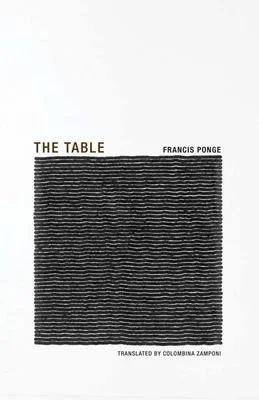
The Table by Francis Ponge (translated by Colombina Zamponi) {Reviewed by THOMAS}

“The table is a faithful friend, but you have to go to it,” writes Francis Ponge, poet of ‘things’, in this extraordinarily subtle little book, written sporadically between 1967 and 1973, on his relationship with the table that lay beneath his elbow whenever he was writing. “The table serves as a support of the body of the writer that I sometimes {try to be | am} so that I don’t collapse (which is what I am doing at this moment) (not for fun) (not for pleasure) (but as a consolation) (so as not to collapse).” A thought may come, or not, and be expressed, or not, perhaps in some relationship with text, a problematic relationship at best, when you think of it, and go, and be perhaps forgotten, more and more commonly forgotten, or the text unread, for even the most-read text lies mostly unread, but the table continues, whatever it is, object or concept, and whatever the relationship between the table and the idea of the table that presses upon, or from, the word Table. The table lies under the work of the writer (the working of the writer), whatever that work might be, the labour of writing is supported by the table, under all writing lies the table. “The table has something of the mother carrying (on four legs) the body of the writer.” Once all the unnecessities have been removed from the act of writing, once the content and the intent have been removed, Ponge finds his table. Because the table is always beneath the writing, all writing is ultimately never on anything other than the table. “As I remember the table (the notion of the table), some table comes under my elbow. As I am wanting to write the table, it comes to my elbow and the same time the notion comes to mind.” If language could mediate the space between the object pressing at his elbow and the concept of the table, if language could allow this object to exist other than merely as the index of the idea that is imposed upon it, Ponge’s patient, precise, careful, playful rigour will approach it certainly closely enough to both deepen and dissolve the concept, to begin to replace ideas with thought. “It takes many words to destroy a concept (or rather to make of this word no longer a concept but a conceptacle).” Ponge’s operations are forensic, and his “table was (and remains) the operating table, the dissecting table.” As a support for the writer, the (t)able represents that which is able to be, and remains uncertain, and not that which must be. “One could say that this Table is nothing other than the substantification of a qualifying suffix, indicating only pure possibility.” All new thought comes from objects, from objects pushing back against the concepts imposed upon them, pushing through the layers of memory and habituation that separate us from them. If the aesthetic is not the opposite of an anaesthetic it is in fact the anaesthetic. Only objects can rescue us from the idea we have of them, but they are hard for us to reach. “The greater my despair, the more intense (necessarily intense) my fixation on the object.” Objects may be reached through the patient, precise, careful, playful abrasion of the language used to describe them, a process known as poetry, an operation Ponge performs upon a table. That which is horizontal is in a state of flux but that which is vertical has been hoisted to the plane of aspiration and display. Viewing the vertical we see that walls are built from bottom to top whereas text is built from top to bottom, but viewing on the horizontal we see that the labour of laying brick by brick and the labour of laying word by word are the same labour, or at least analogous labours. On the horizontal table the relationship between objects and language is co-operative, each operating on the other, each opening and redefining the other on the delimited space of the table. “I will remember you my table, table that was my table, any table, any old table,” writes Ponge of the object whose presence has written this book, but which still remains a presence beyond the language he uses to reach towards it (and he reaches closer to an object than language ordinarily can reach). “I let you survive in the paradise of the unsaid,” he says. Language can be stretched but not escaped. “We are enclosed within our language … but what a marvellous prison,” writes Ponge.
Book of the Week: CHICANES by Clara Schulmann

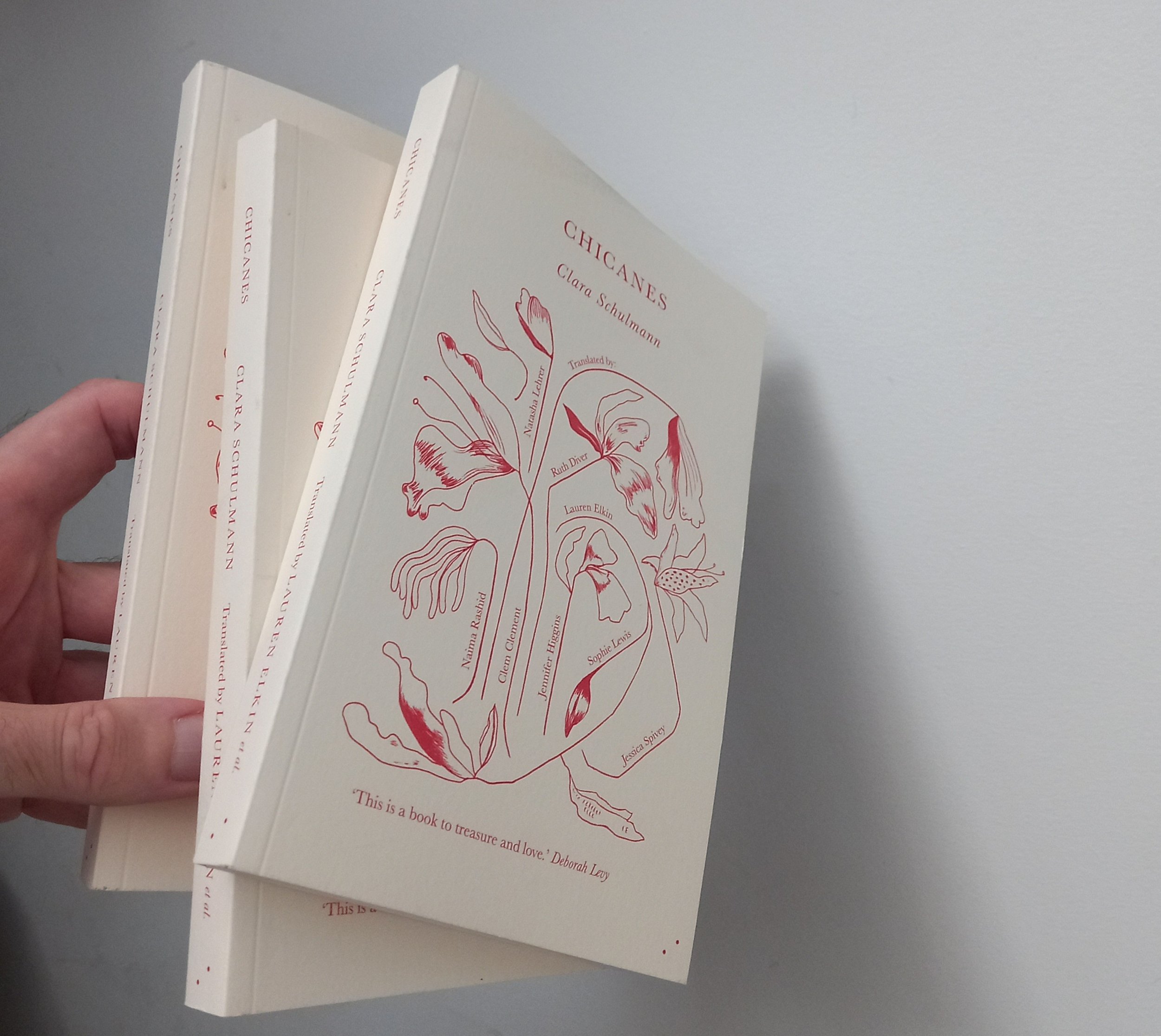
Our Book of the Week, CHICANES by Clara Schulmann, is a collection of short pieces about voice and women’s experience. Schulmann dips and pivots, captures, and lets fly. As well as interrogating the events of her own life (especially the loss of a job and a break-up with a lover), she delves into literature and classics, art and film, exploring how women use their voice and how they are used (or are stigmatised) by their voice. Her digressions move against each other, building questions and ideas. Through a medley of female voices, from anglophone and francophone theorists to the stranger on the street, Schulmann weaves an anarchic, polyphonic essay where wayward words take seed.
>>Read Stella’s review.
>>Many translating voices.
>>The author reads from Zizanies while wearing five different jackets.
>>Your copy of Chicanes.
>>Other excellent books from Les Fugitives (one of our favourite small publishers).

CHICANES by Clara Schulmann — reviewed by Stella

Chicanes by Clara Schulmann (translated from French by Naima Rashid, Natasha Lehrer, Lauren Elkin, Ruth Diver, Jessica Spivey, Jennifer Higgins, Clem Clement and Sophie Lewis) {Reviewed by STELLA}

Looking for some background about author Clara Schulmann, I clicked on a link to a written Q&A. Looking for the ‘translate’ button (not that this is a perfect science on most computers), I happened upon the ‘read aloud’ option. As Chicanes is an investigation into voice, it felt appropriate to listen (even though it’s beyond my understanding of French). The AI failed terribly. Chatbots have been all the rage this week in the news and this failure may bring cheer to some, and amusement to others. This is a segue into a review of Chicanes, a collection of short pieces about voice and women’s experience. Schulmann dips and pivots, captures, and lets fly. She delves into literature and classics, art and film, exploring how women use their voice and how they are used (or stigmatised) by their voice. Her digressions move against each other building questions and ideas under the chapter headings ‘On/Off’, ‘Breathing’, ‘Fatigue’, ‘Overflowing’, ‘Speed’, and ‘Irritation’. The essays and snippets are both personal and critical (feminist theory and art critique are bundled here nicely, without being too pointy-headed; in other words, you can take it as you find it or investigate further), angry, and amusing. Taking her watching (cinema) and reading (essays and fiction), Schulmann drives us, never in a straight line, so we can observe her thinking about voice — its physical, emotional and intellectual power — and its cultural significance. How are women through their voice portrayed in films? Are they mostly silent/ screaming/ husky or simpering? How do women use their voices to protest and complain about inequality? Is it subtle? A pointed yet subtle change in mode or a tirade of small irritations (no time, too many family demands, commonplace sexism at work)? There are so many ideas packed into these short pieces, and they point in further directions and diversions. She quotes writers and draws up a map by which we can navigate her thinking out loud — about voice and in voice. In French the title is Zizanies which translates as discord or disharmony. When we say the word ‘voice’ we are likely to think of harmony or articulation. Yet if we think about the idea of voice as Schulmann has in the context of gender, discord is more than appropriate. The English language title, Chicanes: a sharp double bend, likely with some obstacle; is an apt descriptor also. Interestingly, there are several translators (one for each section), each with their ‘own voice’ interpreting Clara Schulmann’s interpretations. This observation by the author of language and tone (voice) by other writers/artists and then in turn via interpretation gives readers in English another level of voice. And then, in turn, we use our voice in its imperfect way (but probably less imperfectly than a chatbot, as if perfection was even the aim), to reflect our emotional and cultural condition. The book is immersive and curious in the best possible way.

>>Find out more about the book.

New releases (5.5.23)

Wall by Jen Craig $33
A woman returns to Australia to clear out her father's house, with an eye to transforming the contents into an art installation in the tradition of the revered Chinese artist Song Dong. What she hasn't reckoned with is the tangle of jealousies, resentments, and familial complications that she had thought, in leaving the country, she had put behind her — a tangle that ensnares her before she arrives.
Wall is an extraordinarily compacted work of rich complexity, humour, and sadness. Its narrator's steadfast desire to explain herself, to clarify the seemingly unclarifiable, is as close to mirroring the roiling momentum of real consciousness that I've read in a modern novel. When I read Jen Craig I find it impossible to imagine a better way to capture the mysterious workings of the mind — its inadvertent epiphanies, its loose but determined associations, its cruelly recurring entrapments — without writing just like her. But no one else could.” —Shaun Prescott
"Every new novel by Jen Craig is cause for celebration. They are a reminder that literature is still being written in the English language.” —Mauro Javier Cárdenas
>>”Vast ambition and meticulous execution.”
>>’Waste Not’ by Song Dong.
>>’Haze’.
>>Read Thomas’s review of Panthers and the Museum of Fire.

Of Cattle and Men by Ana Paula Maia (translated by Zoë Perry) $38
Animals go mad and men die (accidentally and not) at a slaughterhouse in an impoverished, isolated corner of Brazil. In a landscape worthy of Cormac McCarthy, the river runs septic with blood. Edgar Wilson makes the sign of the cross on the forehead of a cow, then stuns it with a mallet. He does this over and over again, as the stun operator at Senhor Milo's slaughterhouse: reliable, responsible, quietly dispatching cows and following orders, wherever that may take him. It's important to calm the cows, especially now that they seem so unsettled: they have begun to run in panic into walls and over cliffs. Bronco Gil, the foreman, thinks it's a jaguar or a wild boar. Edgar Wilson has other suspicions. But what is certain is that there is something in this desolate corner of Brazil driving men, and animals, to murder and madness. 
"Brutal yet gripping, as if Cormac McCarthy penned an anti-meat noir." —Kirkus
>>Read an extract.

Fungi of Aotearoa: A curious forager’s guide by Liv Sisson, with photographs by Paula Vigus $45
Enter and explore the fascinating world of fungi. In this very clear and informative, practical up-to-date guide, forager and fungus enthusiast Liv Sisson shares her top tips and takes the reader on a journey to discover the unique and diverse fungi Aotearoa has to offer. Discover how to identify the best edible varieties, and how to cook with them, how these incredible organisms have shaped the world as we know it, and the role they are playing in modern medical and environmental research. Featuring full-colour photographs, fun facts and current descriptions of over 130 species (including our brilliant blue national fungus, werewere kokako), Fungi of Aotearoa is packed full of information and advice that will delight armchair enthusiasts, backcountry explorers and budding experts alike.
>>Look inside!

The Patriarchs: How men came to rule by Angela Saini $38
Angela Saini goes in search of the true roots of what we call patriarchy, uncovering a complex history of how it first became embedded in societies and spread across the globe from prehistory into the present.
Travelling to the world's earliest known human settlements, analysing the latest research findings in science and archaeology, and tracing cultural and political histories from the Americas to Asia, she overturns simplistic universal theories to show that what patriarchy is and how far it goes back really depends on where you live. Despite all the push back against sexism, abuse, and discrimination in our own time, even revolutionary efforts to bring about equality have often ended in failure and backlash. Saini ends by asking what part we all play — women included — in keeping patriarchal structures alive, and why we need to look beyond the old grand narratives to understand how it persists in the present.
The Patriarchs is a hopeful, essential read, not just for feminists, but for anyone with a stake in existence. I learned something new on every page of this totally essential book. And for such a serious topic, I was surprised to be greatly entertained too. Angela is the best possible guide.” —Sathnam Sanghera
”Bold, incisive, and beautifully told, The Patriarchs is a truly riveting investigation into the origins and consequences of structural power. The depth and originality of Angela Saini's thought and research is breath-taking, and world-changing. A phenomenally important and deeply enjoyable book.” —Elinor Cleghorn

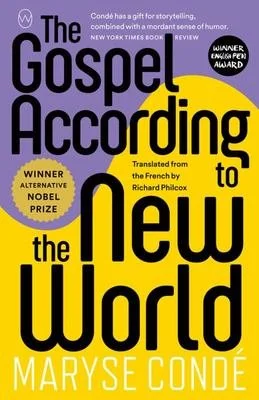
The Gospel According to the New World by Maryse Condé (translated by Richard Philcox $43
A miracle baby is rumoured to be the child of God. Caribbean author Maryse Condé follows his journey in search of his origins and mission. Baby Pascal is strikingly beautiful, brown in complexion, with grey-green eyes like the sea. But where does he come from? Is he really the child of God? So goes the rumour, and many signs throughout his life will cause this theory to gain ground.  From journey to journey and from one community to another, Pascal sets off in search of his origins, trying to understand the meaning of his mission. Will he be able to change the fate of humanity? And what will the New World Gospel reveal? 
”The book borrows from the tradition of magical realism and draws us into a world full of colour and life. This is a book that succeeds in mixing humour with poetry, and depth with lightness.” —judges’ citation, short-listing the book for the 2023 International Booker Prize
>>Read an extract.
>>Intimate enemies.
>>The author’s voice.
>>Other books on the 2023 International Booker Prize short list.

Sewer (‘Object Lessons’ series) by Jessica Leigh Hester $23
What can underground pipes tell us about human eating habits and the spread or containment of disease, such as COVID-19? Why are sewers spitting out plastic and trash into waterways around the world? How are clogs getting gnarlier and more numerous? Jessica Leigh Hester leads readers through the past, present, and future of the system humans have created to deal with our own waste and argues that sewers can be seen as a mirror to the world above at a time when our behaviors are drastically reshaping the environment for the worse. Sifting through the muck offers a fresh way to approach questions about urbanization, public health, infrastructure, ecology, sustainability, and consumerism — and what we value. Without understanding sewers, any attempt to steward the future is incomplete.
>>Other books in the ‘Object Lessons’ series.

The Deck by Fiona Farrell $37
During a time of plague and profound social collapse, a group of friends escape to a house in the country where they entertain themselves by playing music, eating, drinking and telling stories about their lives. The Deck borrows the motifs of Giovanni Boccaccio's 14th-century masterpiece The Decameron to tell the story of another small group gathered in a bay on Banks Peninsula during a time, a little way off in the future, of contagion and global catastrophe. What is the role of fiction, this novel asks, as civilisation falters? What is the point of inventing stories when reality so eclipses what we can imagine?
”The evocative nature writing, the nuanced points of view, and the sharpness and clarity of the non-fiction wraparound sing the The Deck to vivid life. Flashes of wit and humour sparkle through the text. The Deck is a modern masterpiece of invention and curated facts by a writer at the height of her powers, a luminous intelligence and compassion shining forth from every page.” —Aotearoa New Zealand Review of Books
>>Lynn Freeman reviews the book.

Space Crone by Ursula K. Le Guin $45
Witness to the twentieth century’s rebellions and upheavals, including women’s liberation, the civil rights movement and anti-war and environmental activism, Le Guin continued to fight for social and environmental justice throughout her life. The book shows the development of Le Guin’s expansive, multilayered and deeply radical feminist consciousness. Famous for her experiments in imagining society where gender is irrelevant in novels such as The Left Hand of Darkness, Le Guin’s feminism kept ahead of the times to reimagine gender in a non-essentialising way. Her feminism developed from its roots in her ecological, anti-war and anti-nuclear activism, to her self-education about racism and her writing about ageing.

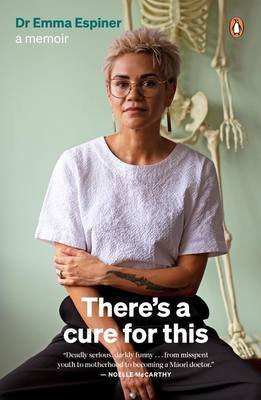
There’s a Cure for This: A memoir by Emma Espiner $35
Encompassing whānau, love, death, '90s action movies and more, Espiner charts her life in a dozen poised, interconnected chapters, from her childhood shuttling between a 'purple lesbian state house and a series of man-alone rentals' to navigating parenthood on her own terms; and from the quietly perceived inequities of her early life to hard-won revelations as a Māori medical student and junior doctor during the Covid-19 pandemic.
>>What makes a doctor?
>>Why become a doctor?

The Road: A story of Romans and ways to the past by Christopher Hadley $38
In the beginning was Watling Street, the first road scored on the land when the invading Romans arrived on a cold and alien Kentish shore in 43 CE. Campaign roads rolled out to all points of the compass, forcing their way inland and as the Britons fell back, the roads pursued them relentlessly, carrying troops, supplies and military despatches. In the years of fighting that followed, as the legions pushed onwards across what is now England, into Wales and north into Scotland in search of booty, mineral wealth, land and tribute, they left behind a vast road network, linking marching camps and forts, changing the landscape, etching the story of the Roman advance into the face of the land, still channelling people’s lives today.

On the Origin of Time: Stephen Hawking’s last theory by Thomas Hertog $40
Perhaps the biggest question Stephen Hawking tried to answer in his extraordinary life was how the universe could have created conditions so perfectly hospitable to life. Pondering this mystery led Hawking to study the big bang origin of the universe, but his early work ran into a crisis when the maths predicted many big bangs producing a multiverse — countless different universes, most of which were far too bizarre to harbour life. Holed up in the theoretical physics department at Cambridge, Stephen Hawking and his friend and collaborator Thomas Hertog worked shoulder to shoulder for twenty years on a new quantum theory of the cosmos. As their discoveries took them deeper into the big bang, they were startled to find a deeper level of evolution in which the physical laws themselves transform and simplify until particles, forces, and even time itself fades away. Once upon a time, perhaps, there was no time. This led them to a revolutionary idea — the laws of physics are not set in stone but are born and co-evolve as the universe they govern takes shape.

Glimpse by Jane Higgins $24
The city authorities have abandoned the D-Zone as damaged beyond repair. It's a no-go area where ongoing earthquakes threaten to destroy what's left. But Jonah and Bas and everyone else trying to survive in the devastation there can't leave-they're 'illegals', without citizenship, without rights. Jonah can see the quakes - before the ground shudders and grinds, before the buildings fall. Glimpsing is a rare ability and a great survival asset. It has attracted the attention of the entertainment company GlimpseCorp and the cult movement People for a New Nation. Both are desperate to control and cash in on this remarkable power. When Bas joins People for a New Nation and disappears, Jonah knows his friend is in great danger. And he knows that GlimpseCorp, with its reality TV program, offers a way to save him-and a way to bring new hope to the people of the D-Zone. But Jonah's plan puts everything, including his own life, at risk.

The Sparrow by Tessa Duder $22
In September 1840, two ships arrive on the shores of the Waitemata Harbour to establish Auckland, the new capital of New Zealand. Among the settlers on board the Platina is young Harry, travelling alone and determined to return to family in England. But the more immediate challenge is finding food and shelter - and hiding the truth about Harry's real identity and what was left behind in Van Diemen's Land.

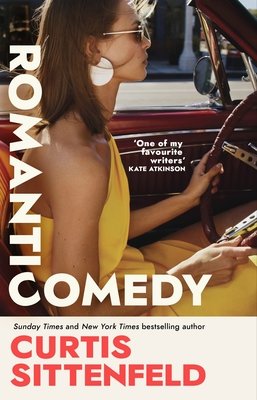
Romantic Comedy by Curtis Sittenfeld $37
With a series of heartbreaks under her belt, Sally Milz — successful TV script writer for a legendary late-night TV comedy show — has long abandoned the search for love. But when her friend and fellow writer begins to date a glamorous actress, he joins the growing club of interesting but average-looking men who get to date accomplished, beautiful women. Sally channels her annoyance into a sketch, poking fun at this 'social rule'. The reverse never happens for a woman. Then Sally meets Noah, a pop idol with a reputation for dating models. But this isn't a romantic comedy — it's real life. Would someone like him ever date someone like her? Sittenfeld, as always, skewers all our clicheed preconceptions about the dynamics of relationships.
>>”Anyone who ever reads Sittenfeld will read anything she ever writes.” —The Times

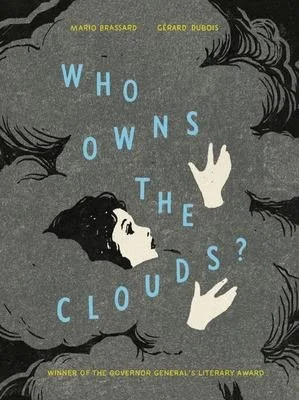
Who Owns the Clouds? by Mario Brassard and Gerard Dubois {Reviewed by STELLA}

Beautifully told and drawn, this story of wartime trauma is delicate and honest. Told through the eyes of Mila as she looks back at her nine-year-old self, it places memory at the centre of the story — both its necessity and its burden. A girl whose life is shattered by war; who has walked a road to escape, who has witnessed things that she couldn’t understand at the time, nor fully assimilate in her adult life, Mila is a thirty-four-year-old woman living in the country her family escaped to, being like any other young woman, but always there is a part of herself that is different. Trauma plays with memory, and memory is unreliable. As she considers the road to the new country, she realises that each member of her small family will have their own telling — their own witness. A reminder to us all, as we witness countless people on the move right now (from our distant remove), seemingly a common story in fact is no more common than our very own existence which we hold dear as our very own. For Mila sees and doesn’t see — she is a witness (and victim of) to the stark tragedy and misery of war, but also protected by her own family and more interestingly by her own psyche. She sleeps and sleeps — an endeavour to keep reality at bay. Told as memory, some elements are removed and others elevated. Objects, in this case the clouds, are used as a tool to articulate this pain, and also as hope for better or more hopeful times. White clouds are to strive towards, away from the black smoke bomb clouds of memory. Cats are to stroke and resurrect gentleness. And perhaps, also innocence. But a new life, even years on, cannot still Mila’s fear of queues or black clouds, but the memory of a brave act can make her smile and look beyond the pain she carries with her. Mario Brassard’s lyrical words and Gerard Dubois's stunning limited palette drawings are an evocative combination. 

>>Look inside!

Book of the Week: GREEK LESSONS by Han Kang

Greek Lessons by Han Kang (translated from Korean by Emily Yae Won and Deborah Smith)

In Han Kang’s much-anticipated new novel, two characters experiencing loss find profound connection through language. In a class in Ancient Greek, a woman who has lost the ability to speak due to losses in her personal life and the tutor who is in the last stages of losing his eyesight find in each other and in the subtleties of the languages in which they are immersed, a new awareness and clarity that will help them overcome their feelings of displacement and alienation. Through language they become accessible to each other — and accessible to us. This slim volume of Han Kang’s crystalline prose is presented as a beautiful hardback.
>>How language misses the mark.
>>Losing language.
>>Solace in language.
>>An intimate connection.
>>I couldn’t bear fiction.
>>Your copy.

New releases 28.4.23

Standing Heavy by GauZ’ (translated by Frank Wynne) $38
Initially a little intrigued, all babies eventually return the security guard's smile. The security guard adores babies. Perhaps because babies do not shoplift. Babies adore the security guard. Perhaps because he does not drag babies to the sales.”
The 1960s — Ferdinand arrives in Paris from Côte d'Ivoire, ready to take on the world and become a big somebody. The 1990s — It is the Golden Age of immigration, and Ossiri and Kassoum navigate a Paris on the brink of momentous change. The 2010s — In a Sephora on the Champs-Élysées, the all-seeing eyes of a security guard observes the habits of those who come to worship at this church to consumerism. Amidst the political bickering of the inhabitants of the Residence for Students from Côte d'Ivoire and the ever-changing landscape of French immigration policy, Ferdinand, Ossiri and Kassoum, two generations of Ivoirians, attempt to make their way as undocumented workers, taking shifts as security at a flour mill. Sharply satirical, political and poignant, Standing Heavy is a searingly witty deconstruction of colonial legacies and capitalist consumption, an unprecedented and unforgettable account of everything that passes under a security guard's gaze. There are fresh ideas and observations of the human condition (so to call it) on every page of this remarkable book, expressed with a concision and humour that may well change the way you think.
Short-listed for the 2023 International Booker Prize.
”A sharp and satirical take on the legacies of French colonial history and life in Paris today. Told in a fast-paced, and fluently translated, style of shifting perspectives, Standing Heavy carries us through the decades.” —International Booker Prize judges’ citation
>>A succession of fictions.
>>Read an extract.
>>The most powerful way of fostering empathy.

May the Tigris Grieve for You by Emilienne Malfatto (translated by Lorna Fox Scott) $34
Rural Iraq, during the war against the Islamic State. A pregnancy out of wedlock. The young woman knows her fate is sealed. In crystalline prose May the Tigris Grieve for You enters the minds of all protagonists, before and after death; fragments of the legend of Gilgamesh, the Mesopotamian hero who carries along the memory of the country and its people, punctuate the family members' short monologues, spaced with the mythical voice of the Tigris River, who has seen it all. Inspired by her experience of Iraq's complex reality and brutal wars, Malfatto delivers an uncompromising yet compassionate insight into a rigid society ruled by fathers and sons, a world in which life matters less than honour.
”A prose poem of devastating power, conveyed in simple devastating prose. It’s about war and loss, conformity and obligation, but most importantly about misogyny, femicide, power, vulnerability, and the injustice of it all. A poignant and thought-provoking novella, that will take you an hour to read, but the inequity at its heart will stay with you for a very, very long time.” —Paul Burke
>>Read the first chapter.

Look at the Lights, My Love by Annie Ernaux (translated by Alison L. Strayer) $35
For half a century, French writer Annie Ernaux (the 2022 Nobel Prize in Literature laureate) has explored stories and subjects often considered unworthy of artistic reflection. In this exquisite meditation, Ernaux turns her attention to the phenomenon of the big-box superstore, a ubiquitous feature of modern life that has received scant attention in literature. Recording her visits to a single superstore in Paris for over a year, Ernaux captures the world that exists within its massive walls. Culture, class, and capitalism converge, reinscribing the individual's role and rank within society while absorbing individuality into the machine of mass consumerism. Through Ernaux's eyes, the superstore emerges as a "great human meeting place, a spectacle," a space where we come into direct contact with difference. She notes the unexpectedly intimate encounters between customers; how our collective desires are dictated by the daily, seasonal, and annual rhythms of the marketplace; and the ways that the built environment reveals the contours of gender and race in contemporary society. With her relentless powers of observation, Annie Ernaux takes the measure of a place we thought we knew, calling us to question the experiences we overlook and to gaze more deeply into ordinary life. 
"Translated from the French with great intelligence and sensitivity by Alison Strayer. Ernaux's diary is a provocation: to accept these life scenes as worthy of our time and attention." —Kate Briggs, Washington Post
"The subject at the heart of Look at the Lights, My Love is what we reveal of ourselves in the strange sterility of the store. Ernaux's singular style conveys both the soullessness and the dreamlike charm of the place." —Tess Little, Literary Review
>>
Alone together.
>>”I don’t see writing as liberation.”
>>Both comfort and alienation.

Pond by Claire-Louise Bennett $32
A deceptively slender volume, Pond captures with utterly mesmerizing virtuosity the interior reality of its unnamed protagonist, a young woman living a singular and mostly solitary existence on the outskirts of a small coastal village. Sidestepping the usual conventions of narrative, it focuses on the details of her daily experience—from the best way to eat porridge or bananas to an encounter with cows—rendered sometimes in story-length, story-like stretches of narrative, sometimes in fragments no longer than a page, but always suffused with the hypersaturated, almost synesthetic intensity of the physical world that we remember from childhood. The effect is of character refracted and ventriloquized by environment, catching as it bounces her longings, frustrations, and disappointments—the ending of an affair, or the ambivalent beginning with a new lover. As the narrator's persona emerges in all its eccentricity, sometimes painfully and often hilariously, we cannot help but see mirrored there our own fraught desires and limitations, and our own fugitive desire, despite everything, to be known. New edition.
”Claire-Louise Bennett sets the conventions of literary fiction ablaze in this ferociously intelligent and funny debut. Don't be fooled by Pond’s small size. It contains multitudes.” —Jenny Offill
”Claire-Louise Bennett is a major writer to be discovered and treasured.” —Deborah Levy
>>Read Thomas’s review.
>>The mind in solitude.
>>Modes of solitude.

Pathogenesis: How germs made history by Jonathan Kennedy $75
Humans did not make history — we were its host. This humbling and revelatory book shows how infectious disease has shaped humanity at every stage, from the first success of Homo sapiens over the equally intelligent Neanderthals to the fall of Rome, and the rise of Islam. How did the Black Death lead to the birth of capitalism? And how did the Industrial Revolution lead to the birth of the welfare state? Infectious diseases are not just something that happens to us, but a part of who we are. The only reason humans don't lay eggs is that a virus long ago inserted itself into our DNA. In fact, 8% of the human genome was put there by viruses. We have been thinking about the survival of the fittest all wrong- human evolution is not simply about our strength and intelligence, but about what viruses can and can't use for their benefit.
Pathogenesis doesn't only cover thousands of years of history - it seeks radically to alter the way the reader views many of the (often very well-known) events it describes.” —Rachel Cooke, Observer
>>
A golden age for microbes.

The Long Form by Kate Briggs $38
It’s early morning and there’s a whole new day ahead. How will it unfold? The baby will feed, hopefully she’ll sleep; Helen looks out of the window. The Long Form is the story of two people composing a day together. It is a day of movements and improvisations, common and uncommon rhythms, stopping and starting again. As the morning progresses, a book – The History of Tom Jones by Henry Fielding – gets delivered, and the scope of the day widens further. Matters of care-work share ground with matters of friendship, housing, translation, aesthetics and creativity. Small incidents of the day revive some of the oldest preoccupations of the novel: the force of social circumstance, the power of names, the meaning of duration and the work of love. With lightness and precision, Kate Briggs renews Henry Fielding’s proposition for what a novel can be, combining fiction and essay to write an extraordinary domestic novel of far-reaching ideas.
The Long Form is an absorbing and profound novel in which Kate Briggs breathes extraordinary life into the quiet moments of a young woman: one who is also a new mother, a reader, a daughter, a friend. With every carefully weighted sentence, action and thought, one is immersed in the radical generosity of this writing, its principles of collectivity and its feminist commitment to making the smallest, most everyday act worthy of consideration within a literary canon. A beautifully written book about the art of reading, of criticism, and of surviving through the strangest yet most normal of times.” —Preti Taneja
Ostensibly about a single day in the lives of a new mother and her infant, The Long Form – with its recursive structure, its subtle connections and reverberations, its attentiveness to physical and social life, and its animated conversation with other works of fiction and theory – presents the novel form as the most elastic of containers. Kate Briggs is a brilliant writer and thinker.” —Kathryn Scanlan
”Briggs is a fantastic writer: that is clear by the end of this eminently strange novel. Briggs has written a work that will constantly reward a re-reading, with a voice that combines a deep complexity with moments of piercing clarity. It is an intelligent and well-read book: but it is also emphatically convincing and moving.” —Patrick Maxwell, The Big Issue

Resilience: A story of persecution, escape, survival, and triumph by Inge Woolf $35
Resilience is a Holocaust story and a New Zealand story. Born to a prosperous Jewish family, Inge Woolf witnessed the Nazis marching into Vienna in March 1938. To escape certain death, the family audaciously boarded a train to the heart of Nazi Germany – Berlin – and from there caught a plane to England, pretending they were going on holiday. Hiding their Jewish identity until after World War II, Inge and her family began a new life as impoverished refugees. A move to New Zealand signalled new beginnings. Inge met the love of her life, Ronald Woolf, and together they created the country's pre-eminent photographic studio. They settled in Wellington, raising two children when tragedy struck again with Ron killed at age 57 in a helicopter crash in 1987. Resilience is ultimately the story of a woman who harnessed her past and used it to encourage a more cohesive, inclusive society. In her later years, Inge was pivotal in establishing the Holocaust Centre of New Zealand and was its founding director. She educated thousands on the Holocaust and the dangers of antisemitism, racism and prejudice, often observing that hate starts small. She was often called on by the media to comment about antisemitism and would speak freely about the need to remember the lessons learned from the Nazi genocide.
>>Woolf’s daughter speaks about the book.

Mala’s Cat by Mala Kacenberg $26
Alone in a forest with only a cat for company, this is the true story of a little girl's remarkable survival in the shadow of the Holocaust. Growing up in the Polish village of Tarnogrod on the fringes of a deep pine forest has given twelve-year-old Mala Szorer the happiest childhood she could have hoped for. But, as the German invasion begins, her beloved village becomes a ghetto and her family and friends reduced to starvation, she takes matters into her own hands, bravely removes her yellow star and sneaks out to the surrounding villages to barter for food. It is on her way back that she sees her loved ones rounded up for deportation, and receives a smuggled letter from her sister warning her to stay away. With only her cat, Malach, and the strength of the stories taught by her family, she walks away from her village and everything she holds dear into the dangerous unknown. Malach becomes her family, her protector, her only respite from painful loneliness, and a reminder to stay hopeful even when faced with unfathomable darkness.
”Fresh, unsentimental and utterly unpredictable, this memoir, rescued from obscurity by the efforts of Mala Kacenberg's five children, should be read and cherished as a new, vital document of a history that must never be allowed to vanish.” —The New York Times
>>
Mounting horrors.

Questions I am Asked about the holocaust (young readers’ edition) by Hédi Fried (translated by Alice E. Olsson) $30
Hedi Fried was nineteen when the Nazis arrested her family and transported them to Auschwitz. While there, apart from enduring the daily horrors at the concentration camp, she and her sister were forced into hard labour before being released at the end of the war. After settling in Sweden, Hedi devoted her life to educating young people about the Holocaust. In her 90s, she decided to take the most common questions (such as: "Why did you not fight back?"; "What helped you to survive?"; "Are you able to forgive?"), and her answers, and turn them into a book so that children all over the world could understand what had happened. This is an excellent illustrated edition for young readers.
>>Look inside.

Enter Ghost by Isabella Hammad $38
After years away from her family's homeland, and healing from an affair with an established director, stage actress Sonia Nasir returns to Palestine to visit her older sister Haneen. Though the siblings grew up spending summers at their family home in Haifa, Sonia hasn't been back since the second intifada and the deaths of her grandparents. While Haneen stayed and made a life commuting to Tel Aviv to teach at the university, Sonia remained in London to focus on her burgeoning acting career and now dissolute marriage. On her return, she finds her relationship to Palestine is fragile, both bone-deep and new. Once at Haneen's, Sonia meets the charismatic and candid Mariam, a local director, and finds herself roped into a production of Hamlet in the West Bank. Soon, Sonia is rehearsing Gertude's lines in classical Arabic and spending more time in Ramallah than in Haifa with a dedicated group of men who, in spite of competing egos and priorities, each want to bring Shakespeare to that side of the wall. As opening night draws closer it becomes clear just how many invasive and violent obstacles stand before a troupe of Palestinian actors. Amidst it all, the life Sonia once knew starts to give way to the daunting, exhilarating possibility of finding a new self in her ancestral home.
”Outstanding. Aesthetically, intellectually, emotionally and culturally satisfying. It is astonishing but true that Isabella Hammad is incapable of striking a false note. She immerses her heroine in volatile territory with the accuracy, compassion and coolness of a surgical knife sliding into a diseased body. The result is a stunning beauty — an eye-opening, uplifting novel that grants its vulnerable cast and their endeavors a rare and graceful dignity.” —Leila Aboulela

Aftermath: Colonialism, violence and memory in Australia, New Zealand and the Pacific edited by Angela Wanhalla, Lyndall Ryan and Camille Nurka $50
”What we choose to remember and what we choose to forget about the violent past tell us something about the society we live in now. Whether we like it or not, we’re part of each other’s story. So how do we talk about the past?“ —Joanna Kidman and Vincent O’Malley
Aftermaths explores the life-changing intergenerational effects of colonial violence in Aotearoa New Zealand, Australia and the Pacific. The settings of these accessible, illustrated short essays range from Ōrākau pā in the Waikato to the Kimberleys in northwest Australia, from orphanages in Fiji to the ancestral lands of the Wiyot Tribe in Northern California. Contributors include: Tony Ballantyne, Rachel Burgess, Penelope Edmonds, Anaru Eketone, Stephanie Gilbert, Victoria Haskins, Anna Johnston, Joanna Kidman, Shino Konishi, Jane Lydon, Caitlin Lynch, Keri Mills, Kirstine Moffat, Grace Moore, Amanda Nettelbeck, Erica Newman, Camille Nurka, Patricia O’Brien, Vincent O’Malley, Lachy Paterson, Lyndall Ryan, Sian Smith, Kate Stevens and Angela Wanhalla.
“Story by story, this collection powerfully reveals the living legacy of historical events, showing how they have been remembered (and misremembered) within families and communities into the present day.
'It is a rare publication that can cross the difficult divide between academic history and accessible reading. Every chapter is well-written and evocative. Aftermaths will open eyes. Aftermaths makes a powerful case for ending our historical ignorance. It forces readers to confront the violence embedded in our collective colonial past and it reveals the many reverberations of that violence in our present. It also asks us to unbury the skeletons in our own closets and fairly carry our share of this ‘emotional freight’ and trauma. It asks us to be brave and unchain our dragons.” —Maartje Abbenhuis, Aotearoa New Zealand Review of Books

Laughing in the Dark by Barbara Else $40
By the time Barbara Else was in her forties, she was married to a globally recognised academic physician, had two beautiful teenage daughters and a house in Karori. Gradually she realised her husband didn't want her to have a career of her own or do anything outside his orbit. He refused to acknowledge there was a problem. In the end, the man who became her second husband offered a way out. It was a huge risk. But she fled, with a laundry basket of oddments, two suitcases, and her little Mac Plus and dot matrix printer. The result was best-selling books and literary honours. With her wit and humour, Barbara describes her transformation from a shy but stubborn child into a fulfilled and successful adult.
”I laughed and laughed, and I cried and cried. It's got everything in it except a murder.” —Lesley Graham, soprano (and totally unbiased sister)
>>It’s been quite a ride.

Abigail and the Making of the Moon by Matthew Cunningham and Sarah Wilkins $21
One clear day, Abigail thinks of a question and knows that she won't be able to do anything else if she doesn't have an answer to it. "Daddy," she asked, "where did the Moon come from?""From the Earth, Abigail," replied Daddy. "The Moon was once a part of the Earth.""It was?" Abigail asked. "But how did it get in the sky? And how does it stay in the sky? And why do we only ever see one side of the Moon?" What follows is an evocatively simple story within a story explaining how the newborn Earth collided with another planet, and how gravity acts like invisible hands reaching out and keeping the Moon spinning around the Earth, the Earth spinning around the Sun, and the Sun spinning around the galaxy. And of course by dinner time, Abigail has thought of a new big question...

Pond by Claire-Louise Bennett {Reviewed by THOMAS}
“English, strictly speaking, is not my first language by the way. I haven’t yet discovered what my first language is so for the time being I use English words in order to say things.” Always hinting at experience just beyond the reach of language, Bennett's remarkable book is impelled by the rigours of noticing. Encounters with persons and with the infraordinary are treated with equivalence: acute, highly acute, overly acute, observations immediately plunge the narrator’s awareness into the depths of her response (“My head is turned by imagined elsewheres and hardly at all by present circumstances.”), far from the surface at which outward contact may be made, or may be being made, a process that is both deeply isolating, terrifying and protective. Bennett’s unsparingly acute observations of the usually unacknowledged or unacknowledgeable motivations, urges and responses that underlie human interaction and quotidian existence seem here induced by an acceptance or a resignation that is enabled by despair, or is indistinguishable from despair, both a resignation and a panic, perhaps, a panic on the edge of self-dissolution which is perhaps our last resistance to self-dissolution and therefore fundamental to individual existence: the anxiety which all human activity is designed to conceal. Bennett’s is a very individual voice (click here to hear her read a sample), resonating at times with other works of irredeemably isolated interiority, such David Markson’s superb Wittgenstein’s Mistress or the suppressed hysteria of Thomas Bernhard’s narrators, but tracking entirely her own patterns of thought (I have perhaps made an error here of conflating the author with the narrator, but, if this is an error, it is one hard to avoid in the book in which style and content are inseparable) with an immediacy that precludes the artificially patterning, pseudo-assimilable explanation of a ‘story’. In one excellent section, ‘Control Knobs’, the narrator describes the gradual disintegration of the three knobs that control her cooker and speculates a coming time when the last interchangeable knob breaks and the cooker will become unusable. This reminds her of the counted matches in Marlen Haushofer’s The Wall (another novel of irredeemably isolated interiority), which mark the time to the point at which that narrator will no longer be able to light a fire to cook and warm herself. Following a discussion of Bennett’s narrator’s reading and misreading of that book, she returns to an account of the ultimate hopelessness of her attempts to procure new knobs for her cooker. “I feel at a loss for about ten minutes and it’s a sensation, I realise, not dissimilar to indifference. So, naturally, I handle it rather well.”

AUGUST BLUE by Deborah Levy {reviewed by Stella}

August Blue by Deborah Levy {Reviewed by STELLA}
August Blue is an enigmatic novel. It’s sparsely written, with evocative sentences, yet crisp ideas. Elsa, a famous concert pianist, has walked off the stage in humiliation and is now traveling Europe teaching music to anyone who will have her. Her downfall extremely public; her inner world in turmoil. From the outset, Elsa would like you to believe she has a devil-may-care attitude towards her crisis, but it doesn’t take too much picking at a wound to see her hurt and confusion. But let’s put aside her parentage (or rather abandonment), let’s put aside her recently dyed blue hair, let’s put aside her craving to be free of expectation; for Levy does something from the outset — she sets a perpetual question mark at the centre of this story which underscores each page. Who is the woman in the Athens marketplace? Someone so familiar that the viewer and the viewed are compelled to see each other, to be drawn inexplicably to each other in spite of an enticing rivalry. Doppelganger or mirror image? Familiar or stranger? The same, but different, or not really there at all? A desire, all-consuming. Elsa is drawn to the woman who steals the mechanical horses from under her nose; whose acquisition sends her on an obsessive quest to have the horses as her right, and, when she can’t have them, stealing the woman’s hat is the next best thing to possess, as if possessing this hat binds the two strangers to each other. And maybe it does. Elsa’s flagrant wearing of the trilby is a flag to wave in provocation: Here I am, and you better not forget it — I’m coming for my horses. It’s 2020 and the pandemic is set to lock in. Elsa, back in London, finds a different pattern to live by — an enforced schedule, or non-schedule that will ring familiar to many. That strange time/non-time, of lengthening and shortening; a strange mix of frustration and contentment somehow co-existing, spiked with uncertainty. In August Blue, Levy uses this out-of-time moment in history to best effect in her novel about a woman in limbo. Moving between Greece, Paris, London, and Sardinia (where Elsa visits her maestro in his final months), Levy uses this movement to jointly discombobulate — reflecting Elsa’s fractured state as well as giving us, the reader, mere episodic moments with Elsa, as though we are allowed only glances into her life. In this novel, readers of Levy’s other novels will recognise the themes of mothers and daughters (Hot Milk), of heat as an oppressor as well as an escape (Swimming Home), and enigmatic actions (The Man Who Saw Everything) but will see a change in the telling. Levy seems to draw her memoir style (from her 'Living Autobiography' trilogy) into this novel, creating a fiction that has few boundaries — that impregnates itself into the reader with an ease that is beguiling, so that you are continually entering and re-entering the story, learning a little more each time, but nothing at all — yet paradoxically knowing everything, as if starting again is the only option towards understanding, if that is possible when facing oneself. 

Minor Detail by Adania Shibli (translated by Elisabeth Jacquette) {Reviewed by THOMAS}
Sand absorbs water poured upon it just as it absorbs blood spilt upon it and the actions committed upon it. Where does this water, this blood, and where do these actions go? Can they be recovered? How do they return? Adania Shibli’s remarkable novel is comprised of two parts. The first, told in the third person, describes with elegant impassivity and equivalence the actions and movements of an officer in the Israeli army in the Naqab/Negev desert during the 1948-49 Naqba/War of Independence. Although we gain no access to his thoughts (how could we gain access to his thoughts, after all?), we are witness to his obsessive washing routines, his watchfulness for spiders and insects within his hut and his destruction of them, his tending of a festering spider bite on his thigh, his journeys into the surrounding desert either in vehicles with his soldiers, using maps, searching for Arab ‘insurgents’, or alone, on foot around the camp, following the topography. The other soldiers have no reachable dimension other than being soldiers because any such dimensions would be irrelevant. The officer is the only one who speaks, and that hardly at all except for a long lecture expressing the view that the desert is a wasteland that can be made fertile when cleansed of its current inhabitants. As the rituals of army life are repeated and repeated, the tension builds beneath the narrative. The soldiers come across a group of unarmed Bedouin at an oasis and kill them and their camels, taking a dog and a young woman back to the camp. Their mistreatment of her, culminating in gang rape and later her murder and burial near the camp, can be felt in the narrative long before they occur. The howling dog witness shifts the first section of the book to the second, where a howling dog keeps the first-person narrator awake at night in her house in contemporary Ramallah. She has become obsessed with the fate of the young woman, which she has read about in a newspaper article, and by “the conviction that I can uncover details about the rape and murder as the girl experienced it, not relying on what the soldiers who committed it disclosed.” What happens to those who have no agency in their own story? The narrator cannot accept that the young woman is “a nobody who will forever remain a nobody whose voice nobody will hear,” and, with a borrowed ID, which will help her to enter different areas, and a rented car, one weekend she sets out to see if she can find out more. She takes a pile of maps: the official Israeli maps that show the roads, checkpoints, settlements and army zones in the Negev but do not mark even still-existing Palestinian settlements, and maps of the Naqab before 1948, which give information possibly relevant to her search. Maps are a way in which power imprints itself on territory, and Shibli spends a great deal of careful attention in both parts of the novel to the movements of her main characters over the land, contrasting the movement associated with maps with that concerned with and guided by the terrain. These different ways of moving have, for each of them, quite different results. The movements of the officer in the first section imprints power upon a territory, a pattern traced by the woman in the second section over land that holds the trace of violence in itself. The past is never left behind though it can never be recovered, either. In the first part, the officer has complete ease of movement, heading wherever he wishes, inside or out; in the second part the narrator has her movement checked and restricted wherever she goes (until she reaches the Naqab). “The borders imposed between things here are many. One must pay attention to them, and navigate them, which ultimately protects everyone from perilous consequences,” she notes, waiting at the checkpoints in the wall that divides the territory. “There are some who consider focusing on minor details as the only way to arrive at the truth, and therefore proof of its existence, to reconstruct an incident one has never witnessed simply by noticing little details that everyone else finds to be insignificant,” she says, as a reason for her search. This may be true, but if such minor details exist their significance may also be unrecognised by the searcher. In the military museum that she visits, the only ‘evidence’ is the soap, the jerrycans, the uniforms, the vehicles and the weapons mentioned in the first part. Intention leaves no residue. Also these objects constitute the majority of the soldiers’ experience, given how little the woman meant to them. Part of the narrator’s and Shibli’s project is to uncover the particular from the general, the experience from the history. Although both she and the author bewail injustice, the narrator shows no enmity towards any of the people she meets, all are treated with sympathy; harm arises only from structures of power. Power withdraws the evidence of its actions, hides its victims, disappears into the understructure of everyday life. There is no residue unless the land holds a residue. The second half of the book is lightly told, in keeping with the personality of its narrator, and often funny (she describes a film rewinding in a museum and the settlers dismantling their houses). She visits the settlement with the name of the place where the crime occurred and learns that the actual place is near by, she visits the place and finds nothing of interest, she walks through the surrounding plantations where the desert has been made fertile, but is frightened back by a dog. “I am here in vain,” she says. “I haven’t found anything I’ve been looking for, and this journey hasn’t added anything to what I knew about the incident when I started out.” Reluctant to return to Ramallah, she drives back and forth in the desert, gives a ride to an old woman, and then decides to follow her through a military zone, where she comes across an oasis. The land has drawn her to the core of her quest, but she has no way of recognising it as such, and she does not expect that her quest will be, still unknowingly, fulfilled in the last sentence of the book. 

Book of the Week: SHY by Max Porter

In Shy, Max Porter again shows an incredible ability to get completely inside the head of his narrator, his spare and unconventionally effective prose delivering us an experience that enlarges our empathy and understanding. Shy is a young man who is both damaged and damaging, troubled and troubling, inmate of the residential institution Last Chance but also creature of a pervasive trope of masculinity. Shy is suffering; people want to help him, but can he be helped? What can he find inside him that can help him find his footing? An affecting and humane short novel, presented as a beautiful hardback. 
>>Absolute horror at the political present
>>Men and masculinity.
>>Lucky.
>>Entering the hinterland
>>His father’s voice.
>>Are novels miniature villages?
>>Pebbles.
>>Read our reviews of Lanny.
>>Read Thomas's review of The Death of Francis Bacon
>>Grief Is the Thing With Feathers
>>Your copy of Shy.

NEW RELEASES (21.4.23)

Greek Lessons by Han Kang (translated from Korean by Emily Yae Woon and Deborah Smith) $40
In a classroom in Seoul, a young woman watches her Greek language teacher at the blackboard. She tries to speak but has lost her voice. Her teacher finds himself drawn to the silent woman, for day by day he is losing his sight. Soon they discover a deeper pain binds them together. For her, in the space of just a few months, she has lost both her mother and the custody battle for her nine-year-old son. For him, it's the pain of growing up between Korea and Germany, being torn between two cultures and languages. Greek Lessons tells the story of two ordinary people brought together at a moment of private anguish - the fading light of a man losing his vision meeting the silence of a woman who has lost her language. Yet these are the very things that draw them to one another. Slowly the two discover a profound sense of unity — their voices intersecting with startling beauty, as they move from darkness to light, from silence to expression.
>>How language misses the mark.
>>Losing language.

Praiseworthy by Alexis Wright $45
The much-anticipated new novel from one of Australia’s outstanding authors. Praiseworthy is an epic set in the north of Australia, told with the richness of language and scale of imagery for which Alexis Wright has become renowned. In a small town dominated by a haze cloud, which heralds both an ecological catastrophe and a gathering of the ancestors, a crazed visionary seeks out donkeys as the solution to the global climate crisis and the economic dependency of the Aboriginal people. His wife seeks solace from his madness in following the dance of butterflies and scouring the internet to find out how she can seek repatriation for her Aboriginal/Chinese family to China. One of their sons, called Aboriginal Sovereignty, is determined to commit suicide after being labelled a paedophile. The other, Tommyhawk, wishes his brother dead so that he can pursue his dream of becoming white and powerful. When the town is overrun by donkeys, the residents and their strange religious sects react with anger, led by the Mayor, the albino Aboriginal named Ice Pick, and his outlandishly dressed groupie women. This is a novel which pushes allegory and language to its limits, a cry of outrage against oppression and disadvantage, and a fable for the end of days.
”I’m awed by the range, experiment and political intelligence of Alexis Wright’s work, from fiction such as Carpentaria and The Swan Book, to her ‘collective memoir’ of an Aboriginal elder in Tracker. As essayist, activist, novelist and oral historian she is vital on the subject of land and people.” — Robert Macfarlane, New York Times Book Review
>>Sovereignty of the imagination.

Participation by Anna Moschovakis $35
When the weather revolts, certainties dissolve and binaries blur as members of two reading groups converge at the intersection of theory and practice to reshape their lives, relationships, and reality itself. In Anna Moschovakis’s novel, two reading groups, unofficially called Love and Anti-Love, falter amidst political friction and signs of environmental collapse. Participation offers a prescient look at communication in a time of rupture: anonymous participants exchange fantasies and ruminations, and relationships develop and unravel. As the groups consider—or neglect—their syllabi, and connections between members deepen, a mentor disappears, a translator questions his role, a colleague known as ‘the capitalist’ becomes a point of fixation, and "the news reports" filter through in fragments. With incisive prose and surprising structural shifts, Participation forms an alluring vision of community, and a love story like no other.
”Moschovakis's take on what it means to form community in opposition to the expectations of hierarchy, anticipated outcome, or even narrative feels timely, perhaps even prescient, in an era when the only thing that seems constant is the incontrovertible need for change. Densely intellectual, the novel forces an alert reader to reconsider what it means to participate in the very act of reading.” —Kirkus

Is Mother Dead by Vigdis Hjorth (translated from Norwegian by Charlotte Barslund) $30
'To mother is to murder, or close enough', thinks Johanna, as she looks at the spelling of the two words in Norwegian. She's recently widowed and back in Oslo after a long absence as she prepares for a retrospective of her art. The subject of her work is motherhood and some of her more controversial paintings have brought about a dramatic rift between parent and child. This new proximity, after decades of acrimonious absence, set both women on edge, and before too long Johanna finds her mother stalking her thoughts, and Johanna starts stalking her mother's house.
Long-listed for the 2021 International Booker Prize.
”A darkly insightful examination of mother-daughter relationships that captivates with the suspense of a thriller. The novel's strength lies in its deft use of psychological analysis as it looks at this relationship through one lens after another.” —Kirkus Reviews
>>”The relationship between mother and child is a never-ending story.”
>>Read an extract.
>>”The better I translate, the more I erase myself.”

How Our Solar System Began: The planets, their moons, and beyond by Aina Bestard $45
We live in an amazing planetary system! From the yawning Valles Marineris on Mars and the ocean hiding beneath the ice crust of Jupiter's moon Europa, to the eerily Earth-like terrain of Saturn's moon Titan and the Sun's blazing corona, our solar system brims with wonders. This beautiful large-format book takes children on a trip across the Solar System with the aid of marvellous illustrations, lift-up flaps and a comprehensive text that helps them understand the amazing variety of landscapes within our planetary system. Lift up the layers to discover how the Sun was formed and explore the amazing landscapes of our neighbouring planets. Readers will find out which moons are the most like the Earth, what Saturn's rings are made of, where comets come from, and what lies in the Kuiper Belt, outside the very edge of the solar system.
>>Look inside!

The West: A new history of an old idea by Naoise Mac Sweeney $40
Many assume ‘Western Civilisation’ derives from a cultural inheritance that stretches back to classical antiquity, a golden thread that binds us from Plato to NATO. But what if all this is wrong? What if the Western world does not have its ultimate origins in a single cultural bloodline but rather a messy bramble of ancestors and influences? What if ‘The West’ is just an idea that has been invented, co-opted, and mythologised to serve different purposes through history? As battles over privilege, identity and prejudice rock the cultural wars, it's never been more important to understand how the concept of The West came to be. This book shows how the idea of the West was created, how it has been used to justify imperialism and racism, and also why it's still a powerful ideological tool to understand our world. Told through the lives of fourteen fascinating historical figures — from a powerful Roman matriarch to an Islamic scholar, from a crusading Greek soldier to a founding father of the United States, from a slave girl in the new Americas to a British prime minister — it casts a new light on how ‘The West’ was invented, embraced, rejected and re-imagined to shape our world today.
”One by one she takes on hoary old myths, explodes them with panache, and leaves us instead with a richer, fuller understanding of epochs, worldviews and fascinating individuals from the past. Lots of people will enjoy this clever and thought-provoking account.” —Guardian
”A bold, sweeping bird's-eye view of thousands of years of history that provides a truly global perspective of the past. A fantastic achievement.” —Peter Frankopan
>>Disjunctions between fact and fiction.

Cursed Bread by Sophie Mackintosh $37
In 1951, the small French town of Pont-Saint-Esprit succumbed to a mass poisoning. The poison induced hysteria, violent and euphoric hallucinations, and many deaths. In the years before the disaster, there lived in the town a woman named Elodie. She was the baker's wife — a plain, unremarkable person who yearned to transcend her dull existence. So when a charismatic new couple arrived in town, Elodie quickly fell under their glamorous spell. Thus began a dangerous game of cat and mouse, the intoxication of the chase slowly seeping into everything — but who was the predator and on whom did they prey?
”A shimmering fever-dream of a novel, teasing the reader while finding a fresh narrative framework for the relationship between monotonous small-town life and repressed female desire. Cursed Bread contains more riches than many a novel twice its length.” —Telegraph
”A quietly rich maturation of Mackintosh's skill. This is a book about the power desire and greed exert over reality and memory. Mackintosh has entered a brilliant new stage of writing.” —Guardian
>>The town that went insane.

Mushroom (‘Object Lessons’ series) by Sara Rich $23
They are the things we step on without noticing and the largest organisms on Earth. They are symbols of inexplicable growth and excruciating misery. They are grouped with plants, but they behave more like animals. In their inscrutability, mushrooms are wondrous organisms. The mushroom is an ordinary object whose encounters with humans are usually limited to a couple of species prepackaged at the grocery store. This book offers mushrooms as much more than a pasta ingredient or trendy coffee alternative. It presents these objects as the firmament for life as we know it, enablers of mystical traditions, menders of minds lost to depression. But it acknowledges, too, that this firmament only exists because of death and rot. Rummaging through philosophical, literary, medical, ecological, and anthropological texts only serves to confirm what the average forager already knows: that mushrooms are to be regarded with a reverence deserving of only the most powerful entities: those who create and destroy, and thrive on both.
>>Other books in the excellent ‘Object Lessons’ series.

Saving Time: Discovering a life beyond the clock by Jenny Odell $40
In her first book, How to Do Nothing, Jenny Odell wrote about the importance of disconnecting from the ‘attention economy’ to spend time in quiet contemplation. But what if you don’t have time to spend? In order to answer this seemingly simple question, Odell took a deep dive into the fundamental structure of our society and found that the clock we live by was built for profit, not people. This is why our lives, even in leisure, have come to seem like a series of moments to be bought, sold, and processed ever more efficiently. Odell shows us how our painful relationship to time is inextricably connected not only to persisting social inequities but to the climate crisis, existential dread, and a lethal fatalism. As planet-bound animals, we live inside shortening and lengthening days alongside gardens growing, birds migrating, and cliffs eroding; the stretchy quality of waiting and desire; the way the present may suddenly feel marbled with childhood memory; the slow but sure procession of a pregnancy; the time it takes to heal from injuries. Odell urges us to become stewards of these different rhythms of life in which time is not reducible to standardised units and instead forms the very medium of possibility.
>>A radical act.

Still Life With Bones: Field notes on forensics and loss by Alexa Hagerty $38
An anthropologist working with forensic teams and victims' families to investigate crimes against humanity in Latin America explores what science can tell us about the lives of the dead in this haunting account of grief, the power of ritual, and a quest for justice. "Exhumation can divide brothers and restore fathers, open old wounds and open the possibility of regeneration-of building something new with the pile of broken mirrors that is loss and mourning." Over the course of Guatemala's thirty-year armed conflict -the longest ever in Central America-over 200,000 people were killed. During Argentina's military dictatorship in the seventies, over 30,000 people were disappeared. Today, forensic anthropologists in each country are gathering evidence to prove atrocities and seek justice. But these teams do more than just study skeletons—they work to repair families and countries torn apart by violence.
”When Hagerty talks about ‘lives being violently made into bones’, I defy you not to be moved. The text is unflinching, but then the crimes and the victims deserve nothing less. I guarantee this will make you think long and hard about cruelty and human rights and the dedication and humanity of the forensic scientist." — Sue Black

Abolition. Feminism. Now. by Angela Davis, Erica Meiners, Beth Ritchie, and Gina Dent $28
Abolitionism and feminism stand shoulder-to-shoulder in fighting a common cause—the end of the carceral state, with its key role in perpetuating violence, both public and private, in prisons, in police forces, and in people's homes. As these four scholars assert, abolitionist theories and practices are at their most compelling when they are feminist; and a feminism that is also abolitionist is the most inclusive and persuasive version of feminism for these times.

Blue Jeans (‘Object Lessons’ series) by Carolyn Purnell $23
Few clothing items are as ubiquitous or casual as blue jeans. Yet, their simplicity is deceptive. Blue jeans are nothing if not an exercise in opposites. Americans have accepted jeans as a symbol of their culture, but today jeans are a global consumer product category. Levi Strauss made blue jeans in the 1870s to withstand the hard work of mining, but denim has since become the epitome of leisure. In the 1950s, celebrities like Marlon Brando transformed the utilitarian clothing of industrial labor into a glamorous statement of youthful rebellion, and now, you can find jeans on chic fashion runways. For some, indigo blue might be the color of freedom, but for workers who have produced the dye, it has often been a color of oppression and tyranny. Blue Jeans considers the versatility of this iconic garment and investigates what makes denim a universal signifier, ready to fit any context, meaning, and body.
>>Other books in the excellent ‘Object Lessons’ series.

The Real Work: On the mystery of mastery by Adam Gopnik $38
For decades, Adam Gopnik has been a perceptive critic of art, food, France, and more. But recently, he became obsessed by a fundamental matter: How did the people he was writing about learn their outlandish skill, whether it was drawing a nude or baking a sourdough loaf? In The Real Work—his title the term magicians use for the accumulated craft that makes for a great trick—Gopnik apprentices himself to an artist, a dancer, a boxer, and even a driving instructor (from the DMV), among others, trying his late-middle-age hand at things he assumed were beyond him. He finds that mastering a skill is a process of methodically breaking down and building up, piece by piece—and that true mastery, in any field, requires mastering other people's minds.
”Among the uplifting pleasures of Gopnik's writing is the range and ardour of his enthusiasms. If his only truly fanatical pursuit is making sentences, he seems to intuit that his best ones — his truest — are those that are unselfconsciously committed to their subject, and vitalised by the passionate curiosity that also reins them in.” —New Statesman
A springboard for a discussion of art, family, empathy, mortality. Via memoir, analysis and criticism he assembles a celebration of the flaws that make us human. Gopnik is at his most moving when addressing the limited time we have on Earth.” —Guardian
>>How we gain new skills.

Andaza: A memoir of food, flavour and freedom in the Pakistani kitchen by Sumayya Usmani $50
Usmani conjures a story of what it was like growing up in Pakistan and how the women in her life inspired her to trust her instincts in the kitchen. From a young age, food was Sumayya's portal to nurturing, love and self-expression. She spent the first eight years of her life at sea, with a father who captained merchant ships and a mother who preferred to cook for the family herself on a tiny electric stove in their cabin rather than eat in the officer's mess. When the family moved to Karachi, Sumayya grew up torn between the social expectations of life as a young girl in Pakistan, and the inspiration she felt in the kitchen, watching her mother, and her Nani Mummy (maternal grandmother) and Dadi's (paternal grandmother) confidence, intuition and effortless ability to build complex, layered flavours in their cooking. This food memoir — which includes the most meaningful recipes of Sumayya's childhood — tells the story of how Sumayya's self-belief grew throughout her young life, allowing her to trust her instincts and find her own path between the expectations of following in her father's footsteps as a lawyer and the pressures of a Pakistani woman's presumed place in the household.
”Sumayya Usmani is a brilliant storyteller. She transports us with her delicious descriptions of the smells and flavours of the kitchen.” —Jay Rayner
>>Look inside.
>>When spice hits the oil.

What’s That, Jack? by Cédric Ramadier and Vincent Bourgeau $30
Jack and George are resting quietly when BOOM! A huge and strange ball lands beside them. "What's that, Jack?" "I don't know, George. Maybe it's a rock?" No—too soft. But it rolls. Fast! Jack, George and the ball roll right off the cliff and now it's a parachute. But watch out, they're going to land in the river! Jack and George have a brilliant day full of adventure with this object that changes with the landscape, then turns into a blanket to keep them warm.

BLUE SELF-PORTRAIT by Noémi Lefebvre — reviewed by Thomas

Blue Self-Portrait by Noémi Lefebvre (translated from French by Sophie Lewis)  {Reviewed by THOMAS}
It takes approximately an hour and a half to fly from Berlin to Paris. Upon that hour and a half, a human memory, especially one working at neurotically obsessive speed, can loop a very large amount of time indeed, an hour and a half is plenty of time to go over and go over the things, or several of the things, the unassimilable things, that happened in Berlin, in an attempt to assimilate those things, although they are not assimilable, in an attempt, rather, albeit an involuntary attempt, an unconscious attempt, if that can be called an attempt, to damage oneself by the exercise of one’s memories, to draw self-blame and self-disgust from a situation the hopelessness of which cannot be attributed to anything worthy of self-blame or self-disgust but which is sufficiently involved to exercise the self-blame and self-disgust that seethe always beneath their veneer of not-caring, of niceness, the veneer that preserves self-blame and self-disgust from resolution into anything other than self-blame and self-disgust. Upon this hour and a half can be looped, such is the efficacy of human memory, not only, obsessively, the unassimilable things that happened in Berlin but also much else that happened even into the distant past, but, largely speaking, the more recent things that have bearing upon, or occupy the same memory-pocket, not the best metaphor, as the unassimilable things that happened in Berlin, for disappointment and failure seldom happen in a vacuum but resonate with, even if they are not the direct result of, disappointments and failures reaching back even into the distant past, perhaps especially into the distant past, self-blame and self-disgust having the benefit, or detriment, if a difference can be told between benefit and detriment, of binding experiences, or clumping them, to form an identity, and, not only this, upon that hour and a half can be looped also an endless amount of speculation and projection as to what may be occurring in the minds of others, or in the mind of, in this case, a specific other, a German-American pianist and composer with whom the narrator, who has been visiting Berlin with her sister, has had some manner of romantic encounter, so to call it, the extent of which is unclear, both, seemingly, to the narrator and, certainly, to the reader, the reader being necessarily confined to the mental claustrophobia of the narrator, on account of the obsessive speculation and projection and also the inescapable escapist and self-abnegating fantasising on the part of the narrator, together with the comet-like attraction-and-avoidance of her endless mental orbit around the most unassimilable things that happened in Berlin, or that might have happened in Berlin, or that did not happen in Berlin but are extrapolative fantasies unavoidably attendant upon what happened in Berlin, untrue but just as real as truth, for all thoughts, regardless of actuality, do the same damage to the brain. Lefebvre’s exquisitely pedantic, fugue-like sentences, their structure perfectly indistinguishable from their content, bestow upon her the mantle of Thomas Bernhard, which, after all, does not fall upon just any hem-plucker but, in this case, fully upon someone who, not looking skyward, has crawled far enough into its shadow when looking for something else. Where Bernhard’s narrators tend to direct their loathing outwards until the reader realises that all loathing is in fact self-loathing, Lefebvre’s narrator acknowledges her self-loathing and self-disgust, abnegating herself, rather, for circumstances in which self-abnegation is neither appropriate nor inappropriate, her self-abnegation arising from the circumstances, from her connection with the circumstances, from her rather than from the circumstances, her self-abnegation not, despite her certainty, having, really, any effect upon the circumstances. Not at all not-funny, pitch-perfect in both voice and structure, full of sly commentary on history and modernity, and on the frailties of human personality and desire, providing for the reader simultaneous resistance and release, Lefebvre shares many of Bernhard’s strengths and qualities, and the book contains memorable and affecting passages such as that in which the narrator recalls playing tennis with her mother-in-law, now her ex-mother-in-law, and finding she is not the type for ‘collective happiness’, or her hilariously scathing descriptions of Berlin’s Sony Centre or of the restaurant in what was Brecht's house, or of the narrator's inability to acknowledge the German-American pianist-composer's wife as anything but 'the accompaniment' — or, indeed, many other passages — but the excellence of the book is perhaps less in the passages than in the book as a whole. 

The Ruby in the Smoke by Philip Pullman {Reviewed by STELLA}

You will know Philip Pullman’s 'His Dark Materials' trilogy and you may be a fan awaiting the third installment of 'The Book of Dust' — fingers crossed for later this year. In the meantime, you can always delve backward. Pullman's excellent 'Sally Lockhart' series is worth seeking out. Sally Lockhart’s father has drowned at sea. Orphaned sixteen-year-old Sally doesn’t wait around to be rescued from her plight. Marriage? No thanks. She’s ready to head into the world and is spurred on by a letter of anonymous origin. The letter contains a warning of dire consequences and adds fuel to the strangeness of her father’s death. Sally sets out to unpick the mystery. Not an easy task. It’s Victorian England and young women are not meant to be independent, let alone smart or feisty. That won’t hold Sally Lockhart, Detective back, and with a little help from some new acquaintances including the young photographer Frederick (rather hapless yet brave and quick-witted), Jim (the sharp office lad), and an assortment of useful but not necessarily trustworthy characters, Sally Lockhart delves into the underbelly of London. It’s a risky business of cutthroat villains, aspirant investors, the pull of the opium den, poverty, and the allure of wealth; and at the heart of it all is a jewel with a bloody history. Fortunately, Sally’s father has equipped her for a life of independence, schooling her in accounting and marksmanship — useful; even if her French and embroidery are lacking. The Ruby in the Smoke is the first in the series and it’s a rip-roarer — gripping drama, daring escapades, an excellent heroine, humour laced through, and a bit of romance thrown in for good measure; as well as some spiky history (the dark side of the Victorian era) and intriguing social commentary. Great for 12+ and appealing to older teens as well.