>> Read all Thomas's reviews. 


Screen Tests by Kate Zambreno   {Reviewed by THOMAS}
He finishes the book and draws up the green table to write his review. He takes a slip of paper from between the pages of the book, his reading notes, he calls such slips upon which he usually notes down quotes from the book he is preparing to review, or ideas he may have had during reading the book, which may or may not have arisen from the book, reading notes which are intended to make the writing of each week’s review a little easier for him, though ease is not exactly his aim in writing the reviews, in fact, if he wanted ease, he wouldn’t write reviews at all, or he would just say, Read this book. I enjoyed it and I think you will too. Or words to that effect. He looks at both sides of the slip of paper, but the only thing he has written on it this week seems to be a sentence that is presumably a quote from the book Screen Tests by Kate Zambreno. “When one writes, one is already someone else.” Fair enough, he thinks. That is the sort of thought he might think if he thought thoughts, he thinks, but more likely it is the sort of thought he would copy out of a book, though this sense of the word ‘copy’ seems more appropriative than he is comfortable with, perhaps, he thinks, revealing something shamelessly (or shamefully, he can’t decide) acquisitory about his reading. Appropriative and not appropriate. Kate Zambreno’s book consists of 58 “stories”, some of them as short as a sentence, some as long as a few pages, followed by five “essays”, written a few years earlier, somewhat longer. In fact, the only real difference between the “stories” and the “essays”, he thinks, is their length. The “essays” are more obviously the result of sustained effort, that sense of essaying, he thinks, though they take no real effort to read, they are easy and pleasurable to read, he thinks, even if not quite as easy and pleasurable to read as the “stories”, which are written with such lightness and quickness that they are already inside the reader’s mind, fully formed, claiming space, before the reader is aware that their beauty is snide, prickly, misanthropic, resonant with misery and failure. Both the “stories” and the “essays”, he thinks, are commonly about, or “about”, writers, artists, actors, filmmakers, photographers and others, engaged in a doomed, and therefore, perhaps, heroic, or, if not heroic, then pathetic, or, if such a thing is possible, both heroic and pathetic struggle with the forces of entropy, age, boredom, depression, addiction, AIDS, poverty, prejudice, and so forth, forces that will strip them of the benefit of their intellectual labour and convert it into intellectual capital that can be appropriated by someone else. He doesn’t know if this intellectual labour/ intellectual capital model is useful, even of itself, though it has been something he has been thinking a bit about lately, suspicious as he is of the workings of intellectual capital just as he is of those of financial capital, and, anyway, it is too heavy and clumsy a tool with which to grasp the poignant evanescences of Screen Tests. When he does write his review, he thinks, if he actually manages to write a review, he will instead say something about the way in which Zambreno’s intense interest in, he will probably call it obsession with, her subject matter identifies her, in her own mind, with another precarious, tentative creative person unable to distinguish a tightrope from a tripwire. “Can one’s obsession be a form of autobiography?” she asks, and it soon becomes evident, he will write, that the unfiltered openness of an obsession allows an immeasurable quantity of cross-contamination between the parties, or, if not so much between the parties, between the obsessor and the idea she has of the other with whom she is obsessed, to the extent that the two can no longer be usefully distinguished. All Zambreno’s pieces in the book are in the first person, he has noted, though this note is mental and not on the almost empty slip of paper that pretends to be his reading notes, all Zambreno’s pieces are I pieces, all her obsessions are self-obsessions, indeed surely all obsessions must be self-obsessions, for reasons already roughly sketched, all Zambreno’s obsessions are self-obsessions but what better access to the experience of another could be provided than through the aperture of obsession? Is this not what literature is for? For Zambreno, as for us all, he thinks, identity is porous, she is the people she writes about, she writes to be them, she writes to somehow exist, to survive, to enact, as they do, a “revolt against disappearance.” She is someone else in order to be herself, he thinks, maintaining the first person but destabilising its referent, in much the same way, he thinks, as he might write in the third person to give the impression that he is not writing about himself, to deflect the eye of a reader but also to destabilise the third person referent, for, he thinks, it must be the case that obsession transgresses identity in both directions. When Zambreno has writer’s block when working on one of her essays she says to herself, “I am unsure of what is the use of all this first person anymore,” and when he similarly has reviewer’s block when faced with reviewing Screen Tests, a book about which it would perhaps be better if he merely wrote, Read this book, I enjoyed it and I think you will too, or words to that effect, he finds himself unable to proceed because he fears that, even if he writes in the third person it might seem as if he is writing about himself instead of about the book Screen Tests by Kate Zambreno even though he really is writing about the book Screen Tests. He would not like people to think he was writing about himself, especially when he was not, and, even worse, he would not like them to think that he was expecting them to be interested in his writing about himself when he certainly would never expect them to be so interested, even if he was writing about himself, which he was not. This is the nature of my reviewer’s block, he thinks. I cannot proceed because I do not wish to be present in the text but I cannot proceed without being present in the text. He drinks his fourth cup of coffee and stares at the blank screen of his computer, the screen upon which he was to compose his review. I have still made no progress, he thinks, though, he supposes, four cups of coffee are in themselves a form of progress. 
VOLUME BooksReview by Thomas


The strangest British band you've never heard of lies at the heart of Utopia Avenue by David Mitchell, this week's Book of the Week. Mitchell's books are all different, but each of them provides direct access to the emotional lives of their characters, their development and their vulnerabilities. 

>>Read Stella's review

>>"Hello, I'm David Mitchell."

>>David Mitchell plays with Sam Amidon at the Edinburgh Book Festival

>>This book needs a playlist more than most. 

>>David Mitchell vs. David Byrne

>>He chats with Kim Hill

>>How can you listen to a fictional band? 

>>Neil Gaiman in one ear. 

>>Facing the blank page

>>Let's hope this is a hotel room

>>"If my stories are children, I want them to have distinct personalities.

>>Other books by David Mitchell.

>>Start reading!

VOLUME BooksBook of the week

 NEW RELEASES

The Lying Life of Adults by Elena Ferrante          $37
Giovanna's pretty face has changed: it's turning into the face of an ugly, spiteful adolescent. But is she seeing things as they really are? Into which mirror must she look to find herself and save herself? She is searching for a new face in two kindred cities that fear and detest one another: the Naples of the heights, which assumes a mask of refinement, and the Naples of the depths, which professes to be a place of excess and vulgarity. She moves between these two cities, disoriented by the fact that, whether high or low, the city seems to offer no answer and no escape. An astounding new novel from the author of the quartet that began with My Brilliant Friend
"An astonishing, deeply moving tale of the sorts of wisdom, beauty and knowledge that remain as unruly as the determinedly inharmonious faces of these women." —Guardian
Summerwater by Sarah Moss       $35
On the longest day of the summer, twelve people sit cooped up with their families in a faded Scottish cabin park. In twenty-four hours they reveal their capacity not only for kinship but for cruelty. 
"Moss’s ability to conjure up the fleeting and sometimes agonised tenderness of family life is unmatched. ... A great part of a novelist’s skill lies in the breadth of their sympathies and their ability to enter into the lives of people unlike themselves. Moss does this so naturally and comprehensively that at times her simple, pellucid prose and perfectly judged free indirect speech feel almost like documentary or nonfiction – there is an artfulness to her writing so accomplished as to conceal itself." —Guardian 
Box Hill: A story of low self-esteem by Adam Mars-Jones          $34
On the Sunday of his eighteenth birthday, in 1975, Colin takes a walk on Box Hill, a biker hang-out. There he accidentally trips over Ray, a biker napping under a tree – and that’s where it all starts. 
"Adam Mars-Jones has never needed to write at great length to convince readers of his talent. Box Hill is not a novel for the prudish, but it is a masterclass in authorial control. Despite its diminutive length, it is rich with detail and complexity, and has plenty to demonstrate Mars-Jones’s well-deserved place on any list of our best." —Alex Nurnberg, Sunday Times
"The biggest small book of the year." —Guardian
"An exquisitely discomfiting tale of a submissive same-sex relationship. Perfectly realised." —Anthony Cummins, Observer
"It is a testament to Mars-Jones’s skill that we finish the book with everything illuminated, and yet, quite properly, everything left in the dark." —Telegraph
"I very much enjoyed Box Hill. It is a characteristic Mars-Jones mixture of the shocking, the endearing, the funny and the sad, with an unforgettable narrator. The sociological detail is as ever acutely entertaining." —Margaret Drabble
"A tender exploration of the love that truly dare not speak its name – that between master and slave. In plain unadorned prose, Mars-Jones shows us the tender, everyday nature of this. Self-deprecating, sad, and wise." —Fiona McGregor
Mayflies by Andrew O'Hagan         $33
In the summer of 1986, in a small Scottish town, James and Tully ignite a brilliant friendship based on music, films and the rebel spirit. With school over and the locked world of their fathers before them, they rush towards the climax of their youth: a magical weekend in Manchester, the epicentre of everything that inspires them in working-class Britain. There, against the greatest soundtrack ever recorded, a vow is made: to go at life differently. Thirty years on, half a life away, the phone rings. Tully has news — news that forces the life-long friends to confront their own mortality head-on. What follows is a moving examination of the responsibilities and obligations we have to those we love.
"This funny and plangent book is shot through with an aching awareness that though our individual existence is a 'litany of small tragedies', these tragedies are life-sized to us. It’s difficult to think of any other novelist working now who writes about both youth and middle age with such sympathy, and without condescending to either." —Guardian
Not a Novel: A memoir in pieces by Jenny Erpenbeck         $36
Following astonishing, insightful, and pellucidly written novels, including Visitation and Go, Went, Gone, Erpenbeck turns her pen on herself and reveals aspects of her life, her literary and musical influences and preoccupations, and thoughts on society. Her essays are as astonishing, insightful and pellucidly written as her fiction. 
"Wonderful, elegant, and exhilarating. Ferocious as well as virtuosic." —Deborah Eisenberg
"Her restrained, unvarished prose is overwhelming." —Nicole Krauss
"Erpenbeck's writing writing is a lure that leads us — off-centre as into a vortex — into the most haunted and haunting territory." —Anne Michaels
Work: A history of how we spend our time by James Suzman           $33
We live in a society where work defines who we are, what we do and who we spend our time with. But this wasn't always the case. For 95% of our history, our ancestors had a radically different view of its importance; hunter gatherers rarely worked more than fifteen hours per week. How did work become the central organisational principle of our societies? What are the social, economic and environmental consequences of a culture of work? And what might a world where work plays a far less important role look like?
Piranesi by Susanna Clarke           $30
An astounding new novel, reaching right to the shared core of fantasy and loneliness, from the author of Jonathan Strange and Mr Norrell.  Piranesi's house is no ordinary building: its rooms are infinite, its corridors endless, its walls are lined with thousands upon thousands of statues, each one different from all the others. Within the labyrinth of halls an ocean is imprisoned; waves thunder up staircases, rooms are flooded in an instant. But Piranesi is not afraid; he understands the tides as he understands the pattern of the labyrinth itself. He lives to explore the house. There is one other person in the house—a man called The Other, who visits Piranesi twice a week and asks for help with research into A Great and Secret Knowledge. But as Piranesi explores, evidence emerges of another person, and a terrible truth begins to unravel, revealing a world beyond the one Piranesi has always known.
"A remarkable feat, not just of craft but of reinvention." —Guardian
>>Some prints by a non-fictional Piranesi.
A Year of Simple Family Food by Julia Busuttil Nishimura        $40
At last, the new book from the author of Ostro (one of our favourite cookbooks)! This book, too, is beautifully presented and contains approachable recipes for  recipes for delicious food. 
The Wild Silence by Raynor Winn         $40
In The Salt Path, Raynor and Moth went out to find the sea, the windswept and wild coastline, to find a way through homelessness, to find themselves again. Now, in The Wild Silence, they come back to what should be home, but four walls no longer feel that way. For Raynor, recovering self-esteem and trust in herself, and in others, is harder than she expected. She continues to face Moth's debilitating illness and struggles to find a way to adjust to a life in one place, unmoving. Then an incredible gesture by someone who read their story changes everything. 
"In this unflinching sequel to The Salt Path, nature provides solace against forebodings of mortality." —Guardian
Burnt Sugar by Avni Doshi             $35
In her youth, Tara was wild. She abandoned her loveless marriage to join an ashram, endured a brief stint as a beggar (mostly to spite her affluent parents), and spent years chasing after a dishevelled, homeless 'artist' - all with her young child in tow. Now she is forgetting things, mixing up her maid's wages and leaving the gas on all night, and her grown-up daughter is faced with the task of caring for a woman who never cared for her.
"Taut, unsettling, ferocious." —Fatima Bhutto
"Crystalline, surgical, compulsively readable. An examination of toxic relationships and the ties that bind us." —Sharlene Teo
"Raw, wise and cuttingly funny on love and cruelty, marriage and motherhood, art and illness, and one woman's fight for her sense of self." —Rowan Hisayo Buchanan
D: (A tale of two worlds) by Michel Faber       $37
A contemporary Dickensian fable about moral courage and self-determination. 12-year-old Dhikilo was born in a faraway country, though she's doing her best to feel at home with her new parents in the crumbly seaside town of Cawber-on-Sands. One day, the letter D disappears from the language, and Dhikilo is the only person who notices it's gone. You'd think the loss of one little letter wouldn't make much of a ifference to aily life. But it actually makes things very ifficult and, eventually, quite esperate. Determined to rescue the D, Dhikilo teams up with her old history teacher, Professor Dodderfield. In moments, she is in the wintery land of Liminus where she meets the Magwitches, the Quilps, the Spottletoes, and other strange tribes. Can she escape from the terrifying Bleak House? Can she stop the D from disappearing for ever? And can Dhikilo — a girl with no past and no country — discover who she is and where she really belongs?

Protection by Paul Hersey         $25
A gripping and authentic mountaineering novel from one of New Zealand's foremost outdoors writers. 
"Paul Hersey writes from a place of deep understanding of the mountain environment and the ways in which climbers are defined and shaped by their profound and precarious interactions with the natural world as well as each other. Protection is simply one of the most gripping novels I have read in recent years." —Laurence Fearnley


Real Life by Brandon Taylor          $23
Wallace has spent his summer in the lab breeding a strain of microscopic worms, a slow and painstaking process. He is four years into a biochemistry degree at a lakeside Midwestern university, a life that's a world away from his childhood growing up in Alabama. His father died a few weeks ago, but Wallace has not been home, and he hasn't told his friends. For reasons of self-preservation, he has become used to keeping a wary distance even from those closest to him. Over the course of one blustery end-of-summer weekend, a catastrophic mishap and a series of intense confrontations force Wallace to grapple with intimacy, desire, the trauma of the past and the question of the future.
A chilling history of the abrading of democracy since the Cold War, with lessons for us all.
>>Eeek! 

The House by the Lake: The story of a home and a hundred years of history by Thomas Harding and Britta Teckentrup        $30
A beautiful picture book adaptation of Harding's book telling the history of twentieth-century Germany through the stories of five families who lived in a house on the outskirts of Berlin. 
>>See also
Having and Being Had by Eula Biss         $40
A timely and arresting new look at affluence by a consistently surprising writer. 'My adult life can be divided into two distinct parts,' Eula Biss writes, 'the time before I owned a washing machine and the time after.' Having just purchased her first home, she now embarks on a roguish and risky self-audit of the value system she has bought into. The result is a radical interrogation of work, leisure and capitalism.
Francoise Gilot & Pablo Picasso; Frida Kahlo & Diego Rivera; Carl Andre & Ana Mendieta; Christo & Jeanne-Claude; Robert Delaunay & Sonia Delaunay; Lee Krasner & Jackson Pollock; Barbara Hepworth & Ben Nicholson; Georgia O'Keeffe & Alfred Stieglitz; Lee Miller & Man Ray; Max Ernst & Dorothea Tanning; Jasper Johns & Robert Rauschenberg; Elaine de Kooning & William de Kooning; Maria Martins & Marcel Duchamp; Hans Arp & Sophie Taeuber-Arp; Raoul Hausmann & Hannah Hoch; Josef Albers & Anni Albers; Gwendolyn Knight & Jacob Lawrence; Kay Sage & Yves Tanguy; Nancy Holt & Robert Smithson; Marina Abramovic & Ulay; Gilbert & George; Joseph Cornell & Yayoi Kusama; Carroll Dunham & Laurie Simmons; Camille Claudel & Auguste Rodin; Maud Hunt Squire & Ethel Mars; Frances Loring & Florence Wyle; Alexander Rodchenko & Varvara Stepanova; Niki de Saint Phalle & Jean Tinguely; Leon Golub & Nancy Spero; Lili Elbe & Gerda Wegener; Bernd Becher & Hilla Becher; Emilia Kabakov & Ilya Kabakov; Tim Noble & Sue Webster; Idris Khan & Annie Morris.


VOLUME BooksNew releases


>> Read all Stella's reviews.


The Phantom Twin by Lisa Brown       
Ever wanted to run away to the circus? Maybe, think again. Lisa Brown’s graphic novel The Phantom Twin lays bare the hardship endured, as well as belonging provided, by the circus — in this case, the sideshow carnival of the 1920s for the unwanted and the freakish. Isabel and Jane are conjoined twins sold to the dastardly Mr Carlisle — the owner of the sideshow. Sharing an arm and leg isn’t much fun, especially when Isabel's sister, Jane, is the boss. When Isabel would rather stay in, drawing, Jane wants to go out and enjoy herself. Dancing and acting on stage, with Mr Carlisle ‘taking care’ of their money, isn’t what either girl wants, but in a world with no parents, their only family being their fellow obscurities, and no home, a way out doesn’t look too promising — until Jane meets an ambitious surgeon. Jane sees a chance for them both to have a ‘normal’ life, but the surgery to part the girls goes wrong and Isabel is left with a clumsy prosthetic arm and leg and no sister. Well, a sort of sister, a phantom twin. With nowhere to go, Isabel returns to the carnival and into the care of Nora, the tattooed lady, who encourages her to make a new life for herself. But without Jane, what can she be? Carlisle grudgingly lets her stay and gives her a new role — the mechanical doll. Haunted by her sister, who badgers her to leave the carnival, Isabel is constantly aware of this phantom at her side. Will Jane ever let her go and does she really want her to go? Fortunately, she has a friend in Nora, and she shows her the possibility of a way out of her dilemmas, initially introducing her to someone that can make her better prosthetics and who, later, will open a window to her talents. With the carnival falling on hard times, there’s a journalist sniffing around for a scandal, and Isabel finds herself at the centre of drama she is unfairly blamed for and life seems to go from bad to worse. Who will save her now? Lisa Brown’s comic-style drawings are flat and colourful, with a blue palette that underscores the depression times and the hardships that befall Isabel. There are also pockets of radiant reds and greens, reflecting the excitement and entertainment aspects of the sideshow and the fabulousness of its players. Lisa Brown uses colour to highlight emotional drama too, with intense dark scenes and endearing moments in bright and lively tones. The illustrations also subtly portray the fringes of society in depression-era America giving the reader an insight into this difficult but fascinating period. At the conclusion of the book, in the author's notes, Brown shares some of her research into the carnival and the real people who found themselves on the stage. Aimed at teens, The Phantom Twin would be suitable for most ages with its quirky and thoughtful exploration of difference, friendship, coming-of-age and falling in love, identity and realising your true talents. A ghost story with a happy ending.   


 >> Read all Thomas's reviews. 


Grove: A field novel by Esther Kinsky   {Reviewed by THOMAS}
“Absence is inconceivable, as long as there is presence. For the bereaved, the world is defined by absence,” she wrote. She went to Olevano, some distance from Rome, in the hills, in the winter, two months after her partner died, the bereavement was taking hold, she no longer fitted into her life. It was winter, as I said, she stayed alone in Olevano, she looked out of the window, she went for walks, she took photographs, she wrote. The whole place, and the text she wrote, was cold, damp, dim, filled with mist, vagueness, echoes, mishearings. Well, of course. This is not to say that her observations were not precise, preternaturally precise, and the sentences she wrote to describe them, they too were preternaturally precise, whatever that means. “In the unfamiliar landscape I learned to read the spatial shifts that come along with changes to the incidence of light.” She is unable to think of the one who is lost, rather, the one she has lost, she is unable to face an absence that at this time is an overwhelming absence, instead she observes in minute detail, with great subtlety, as if subtlety could be anything but great, the particulars of the day and the season, the fall of light, those things that only she could notice, or only a bereaved person could notice, the weight of noticing shifted by her bereavement, death pulling at everything and changing its shape, changing the fall of light, even, or making her aware of changes in the fall of light, and in the shape of everything, so to call it, that are inaccessible to the non-bereaved. There are other worlds, but they are all in this one, wrote Paul Éluard, apropos of something, if it was him who wrote it, and if that was what he wrote, if these are different things, but as we can cope with the world only by suppressing almost everything that comes at us, even at best, we notice only as our circumstances allow, our mental circumstances, our emotional circumstances perhaps most significantly, and we are somehow sharing space but seeing everything differently from others and some more differently than others. We live in different worlds in the same world. She was bereaved, she saw what she saw, observed what she observed, with great precision and intensity as I have said, out of the mist, among the fallen leaves. There is a cemetery in every town, or vice-versa, she visits them all, acquaints herself with the faces of the dead, but not her dead, not the one of whom she is bereaved. She writes of herself in a continuous past, “I would.” she writes, “Each morning I went,” she writes, as if also all that is observed also continues in this continuous and unbordered way, which might be so. Death, first of all, is an aberration of time, bereavement acts on time like a point of infinite gravity that cannot be observed but which bends all else. Memories are the property of death, there can be no memories if she is to face each day, though the memories pluck at her in her dreams. She observes, she wanders, she acts on nothing, she changes nothing, the season moves slowly through darkness and chill. She travels to the nearby towns and into the hills, the mists. She recognises herself more in those displaced like her to Italy, the migrants and the refugees, those for whom no easy place welcomes them, those who have lost something, recently, that the others around there have perhaps not recently lost. “We sized each other up as actors on a stage of foreignness,” she writes, “Each concerned with his own fragmented role, whose significance for the entire play, directed from an unknown place, might never come to light.” She is aware, everywhere, of the loss that outlines and gives shape to that which goes on, and the mechanisms of loss that are built into the function of a whole town, or a whole human life. She sees the junkyard by the bus station, “an intermediate space for the partially discarded, whose time for final absence has nevertheless not yet arrived.” She visits the Etruscan tombs and sees the reliefs there as a membrane separating the living from the dead, their loss is one of space as well as of time, what is shared between her and them is two dimensional only, “as if the dead would know how to reach through the cool thickness of the masonry to touch the object’s or animal’s other side, invisible to us, and hold it in their life-averted hands.” The membrane is infinitely thin. It is only two dimensions. It is everywhere. She asks, “Will it wither away, the hand I pull back from the morti?” Time passes. Something unobserved is changing beneath the changes she observes, “the Spring air a different shade of blue-gray.” She leaves Olevano and leaves the first section of the book. Because she, we, you, I perceive only a fraction of what we could call the external, the fraction to which we are at a moment attuned, it is easy to fall out of tune with others. For her, whom bereavement has differently attuned, or untuned, her reattunement must be achieved by words, she who lives by words must recalibrate her world through words, descriptions, care, precision, nuance, it is wrong to think of nuance as somehow imprecise, it, all this, is an exercise in slowness, and we who read must also change our speed to the speed of her noticing if we are to experience the text, if we are to experience, through the wonder of her text, somehow, her experience, or something thereof. The external reveals itself only to those moving at the precise right speed of perception, so she shows us, and so too her text reveals itself only to those moving at the precise right speed, those who read the text at the speed the text requires. In the second section she remembers, memory being the province of death, or vice-versa, her father, of whom she has also been bereaved, a little longer ago, and the holidays in Italy of her childhood, with him, and, presumably, with her mother, though this section deals specifically with memories of her father, perhaps because her mother is still alive, if she is still alive. This section is the section of the father, of the memories of the father more particularly, the only way her father now exists, he has finished contributing to memories that might be had of him and fairly soon these memories become the memories of memories, the parts magnified becoming still more magnified, the other parts abraded, becoming lost. Each memory contains a necropolis, it seems. With nothing, she begins the third and final section. She rents a cottage, so to call it, in the delta of the Po. Marshes, salt pans, mists again, fogs, rains. Birds. It is winter. “Everything had been repeatedly disturbed, was forever suspended between traces and effacement.” All that is human, and all of nature is abraded. “It was even hot when I arrived, the air similarly gray and viscous, and the landscape lay motionless, disintegrating under its weight; on hillcrests and in the occasionally visible strips of riverbank clung fragments of memory that had been torn away from a larger picture and settled there.” Time moves differently, again, here, she lets it, broken things stand about, the past is forgotten but is everywhere, is in the dust and mud, more often mud, the rain, the fog. “It was a place that could only be found in its absence, by recalling what was lost, therein lay its reality.” But here in this slow nowhere something almost unperceived begins to change, the emptiness provides a space, the past gets somehow out of her, death begins not to completely overwhelm her, memory relinquishes something of its choke. She even gets a ride to town with the owner of the cottage, in his car. Perhaps she comes to think that history is the proper province of the past. “Among the places of the living are the places of the dead,” she says, and not vice-versa nor one inside the other. She visits Ravenna and in Ravenna the two mosaics spoken of to her by her father not long before his death, actually the last time she saw him before his death. The mosaics are now outside her, sensed, and no longer trapped inside, her father’s experience of the two blue mosaics likewise no longer trapped, the experience of her father, something of a connoisseur of blue, no longer confined inside the one who is bereaved, the bearer of his memory, but somehow shared with her. These two mosaics, I wonder, for her, also a connoisseur of blue, are, perhaps, the mosaic of life and the mosaic of death. “These two mosaics — the dark-blue, bordered harbour with its still unsteady boats; and the light-blue expanse with no obstruction, nothing nameable, not even a horizon.”

VOLUME BooksReview by Thomas


Book of the Week: A Ghost in the Throat by Doireann Ní Ghríofa.
This remarkably fluid combination of essay and autofiction splices together the stories of an Irish noblewoman who wrote a remarkable poem on finding her husband murdered by English soldiers in 1773, and a young mother today who narrowly avoids tragedy in her own life and feels spoken to directly across the centuries through the poem. 
"An extraordinary book that braids the past and present, self and other into a new kind of poetry. Doireann Ní Gríofa writes with a magical kind of knowledge of herself and the world, and of the remembered and imagined, Eibhlín Dubh. This is a book about life, its wonder and its pain, written with hunger and grace, every line a charm." —Emilie Pine
VOLUME BooksBook of the week

 NEW RELEASES

Mordew by Alex Pheby         $38
God is dead, his corpse hidden in the catacombs beneath Mordew. In the slums of the sea-battered city a young boy called Nathan Treeves lives with his parents, eking out a meagre existence by picking treasures from the Living Mud and the half-formed, short-lived creatures it spawns. Until one day his desperate mother sells him to the mysterious Master of Mordew. The Master derives his magical power from feeding on the corpse of God. But Nathan, despite his fear and lowly station, has his own strength - and it is greater than the Master has ever known. Great enough to destroy everything the Master has built. One of the most fascinating books published this year. A book unlike any other. 
"Mordew is a darkly brilliant novel, extraordinary, absorbing and dream-haunting. That it succeeds as well as it does speaks to Pheby’s determination not to passively inhabit his Gormenghastly idiom but instead to lead it to its most extreme iteration, to force inventiveness and grotesqueness into every crevice of his work." —Guardian 
In the Time of the Manaroans by Miro Bilbrough       $40
In 1978, when Miro Bilbrough was fourteen she was sent to live with her father living by "alternative lifestyle" back-to-the-land principles (and poverty) near Canvastown. Their house is a stopping point for the Manaroans travelling to and from their remote Marlborough commune. 
"A lost world of hippies and drifters breaks into gleaming life. Miro Bilbrough trains a poet's tender, unsparing gaze on growing up female in the anything-goes 1970s. In the Time of the Manaroans lucidly portrays the visions and limits of the counter-culture, as well as all the fearful ecstasy of being young." —Michelle de Kretser
King Kong Theory by Virginie Despentes          $35
"I can think of almost no book I’ve enjoyed in recent years as much as King Kong Theory – in part for its content, in part for the ferocity of its style. In a world that continues to have difficulty contending with sex work, porn, class, and sexual violence without resorting to tired tropes, Virginie Despentes offers a fresh, necessary, inspiring path forward, just as she has been doing for decades now in a variety of media. This book is a classic, and I’m so grateful for it." —Maggie Nelson
Bug Week by Airini Beautrais              $30
A scalpel-sharp short story collection: A science educator in domestic chaos fetishises Scandinavian furniture and champagne flutes. A group of white-collar deadbeats attend a swinger's party in the era of drunk Muldoon. A pervasive smell seeps through the walls of a German housing block. A seabird performs at an open-mic night. 
>>'Bug Day' [unrelated].

Love and Other Thought Experiments by Sophie Ward           $28
Rachel and Eliza are hoping to have a baby. The couple spend many happy evenings together planning for the future. One night Rachel wakes up screaming and tells Eliza that an ant has crawled into her eye and is stuck there. She knows it sounds mad — but she also knows it’s true. As a scientist, Eliza won’t take Rachel’s fear seriously and they have a bitter fight. Suddenly their entire relationship is called into question. Told in ten interconnecting but self-contained chapters – each from a different character’s perspective – this novel is inspired by some of the best-known thought experiments in philosophy, particularly philosophy of mind.
What Comes After Farce? by Hal Foster           $33
If farce follows tragedy, what follows farce? Where does the double predicament of a post-truth and post-shame politics leave artists and critics on the Left? How to demystify a hegemonic order that dismisses its own contradictions? How to belittle a political elite that cannot be embarrassed, or to mock party leaders who thrive on the absurd? How to out-dada President Ubu? And, in any event, why add outrage to a media economy that thrives on the same? Where now for art?


The Golden Maze: A biography of Prague by Richard Fidler         $45
Witnessing the Velvet Revolution in 1989 got Fidler hooked on Prague, and, in this book he presents the history and importance of the city—from the Dark Ages to the present— in an enjoyable and digressive way. 
Splash! 10,000 years of swimming by Howard Means         $33
From the first evidence of bodily immersion to the modern Olympics. A very readable history. 
Norse Tales: Stories from across the Rainbow Bridge by Kevin Crossley-Holland and Jeffrey Alan Love          $43
Gods, giants, trolls, elves, humans: Crossley-Holland's excellent retellings are perfectly matched with Love's bold illustrations. A companion volume to their Norse Myths: Tales of Odin, Thor and Loki. 
Stamped: Racism, antiracism and you by Jason Reynolds and Ibram X. Kendi      $30
The construct of race has always been used to gain and keep power, to create dynamics that separate and silence. This reimagining of Dr. Ibram X. Kendi's Stamped from the Beginning reveals the history of racist ideas in America, and inspires hope for an antiracist future.
Primer by Matthew Craven            $80
Craven has made remarkable geometric collages using found images from textbooks and photographs of the natural world. The result is a cross-cultural, cross-temporal, private-but-inviting universe. Impressive.
>>Visit Matthew Craven's website


Circles and Squares: The lives and art of the Hampstead Modernists by Caroline Maclean       $55
The love affair between Barbara Hepworth and Ben Nicholson created a centre of gravity which soon drew the likes of Henry Moore, Paul Nash, Herbert Read, Walter Gropius, and Piet Mondrian into its orbit. 
Palestine: A four thousand year history by Nur Masalha            $38
Starting with the earliest references in Egyptian and Assyrian texts, and drawing on the latest archaeological evidence and other sources, Masalha explores how Palestine and its Palestinian identity have evolved over thousands of years, from the Bronze Age to the present day. 


Tiger, Tiger, Burning Bright edited by Fiona Waters           $55
An animal poem for every day of the year, beautifully illustrated by Britta Teckentrup. 
Soviet Signs and Street Relics by Jason Guilbeau        $55
From remote rural roadsides to densely populated cities, the photographs (taken from Google Street View) reveal traces of history in plain sight: a Brutalist hammer and sickle stands in a remote field; a jet fighter is anchored to the ground by its concrete exhaust plume; a skeletal tractor sits on a cast-iron platform; an village sign resembles a Constructivist sculpture. Astonishing.
Deacon King Kong by James McBride       $37
The year is 1969, and Sportcoat is the hard-drinking deacon of an old church in the Cause Houses projects in south Brooklyn. Sportcoat, also known as Deacon Cuffy, lost his wife a while ago, and his life has been on a downward spiral since. He argues with her ghost almost constantly and is obsessed with the money from the Christmas Club, which was in a secret place she didn't tell anyone about before dying. One day, drunk and angry, Sportcoat saunters into the Cause Houses courtyard, takes a rusty .38 from his pocket, and shoots Deems, the project's chief drug dealer. Deems dodges at the last second and the bullet merely rips his ear off, but the consequences of Sportcoat's actions go above and beyond a damaged ear and a trip to the hospital.
"A feverish love letter to New York City, people, and writing. The prose is relentless and McBride's storytelling skills shine as he drags readers at breakneck speed trough a plethora of lives, times, events, and conversations. The novel is 370 pages, but McBride has packed enough in there for a dozen novellas, and reading them all mashed together is a pleasure." —NPR
Upriver: From the sea to the Southern Alps by Carl Heinz           $50
Heinz travels up each of 24 rivers that flow from either side of the Southern Alps, introducing us to the both the natural and historical catchments of the mosaic of back-country areas that make up the South Island. 
The Deficit Myth: Modern monetary theory and how to build a better economy by Stephanie Kelton          $38
Kelton shows that deficit and government debt are not the bugbears politicians often make hem out to be, but in fact tools to stimulate the economy as well as create a fairer and more prosperous society.  
>>Max Harris on the issue of government debt in New Zealand. 

A Field Guide to Punk by Steve Wide         $35
How do we place the punk movement in the context of the wider zeitgeist of the time? 
>>The Enemy live.


VOLUME BooksNew releases


>> Read all Stella's reviews.


Summer by Ali Smith          {Reviewed by STELLA}                    
In the final book of the 'Seasons' quartet, Ali Smith once again delivers a brilliant and splendid novel, Summer. Opening with some true and awful happenings in recent times — government corruption, politicians who openly lie, raging fires due to climate change, the rise of fascism, rejection of refugees — and the upshot of these challenges being a shrug accompanied by a 'So?', Ali Smith cuts to the core of an apparently apathetic modern culture. But then, it’s also not. Protest, both peaceful and disruptive, activism via social media and the rise of mass action (Black Lives Matter, Extinction Rebellion) all have their moment in this novel, which is set precisely now. Yes, even Covid is there. For a publishing industry that moves traditionally slowly, Ali Smith has pulled off some kind of feat: a book written and published absolutely in the moment. As with all the quartet, Smith draws on her vast knowledge of art and literature, and for Summer we have references to Dickens and to Shakespeare’s The Winter’s Tale, as to well less-known figures such as filmmaker Lorenza Mazzetti. And while the books are experimental in nature — the novel doing something to us with its mirror to our immediate world — Smith also gives us excellent story-telling, cleverly tying us back to her first in the series, Autumn. Enter sixteen-year-old Sacha and her precious (yet brilliant) brother Robert and their family. Their parents are living in separate houses next door to each other, driven apart, in part, by their differing views (and votes) on Brexit. Sacha is fighting against political apathy and Robert is quoting new right rhetoric. When Robert hinders Sacha with time (you’ll have to read Summer to find out what happens) the family strike up an unexpected meeting with Arthur and Charlotte, on-line media writers, who are on their way to return an object (which just happens to be a Barbara Hepworth sculpture) to Daniel Gluck. You might remember Gluck from Autumn — the 100yr-old man whose dreams we entered. And here, we step back in time with Daniel to 1940 and the internment of alien persons in England during WWII. Daniel and his father are interned as German Englishmen (Daniel is Jewish), while his sister is somewhere in France working for the resistance. Here you have a focus on another time which was fraught with difficulties, with delusions and despair, but also it was a strangely creative and communal time — many European artists, musicians and writers who had escaped fascism, were rounded up and imprisoned together and this was a springboard for postwar endeavours. Summer is a book that will both stun you and fill you with hope, moments of kindness, forgiveness, and a window to a better world if we dare to step through. There is so much in these pages that you will be immersed without trying, and like all the books in this quartet, it operates on several layers (the stories, the art, the literary references, the political landscape, the ability of art to act as a catharsis, and the exploration of what a novel can be) allowing you, as the reader, to dive as deeply as you wish. Full submersion recommended. 


 >> Read all Thomas's reviews. 


Translation as Transhumance by Mireille Gansel (translated by Ros Schwartz)      {Reviewed by THOMAS}
“What does a language retain of the violence it has been used to commit?” asks Mireille Gansel in this short, thoughtful book about what we could call the deeper strata of languages, their consonance and resilience. After witnessing first-hand the fracture of the transnational Mitteleuropean German by Nazism and the concomitant reduction of its polymorphism to relatively depthless bureaucratic functionality, she asks, “How do you bridge the abyss created in the German language by the barbed-wire fences and watchtowers of history?” But of course, though not without hardship, language is itself the means to overcome the depredations inflicted upon it. As Paul Celan wrote, “Reachable, near and not lost, there remained amid the losses this one thing: language. It, the language, remained, not lost, yes in spite of everything. But it had to pass through its own answerlessness, pass through frightful muting, pass through the thousand darknesses of death bringing speech.” For Gansel, who has had a long career translating poetry into French from German, and also, in the early 1970s, from Vietnamese (as an act of solidarity with the Vietnamese people), it is in language that the struggle for identity, freedom and self-determination must be enacted, and where can be found “the ultimate refuge: poetry as the language of survival.” It is in poetry, not only in the meanings of the words but in the layers of meaning that are inherently structural, in the relationships between form and cadence, between metre and rhythm that form the inner architecture of a language and which can only be reached through poetry (or, rather, of which poetry is the symptom of an encounter), that the particular can act as a universal and translate itself, whole and unchanged, into a particular within the patterns of structure and meaning that form another language. “No word that speaks of what is human is untranslatable,” writes Gansel. The ‘transhumance’ of the book’s title suggests that texts can be enabled to migrate to new contexts just as flocks may be moved to new pastures in order to survive, to grow and to multiply. As contexts change, in time or place or with the rigours of historical circumstance, the requirements of translation change, though the original text remains the same, intact. Translating poetry, for Gansel, is a deeply political act, an inwardly political rather than an outwardly political act: “I learned the accents of an interior language. A language of poetry experienced and shared at the source itself, the very place where it is under threat.” The particularities of a language are unique to each region, each context, each person, and to understand and translate a poem or other text requires great humility, acuity and discipline. “The stranger was not the other, it was me. I was the one who had everything to learn, everything to understand, from the other.” There can be no true translation of poetry without consideration of the breath-patterns, the “ballet of cesurae” that structure the original poem. As she worked more and more deeply, for Gansel “translation came to mean learning to listen to the silence between the lines, to the underground springs,” and the core of a poem is “like drawing a breath, a breath of utterance that was both specific and universal.” A successful translation cannot be achieved without clearing language of its habitual grime and rediscovering “the sensuality beneath the shell of common abstractions.” Each poetry is “a different way of being open to the world,” preserving and conveying quite different and often more subtle freightings of personal and collective identity and experience than, say, folklore or material culture, and at once both more fragile and more robust than folklore or material culture. One of Gansel’s great achievements has been to translate the entire works of the poet Nelly Sachs from German into French. Sachs laboured to heal the damage done by Nazism to Mitteleuropean German, to reinstate particularly a Jewish tincture to the language from which it had been expurgated by the Holocaust, “to join the mutilated syllables,” to make poetry possible in such a way that trauma can be both given voice and overcome, to find once again “that German language, the crucible language of Mitteleuropa, the language on which the Nazi ideology had no grip, because it is a language of the mind, without a territory and without borders and with multiple affiliations, a language that is both supranational and at the same time the sanctuary of each dialect.” Gansel and Schwartz, consummate translators, are invisible stomata through which meaning passes between languages, even when the meaning is, paradoxically, inextricable from those languages. 


Book of the Week: Summer by Ali Smith. Smith's outstanding quartet, written 'in real time', comes to its conclusion with this eagerly anticipated and completely wonderful novel. Facing down some of the biggest issues of our time, Smith remains always playful, personable and pleasurable to read. 
"These novels, in straddling immediacy and permanence, the personal as well as the scope of a world tilting toward disaster, are the ones we might well be looking back on years from now as the defining literature of an indefinable era. And the shape the telling takes is, if not salvation, brilliance itself." —The New York Times

>>Read Stella's review.
>>Read Stella's reviews of the other books in the quartet:
 >> Autumn. >>Winter. >>Spring.

 NEW RELEASES

FLAVOUR by Yotam Ottolenghi and Ixta Belfrage          $60
Flavour-forward, vegetable-based recipes are at the heart of Yotam Ottolenghi's food. In this stunning new cookbook Ottolenghi and co-writer Ixta Belfrage break down the three factors that create flavour and offer innovative vegetable dishes that deliver brand-new ingredient combinations to excite and inspire. FLAVOUR combines simple recipes for weeknights, low effort-high impact dishes, and standout meals for the relaxed cook. The book is presented in three parts, which reveal how to tap into the potential of ordinary vegetables to create extraordinary food: Process explains cooking methods that elevate vegetables to great heights; Pairing identifies four basic pairings that are fundamental to great flavour; Produce offers impactful vegetables that do the work for you. With 100 wonderful and beautifully photographed recipes, such as Aubergine Dumplings alla Parmigiana, Hasselback Beetroot with Lime Leaf Butter, Miso Butter Onions, Spicy Mushroom Lasagne and Romano Pepper Schnitzel, this book will immediately become one of the most frequently used on your kitchen bookshelf. 
The Girl from Revolution Road by Ghazaleh Golbakhsh      $37
A young first-generation Iranian immigrant in New Zealand speaks powerfully of displacement, being different and living between two worlds. Based on Ghazaleh Golbakhsh's experience as an Iranian immigrant growing up in New Zealand, these essays range from a childhood in war-torn Iran, including the trauma of a night spent in prison as a six-year-old, to learning English so she could make friends, to dating in the days of Corona. 
Migrants by Issa Watanabe           $30
The migrants must leave the forest. Borders are crossed, sacrifices made, loved ones are lost. It takes such courage to reach the end. At last the journey is over and the migrants arrive. This is the new place. A beautiful picture book with an important message. 

Māori Made Fun: 200+ puzzles and games to boost your reo by Scotty Morrison and Stacey Morrison          $25
The fun includes crosswords, word-finds, rhyming riddles, visual puzzles, colouring-in activities, word matches, and code crackers. 
Strange Flowers by Donal Ryan          $35
A new novel from the celebrated author of From a Low and Quiet Sea. In 1973, twenty-year-old Moll Gladney takes a morning bus from her rural home and disappears. Bewildered and distraught, Paddy and Kit must confront an unbearable prospect- that they will never see their daughter again. Five years later, Moll returns. What - and who - she brings with her will change the course of her family's life forever.
"A gorgeously wrought book – compassionate without dissolving into nostalgia." —Guardian
Match the skeletons with the dinosaurs and learn all about who they were and how they lived. 

K. by Roberto Calasso          $26
What are Kafka's stories about? Are they dreams? Allegories? Symbols? Things that happen every day? But where and when? In this remarkable book, Roberto Calasso sets out not to dispel the mystery but to let it be illuminated by its own light. With his unique vision, imagination, and intellectual acumen, Calasso attempts to enter the flow, the tortuous movement, the physiology of the stories to discover what they are meant to signify and to delve into the most basic question: Who is K.?

I Am the Universe by Vasanti Unka           $25
The universe is very big and, although we are comparatively very small, we have a place in it. Vasanti Unka lives in Auckland, New Zealand, the Earth, the Solar System, the Galaxy, the Milky Way, the Universe.
Hope in Hell: A decade to confront the climate emergency by Jonathon Porritt        $33
"Brave and unflinching in setting out the reality of the hell towards which we're headed, but even more urgent, passionate and compelling about the grounds for hope if we change course fast enough, Hope in Hell is a powerful call to arms from one of Britain's most eloquent and trusted campaigners." —Caroline Lucas
Here is the Beehive by Sarah Crossan          $33
Ana and Connor have been having an affair for three years. In hotel rooms and coffee shops, swiftly deleted texts and briefly snatched weekends, they have built a world with none but the two of them in it. But then the unimaginable happens, and Ana finds herself alone, trapped inside her secret. How can we lose someone the world never knew was ours? How do we grieve for something no one else can ever find out? In her desperate bid for answers, Ana seeks out the shadowy figure who has always stood just beyond her reach – Connor's wife Rebecca.
"Truly remarkable." —Irish Times
"Highly original and vibrant." —Guardian
When Darkness Stays: Hōhepa Kereopa and a Tūhoe oral history by Paul Moon         $30
This book – unsettling, harrowing, and ultimately redemptive – is based on the time the author spent with the Tūhoe tohunga, Hōhepa Kereopa. It plunges into a cultural landscape that has almost vanished, bringing to light insights that are enriching and sometimes shocking. The book includes an oral history that has never appeared in print until now, and which reveals one of the most tragic and distressing events in the country's colonial era.


This Life: An unsettled memoir by Alison Jones         $40
"This book is about my making sense here, of my becoming and being Pākehā. Every Pākehā becomes a Pākehā in their own way, finding her or his own meaning for that Māori word. This is the story of what it means to me. I have written this book for Pākehā — and other New Zealanders — curious about their sense of identity and about the ambivalences we Pākehā often experience in our relationships with Māori."

Spoon-Fed: Why almost everything we've been told about food is wrong by Tim Spector        $37
Is salt really bad for you? Is fish good for you? What about coffee, red meat, or saturated fats? Can pregnant women rely on their doctor's advice about what to eat? Does gluten-free food carry any health benefits at all? Spector examines the science behind our deep-seated ideas about food. 


The Standardisation of Demoralisation Procedures by Jennifer Hofmann         $38
It is November 9th 1989 in East Berlin, the day the Berlin Wall will fall. Bernd Zeiger, a Stasi agent whose manual on the demoralisation of political opponents once made him renowned is now in the fading twilight of his career. Just as things start to slip, connections from decades ago start to resurface, connections involving a physicist sent to America to spy on paranormal research. Crazed. 


All's Happy That Ends Happy by Rose Lagercrantz and Eva Eriksson       $20
The final book in this much-loved chapter book series that celebrates Dani's special ability to be happy and make others happy too. It is a little sad that this is the final book about Dani and Ella's friendship. The road between them has become longer and longer. They almost never meet. Will their friendship survive the distance?


VOLUME BooksNew releases


>> Read all Stella's reviews.


The Animals in That Country by Laura Jean McKay    {Reviewed by STELLA}
It’s the flu, but nothing like you have seen before. When Laura Jean McKay started writing her latest novel, The Animals in That Country, she had no idea she would be launching her book virtually because she would be in lock-down in New Zealand during a worldwide pandemic! So, you might not be in the mood for a ‘plague’ book, but this one will surprise you. It’s completely unexpected and refreshing. The Zooflu has hit Australia and everyone is getting pinkeye and talking to the animals. Enter our heroine — if you could possibly call her that — Jean, and her animal companion, a dingo called Sue. Jean’s an alcoholic, chain-smoking (if she can get any ciggies) brassy mess with a heart, her greatest love being her grandchild Kimberly, working as a tour guide at a wildlife park and hankering after a ranger’s job — one that Ange, the boss and also Kimberly’s Mum, won’t give her. Sue, an inmate at the park, is the top dog in the enclosure and hankering for a bit of freedom. When the Zooflu hits the park despite their best efforts to keep it out, everything goes to custard. Food is short, the animals are restless and the workers are cracking up, running away or talking to the animals. Or often, trying to communicate that they, the warders are not the enemy. The Zooflu hits everyone with different intensity — the most severe being communication with insects, which leads to some very trance-like experiences for the human species. As Jean finds out, being able to communicate with the animals — she has always wondered what they have been thinking and in the past and has articulated their wants aloud to anyone that would listen — isn’t a walk in the park, and their ways of talking are vastly different from human patterns, with layered meanings and oblique messages for their human companions. When Jean’s wayward son, Lee, turns up at the fence begging to be let in, despite being infected, Jean succumbs, much to her regret. A few days later he’s gone, taking Kimberly with him. Off to see the whales. (The idea of communing with the whales will never have the same resonance after you read this novel). Jean’s guilt drives her to follow, despite the crisis of the wildlife park in freefall (Ange is talking to reptiles, including the crocodile), with Sue by her side. As they traverse Australia — a remade wilderness of human proportions, as resources (fuel, food, alcohol) become scarce and hardy fellows in utes and with guns roam in packs, blocking their ears and noses with anything that comes to hand to keep out the sound and scents of animals — Jean becomes increasing feral and reliant on Sue to help find her granddaughter. Their travels are both hilarious and tense with both animals and humans. Popping in to see her Mum at the old folks' home, she finds the elderly happily interacting with the birds. They free a load of confused pigs from a truck, watch a child lost to the ants, hear the birds call out ‘not yet, not today’ for Jean’s eyes and other tasty morsels, come across towns where animals aren’t welcome, get robbed of petrol and take to the road on foot, meet oddities isolated in their own madness, and others celebrating their new communion. The Animals in That Country is a crazy, yet deeply philosophical, novel about our relationship with animals, what we see and fail to see, and our role as only one of the species in our ecosystem. And with Jean and Sue and their changing power relationship at the centre of this story, you are rewarded with a sharply funny, bizarre and profound exploration of these themes.   


 >> Read all Thomas's reviews. 


Essayism by Brian Dillon      {Reviewed by THOMAS}
An essay is at once a wound and an act of piercing. An essay is not only about (‘about’) its subject but also, whether the writer is aware of this or not, about (‘about’) writing about the subject (and also, by extension, about (‘about’) reading about the subject (although Brian Dillon in his excellent and thoughtful book Essayism is interested primarily the writing of essays (or rather in what he terms ‘essayism’: “not the practice of the form but an attitude to the form — to its spirit of adventure and unfinished nature — and towards much else. Essayism is tentative and hypothetical, and yet it is also a habit of thinking, writing and living that has definite boundaries.” (note here, incidentally, the introduction of the subject of this review within (closer to the surface, though, than this observation) two levels of parentheses)))). An essay is a transparent barrier, a means of focus at once providing intimacy with and distance from its subject, or, better metaphor (if any metaphor can be better than another (and better by what criteria, we might ask (though that is another matter))), an essay is a stick at once both joining and separating the writer and the subject, a tool by which the writer can lever weight upon the subject, which, although never able to be wrenched free from its context (what we might call the hypersubject), a context innately amorphous, unwieldable and inconceivable, provides a point of leverage from which the writer may rearrange the disposition of that grab-bag (or “immense aggregate” (William Gass)) of feelings, thoughts and impressions that is, out of convenience and little more, referred to as the self. To write is to continually and simultaneously pull apart and remake the ‘I’ that writes. An essay is, in Dillon’s words, “a combination of exactitude and evasion,” an eschewing of the compulsion for, or the belief in the possibility of, completion or absolutism, an affirming instead of the fragmentary, the transitory, the subjective. The operating principle of the essay is style, the advancing of the text “through the simultaneous struggle and agreement between fragments,” the production of “spines or quills whose owner evades and attacks at the same time.” Style is the application of form to content, or, rather, form results from the application of style to content. Style can be applied to any subject with equivalent results. Essayism is an essay about essays, or a set of essays about essays, about the reading and, more devotedly, the writing of essays, about the approaches to, reasons for, and functions of essays. Dillon especially examines the connection, for him at least, between the essay and depression: “Writing had become a matter of distracting myself from the urge to destroy myself” (even though “away from my desk it was possible to suppress or ignore the sense of onrushing disaster” (suggesting perhaps that it was only writing itself that presents the void from which it must then rescue the writer (always at the risk of failure))). Is the essay a cure or palliative for depression, or a contributor to, or ‘styler’ of, depression? “What if the ruinous and rescuing affinity between depression and the essay is what got you into this predicament in the first place? Will a description of how you made your way along the dry riverbeds of prose and self-pity provide any clues as to how to get out of the gulch again? How to connect once more, if in fact you have ever really known it, with the main stream of human experience? Such questions seem too large, too embarrassing even  though they have never been too grand for the essay. Or they may seem too small, too personal. Same answer.” As the best essays do, Essayism provides understanding without answers and leaves the reader with a habit of thinking, writing and living which will help them to ask just the sorts of unanswerable questions about their own experience, so to call it, that will increase both their intimacy with and detachment from it.

 NEW RELEASES

Summer by Ali Smith        $34
Smith's outstanding quartet, written 'in real time' comes to its conclusion with this eagerly anticipated volume. 
"These novels, in straddling immediacy and permanence, the personal as well as the scope of a world tilting toward disaster, are the ones we might well be looking back on years from now as the defining literature of an indefinable era. And the shape the telling takes is, if not salvation, brilliance itself." —The New York Times
Read Stella's reviews of the other books in the quartet: >> Autumn. >>Winter. >>Spring.

Wild Swims by Dorthe Nors          $23
The Danish writer Dorthe Nors creates a series of intimate, psychologically acute portraits of individuals in states of emotional crisis: a woman's attempts to cope with a recent breakup lead her to commit a deeply immoral act, a professor's relationship with a much older woman takes a sudden sinister turn, a man who has grown resentful of his partner takes drastic action, and a young woman's nostalgic memories of wild swimming draw her back to the water. In attempting to escape the present moment, Nors's characters must confront the impact of the past. In prose that is both elegantly spare and saturated with emotion, Nors explores the relationships that we have with others, and those we forge with ourselves.
>>Beyond hygge.

Death in Her Hands by Ottessa Moshfegh          $35
An isolated elderly woman and her dog investigate a murder that happened on her land, but the victim is as elusive as the killer. An existential thriller from the author of My Year of Rest and Relaxation

Diamonds by Armin Greder             $33
A small girl's question reveals the chain of exploitation and corruption the led to a pair of diamond earrings. Greder's illustrations are even more searching and powerful than ever. 
The Coral Merchant: Essential stories by Joseph Roth (translated by Ruth Martin)       $28
Roth shows us isolated souls pursuing lost ideals and impossible desires. Forced to remove a bust of the fallen Austrian emperor from his house, an eccentric old count holds a funeral for it and intends to be buried in the same plot himself; a humble coral merchant, dissatisfied with his life and longing for the sea, chooses to adulterate his wares with false coral, with catastrophic results; young Fini, just entering the haze of early sexuality, falls into an unsatisfying relationship with an older musician.

Dark, Salt, Clear: Life in a Cornish fishing village by Lamorna Ash          $35
There is the Cornwall Lamorna Ash knew as a child — the idyllic, folklore-rich place where she spent her summer holidays. Then there is the Cornwall she discovers when, feeling increasingly dislocated in London, she moves to Newlyn, a fishing town near Land's End. This Cornwall is messier and harder; it doesn't seem like a place that would welcome strangers. Before long, however, Lamorna finds herself on a week-long trawler trip with a crew of local fishermen, afforded a rare glimpse into their world, their warmth and their humour. Out on the water, miles from the coast, she learns how fishing requires you to confront who you are and what it is that tethers you to the land. But she also realises that this proud and compassionate community, sustained and defined by the sea for centuries, is under threat.
"Marks the birth of a new star of non-fiction." —William Dalrymple
Double Lives: A history of working motherhood by Helen McCarthy        $33
In Britain today, three-quarters of mothers are in employment and paid work is an unremarkable feature of women's lives after childbirth. Yet a century ago, working mothers were in the minority, excluded altogether from many occupations, whilst their wage-earning was widely perceived as a social ill. In Double Lives, McCarthy accounts for this remarkable transformation, whose consequences have been momentous for Britain's society and economy.

Feminist City: Claiming space in a man-made world by Leslie Kern          $33
This book records an ongoing experiment in living differently, living better, and living more justly in an urban world. We live in the city of men. Our public spaces are not designed for female bodies. There is little consideration for women as mothers, workers or carers. The urban streets often are a place of threats rather than community. What would a metropolis for working women look like?

How to Pronounce Knife by Souvankham Thammavongsa        $43
In these stories, Souvankham Thammavongsa captures the day-to-day lives of immigrants and refugees in a nameless city, illuminating hopes, disappointments, love affairs, and above all, the pursuit of a place to belong. An ex-boxer turned nail salon worker falls for a pair of immaculate hands; a mother and daughter harvest earthworms in the middle of the night; a country music-obsessed housewife abandons her family for fantasy; a young girl's love for her father transcends language.
"Sharp and vital." —Daisy Johnson
"A riveting, subversive collection." —Madeleine Thien
Wonder Women: A bingo game by Isobel Thomas and Laura Bernard       $35
Get to know these high-flying women from many fields and countries in this beautifully drawn (and fun!) game. Many of these women featured in the Wonder Women Happy Families Game, but there are several new additions to the pantheon in this game, including Jacinda Ardern and Greta Thunberg. 
The Nature Activity Book: 99 ideas for activities in the natural world of Aotearoa New Zealand by Rachel Haydon and Pippa Keel         $35
Good fun and good information; produced in conjunction with Te Papa. 


Those Seal Rock Kids by Jon Tucker          $23
When a group of young Australian and Kiwi sailing friends are allowed to camp in New Zealand's Bay of Islands, they discover something very unexpected on a tiny nearby rocky islet. Fresh cultural and environmental insights are introduced with the arrival of a pair of children from the local iwi who bring humour and resilience while facing problems that threaten to turn their lives upside-down. 
Why Do Cats Meow? by Lily Snowden-Fine and Nick Crumpton     $30
How long have people kept cats? Why do cats like scratching chairs? What does 'meow' mean? Do cats have nine lives? Great illustrations, too. 
Jefferson by Jean-Claude Mourlevat       $17
When Jefferson the hedgehog goes to his local hairdresser's, he's shocked to discover the barber lying dead on the floor. Falsely accused of the murder, Jefferson goes into hiding in the human kingdom with only his friend Gilbert the pig to help him clear his name. But can the two hunt down the real killer before it's too late? And how is the murder connected to the fight for animal rights?

Poo Bingo by Aidan Onn and Claudia Boldt      $35
Now you can keep your hands clean and reunite the animals with their droppings. 


VOLUME BooksNew releases
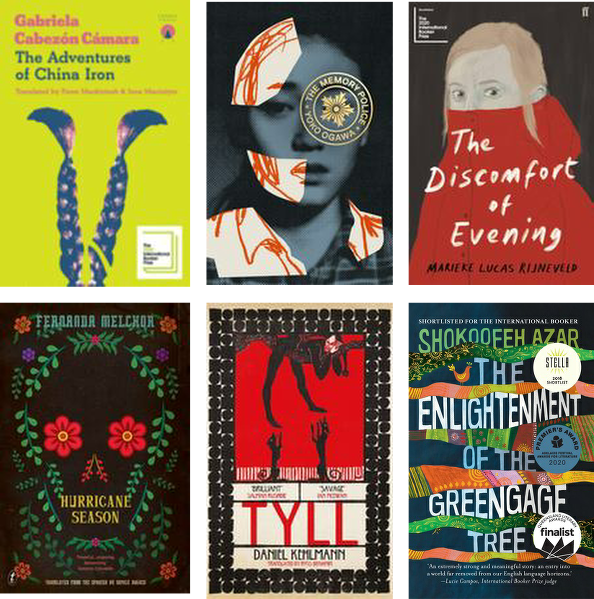
There are some remarkably good books short-listed this year for the International Booker Prize. The winner will be announced in a few days (on 26 March). Tell us which book you think should receive the award.